
Long Story ShortReadHide
- What it is: three published quartiers of the 6e, Saint-Germain-des-Prés, Odéon and Monnaie, running from the Seine quays down to the Jardin du Luxembourg: publishers, galleries, cinemas, the oldest church in Paris, and the most expensive residential square metre of the seven Paris districts we cover.
- Who it suits: someone who wants to walk to everything, cares about the address, and will accept old stairs, a small kitchen and other people's holiday photographs outside the front door.
- What it costs: 14 211 EUR / m² to buy, and a median of 31 EUR / m² / month for what tenants here actually pay.
- What people complain about: the crowds, the price of ordinary things, and how little of the everyday food trade is left.
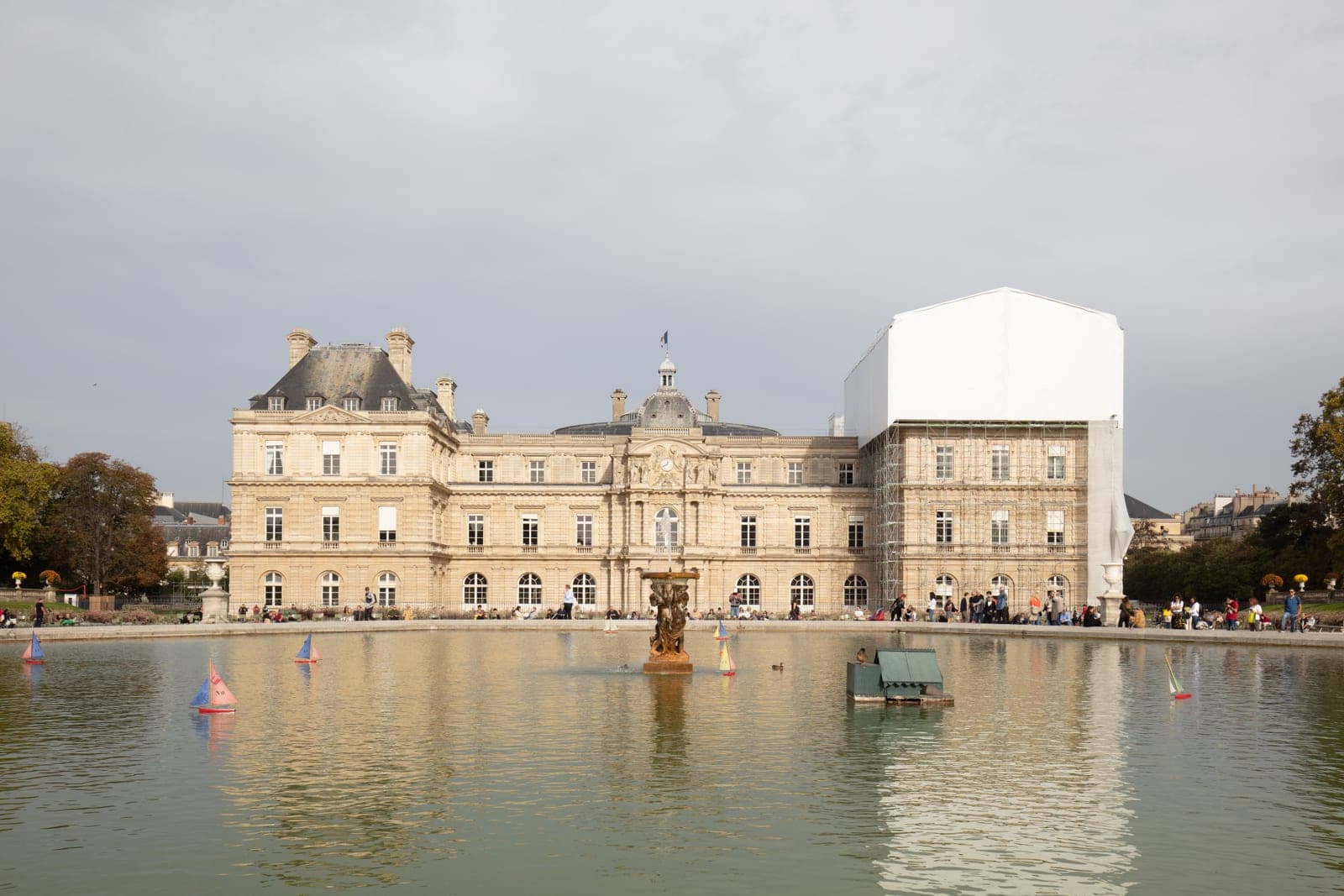
First impressions
The first surprise is the scale. Saint-Germain has a reputation the size of a city and it is 1.28 km² of small streets, most of which you can cross in ten minutes. The district on this page is three of the four published quartiers of the 6e arrondissement, Saint-Germain-des-Prés, Odéon and Monnaie, and it runs from the Seine quays opposite the Louvre south to the Jardin du Luxembourg, and east to the place Saint-Michel.
The second is that it is flat. After Montmartre or Belleville that sounds like a small thing, and it is not: everything here is walkable in ordinary shoes with shopping in both hands, which is the practical reason people stay for decades.
The third is the building stock, and it is the thing that decides whether you will be happy here. Boulevard Saint-Germain was cut through in the nineteenth century and its corners carry the tall, regular, lift-equipped haussmannien blocks people picture when they think of Paris. Almost everything behind it is older and smaller: seventeenth and eighteenth century houses on rue de Seine, rue Jacob, rue Mazarine and rue Guisarde, with a narrow stone stair, a courtyard the width of a car, uneven floors, and often no lift at all. Flats are laid out around chimneys rather than around plans. The top floor is the old servants' storey under a zinc roof, which is charming in photographs and, in August, an oven. Air conditioning is rare, external units are usually not allowed, and a fifth-floor south-facing flat with no shutters is a genuinely different proposition from the same flat two floors down.
At night the district splits in two. The Buci crossroads, rue de Buci, rue de Seine and rue Grégoire-de-Tours, is loud until one or two in the morning, and so is the stretch around Odéon and rue Saint-André-des-Arts. Two streets away, on rue Jacob or rue de l'Abbaye, you can hear your own footsteps. View any flat here on a Friday at 23:00, not on a Tuesday at midday.
Who lives here, and what the streets look like
This is the wealthiest of the seven Paris districts on this site and the numbers say so carefully. Taking the median of the district's IRIS medians, its small statistical areas, disposable income per consumption unit runs about 39,150 EUR a year on INSEE's Filosofi 2021 figures, and the published median for the whole 6e arrondissement, the number anyone can look up, is 41,750. Belleville, fifteen minutes away by metro, sits at 22,235 on the same measure. That gap is the most useful single fact about the Paris property map.
The people are less uniform than the price suggests. Owners who bought decades ago and are not moving. Publishers, editors, gallerists and antiquarians, because the trade is still physically here on rue de Seine, rue Bonaparte and rue Jacob. Professional couples without children, in flats that would not fit any. And a real student population: the École nationale supérieure des Beaux-Arts is on rue Bonaparte, the old faculty of medicine and its libraries are on rue de l'École-de-Médecine, and the Sénat sits at the bottom of the district in the Palais du Luxembourg, so the streets at 08:30 are not the streets at 15:00.
What you will not find much of is family-sized housing at family prices, or the ordinary mixed street life of a residential arrondissement. The ground floors that in the 1970s held butchers and hardware shops now hold fashion, beauty and interiors. That is not nostalgia, it is a shopping decision you will make every week.
Getting around
Four metro stations stand inside the district: Saint-Germain-des-Prés and Mabillon, plus Odéon and Saint-Michel at the eastern end. Line 4 links three of the city's mainline terminals, Gare du Nord, Gare de l'Est and Montparnasse, and it runs through Châtelet. Line 10 crosses east to west from Mabillon and Odéon toward Gare d'Austerlitz one way and Boulogne the other.
For anything beyond the périphérique the RER matters more. Luxembourg, at the southern end of the district, is on RER B, the line that runs north to Gare du Nord and on to Charles de Gaulle, and south toward Denfert and the Orly connection. Saint-Michel Notre-Dame, just across the boulevard Saint-Michel in the 5e, adds RER B and RER C. Very few addresses in Paris hold that combination.
The district is flat and short, so a bike is often the fastest thing. There are Vélib' docks throughout, boulevard Saint-Germain carries a protected bike lane, and the Seine quays are closed to through traffic on the right bank, which makes a river-side commute genuinely pleasant.
A car is the one thing that does not work. The streets were laid out before carriages were common, resident parking is scarce and expensive, and the whole area sits inside the low-emission zone rules that govern central Paris. Most residents here do not own one, and the ones who do keep it in a paid garage rather than at the kerb.
Typical weekday minutes from Place Saint-Germain-des-Prés, with the icon showing how. Door to door from the place Saint-Germain-des-Prés on a typical weekday morning; the icon shows the fastest sensible way., 2026-08.
Daily life
Here is the honest headline: this is the weakest district in the set for everyday shopping, and it is the thing new arrivals notice in week two rather than week one. Luxury and beauty retail has taken the ground floors, and the butchers, greengrocers and fishmongers that fill comparable streets in the 10e or the 18e have largely gone.
What is left is good, and you should know where it is. The Marché Saint-Germain, the covered market on rue Lobineau, is the anchor: fish, meat, cheese and produce under one roof, Tuesday to Saturday and Sunday morning, closed Monday. Fromagerie Sanders is beside it on the same street. For a full shop, the Carrefour Market on rue de Seine and the Monoprix on rue de Rennes are the two most people use, with a Franprix on rue Gozlin by the church square, a Carrefour Express on boulevard Saint-Germain, and a Carrefour City at place Saint-Michel for the late gaps. La Vie Claire on rue Mazarine and Naturalia on boulevard Saint-Michel cover organic. Ep!c, on rue Mabillon, is the small supermarket nearest the market hall.
The other habit worth building is the roving market. Marché Raspail, a short walk west on boulevard Raspail, runs on Tuesday and Friday, with the well-known organic market on Sunday. Paris markets close early in the afternoon, so this is a before-lunch errand or it does not happen.
Bakeries are the one everyday trade that has not thinned: there is a good one on almost every block, and the queue at 08:00 tells you which. For delivery, Uber Eats and Deliveroo are the two services that trade here, and coverage in the 6e is dense enough that the choice is about the restaurant, not the postcode.
Local Places Worth Knowing
Independent and close by, chosen on merit. Nobody pays to appear here.
The covered market on rue Lobineau, where the everyday trade survives at proper scale: fishmonger, butcher, cheese and produce. Tuesday to Sunday morning, closed Monday.
The cafe of the art trade, on rue de Seine, with a back room of old painted panels and a terrace that fills the moment the sun reaches it. Open till two in the morning.
A 1906 art nouveau room on rue Racine serving the traditional bouillon formula: French classics at prices with no business existing in the 6e. Where you eat on a Tuesday.
View on Google MapsA proper cheesemonger on rue Lobineau, worth naming because almost none are left here. The small food trades have been priced out by fashion and beauty retail.
Checked August 2026. Places close and change, so tell us if something here is out of date.
Schools and families
This district has the strongest school figure of the seven Paris districts on this site, and it is worth understanding what the number means. The score is the taux d'accès de la seconde au bac: of the pupils who start seconde at a lycée standing here, the share who reach the baccalauréat at that same school. It is a harder measure to flatter than a pass rate, because a school cannot improve it by moving weak pupils out before the exam.
Three lycées sit inside the boundary, all public, with 591 pupils in seconde between them. Montaigne, on the Luxembourg side, scores 95 on a cohort of 386. Fénelon, on rue de l'Éperon, scores 96 on 174. Maximilien Vox, a lycée professionnel, scores 61 on 31 pupils, which is roughly what its intake predicts: its value added, a different measure that compares a school against the pupils it receives rather than against other schools, is 3 points below the expectation. The pooled figure across all three tracks is 94; the general and technological route alone is 95, the vocational route alone 61. One caveat matters more here than the score does: a Paris lycée recruits well beyond its own streets, so this describes the schools that stand here, not the children who live here.
Below lycée age, the practical picture is a walkable one. Primary schools and crèches are scattered through the quartiers, and the Jardin du Luxembourg at the southern end does the work that a neighborhood park does elsewhere, with the sailing pond, the puppet theatre and a large enclosed playground.
Working out what a specific address costs, against what it would rent for and what the street is actually like, is exactly the gap we built Apraiz to close. If you are weighing this district against its neighbors, read the Paris guides side by side, and walk the block at three different hours before you sign a lease or purchase.
Kids Friendly. Better than the price and the reputation suggest, if you can afford the space. The Jardin du Luxembourg is at the southern end of the district with the sailing pond, the puppet theatre and one of the best playgrounds in Paris, and there are small playgrounds inside the streets as well. The lycées here are the strongest of the seven Paris districts we cover, both of the general ones are public, and the whole district is walkable without crossing anything worse than boulevard Saint-Germain. The real constraints are size and stairs rather than facilities: family-sized flats are rare and priced accordingly, many buildings have no lift, and the everyday food shopping that makes a weeknight easy is thinner here than anywhere else in the set.
Pet Restricted. Paris is easy about dogs indoors and hard about them outdoors, and this district is the sharpest version of that. A dog under a café table or in a restaurant is normal and nobody will comment. What is missing is ground: the streets are stone from wall to wall, the small squares are gravel and benches, and the city's formal gardens are strict about where a dog may go, so a proper off-lead run means crossing the river or taking a train out. Small dogs travel free on the metro in a carrier, larger ones need a lead and a muzzle. The flats compound it: old buildings, narrow stairs, frequently no lift, and four or five floors between a puppy and the pavement. A small dog fits this neighborhood well, a big one does not.
Green space, leisure and eating out
Green space is the Jardin du Luxembourg and, honestly, that is enough for most people: gravel allées, the Médicis fountain, the pond, chairs you can drag into the sun, and the best-kept large garden in central Paris. Inside the streets themselves the green is small and incidental, squares like Laurent-Prache beside the church and Félix-Desruelles on the boulevard, a bench and a few trees rather than somewhere to spend an afternoon.
Culture is absurdly dense. The Odéon Théâtre de l'Europe at the top of rue de l'Odéon, the Institut de France and the Bibliothèque Mazarine on quai de Conti, the Beaux-Arts on rue Bonaparte, the commercial galleries that fill rue de Seine and rue Mazarine, and a run of small cinemas around Odéon and rue Christine that still show subtitled repertory rather than only new releases. If you like the idea of going out on a Tuesday without planning it, this is the district in Paris that rewards you most.
Eating out is two markets in one place. There is the famous half, the boulevard terraces and the two literary cafés on the church square, which are pleasant and are priced for people who came a long way to sit there. Then there is the resident half, the small dining rooms on rue des Canettes, rue Guisarde, rue Grégoire-de-Tours and around rue Racine, where the bill is normal and the room is full of people who walked. The distance between the two is about two hundred metres.
What it costs
Buying here is the top of this map. The median price actually paid across 371 recorded apartment sales in 2025 was 14 211 EUR / m², the highest of the seven Paris districts we cover. Two refinements to keep in your head. Nearly two thirds of Paris apartment sales include a cellar or a parking space in the recorded price; the same median over flats sold with nothing attached is 13,333 EUR/m², a gap of 6.6%, the widest in the set, which tells you how much a cave or a parking space is worth on these streets. And the market moved: the 2024 median on the same basis was 14,800, so prices are about 4% down on the year.
Renting has three numbers and they measure different things. What tenants actually pay, across the whole occupied private stock, has a median of 31 EUR / m² / month excluding charges, with the middle half of the market between 27.6 and 35.4. That figure is computed for the observatory's Paris-zone 2, which this district sits wholly inside, so it is a zone figure rather than a street one. What landlords ask is modelled at 37.9 EUR/m² for the 6e, but charges are inside that number and cannot be pulled out, so the distance between 31.0 and 37.9 is partly rent and partly heating.
Then there is the ceiling, which is the one a tenant should actually read. Paris caps rents, and the cap is set per secteur, per room count, per building era and per régime, so no district has "a cap". In secteur 2, unfurnished, a one-room flat in a pre-1946 building is capped at 43.3 EUR/m² a month, a two-room at 38.3, a three-room at 36.1 and a four-room or larger at 33.8. Post-1990 buildings are capped lower on the small sizes and slightly higher on the largest. Furnished ceilings run about 14% above these. A listing above the ceiling for its own category is unlawful, which is a useful thing to know before you negotiate. The scheme is time-limited: the arrêté in force runs to 24 November 2026, so check the current one on the day you sign.
Now put those against income. The median of this district's IRIS medians, on INSEE's Filosofi 2021 figures, is about 39,150 EUR a year of disposable income per consumption unit, the highest of the seven, and the published median for the 6e is 41,750. At 14,211 EUR/m², a single square metre of floor costs about four and a half months of that income. A 40 m² one-bedroom at the median paid rate works out near 1,240 EUR a month before charges, which is roughly 38% of that yearly figure, and that figure is already after tax and benefits. This district is affordable to the people in it mostly because many of them bought a long time ago.
Weather and climate
Seasonal averages for Paris, one representative month per season. Météo-France 1991-2020 normals for station Paris-Montsouris, the reference station in the 14e that every Paris climate table means, via Infoclimat. Seasons are the representative months: January, April, July and October. Sunshine hours a day are the monthly totals divided by the days in the month (January 59.0 h, April 177.3 h, July 222.4 h, October 118.6 h). Annual figures: mean daily maximum 16.5 °C, mean daily minimum 9.2 °C, 634.3 mm of rain and 1,717.1 hours of sunshine. Rain days are left null because the monthly count of days at or above 1 mm is not published in the accessible normals table; the annual figure quoted for Paris elsewhere is about 111 days, which is regular light rain rather than heavy rain, and the 634.3 mm annual total is low for northern Europe and lower than most people expect. The thing that shapes daily life is the winter dark rather than the cold: 59 hours of sunshine in the whole of January, under two hours a day, and a January mean minimum of 3.2 °C so hard frost is occasional rather than routine. Summer is warm rather than hot in the normals, 25.7 °C by day in July, but Paris is a dense stone city with a real heat island and little air conditioning in older flats, so a heatwave is felt indoors for longer than the daily maximum suggests.
The honest downsides
You pay the highest price per square metre in this set and get the weakest everyday shopping in it. The everyday shopping score here is 78, the lowest of the seven Paris districts on this site, and it is not an abstraction: the small food trades have been priced out of the ground floors, so a normal week means a supermarket run and a market morning rather than four shops on your own street. Prices for ordinary things follow the address, and there is no cheaper parallel street to escape to, because there is no cheaper parallel street.
You live inside somebody else's day out. The church square, the Buci crossroads and Saint-Michel are on every walking tour of Paris, the pavements are narrow, and the noise at the eastern end runs to one or two in the morning at weekends. The crime figures follow the crowd rather than the residents: for the whole 6e, theft from the person is recorded at 669.0 per 10,000 residents against 451.2 for Paris and 91.0 nationally, and home burglary at 7.1 per 1,000 dwellings is the highest of the seven districts here. Neither number describes danger, and both describe friction you will meet: a phone lifted on a terrace, a bag opened on line 4, an old street door that a professional finds interesting.
Crime and safety
Every crime figure published for this part of Paris is an arrondissement figure, so the numbers on this page are the whole 6e, taking in Notre-Dame-des-Champs as well as the three quartiers described here. Nothing finer exists in France.
Read them with the denominator. These are rates per 10,000 residents, and the 6e is a small resident base underneath a very large daily population of visitors, students, staff and people changing trains at Saint-Michel and Odéon. Theft from the person, 669.0 per 10,000 residents against 451.2 for Paris and 91.0 for France, is overwhelmingly a crime against that daytime crowd, divided by the people who sleep here. It is the pickpocketing and phone-snatching number, and it is the one to take seriously as a practical matter and not at all as a measure of how safe your street feels at midnight.
The rest of the picture runs the other way, and it is the more useful part. Assault outside the home is 44.8 against a Paris figure of 52.7, and unarmed robbery 30.2 against 34.5, so on both counts this arrondissement is below the city. Domestic violence is recorded at 26.0, below both the Paris figure of 29.8 and the national 37.6. The exception is home burglary at 7.1 per 1,000 dwellings, above Paris at 5.1 and above the national 5.6, and the highest of the seven districts we cover here: old buildings, valuable contents, street doors onto public passages, and a lot of flats that are empty for parts of the year.
One thing to keep straight if you compare these with another country's crime page: France counts these indicators in three different units, an offence for burglary and robbery, a victim for assault and domestic violence, and a victim interviewed by police for theft from the person. There is no single total offence rate to quote, and adding the lines together would mean adding victims to offences.
Practically, the advice is dull and it works. Do not put a phone on a café table on the boulevard. Watch bags at the Buci crossroads and at Saint-Michel on a Saturday. If you are buying on a lower floor or above a passage, price a proper door and a certified lock into the offer, because the burglary figure here is real.
Is this you?
If you want one of the most walkable and most cultured square kilometres in Paris and you are buying rather than raising a family in three bedrooms, this is the district that does it. You will be paying the top of the market for the address, the light and the galleries, and getting a genuinely strong set of schools and one of the best gardens in Europe at the end of the street.
If you like the same walk and the same bookshops but not the price, the Latin Quarter next door is the direct comparison: 12,081 EUR/m² against 14,211, a school figure of 92 against 94, and better everyday shopping around rue Mouffetard and the Maubert market, in exchange for tourist traffic on the Seine side and the Montagne Sainte-Geneviève to climb. If what you actually want is a calm, green, residential Paris with a family in mind, Batignolles is the honest answer: 10,364 EUR/m², the calmest streets of the seven and the highest quality-of-life score, at the cost of being a real journey from the centre.
Want to know what homes here are actually worth?
Join the waitlistHow we source this
How we put this together. Gathered on the ground by our local field team and written up by the Apraiz research team. Every figure above carries its own source and date. The scores are not computed by the build; walking and transport will use open map and transit data first, then Apraiz's own model. We update prices quarterly, transport and amenities twice a year, and school data when the source publishes.
Sources: DVF (Demandes de valeurs foncières), data.gouv.fr, Observatoires des loyers (OLAP), DRIHL Île-de-France, SSMSI, via data.gouv.fr, Ministère de l'Éducation nationale, data.education.gouv.fr, INSEE, Wikipedia (en).
Safety and crime in Paris →Nearby: Le Marais · Montmartre · Canal Saint-Martin