
Long Story ShortReadHide
- What it is: the piece of Paris that Haussmann never straightened. A dense grid of medieval streets and seventeenth-century mansions across the 3e and the 4e, running from the covered market on rue de Bretagne down to the Seine, with a metro station on every side and Châtelet at the end of the road.
- Who it suits: someone who wants to walk everywhere, does not own a car, does not need a garden, and is prepared to pay for the address and climb the stairs to it.
- What it costs: 12 298 EUR / m² ≈ $1,320 / sq ft to buy, the second dearest of the seven Paris districts we cover.
- What people complain about: the weekend crowds, the noise from the bar streets, and stairs in buildings that are legally difficult to fit a lift into.
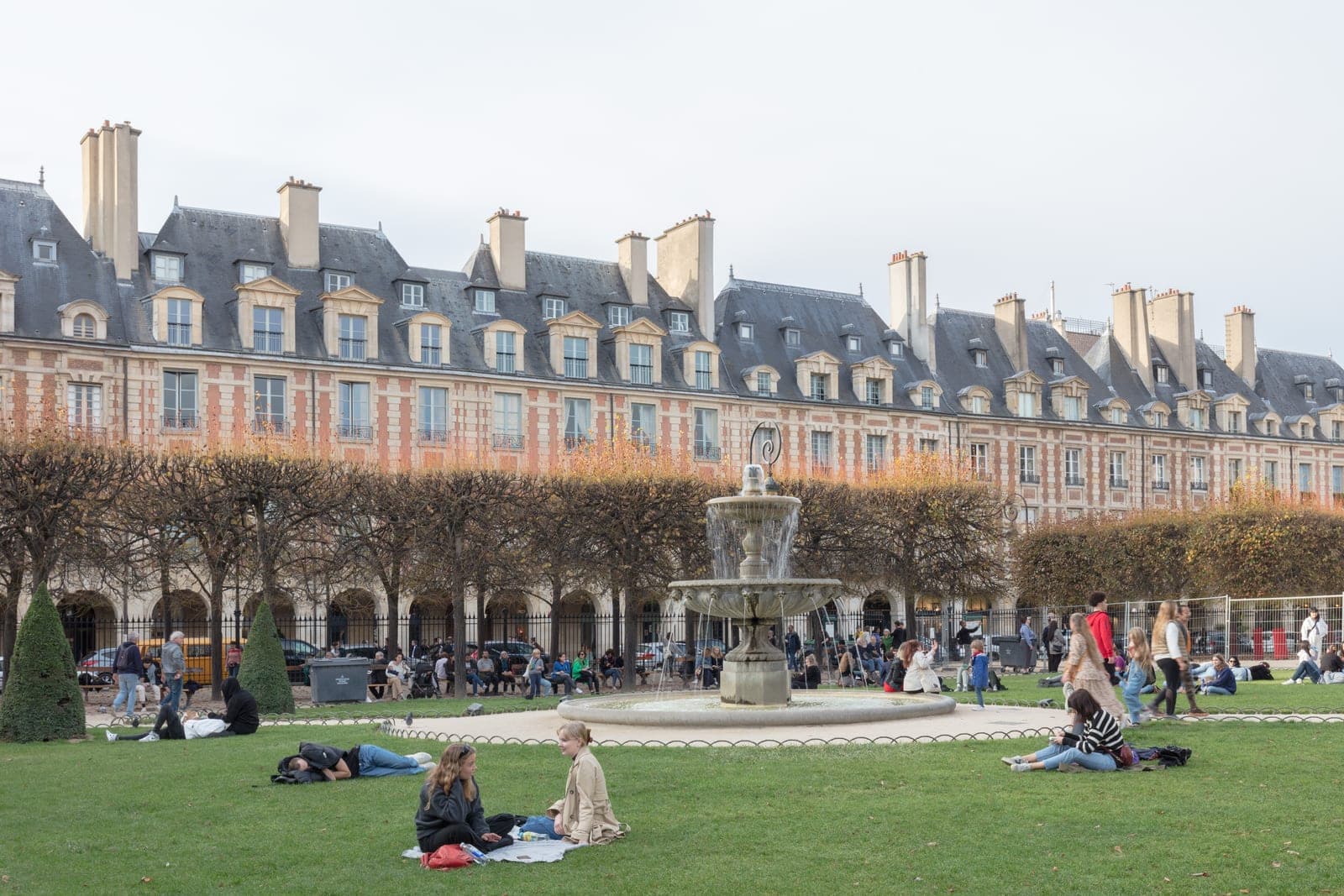
First impressions
Le Marais is not an administrative unit and never has been. Paris publishes 80 quartiers administratifs, and this district is six of them: Archives, Sainte-Avoie and Enfants-Rouges in the 3e, Saint-Merri, Saint-Gervais and Arsenal in the 4e. That runs from the covered market on rue de Bretagne in the north down to the Seine, and east as far as the place des Vosges and the Bastille, and you can still cross the whole of it on foot in well under half an hour if nobody is in your way.
The first thing you notice is what is missing. There are almost no boulevards, no long straight sight lines, no uniform cream façades marching down a hill. The street plan is the pre-revolutionary one, because in 1964 this became the first secteur sauvegardé in France under the loi Malraux, and the rebuilding that flattened most of central Paris was called off here. What survived is the highest concentration of hôtels particuliers in the city: Carnavalet, Salé, Lamoignon, Sens, most of them now museums, libraries or archives with courtyards you can walk into.
The second thing you notice is the density of the ordinary stock between them. Narrow plots, four to six storeys, stone stairs, small windows, an inner courtyard the size of a lift shaft. Then, on the western side behind the Centre Pompidou, the Quartier de l'Horloge, a 1970s scheme dropped into the middle of it, which is the one part of the district that looks like the decade it was built in.
The third thing is the noise. This is not a quiet neighborhood and it never claims to be. Shops here open on a Sunday, which most of Paris does not, so the weekend is the busy part of the week rather than the calm one.
Who lives here, and what the streets look like
The income figure for this district is 34,530 EUR a year, which is the median of the 23 IRIS medians inside it, on INSEE's Filosofi 2021 data. That is a typical figure across the district's small statistical areas rather than a household survey of the district itself, and it is worth setting against the number a reader can look up directly: the published median for the 3e arrondissement, which holds three of the six quartiers, is 34,800. The two are close, which is not true everywhere in Paris.
So this is a comfortable district rather than the richest one. What that money buys is space measured in single figures of square metres. The building stock is overwhelmingly pre-1946, protected, and hard to modernise: lifts are the exception, ceilings vary from grand to cramped inside the same building, plumbing runs where it can, and a top-floor flat under a zinc roof gets seriously hot in August with no realistic way to fit air conditioning to a protected façade. Ask which floor, ask whether the ascenseur actually reaches it, and ask what the courtyard is like, because in a building this deep the courtyard is where your light comes from.
Three populations sit on top of each other in the same few streets, and they have learned to. Rue des Rosiers and the streets around it are the Pletzl, the historic Jewish quarter, with the bakeries, bookshops and falafel counters that go with it. Rue Sainte-Croix-de-la-Bretonnerie and rue des Archives have been the centre of gay Paris since the 1980s, and the bars there set the evening rhythm of the whole western half. And around both there is a settled population of long-term owners and shopkeepers who were here before either the boutiques or the tour groups, and who are the reason the district still has a butcher.
Getting around
The metro is inside the boundary in every direction: Saint-Paul and Hôtel de Ville on line 1, Rambuteau and Hôtel de Ville again on line 11, Pont Marie and Sully-Morland on line 7, and Bastille, where lines 1, 5 and 8 meet, at the eastern corner. Nowhere in the district is more than a few minutes from one of them.
The real advantage is what is immediately outside. Châtelet is on the doorstep at the western end, which puts the RER A, B and D within a walk, and that is the difference between a district that is central and a district that is connected: airports, suburbs and the whole east-west spine of the region all leave from there without a change.
For the rest, you walk. That is the honest answer for almost every journey inside the district and for most journeys to the districts next door. Driving is the opposite story. The streets are medieval, many are one-way or filtered, resident parking is scarce and expensive, and rue de Rivoli along the southern edge has been given over to bikes, buses and taxis. A car here is a liability you pay to store.
Typical weekday minutes from Place du Marché Sainte-Catherine, with the icon showing how. Times are measured door to door for a typical weekday morning from place du Marché Sainte-Catherine; the icon shows the fastest sensible way., 2026-08.
Daily life
Food shopping is small-format and constant rather than weekly. What you actually have is a Franprix on rue Barbette, Carrefour City branches on rue des Lombards and rue de Rivoli, a Carrefour on rue du Temple, a G20 in the streets behind the Archives, a Naturalia for the organic end and a monop' for the ten-o'clock-at-night end. The full-size Monoprix on rue Saint-Antoine is the one you walk to when you need a trolley rather than a basket.
The markets matter more than any of them, and this district has two. The marché Baudoyer sets up on place Baudoyer in front of the mairie du 4e on Wednesday from 10:00 to 20:00 and Saturday from 07:00 to 14:30, and the Wednesday run into the evening is deliberate, for people coming home from work. At the northern end, on rue de Bretagne, the covered marché des Enfants Rouges is the other habit: greengrocers, a cheese stall and a fishmonger on one side, lunch counters on the other, open most of the week and packed at the weekend. Which of the two is yours is mostly a question of which end of the district you live in.
The specialist trades are still here, thinner than they were but not gone: bakeries on most blocks, cheesemongers, a butcher or two, and the Jewish bakeries and delicatessens of rue des Rosiers, which are a genuine everyday resource and not a heritage display.
For delivery, Uber Eats and Deliveroo both operate here, and between them they are the practical choice in Paris.
Local Places Worth Knowing
Independent and close by, chosen on merit. Nobody pays to appear here.
The city's museum of itself, in two hotels particuliers on rue de Sevigne. The permanent collection is free, which makes it a rainy-Sunday habit rather than a one-off.
View on Google MapsA roastery, barista school and cafe on three floors near the Hotel de Ville, pouring single-origin about ten ways. One of the places specialty coffee in Paris started.
A family dining room on rue Vieille du Temple grilling beef and duck over a wood fire for thirty years. No ceremony, few tables, so a reservation is sensible.
View on Google MapsThe open-air market in front of the mairie du 4e, fifteen to twenty stalls. Wednesday runs to 20:00, which is deliberate and unusual in Paris; Saturday ends at 14:30.
View on Google MapsChecked August 2026. Places close and change, so tell us if something here is out of date.
Schools and families
France publishes a school indicator that is worth understanding before you read the bar. It is the taux d'accès de la seconde au bac: of the pupils who start seconde at a given lycée, the share who go on to reach the baccalauréat at that same lycée. It is a better question than a raw pass rate, because a pass rate can be flattered by moving weaker pupils out before the exam and this cannot.
On that measure the seven lycées inside this district come out at 91, pooled over the 1,239 pupils who start seconde at them, so the biggest school counts for the most. That is the widest school base of the seven Paris districts we cover. Five are public and two are private under contract, and the individual rates run from 72 to 97. Massillon reaches 97 on a cohort of 155, Sophie Germain 94 on 285, Les Francs Bourgeois 93 on 259, Charlemagne 93 on 244 and Victor Hugo 91 on 178, with the two vocational lycées, Théophile Gautier at 73 on 46 and Simone Weil at 72 on 72. The vocational track is in that headline on purpose: across Paris the général et technologique route runs 89 to 98 and the professionnel route 38 to 81, so leaving it out would flatter every district that has one. Here the two tracks separately are 93 and 72.
The two vocational schools are worth a second look for a different reason. Value added measures a school against what its intake predicts rather than against other schools, and Simone Weil's is +15, one of the strongest in Paris, with Théophile Gautier's at +14. Value added is not the access rate and should never be read as one, but it tells you something the headline does not: the pupils there do markedly better than their starting point suggests.
One caveat holds for all of it. A Paris lycée recruits well beyond its own streets, so these numbers describe the schools that stand in the district, not the children who live in it. Being straight about what a number measures and what it does not is why Apraiz builds these Paris guides the way it does, and it is worth walking the school run yourself, at eight in the morning, before you sign a lease or purchase.
Kids Restricted. The schools are genuinely strong and there are seven lycées inside the boundary, so the top end of a Paris education is on the doorstep. Place des Vosges and the square du Temple are both inside it, and between them and the small walled gardens there are playgrounds within a short walk of most streets. Everything else argues the other way. The flats are old and small, lifts are the exception rather than the rule in the protected stock, the pavements are narrow enough that a pram often ends up in the road, and anywhere a child can properly run is a metro ride away. Weekends bring a crowd through the main streets that is hard work with a buggy. A family with one child and patience makes this work; a family with three does not.
Pet Restricted. A dog can live here, but the district gives it very little. Place des Vosges and the square du Temple are the two proper squares inside the boundary and both are gravel walks around lawns you are mostly meant to look at rather than cross; the rest is small walled gardens behind hôtels particuliers, and the streets are narrow stone with heavy pedestrian traffic from late morning onward. There is still no large park inside the district: a proper run means the Seine quays at the southern edge, or a metro ride. Small dogs suit the flats, which are old, tall and often up several flights of stairs, and a big dog on a fourth floor with no lift is a decision you make once and live with daily.
Green space, leisure and eating out
Green space here means squares, not parks, and that is the honest way to put it. The two proper ones are both inside the boundary and at opposite ends of it. Place des Vosges, in the Arsenal quartier at the eastern end, is what most people use as their square: arcades on all four sides, gravel walks, lawns in the middle and, on the first warm Saturday of the year, no space left on them. The square du Temple at the northern end is the other, with a pond, older trees and a playground, and it is the one that works on a weekday morning with a child. Everything else is a set of small walled gardens behind the mansions: the jardin des Rosiers-Joseph-Migneret, the square Georges-Cain, the jardin de l'Hôtel Salé, the jardin Anne Frank behind its gate on the impasse. They are lovely and they are tiny. What the district does not have is a park. For anything you would call one you go to the Seine quays at the southern edge, or you get on the metro.
Culture is the compensation and it is enormous. The Musée Carnavalet on rue de Sévigné tells the history of Paris and its permanent collection is free. The Musée Picasso occupies the hôtel Salé. The Archives nationales hold a garden and a museum in the hôtel de Soubise. The Bibliothèque historique de la Ville de Paris on rue Pavée and the Bibliothèque Forney in the hôtel de Sens are both working libraries inside sixteenth-century mansions. There are cinemas inside the district at Beaubourg and by the Hôtel de Ville. The one gap is temporary and it is a big one: the Centre Pompidou, at the western edge, is closed for a full renovation until 2030.
Eating and drinking splits by street, and if you are viewing a flat you should know which street you are on. Rue des Lombards is the jazz strip, three well-known clubs within a hundred metres, which means people leaving them after midnight. Rue Sainte-Croix-de-la-Bretonnerie and rue des Archives are the bar streets and they are loud at the weekend. Rue Vieille du Temple runs the whole range from an old wood-fire dining room to a queue outside a crêperie. Rue des Rosiers is the falafel street and the queue starts at lunchtime. Two streets north of any of them, it is quiet. View the flat on a Saturday night, not a Tuesday afternoon.
What it costs
The number to start from is 12 298 EUR / m² ≈ $1,320 / sq ft, the median price per square metre actually paid across 926 recorded apartment sales inside these six quartiers in 2025. That is DVF, the register of what was really paid, not an asking price and not an arrondissement average. Two things sharpen it. Most Paris flats sell with a cellar or a parking space included in the price, and the same median over flats sold with nothing attached is 12,067, only 1.9% lower. And the direction of travel is up: the 2024 median on the same method was 11,898, and Le Marais overtook the Latin Quarter in 2025, 12,298 against 12,081 where the year before it was 11,898 against 12,000.
Rent needs two numbers, not one, because the district sits in two of the city's 14 rent zones. Saint-Merri and Arsenal are in zone 2 at 31.0 EUR/m² a month; Archives, Sainte-Avoie, Enfants-Rouges and Saint-Gervais are in zone 4 at 30.2. Both are medians of the occupied private rental stock, excluding charges, from the 2024 observatory campaign, with quartiles of 27.6 to 35.4 and 26.7 to 34.3 respectively. Averaging them would produce a number that describes nowhere.
Advertised rent is a different measurement and reads higher, and it splits too, because this district sits in two arrondissements. On the 2025 Carte des loyers the 3e asks 36.3 EUR/m² a month and the 4e asks 37.8. Before you treat the gap against the paid figures as evidence of anything, note that the advertised numbers include charges and the paid ones do not, and that they are modelled per arrondissement from listings rather than measured from occupied tenancies. It is the asking side of the market, useful for what people are trying to get.
Then there is the ceiling, because Paris caps what a landlord may charge. The cap is not one number: it is set per zone, per room count, per building era and per régime, and there are 448 of them. For an unfurnished two-room flat in a pre-1946 building the ceiling is 37.3 EUR/m² a month in zone 4 and 38.3 in zone 2, which is Saint-Merri and Arsenal. A listing above the ceiling for its own category is unlawful, and that is the useful part for a tenant. Two things to hold on to: check the category, because the same flat with one more room or a later build date has a different ceiling, and check the date, because this is a time-limited scheme and the arrêté in force runs to 24 November 2026.
Finally the ratio, which is the thing a listing never shows you. Against the district's income figure of 34,530 EUR a year, a single square metre of Le Marais at the 2025 median costs about 36% of a full year's income. That is the arithmetic behind who actually buys here: overwhelmingly people who already own something, people buying with capital from elsewhere, and people who bought a long time ago.
Weather and climate
Seasonal averages for Paris, one representative month per season. Météo-France 1991-2020 normals for station Paris-Montsouris, the reference station in the 14e that every Paris climate table means, via Infoclimat. Seasons are the representative months: January, April, July and October. Sunshine hours a day are the monthly totals divided by the days in the month (January 59.0 h, April 177.3 h, July 222.4 h, October 118.6 h). Annual figures: mean daily maximum 16.5 °C, mean daily minimum 9.2 °C, 634.3 mm of rain and 1,717.1 hours of sunshine. Rain days are left null because the monthly count of days at or above 1 mm is not published in the accessible normals table; the annual figure quoted for Paris elsewhere is about 111 days, which is regular light rain rather than heavy rain, and the 634.3 mm annual total is low for northern Europe and lower than most people expect. The thing that shapes daily life is the winter dark rather than the cold: 59 hours of sunshine in the whole of January, under two hours a day, and a January mean minimum of 3.2 °C so hard frost is occasional rather than routine. Summer is warm rather than hot in the normals, 25.7 °C by day in July, but Paris is a dense stone city with a real heat island and little air conditioning in older flats, so a heatwave is felt indoors for longer than the daily maximum suggests.
The honest downsides
At the weekend the street is not yours. From Friday afternoon to Sunday evening the main axes fill up, and because the shops open on Sunday, Sunday is the peak rather than the recovery. Rue des Rosiers, rue des Francs-Bourgeois and the approaches to Saint-Paul become slow-moving crowds on pavements that were laid out for handcarts. Add the bar streets and the jazz clubs, and a flat on the wrong corner gets noise from about ten at night until well after two. None of this is a surprise to anyone who lives here, and all of it is invisible in a listing photograph taken at eleven on a Tuesday morning.
The buildings are the reason you came and the reason it is hard work. Protected status means what it says: you cannot simply cut a lift shaft into a listed stair, replace a window with something double-glazed, or put a condenser unit on a façade. So expect stairs, expect small rooms, expect to be told that the works you want are subject to approval, and expect a top floor under zinc to be punishing in August. Getting furniture up is a job for professionals with a hoist. And the entry price is real: at 12,298 EUR/m² this is the second dearest of the seven Paris districts we cover, behind Saint-Germain-des-Prés, on incomes that are not the highest in the city.
Crime and safety
The numbers here need their boundary stated first, because it is not the district. France's finest published grain for Paris is the arrondissement, so these figures are the whole 3e and the whole 4e together, which includes the Hôtel de Ville, the quays and the île Saint-Louis alongside the streets this article is about. Nothing on this page was computed for the six quartiers alone.
They also need their denominator stated. These are rates per resident, and central Paris is not mainly its residents. Offences are recorded where they happen, and they are then divided by the far smaller number of people who sleep there, which is why a central arrondissement reads high on anything that happens to people in crowds.
With that said, the shape is clear and it is worth more than any single score. Theft from the person runs at 756.8 per 10,000 residents, against 451.2 for Paris and 91.0 for France, so more than eight times the national rate. Unarmed robbery is 47.6 against 34.5 for the city and 7.2 nationally. Non-domestic assault is 63.0 against 52.7 and 31.6. That is a pickpocketing, phone-snatching and bag-snatching profile attached to dense crowds, and it is concentrated exactly where the crowds are.
Now the other half, which almost nobody quotes. Home burglary is 6.4 per 1,000 dwellings, which is a different base from the figures above and must be read on its own: the Paris figure is 5.1 and the national figure 5.6, so burglary here is close to the ordinary French level rather than a multiple of it. And domestic violence, at 29.7 per 10,000 residents, sits below the national 37.6. A district that runs eight times the national rate on one indicator and below it on another is not described by a single number, and there is no total to construct here because the ministry counts these things in different units.
In practice: hold your phone the way you would at a station, be careful in the queue and on the terrace rather than on the dark street, and treat the metro at Châtelet and Hôtel de Ville the way you would treat any big interchange in Europe.
Is this you?
If you want to live inside the oldest part of Paris, walk to everything, keep no car, and you can carry the price and the stairs, there is nothing else quite like it. You are buying a medieval street plan, a metro station on every side, Châtelet at the end of the road, the place des Vosges and a museum on your own block, and you are accepting crowds, noise and a flat that is smaller than the money suggests.
If you want the same age of city and the same walkability with fewer weekend crowds, the Latin Quarter is a closer alternative than it looks: 12,081 EUR/m² against 12,298, so effectively the same price, with a slightly stronger schools figure and a higher quality-of-life score. If what you actually want is calm, and you are willing to leave the centre, Batignolles is the other end of this set: 10,364 EUR/m², the highest quality-of-life score of the seven, and the calmest streets in the group. You would be giving up the museums and the medieval streets and gaining the square des Batignolles and a bigger park on the edge of it.
Want to know what homes here are actually worth?
Join the waitlistHow we source this
How we put this together. Gathered on the ground by our local field team and written up by the Apraiz research team. Every figure above carries its own source and date. The scores are not computed by the build; walking and transport will use open map and transit data first, then Apraiz's own model. We update prices quarterly, transport and amenities twice a year, and school data when the source publishes.
Sources: DVF (Demandes de valeurs foncières), data.gouv.fr, Observatoires des loyers (OLAP), 2024 campaign, DRIHL Île-de-France, arrêté IDF-2026-06-12-00003, Ministère de l'Éducation nationale, IVAL 2025, SSMSI, bases statistiques communale et départementale de la délinquance enregistrée, INSEE, Filosofi 2021, Carte des loyers 2025, DHUP and ANIL with leboncoin and Groupe SeLoger.
Safety and crime in Paris →Nearby: Saint-Germain-des-Prés · Montmartre · Canal Saint-Martin