
Long Story ShortReadHide
- What it is: a village Paris annexed in 1860 and never fully absorbed, in the 17e: a church square, an English garden, two long shopping streets, and a whole new quarter built on the old railway land to the west.
- Who it suits: people who want a quiet, flat, family-shaped piece of Paris and will trade a longer ride into the middle for it.
- What it costs: a median of 10 364 EUR / m² to buy, and about 27 EUR / m² a month for what tenants in this rent zone actually pay, excluding charges.
- What people complain about: the centre of Paris is a journey rather than a hop, and the quiet is now fully priced in.
First impressions
Batignolles was a village before it was part of Paris, and it still behaves like one. It sat outside the city until 1860, when Napoleon III annexed it, and the street plan never quite caught up: the grid is small-scale and slightly crooked, the buildings step down to four storeys where a boulevard would keep them at seven, and the whole thing is organised around a square with a church on it rather than around a monument.
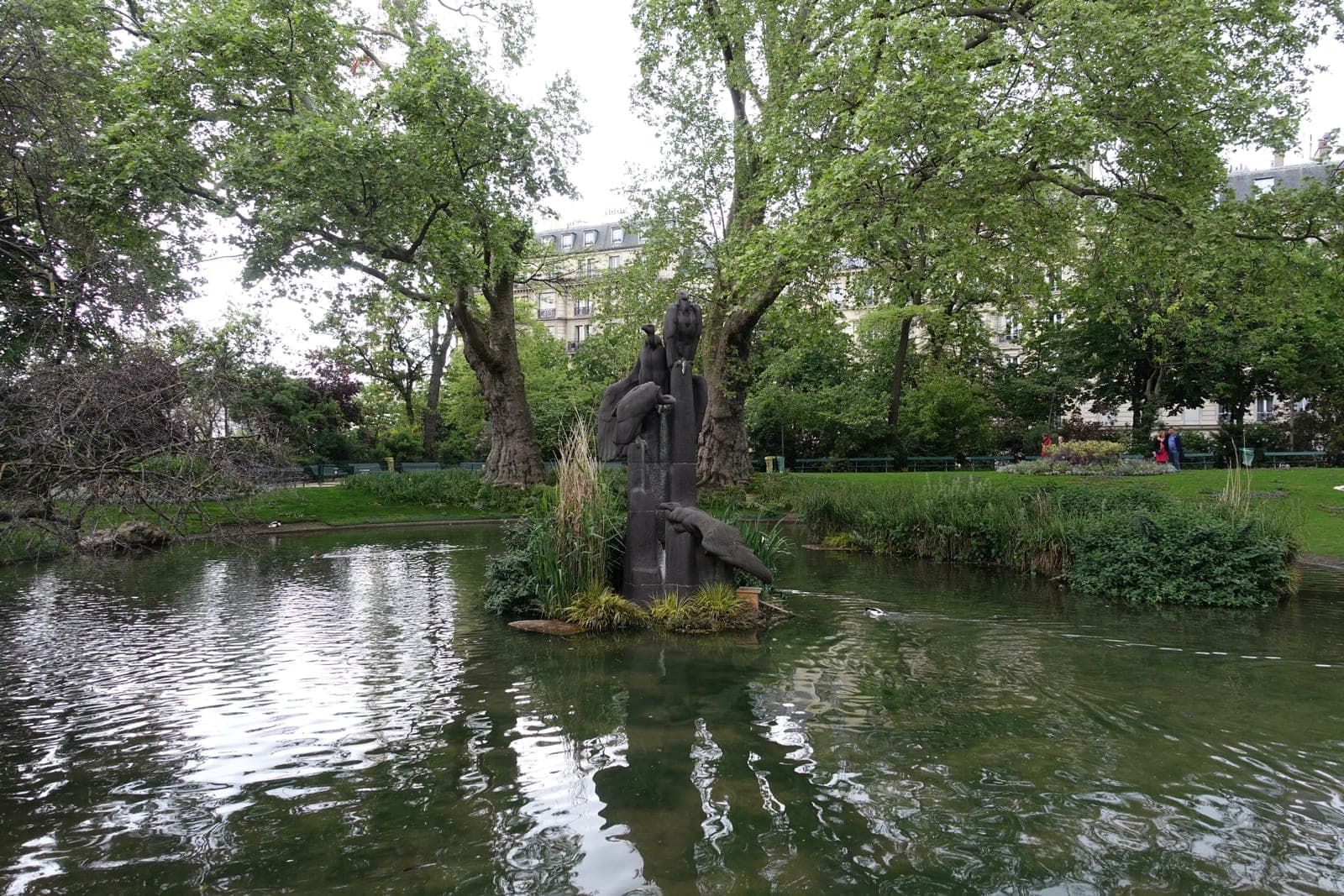
That square is the place du Docteur-Félix-Lobligeois, a short triangle of café terraces in front of the columned front of Sainte-Marie des Batignolles, with the square des Batignolles opening straight out behind it. The park is the district's living room. It was laid out in 1862 in the English manner, with a winding lake, a stream, a rock arch and trees old enough to matter in August, and on a Saturday morning it holds most of the neighborhood at once.
Then, roughly at rue Cardinet, the ground changes completely. West of there the old Saint-Lazare railway lands were rebuilt as Clichy-Batignolles: the Parc Clichy-Batignolles Martin Luther King, new blocks on streets named after Mstislav Rostropovitch and Françoise Dorin, and at the top of it all Renzo Piano's courthouse tower at the porte de Clichy. It is the same district on paper and a different one to walk through, and which side of the tracks you live on will shape your daily life more than the arrondissement number does.
The buildings on the old side are the standard late nineteenth-century Paris article: five or six storeys of pale stone or plaster over a shop, a courtyard behind, a stair that frequently has no lift, and small flats under a zinc roof at the top. Which floor you take decides your August. On a Saturday at two in the morning the noise is very local. The bars on rue des Dames and the terraces around the church square are still going, avenue de Clichy at the eastern edge never really stops, and three streets in from either you can hear the trees.
Who lives here, and what the streets look like
Families who arrived and stayed, professional couples, long-settled owners who bought before the district became fashionable, and a newer population in the flats west of the tracks. It reads as a settled residential neighborhood rather than a scene, which is exactly what its residents say when you ask them why they are here.
On income, be careful with the number, because the honest version of it is two numbers. Across the district's 16 small statistical areas, none of them suppressed, the median of those IRIS medians is 37,865 EUR a year in disposable income per consumption unit (Filosofi 2021). That method is unweighted, so a small well-off area counts the same as a large modest one, and in the 17e it runs 16.5% above the published figure, the largest gap of the seven Paris districts on these pages. The published median for the whole 17e is 33,390 EUR. Read the pair rather than either alone, and treat the lower one as the number you can look up.
The streets that carry the district are rue des Dames, rue Legendre, rue Nollet, rue Lemercier, rue Brochant, rue des Batignolles and rue de Lévis. Almost everything you will use is on one of those seven. The stock splits the same way the district does: on the old side, nineteenth-century faubourg buildings with small rooms, high ceilings on the good floors, a courtyard that decides how dark the flat is, and a lift only if somebody paid for one; on the new side, post-2010 blocks with a lift, insulation, a balcony and a bike room, on wider and windier streets with fewer small shops. A viewing on one side tells you very little about the other.
Getting around
This is the district's weakest suit, and the only headline score here that is held down. The network is genuinely dense, but Batignolles sits in the north-west of Paris, so the middle of the city is a real ride away rather than a walk.
What you have: line 2 at Rome on the southern edge, running east along the boulevard; line 13 at Brochant and La Fourche just off the eastern side; and line 14 at Pont Cardinet and Porte de Clichy on the western and northern edges, which is the driverless line and the fastest thing in the system, running south through Saint-Lazare, Châtelet and Gare de Lyon and on to Orly airport without a change. Pont Cardinet is also a Transilien station on the line into Gare Saint-Lazare, which is the quiet commuter route most visitors never notice and most residents use. Buses run along boulevard des Batignolles and avenue de Clichy, and because the district is flat, a bike is a genuinely serious option here.
The honest caveat is line 13, which has a long-standing reputation for crowding at rush hour, and you are on the branch side of it. If your office is in the centre or the east, look at line 14 and a change rather than assuming line 13 is your line.
Typical weekday minutes from Place du Docteur-Félix-Lobligeois, with the icon showing how. Times are door to door for a typical weekday morning from the place du Docteur-Félix-Lobligeois, and the icon shows the fastest sensible way., 2026-08.
Daily life
Food shopping here is the small trade first and the supermarket second, which is the opposite of most European cities and the thing new arrivals take longest to adjust to.
The chains are all present and all small-format: a Franprix at 75 rue des Dames, a Carrefour Express on rue Legendre, a Carrefour City on rue Cardinet, a G20 at 92 rue de Lévis, a Carrefour Market on place Françoise Dorin in the new quarter, plus a Monoprix, and Naturalia and Biocoop for organic. None of them is a weekly-shop supermarket in the out-of-town sense. You will do several small shops a week instead, which is why the street matters more than the brand.
Two markets set the rhythm. Rue de Lévis is a permanent market street, a run of butchers, greengrocers, fishmongers and cheese shops trading most days, and it is the everyday one. The marché biologique des Batignolles takes over the middle of boulevard des Batignolles on Saturday mornings and runs into the afternoon, and it is the one people plan the weekend around. Between them there are more good bakeries than any one household can justify: Bacillus at 100 rue des Dames and Copains at 61 rue Legendre are two of the ones with queues.
Pharmacies are thick on the ground, several with long evening hours, and there is a real spread of specialist trades still trading on rue Legendre and rue des Dames, which is not true of every fashionable Paris district.
For delivery, Uber Eats and Deliveroo are the two services that cover this address.
Local Places Worth Knowing
Independent and close by, chosen on merit. Nobody pays to appear here.
The park that explains the district: laid out 1862 in the English style with a winding lake and old trees, and used rather than admired. Half the neighbourhood on a Saturday.
The Saturday organic market on the boulevard's terre-plein, growers, cheese, fish and bread, with a queue at the good stalls by ten. One of few certified organic markets in Paris.
The corner cafe on place du Docteur-Felix-Lobligeois, facing the church with the park behind. Not a coffee destination: it is the terrace the district sits on.
View on Google MapsA small bistrot tucked into the passage Geffroy-Didelot off rue des Dames. Full of people who walked there, in a passage most visitors never find. Worth booking.
View on Google MapsChecked August 2026. Places close and change, so tell us if something here is out of date.
Schools and families
This is a district that visibly works for small children. Crèches are unusually easy to find on these streets, écoles maternelles and élémentaires sit on the same blocks as the shops, and the collèges are a walk rather than a commute. The two parks do the rest: playgrounds in both, flat pavements between them, and a Saturday around the church square that is essentially a school-gate conversation with better coffee.
The change comes with the lycée. There is no lycée inside the quartier, so a teenager here leaves the district for school. Carnot, off boulevard Malesherbes to the south west, and Chaptal, on the far side of boulevard des Batignolles, are both close enough to walk to from much of the district, but neither stands inside it, and Paris lycée placement follows sector rules and school choice rather than the nearest front door. If you are moving for a specific school, ask the mairie about the sector for the exact address, and ask it about the address rather than about the neighborhood.
The other family question is the flat, not the school. A third bedroom in Batignolles costs what a small house costs in most of Europe, and on the old side it usually comes with stairs. Working out what your money actually buys per square metre, in this district against the ones you are also considering, is the whole reason Apraiz builds these Paris guides the way it does, and it is worth walking these streets on a wet Tuesday as well as a sunny Saturday before you sign a lease or purchase.
Kids Friendly. One of the easier places in Paris to have small children. Two proper green spaces rather than one, playgrounds in both, flat pavements a pram can actually use, crèches and écoles maternelles on the same streets as the shops, and a Saturday rhythm around the church square that is visibly built around families. The honest limits are the flats and the stairs: the nineteenth-century stock is small-roomed, often lift-less above four floors, and a third bedroom here costs what a house costs elsewhere. Teenagers leave the district for their lycée, since none stands inside it.
Pet Friendly. About as good as central Paris gets for a dog. The streets are flat, quiet and wide enough to walk two abreast, there is a run of vets, groomers and pet shops along rue Legendre and rue des Dames, and the Martin Luther King park on the western edge is big enough to be a real walk rather than a lap of a square. Two caveats worth knowing before you commit. Paris is strict about where a dog may go inside its gardens and squares, and the rules differ from gate to gate, so read the sign rather than follow the crowd. And on the old side of the district a fifth-floor flat with no lift is a different proposition with a large dog than with a small one.
Green space, leisure and eating out
Two green spaces, and they do completely different jobs. The square des Batignolles is the nineteenth-century one: enclosed, planted, shaded, with a lake and ducks and benches, and it feels like a garden. The Parc Clichy-Batignolles Martin Luther King on the western edge is the modern one, built on the railway land, with lawns you can lie on, water, sport and open sky, and it stays open late on summer evenings. Between them the district has both kinds of outdoors, which is rare inside Paris and is most of why it scores highest of the seven Paris districts here for quality of life.
Eating out is unusually good for a district this far from the centre, and almost none of it is aimed at visitors. The concentration is on rue des Dames, rue Legendre, rue Lemercier and around the church square: bistrots, a heavy run of wine bars, crêperies, and a wide spread of Korean, Vietnamese, Lebanese, Italian and North African kitchens. The bars around the square and along rue des Dames run late from Tuesday to Saturday, and that is worth knowing in both directions, as an asset if you want a Thursday evening within walking distance and a liability if your bedroom window faces the terrace.
What it costs
The number to start from is the price actually recorded. In 2025 the median of the 627 registered apartment sales inside this quartier was 10 364 EUR / m², which is what buyers paid and had stamped, not what sellers asked. In 2024 the same method gave 10,338 EUR/m², so the level barely moved in a year.
One thing that median hides is what comes with the flat. Nearly two thirds of Paris apartment sales also carry a cellar or a parking space and the recorded price covers the lot. Take those out and the median for flats sold with nothing attached is 9,778 EUR/m², a gap of 6.0%, one of the two widest of the seven districts on these pages. If you are comparing a listing here with one elsewhere, check whether the cave and the parking are in the price, because in this district that difference is real money.
On rent there are three different numbers and they measure three different things.
What tenants actually pay is 27 EUR / m² a month, excluding charges, the median of the occupied private rental stock with quartiles of 23.6 to 30.3 and 4,315 observations behind it. That is computed for Paris-zone 10, one of the fourteen rent zones, so it describes the zone rather than these streets alone.
What is advertised is 33 EUR / m² a month for the whole 17e, modelled from listings, and charges are included in it and cannot be separated out. So the gap between 26.9 and 32.7 is not a scandal, it is two different measurements of two different things: a median of what is being paid without charges, against a model of what is being asked with them.
And then there is the ceiling, which is the part worth knowing before you view anything. Paris caps what a landlord may charge, and the cap is set per secteur, per room count, per building era and per régime, so there is no such thing as "the cap in Batignolles". For an unfurnished two-room flat in a pre-1946 building in secteur 10, which is a very common thing to rent here, the ceiling is 34 EUR / m² a month. A one-room flat of the same era is capped at 38.8 and a three-room at 32.0. A listing above the ceiling for its own category is unlawful, not merely expensive, which is worth real money to a newcomer who knows it. The scheme is time-limited and the arrêté in force runs to 24 November 2026, so check the ceiling in force on the day you sign.
Set that against what people here earn, which on the district's small statistical areas has a median of 37,865 EUR a year and on the published arrondissement figure 33,390. Hold those two beside a median square metre at 10,364 EUR and the shape of the market is plain enough: this is a district bought by two salaries, or by one salary and help, and the people who make it feel like a village are largely the ones who were already in it.
Weather and climate
Seasonal averages for Paris, one representative month per season. Météo-France 1991-2020 normals for station Paris-Montsouris, the reference station in the 14e that every Paris climate table means, via Infoclimat. Seasons are the representative months: January, April, July and October. Sunshine hours a day are the monthly totals divided by the days in the month (January 59.0 h, April 177.3 h, July 222.4 h, October 118.6 h). Annual figures: mean daily maximum 16.5 °C, mean daily minimum 9.2 °C, 634.3 mm of rain and 1,717.1 hours of sunshine. Rain days are left null because the monthly count of days at or above 1 mm is not published in the accessible normals table; the annual figure quoted for Paris elsewhere is about 111 days, which is regular light rain rather than heavy rain, and the 634.3 mm annual total is low for northern Europe and lower than most people expect. The thing that shapes daily life is the winter dark rather than the cold: 59 hours of sunshine in the whole of January, under two hours a day, and a January mean minimum of 3.2 °C so hard frost is occasional rather than routine. Summer is warm rather than hot in the normals, 25.7 °C by day in July, but Paris is a dense stone city with a real heat island and little air conditioning in older flats, so a heatwave is felt indoors for longer than the daily maximum suggests.
The honest downsides
The middle of Paris is a journey, not a hop. Everything local is excellent and everything central is a ride. Line 14 will carry you into the middle without a change, but you are starting from the north-west edge of the city, and the western side of the district is cut off by the Saint-Lazare railway lands, so your route out is decided by which bridge you live near. Line 13 is the other one you will be told about, and its reputation is earned at eight in the morning. If your working life is in the 4e, the 5e or the 6e, do the commute twice before you sign anything, because the district's great strength, that you never need to leave it, is also what makes leaving it feel long.
The quiet is fully priced. Batignolles is no longer a secret and the recorded prices say so: a median of 10,364 EUR/m² buys, on the old side, a nineteenth-century flat with small rooms, a courtyard outlook and often no lift above the fourth floor. The new side gives you the lift, the insulation and the balcony, and takes away the small shops and the crooked streets that are the reason people want to live here at all. Very few flats in this district give you both halves of what it is selling, and the ones that do are not on the market long.
Crime and safety
Start with what the number is. France publishes recorded crime by arrondissement, which is the finest grain available, so the figures on this page cover the whole 17e: Ternes, the Plaine Monceau, the Épinettes and the streets around the porte de Clichy as well as Batignolles. They were not computed for these streets.
With that said, this is the calmest set of figures of the seven Paris districts on this site. Theft from the person runs at 283.1 per 10,000 residents against 451.2 across Paris, well under the city, though still around three times the national 91.0. Assault outside the family is 32.0 against a national 31.6, which means the 17e sits essentially at the rate for France as a whole while Paris overall runs above it. Unarmed robbery is 19.7 against 34.5 city-wide. Family violence is 27.3 against a national 37.6, below it, although recorded family violence tracks reporting as much as incidence and a lower number is not straightforwardly a safer home.
Home burglary is rated on a different basis and must be read that way: 5.1 per 1,000 dwellings, the same as Paris as a whole and below the national 5.6. It is never comparable with the per-resident rates above, and the four indicators are never added together, because France counts them in three different units.
One caveat applies to every figure here, and it applies to central Paris generally. Offences are recorded where they happen and the rate divides by residents, so a district that draws in people from elsewhere carries a rate computed over the smaller number of people who sleep there. The 17e is more residential than most of the districts on these pages, which is part of why its numbers look calmer, and the everyday risk is the city's ordinary one rather than anything specific to Batignolles: phones and bags on the metro and in a crowd, and closing-time friction on the busiest corners of avenue de Clichy and the place de Clichy end rather than on the quiet streets in the middle.
Is this you?
If you want a real neighborhood inside Paris, with a park you use daily, a market you plan around and a street where the butcher knows you, and you do not need to be in the centre every morning, Batignolles is one of the best answers in the city. It suits families with young children, couples who have decided that quiet is worth more than address, and anyone whose work sits north or west.
If what appeals is the village feel but the price is the obstacle, Belleville is the other end of the same idea, at a recorded median of 8,545 EUR/m² and a very different district in every other respect. If you want the village and do not mind visitors and a hill, Montmartre is 9,222 EUR/m² and busier in every sense. And if you want Batignolles specifically, the question to settle before you commit is which side of rue Cardinet you belong on, because the old streets and the new quarter are two different offers wearing one name.
Want to know what homes here are actually worth?
Join the waitlistHow we source this
How we put this together. Gathered on the ground by our local field team and written up by the Apraiz research team. Every figure above carries its own source and date. The scores are not computed by the build; walking and transport will use open map and transit data first, then Apraiz's own model. We update prices quarterly, transport and amenities twice a year, and school data when the source publishes.
Sources: Demandes de valeurs foncières (DVF), data.gouv.fr, Observatoires des loyers (OLAP), DRIHL Île-de-France, SSMSI, via data.gouv.fr, INSEE, Wikipedia (en).
Safety and crime in Paris →Nearby: Le Marais · Saint-Germain-des-Prés · Montmartre