
Long Story ShortReadHide
- What it is: a hill with a basilica on top and an ordinary Paris arrondissement wrapped around it. Officially the quartiers of Clignancourt and Grandes-Carrières in the 18e, and much the largest of the seven districts we cover in Paris.
- Who it suits: someone who wants Paris prices below the centre, more food shops and street markets than they can use, four metro lines on the doorstep, and does not mind that the last five minutes home are uphill.
- What it costs: 9 222 EUR / m² ≈ $990 / sq ft to buy, and 25.7 EUR/m² a month is the median rent actually paid across the rent zone this sits in.
- What people complain about: the tourist crush around the Sacré-Cœur, the staircases, and the fact that the postcard and the neighborhood are two different places.
First impressions
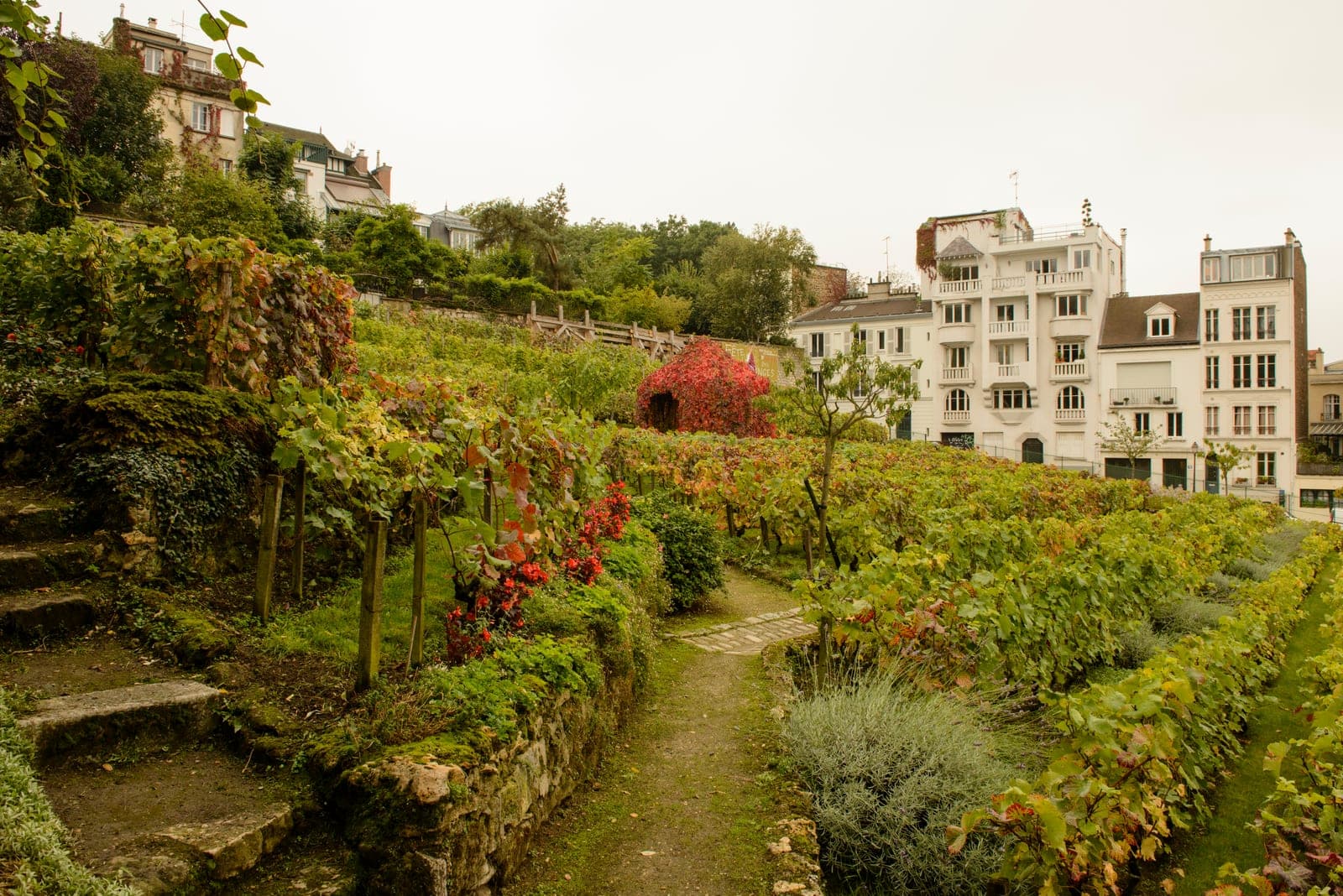
Almost everything written about Montmartre is about roughly six streets. The district in this guide is much bigger than that: the two quartiers administratifs of Clignancourt and Grandes-Carrières, 3.53 km² of the 18e arrondissement, which makes it more than twice the size of any other Paris district we cover. The butte, the basilica and place du Tertre are the top-left corner of it. The rest is Jules Joffrin, rue du Poteau, rue Ordener, rue Damrémont, rue Caulaincourt and the long slope down to the boulevards.
The first thing to understand is the gradient, because it decides how you will live. The butte rises to about 130 m, the highest natural point in Paris, and it is not a gentle rise. Rue Lepic doubles back on itself as it climbs. Rue Foyatier, beside the funicular, is a staircase and nothing else. Lamarck-Caulaincourt metro comes out between two flights of steps. Abbesses is about 36 m underground and has a spiral staircase most residents use exactly once before deciding the lift is fine. Then you get to the other half of the district, north of the crest, and Clignancourt is flat.
The second is the split between the postcard and the neighborhood, which is sharper here than anywhere else in Paris. Place du Tertre, rue Norvins and the steps below the Sacré-Cœur carry the heaviest tourist crush in the city. A few streets north, rue du Poteau on a Tuesday morning is shopping trolleys, butchers and a queue at the bakery. Both are Montmartre. You choose which one you live in, and rent and price barely move between them.
The third is the building stock, which changes three times inside the boundary. On the butte it is pre-Haussmann village housing, low, narrow, charming and frequently liftless, on streets like rue Cortot, rue de l'Abreuvoir and rue Saint-Rustique. Along rue Caulaincourt, rue Damrémont and the boulevards it turns proper haussmannien, five to seven storeys, stone, courtyard, cour intérieure, and a lift in perhaps half of them. North and east toward boulevard Ney it becomes post-war and 1960s to 1970s infill, plainer, often better laid out inside, and mixed with a lot of social housing. Three different Paris in one district.
Who lives here, and what the streets look like
Long settled owners on the butte, families on the Clignancourt side, young professionals renting the small flats around Abbesses and Guy Môquet, and an artistic and gallery-facing crowd that has never entirely left, though it has thinned. The mix reads more ordinary and more mixed than the district's reputation suggests, which is exactly what the income figures say too.
On income, be careful about which number you are reading. The median of the district's 54 IRIS medians, INSEE's small statistical areas, is 30,240 EUR a year of disposable income per consumption unit on Filosofi 2021. That is a typical figure across the district's small areas rather than the district's own median, and the method is unweighted, so small well-off areas count the same as large poorer ones. In the 18e it runs 9.2% above the published figure. The number a reader can look up is the published arrondissement median for the 18e, 24,910 EUR a year. Both are worth having: one describes the spread of small areas inside the district, the other describes the arrondissement as officially measured.
The streets that carry the district are, in the south, rue des Abbesses, rue Lepic, rue des Trois Frères, rue Tholozé and rue d'Orsel; on the western flank, rue Caulaincourt curving above the cemetery and rue Damrémont; and in the north, rue du Poteau, rue Ordener, rue Duhesme, rue Marcadet and rue Custine. If you learn six of those you can find anything.
Two practical things about the flats. Ceiling height and light are usually good on the butte and along Caulaincourt, and surface area usually is not: a lot of the stock is one and two rooms, and the top-floor chambres de bonne under the zinc are small, steep-stepped and, in August, genuinely hard. Air conditioning is rare in Paris apartments and retrofitting it in a protected streetscape is not simple, so ask which way the flat faces and what is above the ceiling before you fall in love with the view.
Getting around
This is the best-served district in our Paris set for public transport, and the getting-around score still lands at 82 rather than 90, for one reason: the climb is at the end of the journey.
Four metro lines run through the boundary. Line 12 takes the spine, Abbesses, Lamarck-Caulaincourt, Jules Joffrin, Marcadet-Poissonniers. Line 4 takes the eastern edge to Simplon and Porte de Clignancourt. Line 2 runs along the southern boulevard through Blanche and Pigalle to Place de Clichy, where Line 13 picks up La Fourche, Guy Môquet and Porte de Saint-Ouen. The T3b tram runs along the boulevards des Maréchaux at the northern edge, with interchanges at Porte de Clignancourt and Porte de Saint-Ouen. Wherever you end up in this district, you are close to a station.
The funiculaire de Montmartre climbs from square Louise Michel to the foot of the basilica, it is part of the RATP network and it takes an ordinary metro ticket. Residents on the upper streets use it as transport, not as a ride.
What none of that fixes is the last stretch. Abbesses is deep. Lamarck-Caulaincourt has steps at both exits. Coming home from the metro with two bags of shopping to a fourth floor without a lift on rue Cortot is a different proposition from doing the same thing in Batignolles, and it is the single reason the walking score here, 80, is the lowest of the seven Paris districts.
Typical weekday minutes from Place des Abbesses, with the icon showing how. Door to door from place des Abbesses on a typical weekday morning; the icon shows the fastest sensible way., 2026-08.
Daily life
Food shopping is the district's quiet superpower, and it is why the everyday shopping score, 88, is the joint highest in our Paris set. Almost every street of any length has a bakery, a butcher or a greengrocer on it.
For the weekly shop, the chains are all present and small-format. There is a Monoprix on rue Ordener and a scatter of Franprix along boulevard Ornano, boulevard Barbès and boulevard Ney. G20 is the local workhorse, with branches on rue Lepic, rue Damrémont, rue Francœur, rue des Cloÿs and rue d'Orsel. Carrefour City and Carrefour Market cover the middle, Intermarché Express sits on rue Lepic and rue Letort, U Express on rue du Poteau, and Aldi on rue du Poteau and rue de Clignancourt for the cheap end. Organic is well covered too: Naturalia on rue Duhesme and boulevard Ornano, Biocoop on rue Caulaincourt, La Vie Claire on rue Custine.
The markets matter more than any of that. Marché Ordener runs on the central strip of rue Ordener on Wednesday and Saturday mornings, and Marché Ney up on boulevard Ney on Thursday and Sunday mornings. Both are morning trade, finished by about one o'clock, which is the rhythm of every open-air market in Paris and takes new arrivals a month to internalise. Rue du Poteau functions as a permanent market street in its own right, and rue Lepic does the same thing on the southern side with better views and higher prices.
For delivery, Uber Eats and Deliveroo both cover the district thoroughly, and this is a district with an unusual density of restaurants, so the choice is genuinely large rather than nominally large.
Local Places Worth Knowing
Independent and close by, chosen on merit. Nobody pays to appear here.
The residents' market on rue Ordener, Wednesday and Saturday mornings, packed up by one. Prices have nothing to do with the ones at the top of the hill.
The oldest house on the butte, where Renoir, Valadon and Utrillo worked, with three terraced gardens and a view onto the Clos Montmartre vineyard. Quieter than place du Tertre.
View on Google MapsThe unreconstructed corner brasserie on rue des Trois Freres, glass on two sides, and the default meeting point around Abbesses. Nobody there is on holiday.
A first-floor room on rue des Abbesses doing south-western cooking and the enormous warm salads with garlic potatoes it is known for. Cheap for the postcode, open late.
View on Google MapsChecked August 2026. Places close and change, so tell us if something here is out of date.
Schools and families
France publishes a result for every lycée in the country, which means the schools figure on this page is a measured one rather than a description. The measure is the taux d'accès de la seconde au bac: of the pupils who start seconde at a school, the share who go on to reach the baccalauréat there. It is a better question than a raw pass rate, because a pass rate can be flattered by moving weak pupils out before the exam and an access rate cannot.
Montmartre scores 72, the lowest score in our Paris set. Four lycées sit inside the two quartiers, with 226 pupils in seconde between them and individual access rates from 44 to 89: Rabelais at 74 with 79 pupils, Saint-Jean de Montmartre professionnel at 77 with 54, Auguste Renoir at 89 with 47, and Belliard professionnel at 44 with 46. The headline pools both routes, weighted by cohort size, so a small school cannot outvote a large one. Split by track, the général et technologique route here scores 80 and the professionnel route 62, and Belliard's value added of minus 12 says it does worse than its intake predicts, which is a different and harsher statement than its access rate alone.
Two honest caveats. A Paris lycée recruits well beyond its own streets, so this describes the schools standing here rather than the children living here. And this is the upper-secondary end only: the primary and collège picture is a matter of your exact sector, which the mairie of the 18e allocates by address and which can differ across a single street.
That granularity is the reason we build these Paris guides from published sources with the boundary named on every figure, rather than from a portal average. Whichever way the numbers point, walk the school run at eight in the morning before you sign a lease or purchase, because in this district a few hundred metres of difference is also a change in altitude.
Kids Friendly. This works, and it works better on some streets than others. The Clignancourt side around Jules Joffrin, rue du Poteau, rue Duhesme and rue Ordener is flat, thick with everyday food shops, and well supplied with small squares and playgrounds. Against that: the butte itself is a hard place to push a pram, the tourist streets around place du Tertre and rue Lepic are not somewhere you let a five-year-old run ahead, and the lycée picture here is the weakest of the seven districts, which matters from about age fifteen rather than age five.
Pet Restricted. Dogs are ordinary here and the district gives them plenty of pavement, the long curve of rue Caulaincourt, the Petite Ceinture walk near rue du Ruisseau, square Suzanne Buisson and the quiet upper streets early in the morning. Three things hold it back from a straight yes. Most Paris squares and gardens either bar dogs or restrict them to the paths, so the green on the map is not all usable. The butte is stairs, and a small dog does not do stairs twice a day for years. And a large share of the older buildings on the hill have no lift, which turns every walk into a climb for the owner as well.
Green space, leisure and eating out
Green space here is many small pieces rather than one big park, and there is a lot of it. Square Louise Michel falls down the front of the hill below the basilica in terraces. Square Suzanne Buisson on the north slope is the local one, boules, plane trees and the headless Saint Denis fountain. Square Carpeaux, Square Léon-Serpollet and Square Marcel-Bleustein-Blanchet cover the western and northern sides, and Les Jardins du Ruisseau and the walkable stretch of the Petite Ceinture du 18e run along the old railway cut near rue du Ruisseau. The cimetière de Montmartre, down in the hollow under the rue Caulaincourt bridge, is a large expanse of green and is used as one.
Leisure is unusually deep for a residential district. Studio 28 on rue Tholozé has been an art-house cinema since 1928. Pathé Wepler covers the mainstream end at place de Clichy. La Cigale, Le Trianon and the Élysée Montmartre on boulevard de Rochechouart are three of the best mid-sized music venues in Paris and are all within walking distance of each other. The Musée de Montmartre on rue Cortot tells the hill's own story, the Halle Saint-Pierre at the foot of it shows art brut and outsider art, and the Marché Saint-Pierre fabric shops around place Saint-Pierre are a genuine Paris institution.
Eating out splits the same way the district does. Around place du Tertre and the top of rue Lepic you are paying tourist prices for tourist food. Along rue des Abbesses, rue des Trois Frères and rue Caulaincourt it becomes a real Paris eating street, busy, mixed and reasonably priced. On the Clignancourt side, around rue du Poteau, rue Duhesme and rue Custine, it is neighborhood restaurants for neighborhood money. Bars are everywhere in all three zones, so the evenings are not quiet anywhere except the upper streets of the butte itself.
What it costs
The price to start from is 9 222 EUR / m² ≈ $990 / sq ft, the median of 2,277 recorded apartment sales inside the two quartiers in 2025. That sales count is much the deepest of the seven Paris districts, which matters: this is a thick, liquid market and the median is not being set by a handful of transactions. It is a price actually paid and registered, not an asking price. On the same method, 2024 was 8,953 EUR/m².
That headline is the whole recorded price, and about 64% of Paris apartment sales include a cellar or a parking space in the deal. Measured over flats sold with nothing attached, the median here is 9,110 EUR/m², only 1.2% below, which is one of the smallest gaps in the set and means the headline is close to a pure flat price.
On rent there are two numbers and they are not the same measurement. What tenants actually pay, on the median of the occupied private stock, is 25.7 EUR/m² a month excluding charges, with quartiles of 22.7 to 28.8 over 4,362 observations. That figure is computed at the scale of the rent zone, Paris-zone 9, not the quartier, so treat it as the zone this district sits in. It is the lowest of the seven Paris districts. What landlords advertise, modelled per arrondissement for the 18e, is 29.8 EUR/m² a month with charges included and not separable. One of those includes charges and the other does not, so the gap between them is not evidence of anything.
There is also a legal ceiling, and it is worth knowing how it actually works. Paris caps the rent a landlord may charge, at the loyer de référence majoré, and the cap is set per secteur, per room count, per building era and per régime, so there is no single cap for a district. For a two-room unfurnished flat in a pre-1946 building in secteur 9, which is a common enough listing here, the ceiling is 31.6 EUR/m² a month. For a one-room in the same era it is 35.9, and for a three-room 29.3. A listing above the ceiling for its own category is unlawful, which is the useful part: check the category, not the average. This is a time-limited scheme, currently running to 24 November 2026, so check the arrêté in force when you sign.
Now the relationship that actually tells you something. A square metre here costs 9,222 EUR. The published median disposable income for the 18e is 24,910 EUR a year. Divide one by the other and a single square metre costs about 37% of a year's median income for the arrondissement. Put another way, on the incomes recorded in this arrondissement, the people already living here are not the people the current market is priced for, which is why so much of the stock is small, rented, or held by owners who bought a long time ago.
Weather and climate
Seasonal averages for Paris, one representative month per season. Météo-France 1991-2020 normals for station Paris-Montsouris, the reference station in the 14e that every Paris climate table means, via Infoclimat. Seasons are the representative months: January, April, July and October. Sunshine hours a day are the monthly totals divided by the days in the month (January 59.0 h, April 177.3 h, July 222.4 h, October 118.6 h). Annual figures: mean daily maximum 16.5 °C, mean daily minimum 9.2 °C, 634.3 mm of rain and 1,717.1 hours of sunshine. Rain days are left null because the monthly count of days at or above 1 mm is not published in the accessible normals table; the annual figure quoted for Paris elsewhere is about 111 days, which is regular light rain rather than heavy rain, and the 634.3 mm annual total is low for northern Europe and lower than most people expect. The thing that shapes daily life is the winter dark rather than the cold: 59 hours of sunshine in the whole of January, under two hours a day, and a January mean minimum of 3.2 °C so hard frost is occasional rather than routine. Summer is warm rather than hot in the normals, 25.7 °C by day in July, but Paris is a dense stone city with a real heat island and little air conditioning in older flats, so a heatwave is felt indoors for longer than the daily maximum suggests.
The honest downsides
The hill is a daily tax, not a view. Everything charming about the butte, the staircases, the cobbles, the low old houses, is a cost you pay twice a day for as long as you live here. Rue Foyatier is a staircase. Abbesses is 36 m down. A great many of the older buildings on the hill have no lift, and the ones that do have lifts you can barely get a pushchair into. Groceries, a pram, a bicycle, a sofa delivery, an injured knee, a hot August afternoon: every one of them is harder here than in a flat district, and it is precisely why the walking score, 80, is the lowest of the seven Paris districts despite the shops being everywhere. Look at where a flat sits on the slope before you look at anything else in the listing.
You would be living inside the heaviest tourist crush in Paris, and along its southern edge, inside its nightlife strip. Place du Tertre, rue Norvins, the steps below the basilica and the top of rue Lepic are saturated for most of the year, which means crowds, queues at your own bakery, and coach traffic. Meanwhile the district's southern boundary is the boulevard de Clichy and boulevard de Rochechouart, which is Pigalle, the Moulin Rouge, three big music venues and the bars that empty at two in the morning. Both problems are geographic and both are solvable by choosing a street, but you have to choose deliberately, and a viewing at eleven on a Sunday morning will not tell you what you need to know.
Crime and safety
Start with what the number is, because it is not what a reader will assume. France publishes recorded crime by arrondissement, which is the finest grain there is, and this district is two of the four quartiers of one. The figures below are the whole 18e, which also contains Goutte-d'Or and La Chapelle, and neither of those is in Montmartre. No published figure exists for these two quartiers alone. Read the numbers as a description of the 18e.
The 18e recorded 510.1 thefts from the person per 10,000 residents in 2025, against 451.2 in Paris as a whole and 91.0 nationally. Unarmed robbery ran at 64.3 per 10,000, against 34.5 in Paris and 7.2 nationally, and of these five indicators that is the one where the gap to the national figure is widest. Non-domestic assault was 55.8, against 52.7 in Paris and 31.6 nationally.
Then the two that run the other way, and they are the ones that touch a home. Home burglary was 5.9 per 1,000 dwellings, close to the national 5.6 and a little above the Paris 5.1. Note the different base: burglary is rated per 1,000 dwellings, not per 10,000 residents, because that is how the ministry rates it, and the two scales must never be read side by side. Domestic violence was 26.8 per 10,000 residents, below both Paris at 29.8 and France at 37.6.
Two things to hold on to when reading any of it. France counts these indicators in three different units, an infraction for burglary and robbery, a victime for assault and domestic violence, a victime entendue for theft from the person, so they cannot be added into a total and no total exists to quote. And the denominator is residents. The rate divides offences recorded in the 18e by the people who sleep in the 18e, while the tourist crush around the Sacré-Cœur is the heaviest in Paris and every one of those visitors is a potential victim who is not in the bottom of the fraction. A pickpocket rate calculated this way tells you about the streets, not about your building.
The practical reading is the ordinary big-city one. Bag and phone snatching on the crowded stretches, at the top of rue Lepic, on the steps below the basilica, at place du Tertre and on the metro at Abbesses and Pigalle. Trouble at closing time along the boulevard de Clichy. Against that, a burglary rate at roughly the national level, and family violence below it.
Is this you?
Yes, if you want central Paris on a budget that will not stretch to the Marais or Saint-Germain, and you would rather have the markets, the four metro lines and the food shops than have a flat street. Yes if the two-sided nature of the place appeals, a postcard for the weekend and rue du Poteau for the Tuesday. Yes if you have young children and can settle on the Clignancourt side, where the squares and the playgrounds are.
No, probably, if you want quiet and level ground. Batignolles, over in the 17e, is the honest alternative: flatter, calmer, the highest quality-of-life score of the seven at 82 against 74 here, with a market of its own and the Martin Luther King park on its edge. It costs more to buy, 10,364 EUR/m² against 9,222, and you give up the sheer density of shops, stations and markets you get here. And if the constraint is money rather than gradient, Belleville is the cheapest of the seven at 8,545 EUR/m², at the cost of the poorest housing stock in the set and the fewest metro stations, two.
Want to know what homes here are actually worth?
Join the waitlistHow we source this
How we put this together. Gathered on the ground by our local field team and written up by the Apraiz research team. Every figure above carries its own source and date. The scores are not computed by the build; walking and transport will use open map and transit data first, then Apraiz's own model. We update prices quarterly, transport and amenities twice a year, and school data when the source publishes.
Sources: DVF, Demandes de valeurs foncières (data.gouv.fr), Observatoires des loyers (OLAP), Arrêté IDF-2026-06-12-00003, DRIHL Île-de-France, SSMSI, Ministère de l'Intérieur (data.gouv.fr), Ministère de l'Éducation nationale, IVAL 2025, INSEE, OpenStreetMap contributors, via the Overpass API.
Safety and crime in Paris →Nearby: Le Marais · Saint-Germain-des-Prés · Canal Saint-Martin