
Long Story ShortReadHide
- What it is: two of the city's eighty quartiers administratifs, Porte-Saint-Martin and Hôpital-Saint-Louis, either side of a working water canal with nine locks and iron footbridges, in the 10e.
- Who it suits: people who want the densest everyday food shopping in central Paris, want to walk everywhere on flat ground, and accept that the quays belong to the whole city on a warm evening.
- What it costs: about 9 583 EUR / m² ≈ $1,030 / sq ft to buy, and rent actually paid in this zone runs at about 26 EUR / m² a month, excluding charges.
- What people complain about: the noise on the quays from May to September, and the street theft recorded across the arrondissement, the highest of the seven districts on this site.
First impressions
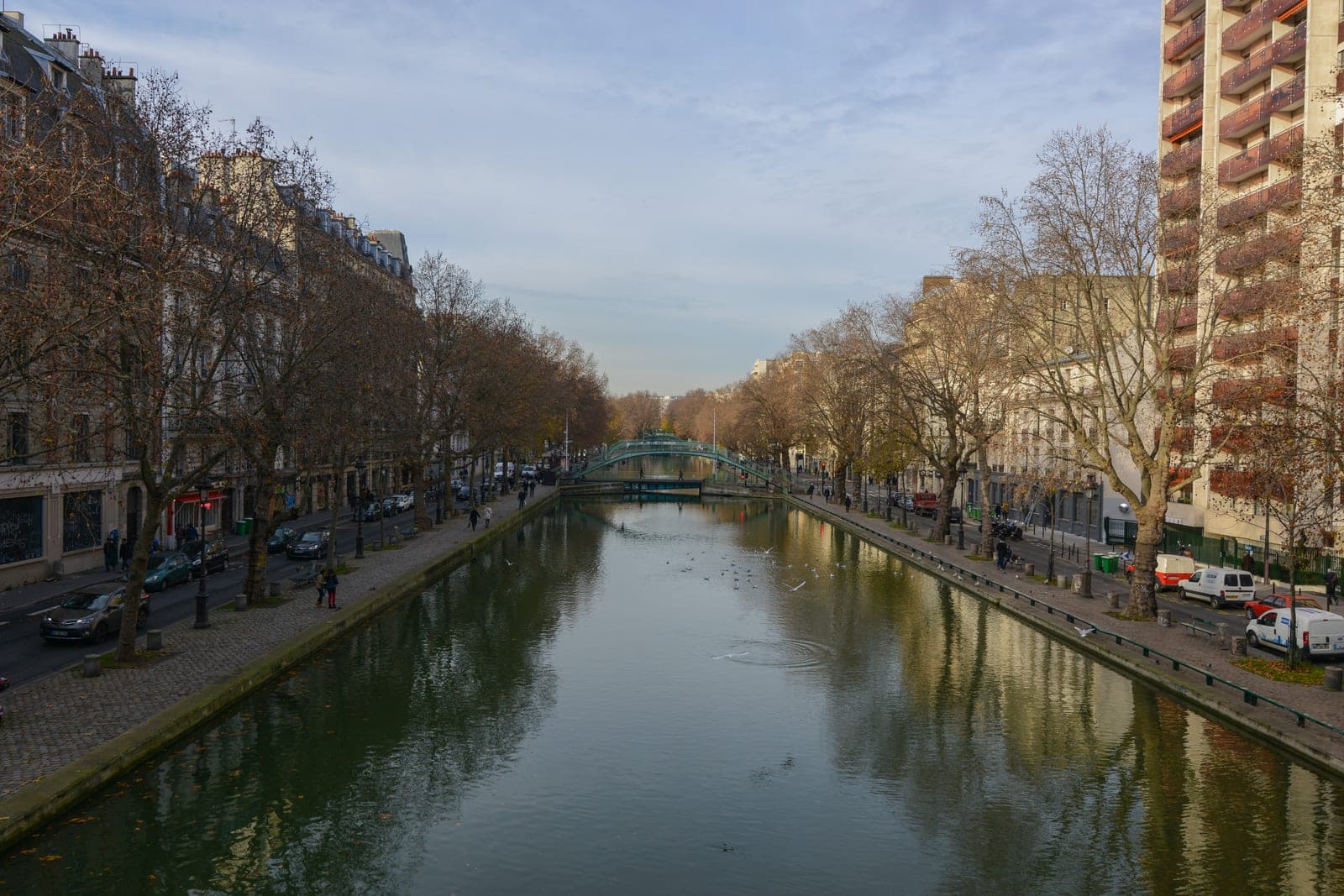
The name is a canal and the district is not. What people photograph is about four hundred metres of water between the écluse des Récollets and the rue de la Grange-aux-Belles: plane trees, green iron footbridges that pivot open for a boat, a stone edge people sit on. What you would actually live in is the streets behind it, and there are a lot of them.
Paris publishes no official boundary for "Canal Saint-Martin", but it does publish eighty quartiers administratifs, and this district is two of them: Porte-Saint-Martin and Hôpital-Saint-Louis. Porte-Saint-Martin runs from the triumphal arch and the rue du Faubourg-Saint-Martin east to the water. Hôpital-Saint-Louis wraps around the hospital and climbs gently towards the boulevard de la Villette and the bassin at the top. Between them the ground is flat, which after Montmartre or Belleville is the first thing your legs notice.
The second thing is that it is a faubourg, not a haussmannien quarter. Away from the boulevards the buildings are older, plainer and narrower than the Paris of postcards: five to seven storeys, shallow courtyards, workshops and passages behind the street door, façades that were never given the balconies and the stone dressing. On the boulevard de Magenta and the boulevard de Strasbourg you get the full Haussmann treatment and the full Haussmann traffic with it. Around the hospital and along the boulevard de la Villette there is 1970s and 1980s infill, which is the stock that reliably has a lift.
August is the season that tells you what you have bought. A great many flats here are top-floor conversions under a zinc roof with no air conditioning, and a zinc roof in a heatwave is an oven. Which floor, which way it faces and whether the courtyard gives you a through draught matter more than the arrondissement does.
Who lives here, and what the streets look like
Across the district's 21 small statistical areas, the typical median disposable income is 29,430 EUR a year, which is the median of those IRIS medians rather than a single published number for the district. The figure a reader can look up, the published median for the whole 10e, is 29,470, and here the two land within a rounding error of one another, which is not true everywhere in Paris. Read together they say this is a middle-income arrondissement, not a rich one.
The mix on the street reflects that. Young professionals and renters dominate the flats along the canal and around the place Jacques Bonsergent. The Hôpital Saint-Louis is a large employer inside the boundary and the two mainline stations just outside are another, so a lot of people here work shifts. Families are here too, more in the quieter streets north and east of the hospital, around the rue Sainte-Marthe and the rue de la Grange-aux-Belles, than on the quays.
The streets worth knowing by name are the quai de Valmy and the quai de Jemmapes either side of the water, then rue de Lancry, rue Beaurepaire, rue Yves Toudic, rue Bichat and rue Alibert feeding into them, the rue du Château d'Eau and the rue du Faubourg-Saint-Martin running the length of the western half, and the place Sainte-Marthe at the top, which is a small painted square that feels like a village and is about six minutes from a six-lane boulevard.
At two in the morning on a Saturday in July the quays are full of people sitting on the edge with bottles, and it is not a nightclub noise, it is hundreds of separate conversations that do not stop. In February it is silent. If you are viewing a flat facing the water, view it in the evening and in the right month, because the two versions of this street are not the same place. One street back, on the rue Yves Toudic or the rue de Marseille, it is already much quieter.
Getting around
Very good, and the strength here is interchange rather than any single line. Inside the district you have Jacques Bonsergent on line 5, Château d'Eau on line 4, Belleville on lines 2 and 11, and République, which is one of the biggest interchanges in the network with lines 3, 5, 8, 9 and 11 in it. Immediately outside are Goncourt on line 11, Colonel Fabien on line 2 and Louis Blanc on lines 7 and 7bis.
The bigger fact is the two mainline stations on the doorstep. The Gare de l'Est and the Gare du Nord are both a short walk out of the northern edge, which puts Eurostar, the northern and eastern TGV networks and the RER B, D and E within walking distance of a home. For anyone who travels for work, that is the single strongest practical argument for living here, and it is the same fact that shapes the crime section further down.
Cycling is the other genuine advantage. The district is flat, the quays have their own protected route, and the canal gives you a continuous north-south axis from the Bassin de la Villette down to the Bastille without a single hill. On Sundays and public holidays the quai de Valmy and the quai de Jemmapes are closed to traffic under Paris Respire, and in high summer that closure runs longer.
Typical weekday minutes from Quai de Valmy at the écluse des Récollets, with the icon showing how. Door-to-door minutes from the quai de Valmy for a typical weekday morning; the icon shows the fastest sensible way. Paris has no ferry terminal, so the fourth anchor is the Gare de Lyon., 2026-08.
Daily life
Everyday food shopping is the real strength of this district. You are rarely more than two minutes from a bakery, a butcher, a fishmonger or a greengrocer, and the small independent trade has survived here in a way it has not in Le Marais or Saint-Germain-des-Prés, where boutique and luxury retail took much of the everyday business.
For a full trolley, the Intermarché on the place Jacques Bonsergent is the practical anchor, with a Monoprix on the rue de Marseille just off the quai de Valmy, a Lidl on the boulevard de Strasbourg, a G20 on the avenue Parmentier and Franprix branches scattered through the faubourg streets. Organic and health shops are unusually thick on the ground: Naturalia on the avenue Parmentier, La Vie Claire at 68 rue du Faubourg-Saint-Martin, and two Biocoop stores.
The markets matter more than the supermarkets, which is true of Paris generally and especially true here, because there are three. The marché couvert Saint-Martin at 31-33 rue du Château d'Eau is the covered hall, open Tuesday to Saturday and Sunday morning, so it is the one you can actually use on a Wednesday evening. The marché Alibert runs along the hospital on the rue Alibert on Sunday, small and useful. The marché de la Villette on the boulevard de la Villette at the eastern edge runs Wednesday and Saturday mornings and is the big open-air one.
For delivery, Uber Eats and Deliveroo both cover this district, and between them they are the market in France.
Local Places Worth Knowing
Independent and close by, chosen on merit. Nobody pays to appear here.
Christophe Vasseur's bakery behind a listed 1889 shopfront on rue Yves Toudic. Organic flour, long fermentation, shaped by hand; the pain des amis is what the queue is for.
View on Google MapsA bistro and wine cave on rue de Lancry doing natural wine since 2000, 400-odd references and a menu that changes daily. Tiny, so book; the cave next door sells to take away.
View on Google MapsA working hospital that is also one of the best preserved pieces of early 17th-century Paris. The brick and stone quadrangle of 1607 sits behind the modern buildings.
View on Google MapsThe 1859 covered hall on rue du Chateau d'Eau, rebuilt 1880 in the Baltard iron-and-glass manner. Fishmonger, butcher, cheese and wine, Tuesday to Sunday morning.
View on Google MapsChecked August 2026. Places close and change, so tell us if something here is out of date.
Schools and families
France is the one country on this site where the Schools bar carries a real number, because the ministry publishes a result for every lycée. The measure is the taux d'accès de la seconde au bac: of the pupils who start seconde at a school, the share who reach the baccalauréat at that same school. It is the honest version of a pass rate, because it cannot be flattered by moving weak pupils out before the exam.
Three lycées stand inside this district and 377 pupils start seconde in them each year. Bossuet-Notre-Dame, private under contract and the largest of the three at 197 pupils, reads 92. The two public vocational lycées read lower: Gustave Ferrié at 65 on 118 pupils, and Marie Laurencin at 43 on 62. Pooled over pupils, the district's figure is 75, and the split behind it is the widest of the seven Paris districts on this site: the général et technologique route alone reads 92 and the professionnel route alone 57.
Two things that number does not say. Value added, which measures a school against what its intake predicts rather than what happens to its pupils, runs +11 at Gustave Ferrié and -17 at Marie Laurencin, so the school with the lower access rate is the one adding more to the children who go there. And a Paris lycée recruits across the whole city, so this describes the schools standing on these streets rather than the children who live on them. Below lycée level, the supply of schooling within a short walk of the middle of the district is genuinely deep, at every stage from crèche age upwards.
Knowing which of those numbers answers your actual question is most of what we try to do in these Paris guides, and it is worth walking a child's route to school, and standing on the quay at eleven at night, before you sign a lease or purchase.
Kids Restricted. Workable, with real caveats. In its favour: three food markets, small squares scattered through both halves of the district, the Jardin Villemin as the one proper garden, a dense supply of schooling within a short walk, and streets flat enough for a pram everywhere except the boulevards. Against it: the canal edge is low and open along much of the quays, which is a genuine consideration with a toddler; the boulevard de Magenta, the boulevard de Strasbourg and the boulevard de la Villette carry heavy traffic and are unpleasant to walk a child along; the faubourg building stock means small rooms, frequently no lift and family-sized flats that are scarce and expensive; and the quays are loud late on a warm weekend, which is exactly when a small child is asleep.
Pet Friendly. One of the easier central Paris districts for a dog. The quays of the canal give you a long flat continuous walk with plane trees and no gradient at all, and on Sundays and public holidays the quai de Valmy and the quai de Jemmapes are closed to traffic under Paris Respire, which turns the whole length into a promenade. Cafés and bar terraces here are relaxed about a dog under the table. The honest limits are the same ones every dense Paris district has: no large park inside the boundary, so a proper run means walking east to the Buttes-Chaumont, most municipal lawns are not open to dogs, and a small dog rides the metro in a closed bag while a larger one needs a lead, a muzzle and a ticket. A flat with no lift on the fifth floor is a different proposition with a big dog.
Green space, leisure and eating out
Green space is the honest weak point, and the canal partly compensates for it. The Jardin Villemin, on the rue des Récollets beside the old Récollets convent, is the one garden of any size, with lawns you can lie on and a play area. After that it is squares: square Eugène Varlin, square Frédérick Lemaître, square des Récollets, the parc Juliette Dodu up near the hospital. Inside the walls of the Hôpital Saint-Louis there is a walled garden in the 1607 quadrangle that most people who live here have never walked into. The Bassin de la Villette at the top of the district is the nearest thing to open water and space, and the Parc des Buttes-Chaumont is the proper park, east and slightly uphill.
For leisure, Point Éphémère at 200 quai de Valmy is the arts venue that defines the northern stretch, concerts, studios and a canal-side terrace in a converted depot on the water. Le Comptoir Général at 80 quai de Jemmapes is a bar and cultural space in a courtyard off the quay that most people walk past. Artazart at 83 quai de Valmy is the design bookshop the district is known for, and it opens on Sundays.
Eating and drinking is concentrated in three clusters. The quays and the streets feeding them, rue de Lancry, rue Beaurepaire and rue Yves Toudic, hold the natural wine bars, the small bistros and the coffee places. The place Sainte-Marthe and the streets around it are a smaller, quieter version of the same thing with terraces on a pedestrian square. And the rue du Château d'Eau and the rue du Faubourg-Saint-Martin carry the working end of it, the couscous, the Sri Lankan and Indian kitchens and the cheap lunch that the arrondissement actually eats.
What it costs
Expensive, and fifth of the seven Paris districts on this site, below Batignolles and above Montmartre. The median price actually paid was 9 583 EUR / m² ≈ $1,030 / sq ft, over 763 recorded sales in 2025 inside the two quartiers. That is a transaction price from the tax administration's register, not an asking price. Two useful details behind it: about two thirds of Paris flats sell with a cellar or a parking space included in the recorded price, and stripping those out here moves the median only to 9,531, a gap of 0.5% and the narrowest in the Paris set, so the headline is close to a pure flat price. And the same method on 2024 gave 9,306, so this is a market that moved a little, not a lot.
Rent comes in three numbers that measure three different things, and mixing them up is how people end up angry.
- What tenants actually pay is 26 EUR / m² per month, excluding charges, the median of the occupied private rental stock, with the middle half of tenancies between 23.0 and 29.9. It is computed at the scale of the observatory's zone, Paris-zone 11, not at street level.
- What landlords advertise is 31.2 EUR/m² a month for the whole 10e, and that figure includes charges and cannot be separated from them. Most of the gap between 26.3 and 31.2 is that difference in definition rather than a difference in the market.
- What the law allows is set per secteur, per room count, per building era and per régime, so there is no single cap for a district. In secteur 11, an unfurnished two-room flat in a pre-1946 building is capped at 32.8 EUR/m² a month; the same flat in a post-1990 building is capped at 29.2, and a one-room pre-1946 at 37.8. A listing above the ceiling for its own category is not merely expensive, it is unlawful, which is worth real money to a newcomer. The scheme is time-limited and the current arrêté runs to 24 November 2026.
Now the relationship that matters, and one it takes two published figures to see. Set the buying price against the 29,430 EUR a year typical across the district's small statistical areas and a single square metre of floor costs about a third of a year of it. That is our arithmetic on the two numbers above rather than a published ratio, and it is the reason so many people here rent, and rent small.
Weather and climate
Seasonal averages for Paris, one representative month per season. Météo-France 1991-2020 normals for station Paris-Montsouris, the reference station in the 14e that every Paris climate table means, via Infoclimat. Seasons are the representative months: January, April, July and October. Sunshine hours a day are the monthly totals divided by the days in the month (January 59.0 h, April 177.3 h, July 222.4 h, October 118.6 h). Annual figures: mean daily maximum 16.5 °C, mean daily minimum 9.2 °C, 634.3 mm of rain and 1,717.1 hours of sunshine. Rain days are left null because the monthly count of days at or above 1 mm is not published in the accessible normals table; the annual figure quoted for Paris elsewhere is about 111 days, which is regular light rain rather than heavy rain, and the 634.3 mm annual total is low for northern Europe and lower than most people expect. The thing that shapes daily life is the winter dark rather than the cold: 59 hours of sunshine in the whole of January, under two hours a day, and a January mean minimum of 3.2 °C so hard frost is occasional rather than routine. Summer is warm rather than hot in the normals, 25.7 °C by day in July, but Paris is a dense stone city with a real heat island and little air conditioning in older flats, so a heatwave is felt indoors for longer than the daily maximum suggests.
The honest downsides
From May to September the quays are the city's living room, and you live in it. This is not nightclub noise, which stops. It is several hundred people sitting on a stone edge talking, from about eight in the evening until well after one, every dry night, plus the litter that goes with it and the cleaning trucks that follow at dawn. The city closes the quays to traffic on Sundays and stretches that closure through the summer, which is lovely and makes the crowd bigger. A flat facing the water is worth a premium and costs you the sleep, and one street back is a genuinely different life. Add to that the street theft recorded across this arrondissement, which is the highest of the seven districts on this site and is set out further down with the caveat it needs.
The building stock is faubourg stock, which means no lift, small rooms and a zinc roof. Away from the boulevards these are older and plainer buildings than the haussmannien Paris people imagine buying into: narrow stairwells, a fifth-floor walk-up as standard, thin floors, courtyards that are light wells rather than gardens, and top floors converted out of servants' rooms that bake in a heatwave. Family-sized flats with a lift exist and they are concentrated in the post-war infill near the hospital and along the boulevards, which is where the traffic is. You will spend more time on which floor and which aspect than on which street.
Crime and safety
Start with what the number covers, because it is the whole story. France publishes recorded crime no finer than the arrondissement, so this district's figure is the figure for the whole 10e, and the 10e contains the Gare du Nord and the Gare de l'Est. Neither station is inside this district's boundary, and both are inside the number.
Theft from the person runs at 917.1 per 10,000 residents a year, against 451.2 across Paris and 91.0 across France. That is ten times the national rate and the highest of the seven Paris districts on this site. Robbery without a weapon is 96.8 against a national 7.2, and assault outside the family 136.2 against 31.6.
Here is the part that a bare number hides. The denominator is residents. It counts offences recorded anywhere in an arrondissement that hundreds of thousands of people cross every day, and divides them by the far smaller number of people who sleep there. Two mainline stations, their concourses, their platforms and the metro lines feeding them are all inside that top line, and station pickpocketing is a crime committed against travellers, most of whom are not from the 10e and many of whom are not from France. So the figure is real, and it is also arithmetic: it describes an arrondissement's throughput, not a resident's street.
Now the contrast, which is the honest shape of this district. Home burglary is 3.6 per 1,000 dwellings, against 5.1 across Paris and 5.6 across France. It is below the city and below the country, and it is the lowest of the seven districts here. Note the different denominator: burglary is rated per dwelling, because that is the basis the ministry publishes it on, and it must never be read alongside the per-resident rates. A fourth-floor flat behind a coded door and an interphone is a hard target, and that is exactly what most homes here are.
The indicator that does describe what happens inside homes is family violence, at 44.4 per 10,000 residents against 29.8 across Paris and 37.6 across France, above both. It counts victims rather than offences and moves with willingness to report as much as with incidence.
The four indicators are counted in three different units, an infraction, a victim, and a victim interviewed, so they are never added into a total, and France publishes no single total-offences figure to compare with. In practice: carry your phone the way you would in any station district, watch the metro at République and around the two gares, and worry a great deal less about your front door than the top line suggests.
Is this you?
If you want to walk to a fishmonger, a covered market and a mainline platform in the same twenty minutes, on flat ground, with water at the end of your street, this district does something no other central Paris quarter does at this price. It suits a renter or a first purchase more than a family upsize, and it suits somebody who travels, because the Gare du Nord and the Gare de l'Est are a walk rather than a journey.
If the noise is what worries you, the alternative in this set is Batignolles in the 17e: the calmest streets of the seven, a real square with a park on the edge of it, and recorded street theft of 283.1 per 10,000 against 917.1 here. You pay for it, at a median of 10,364 EUR/m² against 9,583, and you give up the centre, because the 17e is a real ride from the middle of the city. If the constraint is money rather than quiet, Belleville is the cheapest of the seven at 8,545 EUR/m², steeper, poorer and considerably less polished, with the same rent zone as here.
Want to know what homes here are actually worth?
Join the waitlistHow we source this
How we put this together. Gathered on the ground by our local field team and written up by the Apraiz research team. Every figure above carries its own source and date. The scores are not computed by the build; walking and transport will use open map and transit data first, then Apraiz's own model. We update prices quarterly, transport and amenities twice a year, and school data when the source publishes.
Sources: DVF (Demandes de valeurs foncières), data.gouv.fr, Observatoires des loyers (OLAP), DRIHL Île-de-France, arrêté IDF-2026-06-12-00003, SSMSI, bases statistiques communale et départementale de la délinquance enregistrée, Ministère de l'Éducation nationale, IVAL 2025, INSEE, Filosofi 2021 (BASE_TD_FILO_IRIS_2021_DISP), Wikipedia (en), Canal Saint-Martin.
Safety and crime in Paris →Nearby: Le Marais · Saint-Germain-des-Prés · Montmartre