
Long Story ShortReadHide
- What it is: the north-west corner of the 20e, a hill of small streets above the boulevard de Belleville that was its own town until 1860 and still behaves like one.
- Who it suits: people who want a real Paris address, cheap and excellent food shopping and a view, and who are willing to climb for it.
- What it costs: 8 545 EUR / m² ≈ $920 / sq ft to buy on the price actually paid, the lowest of these seven Paris districts, and 26 EUR / m² / mo a month in rent on the zone figure.
- What people complain about: two metro stations and a constant gradient, and a district that is much poorer than its neighbors and shows it in the housing.
First impressions
Belleville is one of the eighty quartiers administratifs of Paris, and at 0.80 km² it is the smallest of the seven Paris districts on this site. It occupies the north-west corner of the 20e: the boulevard de Belleville down its western side, rue de Belleville along the top, rue des Pyrénées and rue de Ménilmontant closing it in on the east and south.
The first thing to understand is that the name is bigger than the quartier. Belleville was a town in its own right until New Year's Day 1860, and when Paris swallowed it the territory was deliberately cut in half, into the new 19e and the new 20e. So people say Belleville about streets on both sides of the line, and everything on this page describes only the 20e half.
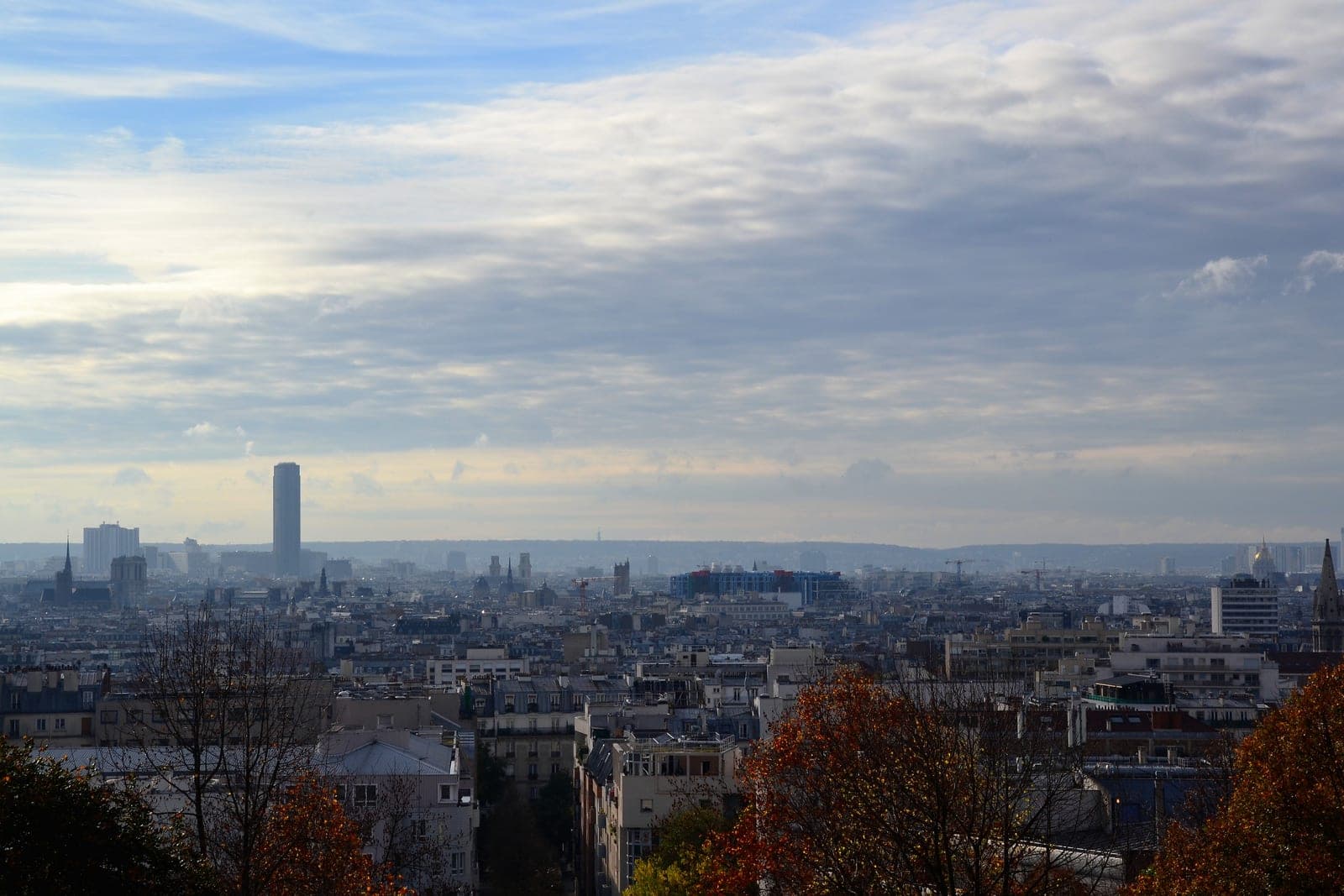
The second thing is the hill, and it is not a figure of speech. You arrive at the bottom, on the boulevard, at a crossroads of four arrondissements with the métro running underneath and the market traffic on top of it. From there every street goes up. Rue Julien-Lacroix, rue Ramponeau, rue de la Mare and rue des Cascades all climb, some of them by steps, and by the time you reach rue des Envierges at the top of the park you are looking back over the whole city. That climb is the single fact that shapes daily life here: the shopping is at the bottom and a good many of the flats are at the top.
The third is the building stock, and it is the least Parisian thing about the district. This is not a haussmannien quarter and it never was. What survives from the village is low, plain faubourg building, four or five storeys, one staircase, small courtyards, workshops behind. Around and between it stand large blocks put up in the 1960s and 1970s, when much of the old fabric was cleared. The practical consequence is that two flats a hundred metres apart can be completely different propositions: a walk-up with no lift, a shared courtyard and single glazing on the street, or a lift, a balcony and a concrete slab that holds the heat. Ask which, on every viewing.
And ask about the top floor. A converted attic under a zinc roof, which is a common and often charming thing to be shown here, is a different flat in August than it is in April. Very little of this housing has air conditioning, and the flats at the top of the hill catch the afternoon sun with nothing standing in front of them.
Who lives here, and what the streets look like
Belleville is the poorest district in this set by a wide margin, and there is no honest way to write about it without saying so first. The median of the district's IRIS medians, the small statistical areas Belleville is made of, is 22,235 EUR a year of disposable income per consumption unit on the Filosofi 2021 figures, and the published median for the whole 20e beside it is 23,570. Saint-Germain-des-Prés, fifteen minutes away on the métro, is 39,150. That gap is the most useful number on this page, and it explains more about how these streets look and work than any of the others.
What it means in practice is smaller flats, more people in them, more social housing, older wiring and windows, and shops that price for a customer counting. It does not mean neglect. The district has an unusual density of people who have been here a very long time, families who came from Tunisia, Algeria and Morocco in the post-war decades and from Wenzhou in eastern China more recently, and the shops along the boulevard and up rue de Belleville are theirs. There is also a long-established population of artists and small workshops, which is what gave rue Denoyez its permanently repainted walls: a short street of tolerated graffiti that changes week by week and has been in the guidebooks for years.
The streets to know are the boulevard de Belleville at the bottom, rue de Belleville along the top, and between them rue Ramponeau, rue Julien-Lacroix, rue Denoyez, rue de la Mare, rue des Cascades, rue Piat and rue des Envierges. The last four are the quiet ones and the reason people fall for the district: narrow, sloping, half village, with the city appearing between the buildings.
At 2am on a Saturday, the difference between the bottom and the top is stark. The boulevard and the first hundred metres of rue de Belleville are still awake, with bars, late food and traffic. The upper lanes are silent. If you are viewing a flat, view it once at that hour and once on a Tuesday morning when the market is being built, because those are the two extremes of what living here sounds like.
Getting around
This is the weakest thing about Belleville and the honest reason its getting-around score is the lowest of these seven Paris districts.
Two métro stations stand inside the boundary, Pyrénées and Jourdain, both on line 11, which runs along rue de Belleville at the top of the hill. That is the whole of the rail service inside the district. On the western edge, on the boulevard, line 2 calls at Belleville and Couronnes, and Belleville is where lines 2 and 11 cross. There is no RER station and no tram.
So the geography of your commute depends entirely on where in the district you land. Near the top, line 11 is a doorstep service. Halfway up, you are choosing between a walk down to the boulevard and a walk up to rue de Belleville, and one of those is uphill on the way home. Buses run the boulevard and rue des Pyrénées and fill in the cross-town gaps, and the district is well supplied with bike-share stands, though a bicycle here means the hill both ways.
Typical weekday minutes from Place Fréhel, boulevard de Belleville, with the icon showing how. Times are measured door to door for a typical weekday morning from the bottom of the district at place Fréhel; the icon shows the fastest sensible way., 2026-08.
Daily life
Food shopping is what Belleville is genuinely, unambiguously good at, and it is a large part of why people stay.
The anchor is the marché de Belleville, on the central reservation of the boulevard, Tuesday and Friday mornings. It is one of the biggest open-air markets in Paris and among the cheapest, mostly fruit and vegetables with North African bakery, spice and olive stalls through it. Up at the other end of the district, the marché Pyrénées runs on rue des Pyrénées between rue de l'Ermitage and rue de Ménilmontant, on Thursday and Sunday mornings, and is the smaller, calmer one.
For the rest, the chains are all small central formats. Franprix has several branches including one on rue de Belleville, there are Carrefour City stores including one on rue Étienne Dolet and a Carrefour Express on rue des Pyrénées, an Intermarché on rue Olivier Métra, and a G20. Naturalia and a Biocoop on rue de Belleville cover organic. But the chains are not the story: the density of independent food shops here is the highest of any district in this set, and that means Chinese supermarkets and traiteurs along the boulevard and rue de Belleville, halal butchers, bakeries, and small alimentations générales that are open when everything else is shut.
For delivery, Uber Eats and Deliveroo both serve this district, and between them they cover most of what is worth ordering from.
Local Places Worth Knowing
Independent and close by, chosen on merit. Nobody pays to appear here.
The hill terraced up from rue des Couronnes, with a cascade, a patch of vineyard and playgrounds. The belvedere at the top is why people come: the whole city laid out west.
View on Google MapsThe big open-air market on the boulevard's central reservation, Tuesday and Friday mornings. Produce at prices that are not central Paris, plus North African bakers and spice traders.
A former cabaret on rue de Belleville, now a plain bar with a zinc counter and a terrace spilling onto rue Denoyez. Cheap, packed till late, and about as mixed as Paris gets.
Raquel Carena's bistrot a vins below the park: cracked tiles, a daily blackboard and a natural wine list other chefs cross Paris for. Small, and booking is genuinely necessary.
Checked August 2026. Places close and change, so tell us if something here is out of date.
Schools and families
Belleville scores 87 on schools, which puts it fourth of these seven Paris districts, and the number deserves an explanation because it is not a pass rate.
It is the taux d'accès de la seconde au bac: of the pupils who start seconde at a lycée standing in this district, the share who reach the baccalauréat there. That is a deliberately harder question than a pass rate, because a school cannot flatter it by moving weaker pupils out before the exam. It is pooled over pupils rather than averaged over schools, so a small lycée cannot outweigh a large one.
Two lycées stand inside the boundary, 260 pupils in seconde between them. Sainte-Louise, on rue des Envierges beside the park, is private under contract and reaches 91. Étienne Dolet, on rue d'Eupatoria, is a public lycée professionnel and reaches 79. Taken as tracks, the général et technologique route here is 91 and the professionnel route 79, and that spread is normal across Paris, where vocational access rates run well below the academic ones. Étienne Dolet is worth a separate word: its value added, which measures a school against what its intake predicts rather than against other schools, is +19, the strongest in the whole Paris set. That is a different question from the headline and a better one if you are asking what a school does for the children who go there.
One caveat that applies to every Paris district: a lycée recruits well beyond its own streets, so this measures the schools that stand here, not the children who live here. Below lycée age, the district is dense with maternelles and écoles, and the carte scolaire is what actually decides where a child goes, so the address matters more than the district does. It is worth asking the mairie du 20e which school a specific address feeds before you sign a lease or purchase, and worth reading the rest of our Paris guides alongside it, because in Paris the school question and the price question are usually the same question wearing different clothes. Knowing what a flat is actually worth before you commit is the entire reason Apraiz exists.
Kids Friendly. Better for children than the price suggests, which is the reverse of most central Paris. Playgrounds are unusually well spread through a district of well under a square kilometre, the Parc de Belleville has slides and a climbing area as well as the view, the food shopping is close and cheap, and both lycées are inside the boundary rather than a bus ride away. What to weigh against that: the flats are small and often walk-up, the boulevard is a genuinely busy road to cross with a pushchair, and the hill means the last stretch home is uphill with the shopping and the child.
Pet Friendly. An easy district for a dog by central Paris standards. The Parc de Belleville is at the top of the hill with real slopes and grass, the Petite Ceinture strip and a string of small gardens fill in below it, and the streets away from the boulevard are quiet enough that a dog on a lead is unremarkable. Two honest caveats. The gradient is constant, so an old or short-legged dog will feel the climb home, and the pavements on the busy stretches are narrow, worn and often crowded with market or shop traffic. Flats are small and many have no lift, which argues for a small or medium dog rather than a large one.
Green space, leisure and eating out
The Parc de Belleville is the district's best asset and it is not close. It climbs the hill in terraces from rue des Couronnes to rue Piat, with a cascade running the length of the slope, a surviving patch of vineyard, an open-air theatre, playgrounds and, at the top, the Willy Ronis belvedere, the highest park view in Paris. On a clear evening you can pick out the Eiffel Tower, the Panthéon and Montparnasse from a bench. It is not a formal garden and it is not quiet; it is where the district goes.
Around it sits a scatter of small gardens, the jardin des Couronnes, the jardin des Petites Rigoles, the square by the church of Notre-Dame-de-la-Croix, and a stretch of the Petite Ceinture du 20e, the old railway line turned into a walking strip. None of them is large. Together they do a lot of work in a district of well under a square kilometre.
Eating out has two distinct halves. Along the boulevard and the lower part of rue de Belleville it is Chinese and North African, dense, cheap and open late: Wenzhou restaurants and traiteurs, couscous, grilled meat, pastry. Up the hill, around rue des Envierges, rue de la Mare and rue Jouye-Rouve, it is small wine bars and bistrots, some of them known well beyond the 20e. The two halves are three minutes apart and hardly overlap, which is a fair description of the district generally.
What it costs
Start with the price actually paid, because in France it is recorded: 8 545 EUR / m² ≈ $920 / sq ft is the median of 394 apartment sales inside this district's own boundary in 2025. That is the lowest of these seven Paris districts. Two things sit behind it. Most Paris sales include a cellar or a parking space in the recorded price, and the same median over flats sold with nothing attached is 8,409, only 1.6% below, so the headline is not being inflated by garages. And the 2024 figure on the same method was 8,353, so this is a market that moved up slightly while the most expensive district in the set moved down.
On rent, there are two numbers and they measure different things. What tenants actually pay is 26 EUR / m² / mo a month, a median excluding charges, with the middle half of the market between 23.0 and 29.9. That figure is computed for Paris-zone 11, one of fourteen zones the city is divided into for this purpose, and served to every quartier inside it, so it is a zone figure rather than a Belleville one: Canal Saint-Martin sits in the same zone and carries the same number. What landlords advertise is 28.6, and before you read the gap as a scandal, note that the advertised figure includes charges and cannot be separated from them, while the paid figure excludes them. As asking-versus-paying gaps go, this is the narrowest of the seven.
There is also a legal ceiling, and it is worth knowing precisely because it is precise. In secteur 11, an unfurnished two-room flat in a pre-1946 building may not be let above 32.8 EUR/m² a month; a one-room flat of the same era is capped at 37.8, and a three-room at 31.0. Those are three of 448 published values, because the ceiling moves with the secteur, the room count, the building era and whether the flat is furnished. A listing above the ceiling for its own category is unlawful, which is the useful part. The scheme is time-limited: the arrêté in force runs to 24 November 2026, so check the one in force on the day you sign.
Now the relationship that matters more than any of these on their own. A square metre here costs 8,545 EUR. The median of this district's IRIS medians is 22,235 EUR of disposable income per consumption unit in a year. One square metre of the cheapest district in central Paris costs more than a third of a year's income for the middle of the people who live in it. Belleville is cheap only in the sense that the alternatives are Saint-Germain-des-Prés at 14,211 and Le Marais at 12,284. On any European scale this is still an expensive place to buy a home, which is why its cost level here reads 80 rather than something comfortable.
Weather and climate
Seasonal averages for Paris, one representative month per season. Météo-France 1991-2020 normals for station Paris-Montsouris, the reference station in the 14e that every Paris climate table means, via Infoclimat. Seasons are the representative months: January, April, July and October. Sunshine hours a day are the monthly totals divided by the days in the month (January 59.0 h, April 177.3 h, July 222.4 h, October 118.6 h). Annual figures: mean daily maximum 16.5 °C, mean daily minimum 9.2 °C, 634.3 mm of rain and 1,717.1 hours of sunshine. Rain days are left null because the monthly count of days at or above 1 mm is not published in the accessible normals table; the annual figure quoted for Paris elsewhere is about 111 days, which is regular light rain rather than heavy rain, and the 634.3 mm annual total is low for northern Europe and lower than most people expect. The thing that shapes daily life is the winter dark rather than the cold: 59 hours of sunshine in the whole of January, under two hours a day, and a January mean minimum of 3.2 °C so hard frost is occasional rather than routine. Summer is warm rather than hot in the normals, 25.7 °C by day in July, but Paris is a dense stone city with a real heat island and little air conditioning in older flats, so a heatwave is felt indoors for longer than the daily maximum suggests.
The honest downsides
This district is much poorer than the ones it is usually compared with, and the housing is where you will feel it. The income gap against Saint-Germain-des-Prés, 22,235 against 39,150, is not an abstraction: it shows up as smaller flats, more of them in large 1960s and 1970s blocks, more walk-ups with no lift, more single glazing on a busy boulevard, and buildings whose service charges have been kept down for years by not doing the work. Two flats on the same street can be twenty years apart in condition. Read the procès-verbaux of the last few assemblées générales of the copropriété before you commit to anything here, because the deferred maintenance is the real price and it does not appear in the listing.
You are buying a hill with two métro stations on it. Line 11 runs along the top and line 2 along the bottom edge, and that is the whole of it: no RER, no tram, and the lowest getting-around score of the seven districts here. Whether that is fine or a daily irritation depends on which end of the slope your flat is, and the answer changes when you are carrying shopping, pushing a pram or coming home at midnight. Walk the actual route from the flat to the station you would really use, uphill, before you decide the map looks close enough.
Crime and safety
Every crime figure on this page is an arrondissement figure, the whole 20e, because that is the finest grain France publishes. It covers Belleville along with Saint-Fargeau, Père-Lachaise and Charonne, and none of it was computed for these streets.
With that said, the shape is clear and it is favourable. Theft from the person runs at 201.8 per 10,000 residents, against 451.2 for Paris and 91.0 for France. Nowhere else in this Paris set comes close to that. Unarmed robbery is 19.2 against a city figure of 34.5. Non-domestic assault is 42.6 against 52.7. Home burglary is 4.3 per 1,000 dwellings, note the different base, against 5.1 in Paris and 5.6 nationally, so it is below the national rate.
The reason the street-theft figure is so much lower than central Paris deserves saying out loud, because it is arithmetic as much as it is safety. The rate divides offences by the people who sleep in the arrondissement. The 20e is overwhelmingly a residential one, with no mainline station and nothing that pulls in the city's daily throughput the way the centre does. Arrondissements that hold those things divide a whole city's traffic by a small resident base, which is why the 10e, with two mainline stations inside it, reads 917.1 on the same indicator. Belleville is genuinely less exposed to street theft than the tourist districts, but not by the full width of that gap.
One indicator goes the other way and should not be buried. Domestic violence is recorded at 38.7 per 10,000 residents in the 20e, against 29.8 for Paris and 37.6 for France: above the city, above the country, and the highest of the seven districts here. Recorded violence inside the family also reflects how willing people are to report it and how well local services pick it up, so the figure is not purely a measure of how much of it happens. It is still the one number on this page where this arrondissement is worse than both its city and its country, and anyone reading a page like this deserves to see it rather than a summary that averages it away.
There is no total to quote, and France publishes none. The indicators above are counted in three different ways, some as offences and some as victims, and burglary is rated per dwelling rather than per resident, so adding them would be adding different things together. The city page carries the full rates.
Is this you?
If you want to live in central Paris, eat and shop well on an ordinary budget, and you would rather have a view and a hill than a lift and a flat street, Belleville is the best value in this set and it is not close. It suits people who are out in the neighborhood rather than passing through it, who will use the market twice a week, and who understand that the lower price buys less building rather than more.
If the climb and the two métro lines are the problem, Canal Saint-Martin is the obvious swap: flat, four métro stations, both northern mainline stations a short walk away, and it sits in the same rent zone, so what tenants pay per square metre is the same 26.3. You would pay 9,583 per square metre to buy instead of 8,545, and you would take on by far the worst street-theft figure of these seven districts, 917.1 per 10,000 residents against 201.8 here. If instead what you want is the village-on-a-hill feeling with more to do at street level, that is Montmartre, at 9,222 per square metre and with far more métro on its doorstep, in exchange for the heaviest tourist traffic in Paris outside your front door.
Want to know what homes here are actually worth?
Join the waitlistHow we source this
How we put this together. Gathered on the ground by our local field team and written up by the Apraiz research team. Every figure above carries its own source and date. The scores are not computed by the build; walking and transport will use open map and transit data first, then Apraiz's own model. We update prices quarterly, transport and amenities twice a year, and school data when the source publishes.
Sources: DVF (Demandes de valeurs foncières), data.gouv.fr, Observatoires des loyers (OLAP), DRIHL Île-de-France, arrêté IDF-2026-06-12-00003, SSMSI, via data.gouv.fr, Ministère de l'Éducation nationale, INSEE, Wikipédia (fr).
Safety and crime in Paris →Nearby: Le Marais · Saint-Germain-des-Prés · Montmartre