
Long Story ShortReadHide
- What it is: three published quartiers of the 5e, Sorbonne, Saint-Victor and Val-de-Grâce, climbing the Montagne Sainte-Geneviève from the Seine to the Val-de-Grâce, with the Panthéon at the top and the university spread all the way down.
- Who it suits: people who want to walk to everything, who like living among institutions rather than offices, and who can carry a central Paris price for a flat that is probably older and smaller than they expect.
- What it costs: 12 081 EUR / m² to buy, on the price actually paid in 551 recorded sales, and a median of 30 EUR / m² a month to rent across its rent zone, before charges.
- What people complain about: the hill, the coach parties on the Seine side, and sixth-floor flats with no lift in a July heatwave.
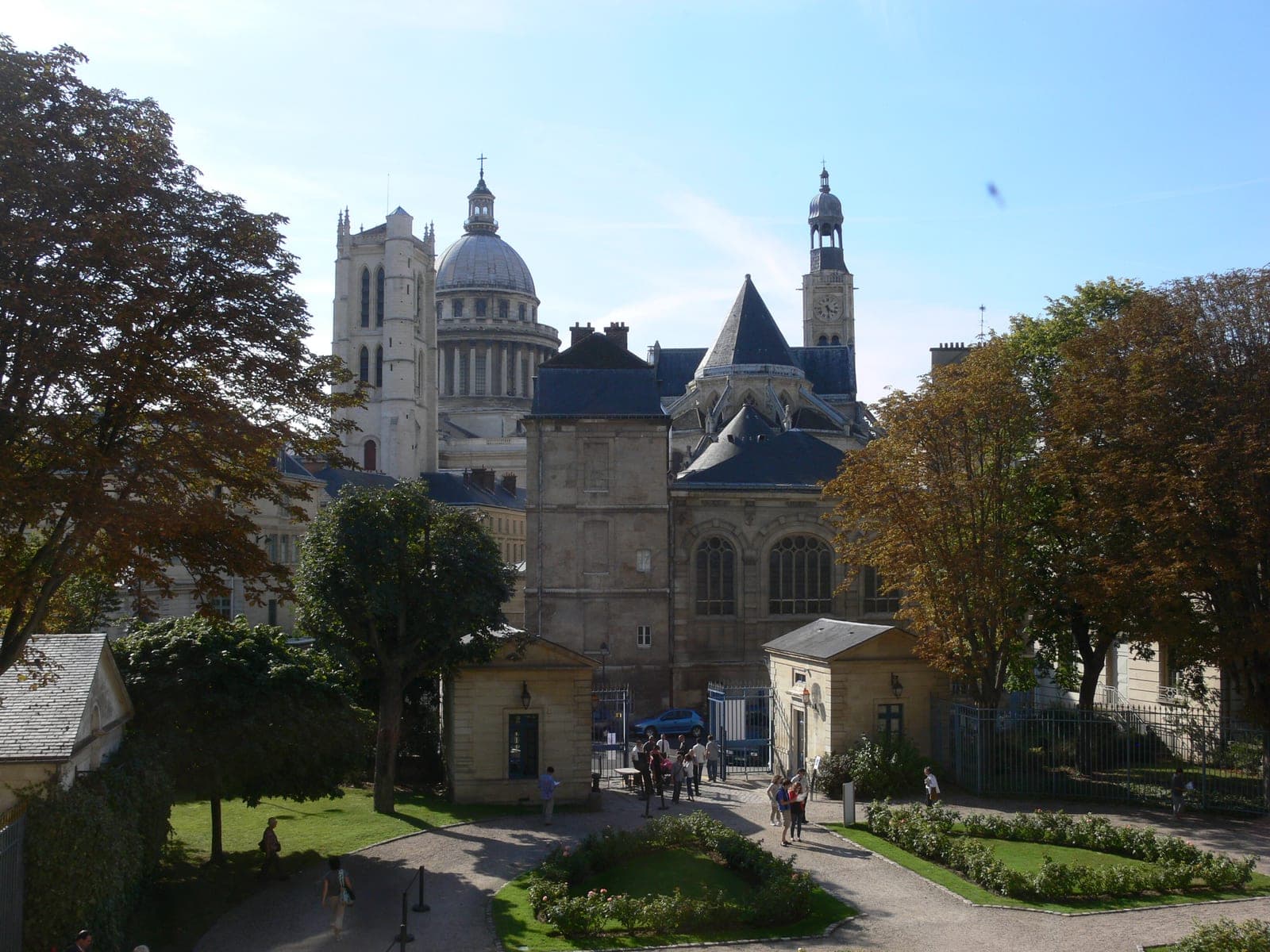
First impressions
The Latin Quarter is not an administrative unit and never has been. Paris publishes 80 quartiers administratifs and none of them is called the Quartier latin, so this article uses the three that everybody means: Sorbonne, Saint-Victor and Val-de-Grâce, all in the 5e arrondissement. That is the boundary behind every figure on this page, which matters more than it sounds: it puts the Panthéon, the Sorbonne, place Maubert and the top of rue Mouffetard inside, and it leaves the Jardin des Plantes just outside on the eastern edge and the Jardin du Luxembourg just outside on the western one.
The first surprise is the gradient. In photographs the district is a flat run of bookshops along the river. On foot it is a hill: the Montagne Sainte-Geneviève rises from the quays at Maubert up rue de la Montagne Sainte-Geneviève and rue Descartes to the Panthéon, and keeps going south to rue d'Ulm and the Val-de-Grâce. It is short, it is steep, and it is the difference between a five-minute walk home and a ten-minute one with shopping.
The second is how much of the ground floor belongs to an institution. The Sorbonne, the Collège de France, the École normale supérieure on rue d'Ulm, the Jussieu campus, the Institut du Monde Arabe on the river, two of the best-known lycées in France and the old Val-de-Grâce all sit inside these three quartiers. That gives the district its unusual thickness of libraries and small repertory cinemas, and it also gives it a calendar: the streets thin out noticeably in July and August, and the good small shops close for three weeks with them.
The third is that there are two districts here, about six hundred metres apart. The Seine side, around place Saint-Michel, rue de la Huchette and rue Saint-Séverin, is one of the most heavily visited few hectares in Europe. The top of the hill and the Val-de-Grâce streets behind it, rue Gay-Lussac, rue Saint-Jacques, rue des Feuillantines, rue de l'Abbé de l'Épée, are quiet, residential and largely left alone. View a flat in both and you would not think you were in the same arrondissement.
Who lives here, and what the streets look like
A typical figure across the district's small statistical areas is 37,090 EUR a year of disposable income per consumption unit, which is the median of its 17 IRIS medians in Filosofi 2021. The published median for the whole 5e arrondissement, the number a reader can look up, is 35,960. Both describe a comfortable, professional arrondissement rather than a spectacular one: this is teaching staff, medicine, law, publishing and the civil service, plus owners who bought decades ago and are not selling.
Then there is the other half of the population, which no income table sees properly. Students, doctoral researchers and visiting academics fill the district in term time, in institutional rooms, in chambres de bonne on the sixth floor and in flat shares, and they leave in June. If you buy here you are buying into a building where several flats turn over every autumn.
The stock splits by street. The boulevards, Saint-Germain, Saint-Michel and Port-Royal, are Haussmann-era: stone, high ceilings, a courtyard, a lift added later in the stairwell or nowhere at all. The hill above them is older and narrower, seventeenth and eighteenth century in places, with staircases that were built before lifts existed and cannot easily take one now, small rooms, exposed beams and floors that slope. Around Jussieu there is 1960s and 1970s infill, including the campus itself, and that is where you find the flats that come with a lift, a balcony and an unromantic amount of light.
Two practical questions to ask on every viewing, in this order. Which floor, and is there a lift. And what is above you: a top-floor flat under zinc, facing south, with no air conditioning, is a genuinely difficult place to sleep in a Paris heatwave, and this is a district where fitting an external unit on a protected façade is not a formality.
Getting around
Line 10 runs along boulevard Saint-Germain through Cluny-La Sorbonne, Maubert-Mutualité, Cardinal Lemoine and Jussieu, which means the low, flat edge of the district is well served and the top of the hill is a climb from all of them. Line 7 crosses at Jussieu and runs north to the Right Bank and south past the district's eastern edge. On the RER, Saint-Michel-Notre-Dame sits on the river with two lines through it, and Port-Royal sits on the southern boundary by the Val-de-Grâce, with Luxembourg a few steps over the western boundary. The RER is the reason airport journeys from here are simple: one train, no change.
Buses matter more than they usually do in Paris, precisely because of the hill. The 38 runs the length of boulevard Saint-Michel to the Gare du Nord and is the standard way of avoiding the walk up from the river with anything heavy.
Cycling is a mixed proposition. The riverside quays and the boulevards are properly laned and Vélib' stands are frequent, but the climb from Maubert to the Panthéon defeats a lot of people on a shopping bike, and an electric one changes the district completely.
The thing worth saying plainly: this is a district you mostly walk. Notre-Dame, the Île Saint-Louis, the Jardin du Luxembourg, the Jardin des Plantes and the Right Bank at Châtelet are all inside a normal walk of the Panthéon. Nobody who lives here well owns a car, and street parking is both scarce and paid.
Typical weekday minutes from Place du Panthéon, with the icon showing how. Measured door to door for a typical weekday morning from the place du Panthéon, at the top of the Montagne Sainte-Geneviève; the icon shows the fastest sensible way., 2026-08.
Daily life
The supermarkets are small central formats, a G20 on rue de la Harpe, a U Express, an Intermarché, a couple of Naturalia and Biocoop shops for organic, and that is the shape of the district: nothing here is a trolley shop. A big weekly stock-up means leaving the boundary or having it delivered.
What replaces it is the market and the food street, which in Paris matter more than the supermarket does. Marché Maubert fills the place Maubert on Tuesday and Thursday mornings and again on Saturday, and marché Port-Royal does the same on the boulevard de Port-Royal by the Val-de-Grâce on the same three days, running a little later into the afternoon. Between them sits rue Mouffetard, which begins at the place de la Contrescarpe and runs downhill as a permanent street of food shops rather than a market: bakers, a cheesemonger, a butcher, a fishmonger, greengrocers stacked out onto the pavement. Like most Paris food streets it goes quiet on a Monday.
For everything else, the density is unusually good. Pharmacies are on almost every significant corner, bakeries are frequent enough that you will end up with a favourite and a spare, and the small trades that have been priced out of some other central districts are still trading here. For delivery, Uber Eats and Deliveroo both cover the district.
One note on August. This is a university quarter, and it behaves like one: a run of the best small shops and restaurants shut for two or three weeks, and the ones that stay open are the ones on the tourist streets. Plan the first summer accordingly.
Local Places Worth Knowing
Independent and close by, chosen on merit. Nobody pays to appear here.
The proper food market filling place Maubert three mornings a week, Tuesday, Thursday and Saturday. Fish, cheese, vegetables and roast chickens, on a square that is otherwise traffic.
A zinc-counter cafe on rue Mouffetard trading since before the First World War, tiled floor and mirrored bar intact. Market traders rather than a queue for photographs.
A bistro on rue Saint-Jacques between the Pantheon and the Luxembourg, red checked cloths and the standards done straight. Priced so Sorbonne staff could keep coming.
View on Google MapsThe cheese shop by place Maubert, with ageing cellars beneath and a counter where somebody asks what you are eating it with before cutting. Expensive, and worth it.
Checked August 2026. Places close and change, so tell us if something here is out of date.
Schools and families
The number in the schools bar is 92, and it is worth understanding what it measures, because it is not a pass rate. It is the taux d'accès brut de la seconde au bac: of the pupils who start seconde at a lycée here, the share who reach the baccalauréat at that same school. A raw pass rate can be flattered by moving weak pupils on before the exam. This one cannot, because those pupils are still in the denominator.
It is pooled over pupils rather than averaged over schools, so a small lycée cannot outweigh a large one. Behind it are 966 pupils in seconde across five lycées, and they are worth naming: Lycée Louis-le-Grand at 98 with 253 pupils in seconde, Lycée Henri-IV at 95 with 250, Lycée Lavoisier at 93 with 222, Sévigné at 95 with 127, private under contract, and Jacques Monod, a lycée professionnel, at 68 with 114. Both routes are in the headline figure: the général et technologique track alone is 95 and the professionnel track alone is 68, and knowing which schools sit behind the number tells you more than the number does.
One caveat that applies to the whole city. A Paris lycée, and Louis-le-Grand and Henri-IV above all, recruits far beyond its own streets, so this measures the schools that stand here, not the children who live here. Living at the foot of the hill does not admit anyone to either of them.
We build these Paris guides so that the number and the thing it actually measures arrive together, because that gap is where most housing decisions go wrong. Walk the streets around the school on an ordinary Tuesday at 08:15 and again at 17:30, and read the arrêté that sets the rent ceiling for the exact category of flat you are looking at, before you sign a lease or purchase.
Kids Friendly. Better than a dense central district usually manages, mostly because of what is on the edges and what is in the classrooms. Five lycées stand inside the boundary, including Louis-le-Grand and Henri-IV, and the pooled access rate to the baccalauréat is 92. The Jardin du Luxembourg on the west side and the Jardin des Plantes on the east are two of the best places in Paris to spend a Saturday with children, and the Arènes de Lutèce is an open, car-free space in the middle. Against that: playgrounds inside the district are thin, the older buildings on the hill are walk-ups with small rooms, pavements are narrow enough that a pram spends time in the road, and a family-sized flat here costs what the price panel says it costs.
Pet Restricted. Paris is easy about dogs in cafés and reasonably easy about them on the metro in a carrier, and the Latin Quarter has quiet residential streets on the Val-de-Grâce side that walk well early. The problem is where you go next. The two big gardens on the district's edges, the Jardin du Luxembourg to the west and the Jardin des Plantes to the east, do not admit dogs, and the green space inside the boundary is mostly small squares rather than anywhere a dog can properly run. Add the climb, the narrow pavements on the hill and the tourist crowds on the Seine side, and this is a district for a small dog and a routine, not for a big one.
Green space, leisure and eating out
Green space here is a story about edges. Inside the boundary there is a lot of green in small pieces: squares, institutional gardens, planted courtyards, the open bowl of the Arènes de Lutèce off rue Monge. What there is not, inside the boundary, is a big park. The two great gardens sit just outside it, one on each side: the Jardin du Luxembourg over the western line and the Jardin des Plantes over the eastern one, both within an easy walk of most of the district, and both gated and shut at dusk.
Leisure is where the district is genuinely exceptional. The Panthéon, the musée de Cluny with its Roman baths, the Institut du Monde Arabe and the Grande Mosquée are all within the boundary or on its edge. So is a remarkable run of small repertory cinemas, Le Champo on rue des Écoles, the Reflet Médicis on rue Champollion, Le Grand Action, screens that show a Fritz Lang season on a Wednesday afternoon. Add the bookshops, the libraries and lectures that are often open to anyone who walks in, and there is a version of a life here that costs almost nothing beyond the rent.
Eating out has three registers and they are close together. The tourist strip around rue de la Huchette and rue Saint-Séverin is exactly what it looks like, and residents largely do not eat there. Rue Mouffetard and the place de la Contrescarpe are the student register: cheap, cheerful, loud, and loud late on a Thursday and a Saturday. The third register, the good one, is scattered along rue Saint-Jacques, around the Panthéon and on the small streets off rue des Écoles, and it is where the district actually eats.
If you are viewing a flat, view it at 23:00 on a Saturday as well as at 11:00 on a Sunday. Between the Contrescarpe and rue Saint-Jacques, two hundred metres apart, those are two different propositions.
What it costs
The number to start from is what people actually paid: 12 081 EUR / m², the median of 551 recorded apartment sales inside these three quartiers in 2025, from the state's own register of transfers rather than from asking prices. Two things it hides. Nearly two thirds of Paris apartment sales include a cellar or a parking space and the recorded price covers those too: the same median over flats sold with nothing attached is 11,643 EUR/m², 3.8% lower. And the market moved: 2024 on the same method was 12,000, and Le Marais overtook the Latin Quarter in 2025, at 12,284, having been below it the year before.
Put that against the income. At 12,081 EUR/m², a 45 m² one-bedroom is roughly 544,000 EUR, which is about fifteen times the 37,090 EUR a year that a typical one of this district's small statistical areas records as median disposable income per consumption unit. That is the honest shape of central Paris: the people who make this district work are overwhelmingly the ones who already own here, or who inherited, or who rent.
On renting there are three different numbers and they are not interchangeable.
What tenants actually pay is a median of 30 EUR / m² a month excluding charges, with quartiles of 26.7 and 34.3 on 2,354 observations. It is computed for Paris-zone 4, one of the observatory's fourteen zones, and served to every quartier inside it, so read it as the level across that zone rather than a measurement of these streets. On a 45 m² flat that is about 1,360 EUR a month before charges.
What landlords ask is 34.6 EUR/m² for the whole 5e, modelled from listings, and charges are included in it and cannot be separated out. The gap between 30.2 and 34.6 is therefore partly asking-versus-agreed and partly the charges themselves. It is not evidence of anything scandalous.
What the law allows is set per category, and quoting it any other way is meaningless. This district is in secteur 4, and an unfurnished two-room flat in a pre-1946 building is capped at 37.3 EUR/m² a month. The same flat built between 1946 and 1970 is capped at 33.8, between 1971 and 1990 at 30.5, and from 1990 at 30.8; a one-room pre-1946 flat is capped at 42.2. Furnished ceilings run roughly 14% higher. A listing above the ceiling for its own category is unlawful, which is the useful part: check the category before you assume a price is legal. The scheme is time-limited and the arrêté in force runs to 24 November 2026, so check the one in force on the day you sign.
Weather and climate
Seasonal averages for Paris, one representative month per season. Météo-France 1991-2020 normals for station Paris-Montsouris, the reference station in the 14e that every Paris climate table means, via Infoclimat. Seasons are the representative months: January, April, July and October. Sunshine hours a day are the monthly totals divided by the days in the month (January 59.0 h, April 177.3 h, July 222.4 h, October 118.6 h). Annual figures: mean daily maximum 16.5 °C, mean daily minimum 9.2 °C, 634.3 mm of rain and 1,717.1 hours of sunshine. Rain days are left null because the monthly count of days at or above 1 mm is not published in the accessible normals table; the annual figure quoted for Paris elsewhere is about 111 days, which is regular light rain rather than heavy rain, and the 634.3 mm annual total is low for northern Europe and lower than most people expect. The thing that shapes daily life is the winter dark rather than the cold: 59 hours of sunshine in the whole of January, under two hours a day, and a January mean minimum of 3.2 °C so hard frost is occasional rather than routine. Summer is warm rather than hot in the normals, 25.7 °C by day in July, but Paris is a dense stone city with a real heat island and little air conditioning in older flats, so a heatwave is felt indoors for longer than the daily maximum suggests.
The honest downsides
The hill is not a detail, it is the district. Everything cheap, everything convenient and every metro station on line 10 is at the bottom, and the quiet residential streets are at the top. That is fine at 30 with a rucksack and a real question at 70, with a pram, with a bicycle, or with four bags of shopping in August. Combine it with the building stock and the problem compounds: a large share of the older housing here was built before lifts, cannot easily be retrofitted with one, and puts the cheapest flats on the sixth floor under a zinc roof, which is the hottest room in Paris in a heatwave and has no air conditioning to fit on a protected façade.
You will be living inside somebody else's day out. The river frontage of this district is one of the most visited places in Europe, and the effects run inland: coach parties, queues, souvenir retail replacing useful shops on the streets nearest the Seine, and the street-theft figure below, which is the single worst number on this page. Add the student nightlife around the Contrescarpe on a Thursday and a Saturday, and the August shutdown when the institutions close and half the good addresses put up a handwritten sign. None of this is a reason not to live here. All of it is a reason to choose your street carefully rather than your arrondissement.
Crime and safety
Every crime figure here is an arrondissement figure, because the arrondissement is the finest grain France publishes. It covers the whole 5e, which is these three quartiers plus Jardin-des-Plantes to the east, and it was not computed for the streets this article describes.
Theft from the person runs at 484.9 per 10,000 residents, against 451.2 for Paris as a whole and 91.0 for France. That is more than five times the national rate, and it is the number that matters here in practice: bags and phones on boulevard Saint-Michel, at the Saint-Michel-Notre-Dame interchange, on the quays and in any crowd on the Seine side. Read the denominator with it. The rate divides by the people who sleep in the 5e, and this is an arrondissement of lecture halls, museums and a heavily visited river frontage whose daytime population is far larger than its resident one.
The other indicators point the other way, and they are the ones that describe living here rather than visiting. Unarmed robbery is 15.2, against 34.5 for Paris and 7.2 nationally, and it is the lowest of the seven Paris districts Apraiz covers. Non-domestic assault is 42.2, below the Paris figure of 52.7 and above the national 31.6. Domestic violence is 25.5, below both Paris at 29.8 and France at 37.6, and also the lowest of the seven, although recorded violence inside the home reflects how much of it is reported as well as how much of it happens.
The exception, and the one that touches a home, is burglary. Home burglary is 6.6 per 1,000 dwellings, against 5.1 for Paris and 5.6 for France, so this district sits above both. Note the different denominator: burglary is rated per 1,000 dwellings, which is the basis the ministry itself uses, and it cannot be read on the same scale as the four figures above. In practical terms it argues for taking the door and the ground-floor and courtyard-facing flats seriously, in a district with a lot of old buildings and a lot of doors that are propped open during the day.
Finally, a warning about arithmetic. There is no total to quote. France counts these indicators in three different units, an infraction for burglary and robbery, a victime for assault and domestic violence, a victime entendue for theft from the person, and publishes no total-recorded-offences figure, so adding the rows would be adding victims to offences.
Is this you?
If you want to live in a walkable central district where the ground floor is universities, bookshops, cinemas and food shops rather than offices, and you can afford it, there is nothing else in Paris quite like this. It suits an academic or a professional couple; it suits a family that values five lycées and two great gardens more than it values a lift and a balcony; and it suits anybody who would rather spend a Wednesday afternoon in a repertory cinema than in a car.
If the hill, the walk-ups and the visitor traffic are the parts you keep catching on, look at Batignolles instead: it is flat, it is calm, it has the highest quality-of-life score of the seven Paris districts Apraiz covers, and it is a genuinely residential piece of the city rather than a monument that people live in. You would give up the institutions, the cinemas and the lycées, which for a lot of people is exactly the trade that decides it.
Want to know what homes here are actually worth?
Join the waitlistHow we source this
How we put this together. Gathered on the ground by our local field team and written up by the Apraiz research team. Every figure above carries its own source and date. The scores are not computed by the build; walking and transport will use open map and transit data first, then Apraiz's own model. We update prices quarterly, transport and amenities twice a year, and school data when the source publishes.
Sources: DVF (Demandes de valeurs foncières), data.gouv.fr, Observatoires des loyers (OLAP), DRIHL Île-de-France, Ministère de l'Éducation nationale, SSMSI, via data.gouv.fr, INSEE.
Safety and crime in Paris →Nearby: Le Marais · Saint-Germain-des-Prés · Montmartre