
Long Story ShortReadHide
- What it is: the harbour basin Marseille was founded on, plus the streets around all three of its sides, which sit in three different arrondissements.
- Who it suits: somebody who wants to live in the middle of the city without a car, on the water, and can sleep through a summer evening on the quays.
- What it costs: 4 118 EUR / m² ≈ $440 / sq ft to buy; sitting tenants pay 12.9 to 13.7 EUR/m² a month excluding charges, while listings ask 14.7 in the 1er, 16.6 in the 2e and 18.4 in the 7e with charges included.
- What people complain about: parking, the noise off the terraces from June to September, and old blocks with no lift.
First impressions
Marseille publishes no boundary for "the Vieux-Port", so this article uses seven IRIS, the small statistical areas INSEE publishes for the whole country: Quai du Port, Saint-Jean-Protis and Hôtel-Dieu in the 2e, Saint-Ferréol and d'Estienne d'Orves in the 1er, and La Criée and Corderie in the 7e. That is 0.80 km² of streets wrapped around a basin roughly 800 by 300 metres, about 24 hectares of water with some 3,500 moorings in it.
Three arrondissements around one basin is not an error, it is how Marseille is arranged: the north quay in the 2e, the head of the port in the 1er, the rive neuve in the 7e. Hold on to that, because almost every number published about this place lands differently on each side of the water.
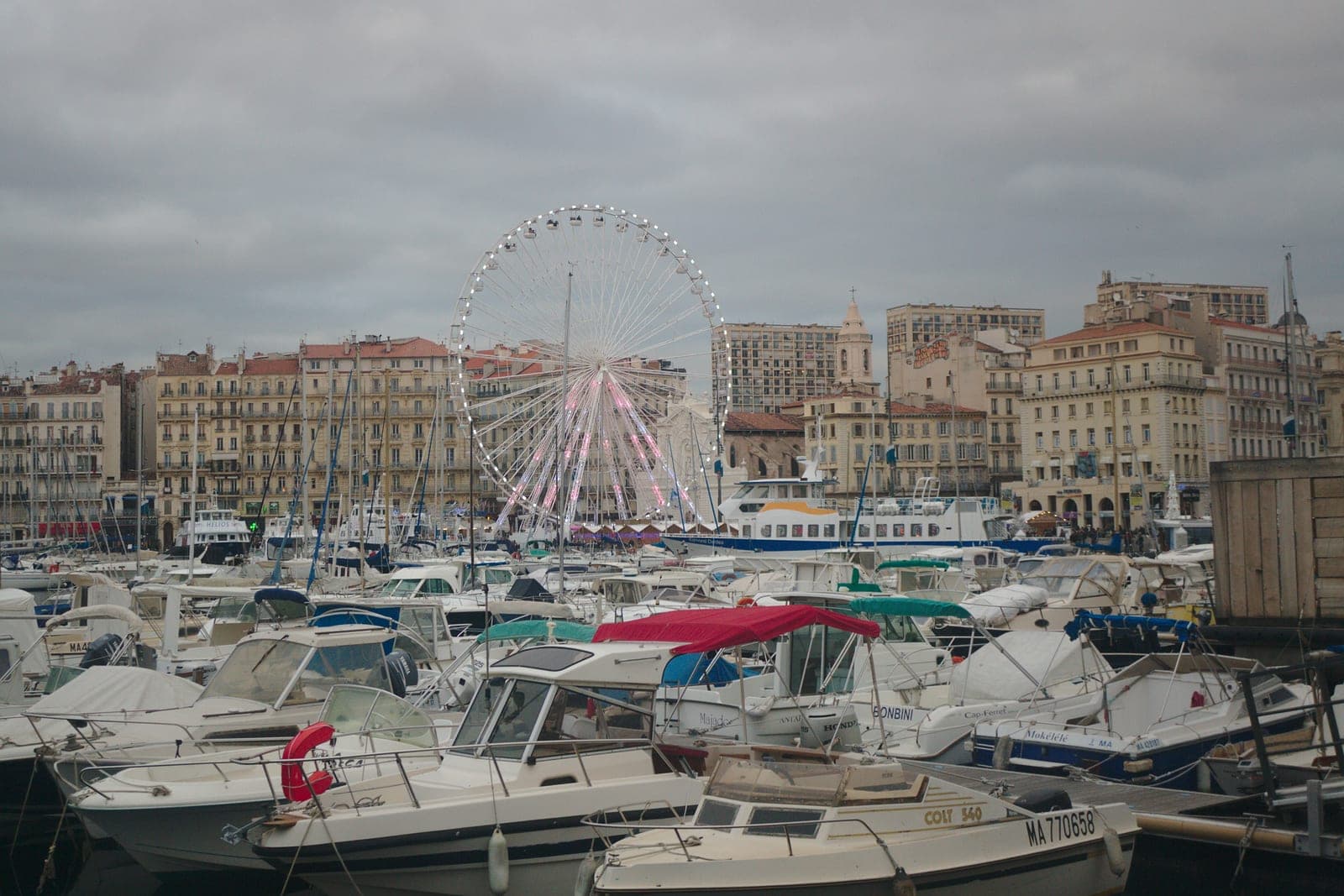
The first thing you notice is that the three sides are three different districts pretending to be one. The quai du Port, the north side, is a 1950s reconstruction: regular stone blocks with arcades along the water, straight streets behind, and Le Panier climbing the hill above it. The quai de Rive Neuve, the south side, is eighteenth and nineteenth century, with La Criée at one end, rue Sainte running behind it and the Abbaye Saint-Victor on the slope above. The head of the port is the commercial city: rue Saint-Ferréol, the cours d'Estienne d'Orves, and the Canebière running inland from the water.
The second is the water working. Small boats still land fish and sell it on the quay in the morning. The ferry boat crosses the basin between the Hôtel de Ville and the place aux Huiles. Norman Foster's Ombrière, a mirrored steel canopy on slender columns, went up at the head of the port for 2013 and the whole quay was given over to people that year. At the mouth stand Fort Saint-Jean and Fort Saint-Nicolas, both ordered by Louis XIV, with the MuCEM joined to the first of them by a footbridge.
The third is the wind. The mistral blows down from the north on average 93 days a year, cold and dry, and it funnels along a basin that points more or less the right way to catch it. It is also the reason this city gets more than 2,800 hours of sun a year. In a top-floor flat it means shutters that bang, washing that dries in an hour, and a week in February when you do not open the windows at all.
Who lives here, and what the streets look like
The income figure for this district is 20,365 EUR a year, the median of the IRIS medians inside it on INSEE's Filosofi 2021 data. Two things to hold on to. It is unweighted, so it is a typical figure across the district's small statistical areas rather than a survey of the district itself. And one of the seven IRIS is suppressed, because too few households live in it to publish safely, so it is excluded rather than counted as nothing. That places the Vieux-Port in the middle of the five Marseille districts covered here, which run from 14,770 EUR in the Joliette to 30,200 EUR in Endoume, more than double, and the sharpest income gradient anywhere in the French set.
The building stock changes when you cross the water, and the reason is the war. Between 22 and 24 January 1943 about 30,000 people were expelled from the old quarters behind the quai du Port and roughly 1,500 buildings were dynamited. Fernand Pouillon was put in charge of rebuilding from 1948. So the north side is a considered 1950s reconstruction: square rooms, decent light, arcades at street level, lifts more often than not, and a plan that makes sense. The south side and the head of the port are the older city that survived: nineteenth-century immeubles with high ceilings and tall shuttered windows, deep stone stairwells, small kitchens carved out later, and frequently no lift above the second floor.
So the questions here are specific. Which floor, and is there a lift that actually reaches it. Do the windows face the quay or an inner courtyard, because the courtyard is quieter and darker and you must pick one. What is underneath you, because a flat above a restaurant terrace on the rive neuve is a different life from the same flat three streets back. And how much of the building is short lets, which on the quay itself is a real question rather than a rude one.
The people are a mix of owners who have been here for decades and are not moving, renters in small old flats, the restaurant and bar trade that works the quays, and a layer of second homes and holiday lets above the water.
Getting around
Metro line 1 has its Vieux-Port station on the north-east corner of the basin, which is the district's own station and the reason a car is optional here. Line 2 does not come to the port; the two lines meet at Saint-Charles and at Castellane. The T2 tram runs up the Canebière through Belsunce Alcazar and Canebière Capucins, a short walk from the head of the port, with the T3 sharing the route as far as Belsunce Alcazar and then turning for Castellane. Buses converge here from most of the city, so the awkward cross-town trip usually resolves into one ride rather than two.
The ferry boat has crossed the basin since 1880, a 283 metre hop from the quai du Port in front of the Hôtel de Ville to the place aux Huiles on the rive neuve. It is a tourist ride and it is also, if you live on one side and work on the other, genuinely the sensible way to get there. The boat is electric now.
Gare de Marseille-Saint-Charles, the mainline station, is up the hill behind the head of the port, at the top of a monumental staircase that is a great deal less charming with a suitcase. The airport is out of the city at Marignane, reached by the coach that leaves from the station.
Driving is the weak point and everybody who lives here says so. The 2013 rebuild took away about half the traffic lanes and gave the head of the port to pedestrians, but both long quays still carry traffic, the streets behind them are narrow and one-way, and on-street parking is genuinely hard in the 1er and the 2e. What people actually do is rent a space in an underground car park and use the car at weekends. Remember too that the city is built on hills: anything inland from these quays is uphill, so ten minutes away often means ten minutes of climbing.
Typical weekday minutes from Quai des Belges, with the icon showing how. Times are measured door to door for a typical weekday morning from the quai des Belges; the icon shows the fastest sensible way., 2026-08.
Daily life
Everyday food is small-format and daily. The full-size supermarket at the head of the port is the Monoprix at 36 La Canebière, with a Naturalia further along the same street and a Carrefour Market on rue de Bir Hakeim in the streets just behind it. On the south side there is a Lidl and a Vival on rue Sainte in the 1er, and a Carrefour City at 87 rue Sainte as you go into the 7e, plus Spar on the boulevard de la Corderie. On the 1er side there is a Franprix on rue Henri Fiocca and Spar branches on the cours Jean Ballard and rue Francis Davso. Behind the north quay, U Express on the Grand Rue and the cooperative Super Cafoutch on rue du Chevalier Roze do the everyday shop for the 2e.
The market matters more than any of them. The fish market on the quai des Belges runs every morning from about 08:00 to 13:00, weather permitting, a dozen or so stalls selling what the small boats landed overnight, and it has been the thing this quay does for as long as the quay has existed. For everything else, walk up the Canebière to Noailles, where the marché des Capucins and the Arabic and North African grocers around it sell fruit, vegetables, spices and bread cheaper and better than any supermarket in the district, and where a great deal of Marseille actually shops.
The small trades survive here: bakers, a few fishmongers off the quay, cheese, and the cave à vins on the corner. For delivery, Uber Eats and Deliveroo both cover the port, and between them they are the practical choice in France.
Local Places Worth Knowing
Independent and close by, chosen on merit. Nobody pays to appear here.
The fish market at the head of the port, mornings until about 13:00, weather permitting. A dozen stalls of what the small boats landed overnight. A working market, not a display.
View on Google MapsThe fifth-century abbey on the slope above the south quay, founded over the tombs of the Marseille martyrs, with late Roman sarcophagi in the crypts below the church.
The oldest bakery in Marseille, on rue Sainte since 1781, its vaulted eighteenth-century oven still in use and given over to one orange-blossom biscuit, the navette.
A Provencal kitchen on the north quay run by Delphine Roux since 1995, looking across at Notre-Dame de la Garde. Bouillabaisse in two courses if you order ahead.
View on Google MapsChecked August 2026. Places close and change, so tell us if something here is out of date.
Schools and families
Green space is the thing to be straight about, because there is no big park inside this boundary and no amount of water makes up for one if you have a four-year-old. What there is instead is a scatter of small gardens: the jardin de la Colline Puget on the slope above the Corderie, the jardin des Vestiges by the Centre Bourse at the top of the 1er, and the jardins du Pharo out on the headland at the mouth of the port, which is the one to know. It is a real lawn, it has the whole basin laid out below it, and on a Sunday it is where half the families of the 7e end up. Playgrounds inside the district are small and few.
The school walk is the other honest point. On both long quays it is a walk beside moving traffic, which is fine for a ten-year-old and tiring with a pushchair. Families who make this district work tend to be on the inland streets rather than on the quay itself.
What a child does get is unusual. The boats, the ferry across the basin, the fish market at eight in the morning, and the sea itself: the plage des Catalans is a walk past the Pharo, the beaches of the Prado are a bus ride, and the calanques are a boat from the quay, or a bus and then a long walk at the other end. That is a real childhood and it is not the one a listing photograph sells.
Being straight about what a district gives a family and what it does not is why we build these Marseille guides the way we do, and it is worth doing the school run yourself, at eight on a Tuesday morning, before you sign a lease or purchase.
Kids Restricted. Workable, but you would be choosing the water over the space. The green here is a scatter of small gardens rather than a park, the playgrounds are few and small, and the school walk on either long quay is a walk beside moving traffic. What a child gets instead is a real one: the boats, the ferry across the basin, the fish market at eight in the morning, the beach at the Catalans past the Pharo, and a bus or a boat to the calanques. Families who make it work here tend to be on the quieter inland streets rather than on the quay itself, with a lift or a low floor, and without a car.
Pet Restricted. A dog lives well here in winter and badly in August. In its favour: the quays are long, flat and continuous, the walk out to the Pharo headland and on to the corniche is one of the best in the city, and Marseille is relaxed about dogs on a terrace. Against it: there is no real park inside the boundary, the ground is stone and it holds the heat, the pavements on both long quays are narrow with traffic beside them, and from June to September the terraces and the crowds make the evening walk an obstacle course. Small and medium dogs suit the flats, which on the south side are old, tall and frequently up several flights.
Green space, leisure and eating out
The public space here is the water and the quays around it, and on a warm evening the whole city treats it that way. Beyond the small gardens above, the walk that matters goes west past Fort Saint-Nicolas to the jardins du Pharo and on to the corniche, which is where people run, and the walk east takes you up the Canebière into a different city entirely.
Culture is dense and most of it is on the water. La Criée on the quai de Rive Neuve was built in 1909 as the fish auction hall, with Criée libre aux poissons still readable on the façade; the auction closed in 1975 and it has been the national theatre of Marseille since 1981. Abbaye Saint-Victor is five minutes up the slope, founded in the fifth century by John Cassian over the tombs of the martyrs, with late Roman sarcophagi in the crypts underneath and a Candlemas procession up from the port every 2 February. At the mouth, Fort Saint-Jean and the MuCEM are joined by a footbridge, and the walk between them is free.
Eating and drinking sorts itself by quay, and if you are viewing a flat you should know which one you are on. The quai de Rive Neuve and the cours d'Estienne d'Orves, the big paved square just behind it built over a former dock basin with a car park underneath, are terraces end to end and they run late. The place aux Huiles and rue Sainte are the bar streets. The quai du Port on the north side is the tourist row with a few genuinely good rooms hidden in it. Then you walk two streets uphill, into the Corderie or behind the Hôtel de Ville, and it is quiet residential Marseille with nothing open after ten. All of that is the Vieux-Port. View the flat at 23:00 on a Saturday in July, not at 11:00 on a Tuesday in March.
What it costs
The number to start from is 4 118 EUR / m² ≈ $440 / sq ft, the median price per square metre actually paid across 351 recorded apartment sales inside these seven IRIS in 2025. That is DVF, the register of what was really paid, not an asking price and not an arrondissement average.
One sharpener. The same median over flats sold with nothing attached, no cellar and no parking space, is 3,913, which is lower. In a district where parking is the daily problem, a sale that includes a space carries a premium, and it is inside the headline figure.
Rent needs three numbers here, not one, because the district has a side in three arrondissements and the rent data is published per arrondissement. The 1er asks 14.7 EUR/m² a month, the 2e 16.6 and the 7e 18.4, on the 2025 Carte des loyers. That range, across one basin you can walk around in half an hour, is wider than the gap between most whole districts in this city, which is the most useful single thing on this page for anyone choosing a side. Three things about those figures. They are asking rents, modelled from listings, not rents tenants are recorded as paying. Charges are included in them and cannot be separated out, so they are not comparable with a rent quoted excluding charges. And they are never averaged into one number here, because the source does not publish one.
There is still no rent ceiling in Marseille.
Against those adverts, what sitting tenants actually pay is both lower and more tightly grouped. The Bouches-du-Rhône rent observatory surveys the occupied private stock and splits this district across three of its zones: 13.7 EUR/m² a month on the Quai du Port and at La Criée, 13.0 at the Corderie, and 12.9 through Saint-Jean-Protis, the Hôtel-Dieu, Saint-Ferréol and d'Estienne d'Orves, all excluding charges. Four of the district's seven statistical areas sit in that last zone, so it is the figure that covers most of the basin. Set the 0.8 EUR/m² spread there against the 3.7 EUR/m² spread in the adverts and you learn something real: the arrondissement boundary moves the asking price far more than it moves the rent anyone is paying. The city is not in the time-limited experiment that caps rents in Paris and Lyon, so there is no lawful maximum per square metre to check a listing against, and a landlord here is not required to state one in the lease. If you are moving from Paris or Lyon, that protection does not travel with you.
Then the ratio, which is the thing a listings site never shows you. Against the district's income figure of 20,365 EUR a year, one square metre at the 2025 median costs about a fifth of a full year's income. And the wider picture is the useful one for a buyer: the five Marseille districts covered here run from 2,774 EUR/m² in the Joliette to 5,074 in Endoume, an 83% spread across four kilometres, which is the widest of any of the three French cities in this set. Marseille is not one market, and the Vieux-Port sits in the upper half of it.
Weather and climate
Seasonal averages for Marseille, one representative month per season. Météo-France 1991-2020 normals for station Marseille-Marignane, the official station for the city, read 12 August 2026 via Infoclimat. Seasons are the representative months: January, April, July and October. Sunshine hours a day are the monthly totals divided by the days in the month (January 147.9 h, April 250.8 h, July 372.2 h, October 196.1 h). Annual figures: mean daily maximum 20.7 °C, mean daily minimum 11.1 °C, 532.3 mm of rain and 2,897.6 hours of sunshine. Rain days are left null because the monthly count of days at or above 1 mm is not filled in on the published normals table. What the numbers say about living here: this is the sunniest big city in France, close to 2,900 hours a year, and the driest, 532 mm of rain in a year against 820 mm in Lyon, with July averaging under 11 mm across the whole month. Summer is genuinely hot, 30.7 °C by day in July, and winter is mild, an 11.8 °C January day and a mean minimum of 3.6 °C. The station sits by the étang de Berre rather than in the city, so it misses the sea moderation on the corniche and the mistral is not in these numbers at all, though it is the thing residents talk about most.
The honest downsides
You are living on the city's biggest public space, and it does not close. From May to September the quays belong to everybody else: terraces full until well past midnight, boats running, crowds off the ferries and the tour boats, buskers, and events that shut the quay for a weekend at a time. Sound carries beautifully across water, which is charming in a film and less so at one in the morning through a single-glazed nineteenth-century window. Add the deliveries that start before seven for shops that open at ten, and the market setting up on the quay at first light. A flat facing the basin is worth real money and costs real sleep, and the two are the same fact.
Parking is a daily problem and the old stock is hard work. On-street space in the 1er and the 2e is scarce enough that most residents pay for an underground berth, the streets behind the quays are narrow and one-way, and the hills start the moment you leave the water. In the older buildings expect stairs, expect a lift that stops one floor short if it exists, and expect small rooms behind a handsome window. A top floor under a zinc roof, in a Mediterranean city with more than 2,800 hours of sun a year, is punishing in August, and the only reliable breeze is the mistral, which arrives 93 days a year and mostly not in the ones you want it.
Crime and safety
The numbers here need their boundary stated first, because it is not this district. France's finest published grain for Marseille is the arrondissement, and the Vieux-Port has a side in three of them, so every figure below is blended across the whole 1er, the whole 2e and the whole 7e. Those three between them also contain Noailles, the Joliette and the corniche. Nothing on this page was measured on the quays alone.
They also need their denominator stated, and here it does most of the work. These are rates per resident. This is the district the whole city crosses during the day, plus most of the people visiting it, and the resident base underneath that flow is small. Offences are recorded where they happen and then divided by the people who sleep there, so the busiest daytime arrondissements read high on anything that happens to people in crowds. That is a real risk to understand and it is not the same as a dangerous place to live.
With that said, the shape is clear. Theft from the person runs at 606.0 per 10,000 residents, against 193.2 for Marseille and 91.0 for France. Unarmed robbery is 83.0 against 28.8 for the city and 7.2 nationally. Non-domestic assault is 101.3 against 50.3 and 31.6. That is a pickpocketing, phone-snatching and bag-snatching profile attached to dense crowds, concentrated exactly where the crowds are: the metro at Vieux-Port, the quay under the Ombrière on a summer evening, the Canebière, and the terraces late.
The other two indicators are on their own bases and both sit above the national level. Home burglary is 13.4 per 1,000 dwellings, a different base that must be read on its own: Marseille is 9.3 and France 5.6. Domestic violence is 52.9 per 10,000 residents against 43.1 for the city and 37.6 nationally, and that indicator counts victims and moves with reporting as much as with incidence. There is no total to construct from these, because the ministry counts them in three different units, so read them one at a time.
In practice: carry your phone the way you would at a station, watch the terrace table and the metro platform rather than the dark street, and treat the quay on a July night the way you would treat any crowded European waterfront.
Is this you?
If you want to live on the water in the middle of a major city, walk to the market, the theatre, the metro and a boat, and you can live with noise and stairs, nothing else in Marseille is this. You are buying the basin, the ferry, the fish market and a flat that faces one of them, and you are accepting crowds, a parking problem and an August that tests the building.
If what appeals is the density and the street life but not the tourists, Cours Julien is the alternative: 3,468 EUR/m² against 4,118 here, a cost level of 46 against 54, the most concentrated bar and restaurant streets in the city and the highest food-shop density in it. What you give up is the water and any quiet at all, because that district has no park inside its boundary at all and its bar streets are the loudest in Marseille. If you want the sea and calm instead, Endoume is the other direction: 5,074 EUR/m², the highest quality-of-life score of the five at 82, the corniche and the Vallon des Auffes, and in exchange the lowest walking and transport scores in the set, 66 and 58, because it is hilly, spread out and has no metro or tram of its own.
Want to know what homes here are actually worth?
Join the waitlistHow we source this
How we put this together. Gathered on the ground by our local field team and written up by the Apraiz research team. Every figure above carries its own source and date. The scores are not computed by the build; walking and transport will use open map and transit data first, then Apraiz's own model. We update prices quarterly, transport and amenities twice a year, and school data when the source publishes.
Sources: DVF (Demandes de valeurs foncières), data.gouv.fr, Carte des loyers 2025, DHUP and ANIL, Observatoire des loyers des Bouches-du-Rhône, via the Observatoires des loyers network, INSEE, Filosofi 2021, SSMSI, bases statistiques communale et départementale de la délinquance enregistrée, Wikipedia (fr), Vieux-Port de Marseille, Wikipedia (fr), Marseille, Office de Tourisme de Marseille.
Safety and crime in Marseille →Nearby: Le Panier · Cours Julien · Endoume