
Long Story ShortReadHide
- What it is: the sea-facing side of Marseille, a hillside of houses and low blocks between the corniche and the ridge, holding the Vallon des Auffes, Malmousque and some of the only streets in the city where a house with a garden is normal.
- Who it suits: someone who wants the water at the end of the street, will keep a car, and does not need a metro or a big weekly shop within walking distance.
- What it costs: 5 074 EUR / m² ≈ $540 / sq ft to buy, the highest of the five Marseille districts covered here; sitting tenants pay 13.0 to 15.9 EUR/m² a month excluding charges depending how close to the water they are, while listings ask 18.4 across the 7e, charges included.
- What people complain about: no metro and no tram at all, thin everyday shopping, hills that make the car close to compulsory, and the burglary rate.
First impressions
Endoume faces the sea rather than the port, and that one fact organises everything else about it. Marseille publishes no boundary for it, so this article uses five IRIS, the statistical areas INSEE publishes for the whole country: Tobelem-Endoume, Crinas-Saint-Eugène, Malmousque-Pêcheurs, Vallon des Auffes and Valmer. That is 0.79 km² of the 7e arrondissement, running from the plage des Catalans south along the water to the Anse de Maldormé.
Two lines hold it together. The corniche Kennedy runs along the sea, low and open, with the bench on the seaward side and the traffic on the landward one. Rue d'Endoume runs behind and above it along the ridge, and it is the actual high street: the church, the shops, the buses, the school gates. Everything else drops between the two, in short streets, stairs and dead ends that were laid out before anybody thought about cars.
The first thing that catches people out is the gradient. This is not the flat waterfront the photographs suggest. Rue d'Endoume sits well above the corniche, the descent to the Vallon des Auffes is a set of steps and a ramp, and Malmousque is a knot of lanes that drop to the water and stop. Ten minutes away here is frequently ten minutes uphill on the way home, with shopping.
The second is the housing. Marseille is a city of flats, and this is one of the few parts of it where houses are normal. Walled gardens, terraces, a surprising number of private pools behind those walls, fishermen's cottages stacked around the inlet, 1960s and 1970s blocks with balconies strung along the corniche where the view was worth building for, and villas above the rocks at Valmer and Maldormé. There is no single building type to describe, which is itself the description.
The third is the quiet. There is no through traffic except on the corniche, no nightlife district, no station and no crowd. On a Tuesday in February the streets above the water are close to silent, and the loudest thing is the wind.
Who lives here, and what the streets look like
A typical income across the district's small statistical areas is 30,200 EUR a year, which is the median of the five IRIS medians on INSEE's Filosofi 2021 data. It is unweighted, so read it as a typical figure across those five areas rather than a survey of the district itself, and none of the five was suppressed. On that basis this is the highest of the five Marseille districts covered on this site, and it is more than double the Joliette, at 14,770, which is four kilometres away. That gap is the sharpest anywhere in the French set, wider than anything in Paris, and it is the single most useful thing to know before you compare two Marseille addresses.
Who that is, in practice: long-settled owners in family houses, professionals who drive to work elsewhere in the city, families who chose the sea and the quiet over the walk to a metro, and, still, fishermen and boat owners around the two small ports. The Vallon des Auffes and Malmousque are not reconstructions. There are working pointus moored in both.
If you are viewing here, the questions are different from the ones you would ask in the centre. Which way does it face, because the mistral comes down hard on this coast and a north-facing terrace is unusable for days at a time. Is there off-street parking, because on-street space in the upper streets is genuinely contested. Is it a house, a house divided into flats, or a block, since all three sit on the same street and they age very differently. Is there a lift, and does the entrance itself involve a flight of steps up from the road. And what is between you and the water, because a sea view here can be one neighbor's roof from disappearing.
Getting around
Start with the thing the sales particulars will not lead with: there is no metro station and no tram stop inside Endoume at all. Not on the edge, not one street over. The rail network of Marseille begins for you at Vieux-Port on line 1, at the far end of the walk into town.
What the district has is buses, and along the corniche it has five lines, the 54, 73, 81, 82S and 83. The 83 is the one people mean when they say the corniche bus: it runs the length of the seafront and links the Vieux-Port end to the Prado. The others fan inland to the metro and to Saint-Charles. It is a usable network and it is a bus network, which means it shares the corniche with everybody else's traffic on a summer Sunday.
Walking into town is genuinely pleasant and it is not short. You go along the corniche or up over the Pharo and down boulevard Charles Livon to the head of the Vieux-Port, mostly downhill on the way in and mostly not on the way back. Plenty of people here do it in the morning and take the bus home.
So most households keep a car, and the trade-off is honest rather than hidden: parking is easier here than in the 1er, 2e or 6e, and driving out of the city to the south, to the Prado beaches and on toward the Goudes and the calanque trailheads, is easy in a way it never is from the centre. The calanques themselves are not on the doorstep, whatever the estate agent implies. What is on the doorstep is swimming off rocks.
Cycling splits the same way as walking. The corniche is flat and the ridge behind it is not, so an electric bike changes this district more than it changes most.
Typical weekday minutes from Église Saint-Eugène, rue d'Endoume, with the icon showing how. Times are measured door to door for a typical weekday morning from the église Saint-Eugène on rue d'Endoume; the icon shows the fastest sensible way., 2026-08.
Daily life
Everyday shopping is the honest weak point of living here. There is no market inside the district and no full-size supermarket in the middle of it.
What there is sits in a short run on rue d'Endoume, around the église Saint-Eugène: a fromagerie, a butcher, bakeries, a pâtisserie, a small convenience store, pharmacies. It works, and a lot of people here shop that way, daily and on foot. For a trolley-sized shop you go to the U Utile on boulevard Augustin Cieussa above the Vallon des Auffes, the Carrefour Market on place du Quatre Septembre at the Catalans end, or the Intermarché Express up toward the Pharo, and there is a Petit Casino on the corniche for the things you forgot. Nobody carries a week's shopping up these streets, which is one more reason for the car.
The market habit that shapes life in the rest of Marseille happens somewhere else. The fish are sold each morning off the boats on the quai des Belges at the head of the Vieux-Port, which is a walk or a bus ride, and the big produce markets, the Prado and Noailles, are a proper trip. What you get in exchange is fish landed in your own inlet and sold to the restaurants above it.
For delivery, Uber Eats and Deliveroo both operate here, and between them they are the practical choice in France.
Local Places Worth Knowing
Independent and close by, chosen on merit. Nobody pays to appear here.
A plain 1883 building on the corniche that outranks every monument in the city: the zero of French altitudes was fixed here, and every height on a French map refers back to it.
The bouillabaisse institution of the Vallon des Auffes, a bar turned restaurant in 1952 and still run by the family, still buying its fish from the boats in the inlet below.
View on Google MapsA small specialty coffee shop at the entrance to the Anse de Maldorme, open since 2022, with a locally roasted house blend and homemade pastries, juices and ice cream.
View on Google MapsThe fromagerie on rue d'Endoume behind a 1960s blue-tiled shopfront, with a carefully chosen counter of raw milk, pressed, soft and blue cheeses. Part of the short food run.
Checked August 2026. Places close and change, so tell us if something here is out of date.
Schools and families
This is a district children do well in, for reasons that have nothing to do with the buildings they are taught in. Primary schools and crèches sit within a short walk of the middle of the district, there is a ludothèque on rue d'Endoume, and the streets above the corniche carry almost no through traffic, so the walk to the gate is a walk rather than a crossing exercise.
Outdoor space is the real argument. Parc Valmer at the southern end has lawns, old trees and a view over the water. The small Jardin de Benedetti sits above the Vallon des Auffes. There is a boulodrome on boulevard Augustin Cieussa and a stadium at the top of the district, and there is the sea, which here means swimming off rocks and off the small beach at Maldormé rather than off sand. Children who grow up in Endoume grow up in the water.
The conditions are worth stating as plainly as the advantages. The gradients make the school run and the shopping run into a car journey more often than they would in the centre. There is no metro or tram, so a teenager's independence arrives later here than it would in Cours Julien or around the Vieux-Port. And the corniche is a fast road with a beautiful bench along it, which is a thing you teach a child about early.
Being straight about what a district does not have is why we build these Marseille guides the way we do. Walk the school run yourself, uphill, on a February morning with the mistral blowing, before you sign a lease or purchase.
Kids Friendly. Quiet residential streets, primary schools and crèches within a short walk of the middle of the district, the Parc Valmer and its lawns at the southern end, the small Jardin de Benedetti above the Vallon des Auffes, a boulodrome, a stadium, and the sea at the end of the road, which children here grow up swimming off rocks rather than sand. The honest conditions attached: the district is hilly and spread out, so the school run and the shopping run both want a car, there is no metro or tram to hand a teenager independence, and the corniche is a fast through-route that a child on a bicycle has to be taught to respect.
Pet Friendly. One of the better dog districts in Marseille. The corniche gives you a continuous seafront walk with a proper pavement, the rocks and paths around Malmousque and the Anse de Maldormé are open ground rather than pavement, and a good share of the housing here is a house with a garden or a terrace rather than a flat on the fourth floor. Two caveats. The gradients are real, so a short-legged or elderly dog does the same climb you do, and July and August on bare stone above the water are hot and shadeless. The corniche is also a fast road with traffic on the landward side of that famous bench, so a lead is not optional along it.
Green space, leisure and eating out
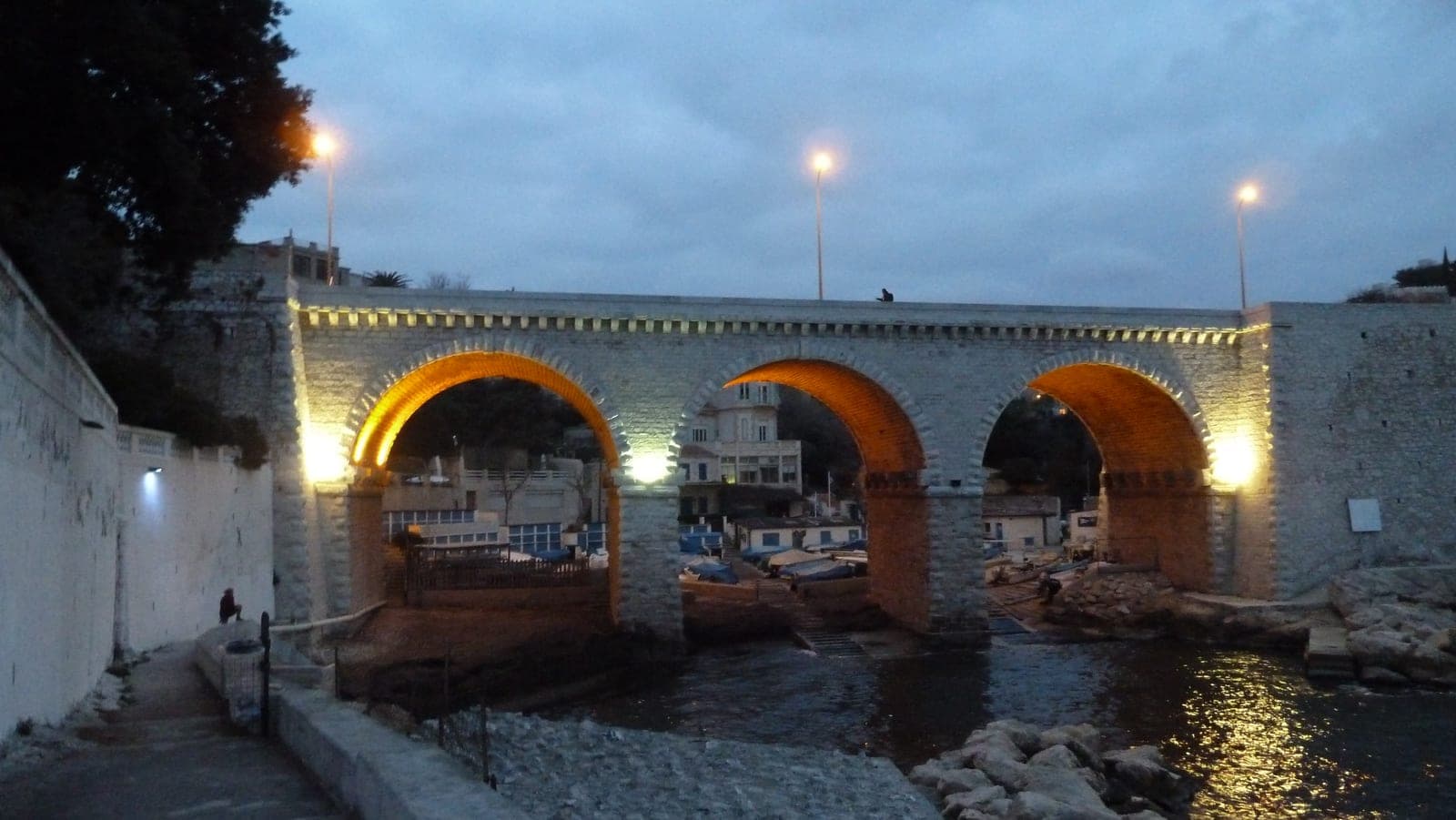
The sea does most of the work here, and it does it better than a park would. The corniche is a continuous seafront promenade with that famous bench along it, and it is the closest thing Marseille has to a public garden that everybody uses. Malmousque is the best of it: a knot of lanes and flat rocks where the city swims, with the Anse de Maldormé and its small beach just south. The plage des Catalans at the northern end is the city beach, sand and busy in summer. And the Vallon des Auffes, three arches of viaduct over a pocket of fishing boats and cabanons, is the picture everybody has seen of Marseille without knowing where it was taken.
For actual grass, Parc Valmer and the Jardin de Benedetti are what the district has, and both are small. The open-air Théâtre Silvain sits in the hillside above the corniche, and a marine research station occupies the rocks at Endoume, which is a reminder that this stretch of water has been studied as well as swum in.
Eating out is sea-facing and mostly expensive. The Vallon des Auffes carries the famous end of it, Chez Fonfon for bouillabaisse and Chez Jeannot for pizza on a terrace over the boats, the latter an institution in a way that has nothing to do with the food being complicated. The corniche has a run of terraces, and the Anse de Maldormé holds the Passedat house at the top of the city's dining scene. What the district does not really have is the cheap, loud, everyday eating that Cours Julien or Noailles do. For that you go into town, which is a bus ride and worth building into the week.
What it costs
The number to start from is 5 074 EUR / m² ≈ $540 / sq ft, the median price per square metre actually paid across 153 recorded apartment sales inside these five IRIS in 2025. That is DVF, the register of what was really paid, not an asking price and not an arrondissement average.
Two sharpeners. The same median over flats sold with nothing attached, no cellar and no parking space, is 4,596, and in a district where a parking space is close to a necessity that gap is a real part of what you are buying rather than an accounting curiosity. And this is the most expensive of the five Marseille districts covered here: the range runs from 2,774 in the Joliette to 5,074 here, which is 83 per cent higher, four kilometres apart. Marseille is not priced as one market the way central Lyon is, and the incomes run the same way, 30,200 a year here against 14,770 in the Joliette.
Set the price against the income and you get the ratio a listing never shows you: one square metre here costs about 17 per cent of a typical year's income for the district. Both halves of that sentence belong to Endoume, which has the highest price and the highest income of the five districts covered here.
On rent, the published figure is 18.4 EUR/m² a month, and three things about it matter more than the number. These are asking rents, modelled from listings, not rents anyone is recorded as paying. Charges are included in them and cannot be separated out, so it is not comparable with a rent quoted before charges. And they are published per arrondissement, so this is the whole 7e, which also contains the rive neuve side of the Vieux-Port and the corniche beyond this district. It is the highest of the five districts covered here.
One more thing, because it is the opposite of Paris and Lyon and people assume otherwise. Marseille has no legal rent ceiling.
The rent actually paid tells the district's real story better than the advert does, because the observatory splits Endoume across three zones and they are the steepest gradient in the city. The median is 15.9 EUR/m² a month at Valmer, 14.4 at Malmousque and the Vallon des Auffes, and 13.0 on the Tobelem and Crinas-Saint-Eugène side, all excluding charges. Valmer is the dearest zone in the whole department. The 2.9 EUR/m² between top and bottom is about 174 EUR a month on a 60 m² flat, and the distance between them is a few hundred metres uphill, away from the water. The city is not part of the time-limited national rent-control experiment, so there is no capped rate per square metre for a landlord to breach, and no arrêté to check a listing against. What protects you here is the market and the lease, not a cap.
Weather and climate
Seasonal averages for Marseille, one representative month per season. Météo-France 1991-2020 normals for station Marseille-Marignane, the official station for the city, read 12 August 2026 via Infoclimat. Seasons are the representative months: January, April, July and October. Sunshine hours a day are the monthly totals divided by the days in the month (January 147.9 h, April 250.8 h, July 372.2 h, October 196.1 h). Annual figures: mean daily maximum 20.7 °C, mean daily minimum 11.1 °C, 532.3 mm of rain and 2,897.6 hours of sunshine. Rain days are left null because the monthly count of days at or above 1 mm is not filled in on the published normals table. What the numbers say about living here: this is the sunniest big city in France, close to 2,900 hours a year, and the driest, 532 mm of rain in a year against 820 mm in Lyon, with July averaging under 11 mm across the whole month. Summer is genuinely hot, 30.7 °C by day in July, and winter is mild, an 11.8 °C January day and a mean minimum of 3.6 °C. The station sits by the étang de Berre rather than in the city, so it misses the sea moderation on the corniche and the mistral is not in these numbers at all, though it is the thing residents talk about most.
The honest downsides
There is no metro, no tram and no train inside Endoume, and the hills make that worse than the map suggests. The whole of your public transport is buses, five lines along the corniche and a handful more inland, sharing the road with the traffic that comes to look at the view. Add thin everyday shopping, no market and no supermarket in the middle of the district, and streets steep enough that carrying two bags home is a decision. The result is that a car is close to compulsory here in a way it is not in most of central Marseille, and a household budget that quietly includes one is the difference between this district working and not working.
You live inside somebody else's photograph, and the weather has opinions. From May to September the corniche is a through-route for the entire city heading to the beaches, the Vallon des Auffes fills with people photographing the fishing boats from the bridge above your street, and weekend parking is gone by mid-morning. Then there is the mistral, which is not a postcard detail: it arrives cold and hard from the northwest, slams shutters, strips the sky to an unreal blue, makes the sea unswimmable for days and turns a top-floor sea-facing terrace into somewhere you cannot sit. In the other direction, August on this coast is hot, glaring and shadeless, and stone and bare rock hold the heat well into the night.
Crime and safety
The boundary comes first, because it is not the district. France's finest published grain for Marseille is the arrondissement, so every figure here covers the whole 7e, which runs from the rive neuve and La Criée on the south side of the Vieux-Port down the corniche past Bompard and the Roucas Blanc. None of it was computed for these five IRIS.
With that said, this district reads the way its residents describe it, right up until one indicator. Theft from the person is 298.5 per 10,000 residents, against 193.2 for Marseille and 91.0 for France. That is above the national rate and it is the lowest of the five Marseille districts covered on this site, several of which run past 500. Non-domestic assault is 40.7, below the city's 50.3. Unarmed robbery is 27.9, just below the city's 28.8 and well above the national 7.2. Violence inside the family is 28.7, below both the city's 43.1 and the national 37.6, and that indicator counts victims and moves with reporting as much as with incidence.
Now the inversion, which is the whole story of this section. Home burglary is 14.1 per 1,000 dwellings, against 9.3 for Marseille and 5.6 for France. That is a different base from the four figures above, it must be read on its own, and on it this is the worst of the five districts covered here, at about two and a half times the national rate.
That combination is not a contradiction, it is a signature. Street crime needs crowds, and there are no crowds here. Burglary wants the opposite: houses rather than upper-floor flats, gardens and walls that screen a door from the street, buildings without an entry phone and a concierge, and streets that empty out between nine and six. Endoume is a district of exactly that kind of property. If you buy or rent here, the sensible money goes on shutters, a solid door and an alarm rather than on avoiding a particular street after dark.
Is this you?
If you want to live in Marseille for the sea rather than for the city, and you are content to keep a car, shop in small quantities and treat the centre as somewhere you travel to, nothing else in this set does what Endoume does. You are buying the water at the end of the street, quiet, air, and a decent chance of outside space of your own, and you are paying the top of the Marseille range for it.
If what you want is the city without the car, Cours Julien is the direct opposite of this district and costs a great deal less: 3,468 EUR/m² against 5,074 here, a cost level of 46 against 58, and it scores 88 for walking and 82 for getting around against 66 and 58 here, with a metro station and the densest food shopping in the city. What you give up is the sea, the quiet and the space. If you want water plus a metro station, the Vieux-Port is the middle path at 4,118 EUR/m², with the traffic, the tourists and the noise of the basin thrown in.
Want to know what homes here are actually worth?
Join the waitlistHow we source this
How we put this together. Gathered on the ground by our local field team and written up by the Apraiz research team. Every figure above carries its own source and date. The scores are not computed by the build; walking and transport will use open map and transit data first, then Apraiz's own model. We update prices quarterly, transport and amenities twice a year, and school data when the source publishes.
Sources: DVF (Demandes de valeurs foncières), data.gouv.fr, Carte des loyers 2025, DHUP and ANIL, Observatoire des loyers des Bouches-du-Rhône, via the Observatoires des loyers network, INSEE, Filosofi 2021, SSMSI, bases statistiques communale et départementale de la délinquance enregistrée, Wikipedia (fr), Wikipedia (en).
Safety and crime in Marseille →Nearby: Le Panier · Vieux-Port · Cours Julien