
Long Story ShortReadHide
- What it is: the plateau above the Canebière. About a quarter of a square kilometre of pedestrian streets, painted shutters, terraces and small food shops, built from three of INSEE's statistical areas in the 6e arrondissement.
- Who it suits: someone who wants to live inside the noise rather than near it, walks everywhere, shops in small quantities from small shops, and does not need a garden.
- What it costs: 3 468 EUR / m² ≈ $370 / sq ft to buy; sitting tenants pay 12.7 to 12.9 EUR/m² a month excluding charges, while listings ask 16.8 across the 6e with charges included.
- What people complain about: Friday and Saturday nights are loud until very late, and there is no green space at all inside the boundary.
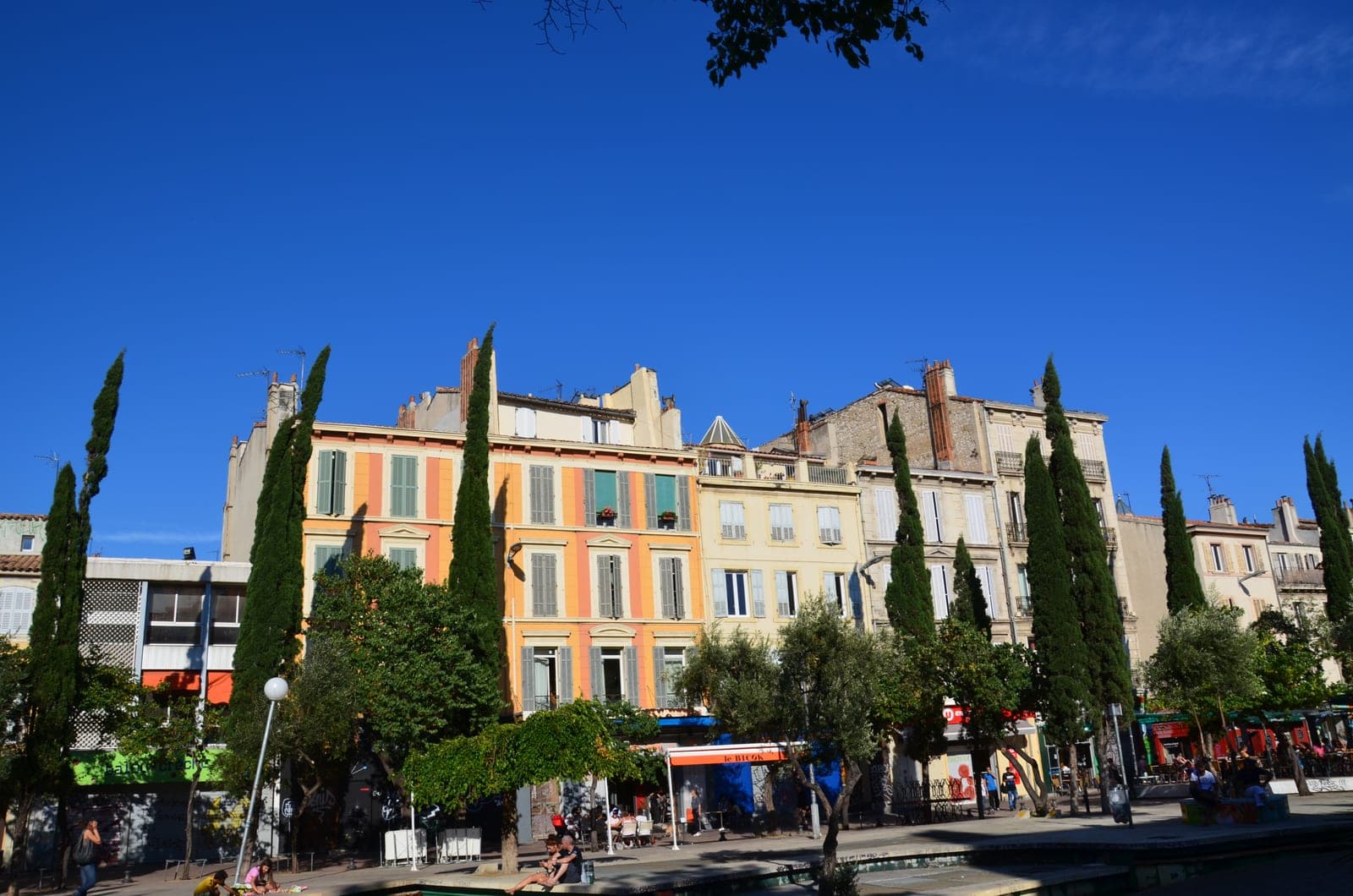
First impressions
Marseille publishes no boundary for "le Cours Ju", so this article uses a named set of INSEE's statistical areas: three IRIS, Julien, Tilsit-Blanqui and Bergers, about a quarter of a square kilometre of the 6e arrondissement. That is small. You can cross the whole of it on foot without hurrying, and most people who live here do it several times a day.
The first thing to understand is that it is up. The Canebière is below you and the cours sits on a plateau above it, which is why the staircase continuing rue Jean-Baptiste-Estelle exists at all: its construction was decided in 1859, to give the people of the cours Julien and the plaine Saint-Michel a more direct way down to the lower town. It still does exactly that, and it still works in one direction more easily than the other. Marseille is a city built on hills, and up here "ten minutes away" regularly means ten minutes uphill on the way home.
The second is that the quarter is a converted market. From 1860 until March 1972 the cours held the Marché Central, the wholesale and retail fruit and vegetable market of the whole city, with the traders' depots and cold rooms occupying the ground floors of the buildings and the banana ripening rooms sitting between the cours and the place Jean-Jaurès. When the wholesale trade moved out to the MIN des Arnavaux, those ground floors emptied and refilled, first with antique dealers, then with restaurants, bars, studios and venues. The upper cours became a garden with a fountain, designed by the Marseille landscape designer Isabelle Linski and inaugurated in 1980 by Gaston Defferre, with a multi-storey car park dug underneath and a metro station on line 2 that opened in 1984. The lower half was redone in 1988.
The third is the paint. Shutters, roller blinds, doorways, stair walls and whole façades here carry street art, and it is repainted often enough that the quarter looks different from one season to the next. It is the visual signature of the place and it is also, practically, what a ground-floor commercial frontage looks like when it has been decorated by fifty years of people who were not asking.
On weather, two things matter more than the average. Marseille summers are hot and dry, and a top-floor flat under an old roof with no air conditioning is genuinely hard work in August, in a quarter with no shade of its own beyond the plane trees on the edges. And the mistral, the cold dry north-westerly that comes down the Rhône valley, blows hard enough often enough to be a fact of daily life: it clears the sky, it drops the temperature quickly, and on the exposed plateau it slams shutters and empties terraces in an afternoon.
Who lives here, and what the streets look like
The income figure for this district is 21,070 EUR a year. That is the median of the three IRIS medians inside the boundary, none of them suppressed, on INSEE's Filosofi 2021 data. Read it as a typical figure across the district's small statistical areas rather than as a household survey of the cours Julien: it is unweighted, and Marseille publishes no arrondissement anchor beside it.
Who that is, in practice: renters in small flats, a real and long-standing population of artists, designers and musicians working out of the old market ground floors, young professionals who wanted the centre without the tourist half of it, and a large number of people who work in the bars, kitchens and venues that make the quarter what it is. It is one of the parts of Marseille where the people serving you at eleven at night live within a few streets.
The building stock is the thing to look at hardest, and it is not uniform. The plateau was built up as a faubourg from the middle of the eighteenth century, once the Louis XIV rampart came down, so the typical building is a three to five storey immeuble with tall shuttered windows, high ceilings, a stone staircase and frequently no lift. Between them sit later blocks, including some 1960s and 1970s infill on corners, which look worse and often work better: lifts, level floors, insulation and a lower heating bill. Ask which floor. Ask whether the ascenseur exists at all, not whether it is planned. Ask what is on the ground floor of your own building, because a bar underneath is a different flat from a bookshop underneath. And ask what the courtyard is: on the plateau a rear courtyard is the difference between a bedroom you can sleep in with the window open and one you cannot.
One more thing belongs here and it is not comfortable. Old buildings in central Marseille have to be inspected properly, not glanced at. On 5 November 2018 two buildings collapsed at 63 and 65 rue d'Aubagne, in Noailles just down the hill from this plateau, and eight people died. The consequence for anyone buying here is practical: read the copropriété minutes and accounts rather than the summary, look for any arrêté de péril history on the address, get the roof, the façade and the structure looked at by someone you are paying, and treat a cheap price on a beautiful old building as a question rather than a bargain.
Getting around
The station is Notre-Dame-du-Mont - Cours Julien, on metro line 2, and it is inside the quarter rather than at the edge of it. Line 2 runs north through Noailles to Saint-Charles, which is the mainline station and the interchange with line 1, and on to the Joliette and the port. Southwards it reaches Castellane, where line 1 crosses, and continues down toward the Prado. The Vieux-Port sits on line 1, so it is one change, and it is also a walk downhill if you would rather.
Below the plateau, the tram runs through Noailles and along the eastern edge near the Plaine, and the bus network fills in the rest, including the route that crosses the quarter itself. In practice, though, almost nothing here is a transport decision. The plateau is small and pedestrianised in its middle, and the honest description of getting around is that you walk, and that the walk back is uphill.
Two things a newcomer underestimates. First, the stairs. Going down to the Canebière and the Vieux-Port is quick and pleasant; coming back up with shopping in July is a different exercise, and an electric bike changes this district more than it changes most. Second, the car. Parking is genuinely hard in the 1er, 2e and 6e, the plateau streets are narrow and half of them are closed to traffic, and the underground car park beneath the cours is the practical answer rather than a kerbside space. If you are moving here with a car, price the parking before you price the flat.
For the airport, the coach runs from Saint-Charles, so the trip starts with the metro either way.
Typical weekday minutes from Cours Julien, with the icon showing how. Times are measured door to door for a typical weekday morning from the cours Julien; the icon shows the fastest sensible way., 2026-08.
Daily life
This is the quarter's real strength and it is the opposite of what the postcards suggest. The everyday food retail here is the densest in Marseille, and it is small-shop retail: greengrocers, bakers, butchers, a cheesemonger, épiceries that stay open when everything else has closed, and a run of small specialist food shops on the cours and the streets around it. You can do a full week's shopping without leaving the plateau, in four or five stops rather than one.
The supermarkets are the backup rather than the plan, and they are all small formats: Carrefour City and Carrefour Express, a Casino, a Spar and a Vival around the edges of the quarter, with a Naturalia on rue de Rome for the organic shop. There is nothing large inside the boundary and there is nowhere to park a trolley, so anything bulky means a trip out.
The marché matters more here than the supermarket does, and it is on the edge rather than inside. The marché de la Plaine on place Jean-Jaurès runs Tuesday, Thursday and Saturday from 07:30 to 13:30, with the flower market taking the same square on Wednesday at the same hours. That is the everyday market for this plateau, and it is one of the last big general markets in a French city centre: food on some stalls, clothes and household goods on others, and a cross-section of the whole city buying from both. Below the hill, the permanent food streets of Noailles around the Marché des Capucins are the other option, with the Arabic and North African grocers where a great deal of Marseille actually shops, and where fruit and vegetables are cheaper than anywhere on the plateau.
Pharmacies are well covered, including one on the cours itself. For delivery, Uber Eats and Deliveroo both cover the quarter, and they are the two that matter in France.
Local Places Worth Knowing
Independent and close by, chosen on merit. Nobody pays to appear here.
The concert hall on the cours, and why a lot of Marseille comes up the hill on a weeknight. Big enough to pull touring acts, small enough to see the stage from anywhere.
View on Google MapsThe market on place Jean-Jaures, just off this district's edge, where the whole plateau actually shops. Produce, fish, cheese and household goods, Tuesday, Thursday and Saturday.
View on Google MapsAn independent bookshop on rue Fontange with an exhibition space attached and a steady evening programme of readings. General stock, strong on literature and art.
View on Google MapsEgyptian cooking on the cours itself: koshary, fatta, mezze and bean falafel made in house, at everyday prices, with plenty for a table that does not eat meat.
View on Google MapsChecked August 2026. Places close and change, so tell us if something here is out of date.
Schools and families
The practical shape of family life here is set by the geography rather than by any ranking. The plateau is small and pedestrian in the middle, the école élémentaire sits on the cours itself, and the school run is a walk across a square rather than a drive across a city, which in Marseille is worth a great deal. Against that, there is no green space at all inside the boundary, so the daily outdoor hour has to be found somewhere else.
Mostly it is found on the edge. The rebuilding of place Jean-Jaurès between October 2018 and May 2021 put in 186 trees, two play areas of about 660 m² together and two bus stops, moved the parking underground and enlarged the pedestrian zone, and that square is now where the quarter's children actually play. It was, and to a degree remains, a contested piece of work: the site was walled off behind 2.5 metres of concrete, quickly nicknamed the wall of shame, and the market traders were displaced for three years and seven months before returning on 3 May 2022.
The sea is not a walk from here, which surprises people. The Vieux-Port is downhill and reachable on foot, but it is a working basin rather than a swim, and the beaches and the calanques are a metro ride and then a bus, plus a walk in from the road at the far end. Families who want the sea at the bottom of the street live on the other side of the city, and that is a real fork in the decision rather than a detail.
None of that is visible in a listing photograph, which is why Apraiz builds these Marseille guides around what a week here actually looks like. Walk the streets at eight on a Tuesday morning and again at one on a Sunday morning, and stand outside the specific building at both, before you sign a lease or purchase.
Kids Restricted. Good in daylight, difficult after nine. The plateau is pedestrian, the school run is a walk rather than a drive, and the rebuilt place Jean-Jaurès on the edge gives the quarter its playgrounds and most of its trees. What is missing is green space inside the boundary itself, which means there is nowhere for a child to run that is not a street or a square, and the flats are old, often on the third or fourth floor with no lift, and often above a bar or a restaurant terrace that runs late on Friday and Saturday. Families here tend to be on the quieter streets away from the cours, and the difference between one street and the next is large.
Pet Restricted. Workable, but honestly harder than the pedestrian streets suggest. In its favour: most of the plateau is closed to cars, the terraces are relaxed about dogs, and everything a dog owner needs day to day is within a few hundred metres. Against it: there is no park and no grass at all inside the boundary, so every real walk is a walk out of the quarter and back up the hill, the pavements around the edges are narrow and heavily parked, and on a Sunday morning the streets carry the previous night's glass. A small dog in a small flat above a bar is a specific kind of arrangement, and it is worth being honest with yourself about it before you sign.
Green space, leisure and eating out
Start with the honest part: there is no park inside this boundary at all. Not a small one. The green you see in photographs of the quarter is street planting and the trees on place Jean-Jaurès on the edge, and beyond that the nearest proper parks, the parc Longchamp to the north-east and the parc du 26e Centenaire out past the eastern edge of the 6e, are a walk or a metro ride away. If a garden or a lawn is part of how you live, this district cannot supply it and no amount of terrace makes up for it.
What it has instead is culture at a density almost nothing else in the city matches. Espace Julien on the cours is the main music venue. Le Molotov is the small one that has been going for decades. La Baleine is the art-house cinema and Vidéodrome 2 the associative video club and screening room, and there are small theatres scattered through the surrounding streets. Record shops, independent bookshops and second-hand clothes fill the ground floors between them, and once a year the self-organised Carnaval de la Plaine takes over the square on the edge.
Eating and drinking is what the quarter is known for, and the scale of it is the thing to understand before you move in. This is the most concentrated bar and restaurant street life in Marseille, packed into that quarter of a square kilometre: terraces along the cours and the pedestrian streets off it, rue Pastoret, rue des Trois Rois, and the small kitchens that make the plateau worth eating in, cooking from a lot of different places rather than a single regional menu. It is genuinely good, and it is genuinely loud. The practical advice is simple and everybody who lives here gives it: view the flat at one in the morning on a Saturday, not at three in the afternoon on a Tuesday.
What it costs
The number to start from is 3 468 EUR / m² ≈ $370 / sq ft, the median price per square metre actually paid across 150 recorded apartment sales inside these three IRIS in 2025. That is DVF, the register of what was really paid, not an asking price. The same median over flats sold with nothing attached, no cellar and no parking space, is 3,300.
Put that in the Marseille frame, because the frame is the story here. Across the five districts we cover, prices run from 2,774 EUR/m² in the Joliette to 5,074 in Endoume, and Endoume is 83% above the Joliette on a four-kilometre drive. That is the widest spread of the three French cities in this set: Marseille is not priced as one market the way central Lyon is, and the cours Julien sits in the middle of it, third of the five. On a European scale it is cheap. A cost level of 46 puts it well below central Paris, below Lyon's Presqu'île, and below most of the city centres in this corpus.
Rent comes in two kinds here and the advert is the louder one. The 2025 Carte des loyers puts asking rents in the 6e at 16.8 EUR/m² a month, and two caveats travel with it. These are modelled asking rents built from listings rather than anything a tenant is recorded as paying, and charges are included in the figure and cannot be pulled back out, so a flat with heavy communal costs is flattered by the comparison. The figure is published per arrondissement, so it covers the whole 6e, including the Préfecture quarter and the streets around rue Paradis, and not this plateau on its own.
One thing that is true here and not in Paris or Lyon: Marseille is not part of the national rent-control experiment, so there is no legal ceiling on what a landlord may ask.
There is a second rent number, and it is the one to plan on. The Bouches-du-Rhône rent observatory puts the median actually paid at 12.9 EUR/m² a month around Tilsit-Blanqui and the Bergers and 12.7 on the Julien plateau itself, both excluding charges, with quartiles of 11.0 to 15.5 and 11.0 to 15.0 behind them. That is roughly four euros a square metre below the advertised figure, and most of the difference is the charges sitting inside the advert plus the gap between a new listing and a lease three years old. Nothing about a listing price here is unlawful for being high. What protects you is the market and your own arithmetic, not an arrêté.
Which brings us to the arithmetic. Against the district's income figure of 21,070 EUR a year, one square metre at the 2025 median costs a little over 16% of a full year of it. That ratio is the honest summary of who is buying up here and how: small flats, often with work needed, frequently bought by people already in the city rather than by first-time buyers arriving with a deposit from somewhere more expensive.
Weather and climate
Seasonal averages for Marseille, one representative month per season. Météo-France 1991-2020 normals for station Marseille-Marignane, the official station for the city, read 12 August 2026 via Infoclimat. Seasons are the representative months: January, April, July and October. Sunshine hours a day are the monthly totals divided by the days in the month (January 147.9 h, April 250.8 h, July 372.2 h, October 196.1 h). Annual figures: mean daily maximum 20.7 °C, mean daily minimum 11.1 °C, 532.3 mm of rain and 2,897.6 hours of sunshine. Rain days are left null because the monthly count of days at or above 1 mm is not filled in on the published normals table. What the numbers say about living here: this is the sunniest big city in France, close to 2,900 hours a year, and the driest, 532 mm of rain in a year against 820 mm in Lyon, with July averaging under 11 mm across the whole month. Summer is genuinely hot, 30.7 °C by day in July, and winter is mild, an 11.8 °C January day and a mean minimum of 3.6 °C. The station sits by the étang de Berre rather than in the city, so it misses the sea moderation on the corniche and the mistral is not in these numbers at all, though it is the thing residents talk about most.
The honest downsides
The noise is not an occasional inconvenience, it is the product, and you cannot buy the quarter without it. The most concentrated bar and restaurant street life in Marseille sits inside a quarter of a square kilometre, on a pedestrian plateau where the sound has nowhere to go but up the façades, and Friday and Saturday nights run very late. In summer, with the windows open because the flat is old and has no air conditioning, that is the deal. There is a genuine street-by-street difference: a flat on a quiet side street with a courtyard is a different life from one on the cours itself or above a terrace, and the price often does not distinguish between them at all. Sunday morning is also part of it, and it involves glass.
There is no green space inside the boundary, and there is nowhere to put a car. No park, no lawn, no shaded square of your own: every real walk, every hour outdoors with a child or a dog, starts by leaving the district, and in a city built on hills that means it also ends with a climb. Parking is hard across the 1er, 2e and 6e, the plateau streets are narrow and largely closed, and the underground car park under the cours is a monthly cost rather than a convenience. Between them, those two gaps are why the quality-of-life score here sits at 72 while the walking and shopping scores sit in the high eighties: this is an extremely liveable quarter in every respect except space and quiet.
Crime and safety
The numbers need their boundary stated first, because it is not this district. France's finest published grain for Marseille is the arrondissement, so these figures cover the whole 6e. The 6e is nineteen IRIS and this district is three of them, and the arrondissement also holds the Préfecture, the Palais de Justice, the luxury shopping streets around rue Paradis and the Castellane interchange. Nothing on this page was computed for the plateau on its own.
They also need their denominator, and in central Marseille that matters more than usual. These are rates per resident: offences recorded in the arrondissement, divided by the number of people who sleep there. The central arrondissements have small resident populations and very large daytime and night-time crowds, which is most of the reason they read several times the city rate.
With that said, the shape is clear and it is a crowd profile. Theft from the person runs at 500.8 per 10,000 residents in the 6e, against 193.2 for Marseille and 91.0 for France. Unarmed robbery is 57.2 against 28.8 for the city and 7.2 nationally. Non-domestic assault is 61.9 against 50.3 and 31.6. Those are the indicators that move with footfall, and this arrondissement has a great deal of it, day and night.
The other half of the picture is the half nobody quotes. Violence inside the family runs at 29.6 per 10,000 residents here, below the Marseille figure of 43.1 and below the national 37.6. Home burglary is 9.5 per 1,000 dwellings, a different base that has to be read on its own, against 9.3 for Marseille and 5.6 nationally, so roughly at the city level and above the ordinary French one. A district that runs five times the national rate on one indicator and below it on another is not described by a single number, and there is none to construct here: the ministry counts these things in three different units, so the indicators are reported separately.
In practice: this is a nightlife quarter and it behaves like one. Keep your phone in a pocket you can feel on a crowded terrace and on the metro, take the same care walking home at two in the morning that you would in any European city centre with this much drinking in it, and note that a ground-floor flat opening onto a pedestrian street is a different proposition from a third floor behind a courtyard door.
Is this you?
If you want to live in the middle of the most concentrated street life in Marseille, walk everywhere, buy your food from six small shops and a market three mornings a week, and you are genuinely untroubled by noise, this is the best version of that in the city, and at 3,468 EUR/m² it is not expensive by European standards.
If what appeals is the walkability and the food but not the volume, Endoume is the other end of the same city: a cost level of 58 against 46 here, a quality-of-life score of 82 against 72, the sea, the Vallon des Auffes and the quietest streets in Marseille, at the price of a walking score of 66 and a getting-around score of 58, with no metro or tram inside the boundary at all. If you want the density and the history without the bars, Le Panier is cheaper again at a cost level of 44, tiny and entirely walkable, with steep lanes and stairs that defeat a pram. And if the water is the point, the Vieux-Port puts you on the basin with the ferries and the fish market, at a cost level of 54.
Want to know what homes here are actually worth?
Join the waitlistHow we source this
How we put this together. Gathered on the ground by our local field team and written up by the Apraiz research team. Every figure above carries its own source and date. The scores are not computed by the build; walking and transport will use open map and transit data first, then Apraiz's own model. We update prices quarterly, transport and amenities twice a year, and school data when the source publishes.
Sources: DVF (Demandes de valeurs foncières), data.gouv.fr, Carte des loyers 2025, DHUP and ANIL, Observatoire des loyers des Bouches-du-Rhône, via the Observatoires des loyers network, INSEE, Filosofi 2021, SSMSI, bases statistiques communale et départementale de la délinquance enregistrée, Wikipedia (fr), Cours Julien, Wikipedia (fr), Place Jean-Jaurès (Marseille), Ville de Marseille, les marchés de la ville.
Safety and crime in Marseille →Nearby: Le Panier · Vieux-Port · Endoume