
Long Story ShortReadHide
- What it is: the port side of Marseille, where the ferries, the container quays, the Docks, the shopping centre and the new office towers of Euroméditerranée sit on top of an old and poor residential quarter.
- Who it suits: someone who wants space and a low price inside the city, does not need a supermarket on the corner, and is happy on a tram.
- What it costs: 2 774 EUR / m² ≈ $300 / sq ft to buy; sitting tenants pay 11.2 to 13.0 EUR/m² a month excluding charges, while listings ask 16.6 across the 2e with charges included.
- What people complain about: how far apart everything is, the port traffic, and the feeling of living inside a building site that has been going for thirty years.
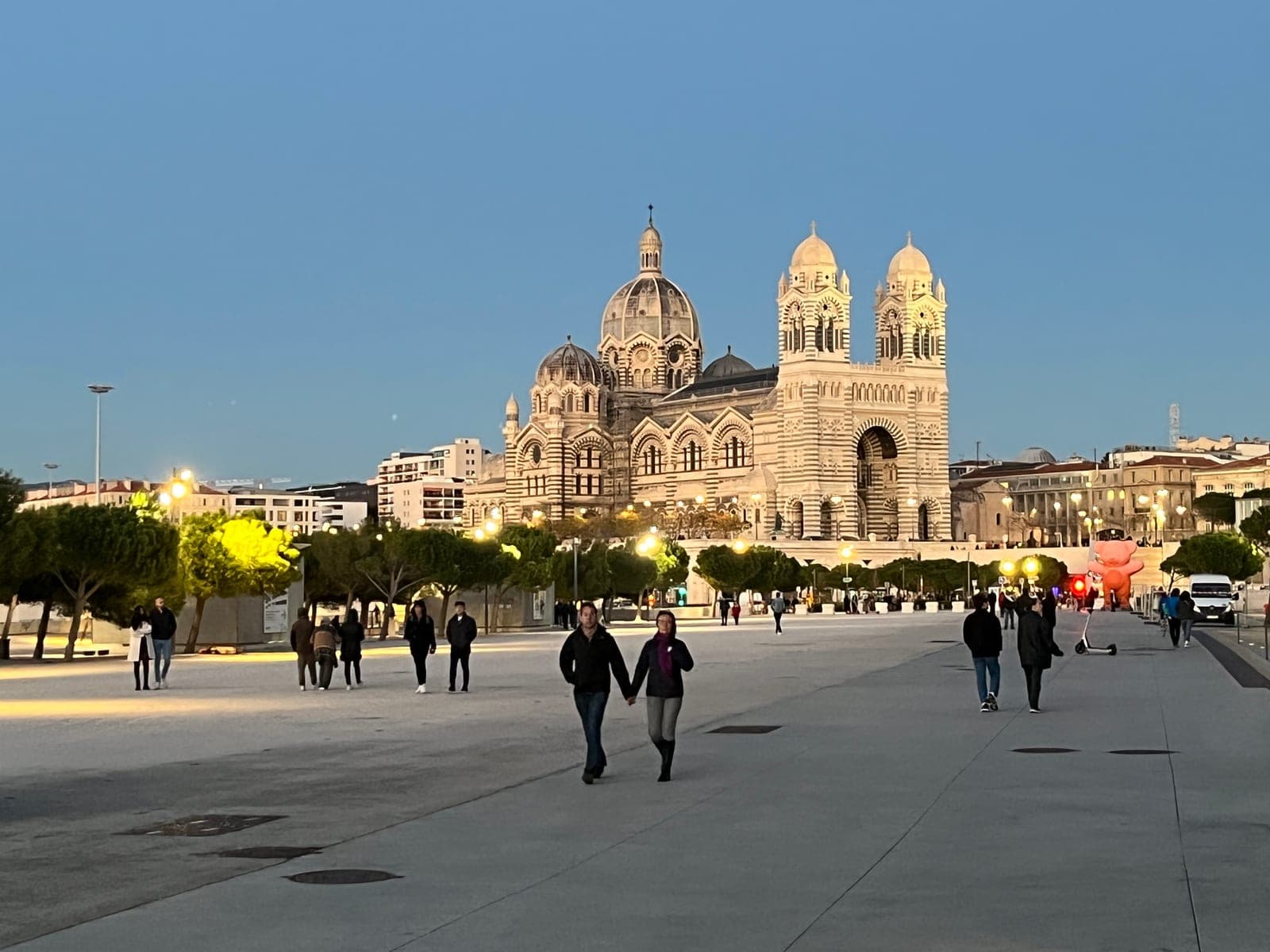
First impressions
Marseille publishes no boundary for La Joliette, so this article uses six IRIS, the statistical areas INSEE publishes for the whole country: Arenc, L'Évêché-Les Docks, Albrand-Ponteves, Forbin, Mazenod-République and Montolieu. That is nearly three square kilometres, much the largest of the five Marseille districts covered here. All of it sits in the 2e arrondissement.
The first thing to understand is that this is a working port and a residential district at the same time, and neither half is decoration. Ferries leave from here for Corsica and North Africa, freight moves on the quays, and the northern edge of the district runs into the commercial port proper. That is not a view, it is a neighbor, with the noise, the lorries and the smell of a port attached.
The second is the scale of what has been built on top of it. Euroméditerranée, launched in 1995 over 310 hectares centred on exactly these streets and extended north in 2007, is the reason the skyline here looks like nowhere else in the city: the CMA CGM tower on the quai d'Arenc, Zaha Hadid's first, and the offices in and around Les Docks, the four great 1860s warehouses that were rescued from decay in the 1990s and now hold companies on the upper floors and shops and restaurants at the bottom. The Terrasses du Port shopping centre sits on the quai du Lazaret with a long terrace over the water where you can watch the ferries load. Further north the old grain silo at Arenc has been turned into a theatre.
And then, two streets inland, the district changes completely. Around Mazenod, République, Montolieu and Forbin are ordinary Marseille streets of nineteenth-century blocks, some of them handsome and some of them in poor condition, where rents are low and the shops are small. Rue de la République, the long straight boulevard cut through in the nineteenth century to join the old port to the new docks, runs down the spine of it, and it is the clearest place in Marseille to see the two halves of this district facing each other across one street.
The Cathédrale de la Major anchors the southern end, the striped Byzantine bulk of it on the quay with the small Romanesque Vieille Major still standing beside it, and the Voûtes de la Major, the arcades underneath, now hold bars, shops and a covered food hall.
On weather, this is the most exposed district in the set. The mistral comes down the Rhône valley from the north and hits the port full on, with nothing between it and the sea. On a windy week in February it will take the door out of your hand on the quay, and it is what makes a fifth-floor flat on a corner colder than the thermometer says. In July the same exposure is the compensation: a flat facing the water gets a breeze that the streets behind the Canebière do not.
Who lives here, and what the streets look like
The income figure for this district is 14,770 EUR a year, the median of its six IRIS medians on INSEE's Filosofi 2021 data, with none of the six suppressed. Two things to hold on to. It is unweighted, so it is a typical figure across the district's small statistical areas rather than a survey of the district itself. And it is the lowest of the five Marseille districts covered here, less than half of Endoume at 30,200, four kilometres away on the other side of the Vieux-Port. That is the sharpest income gradient anywhere in the French set covered on this site, wider even than the gap between Belleville and Saint-Germain in Paris.
That is the single most important thing to know about Joliette, and it is why the two halves of the district can both be true at once. New offices, a shopping centre and towers went up on the port side over thirty years. The streets behind them are among the least well-off in the city, and the people who live in them did not move away when the towers arrived.
The building stock is a genuine mix, and which side of it you land on decides your daily life. There are nineteenth-century immeubles with high ceilings, tall windows, a stone staircase and often no lift, where the flats are handsome and cold in a mistral. There are 1960s and 1970s blocks with small rooms, thin walls and a lift that may or may not work. And there is the new build of the last twenty years along the water, which has insulation, a lift, a parking space and none of the character. Ask which floor, ask about the lift, ask whether the windows have been changed, and if you are looking at a new flat on the quays, ask what is planned on the empty plot beside it, because something usually is.
The daytime and the evening populations are not the same people. Offices in the Docks and the towers fill the district on a weekday and empty it after seven, which is why the boulevards can feel busy at lunchtime and abandoned at nine on a Sunday.
Getting around
Transport is the strongest thing this district has, and it is the reason the whole thing works at all.
Metro line 2 has two stations inside the boundary, Joliette at the southern end and Désirée Clary to the north, which puts Saint-Charles, the mainline station, a couple of stops away and the rest of the network one change behind it. The T2 and T3 trams run the length of the district along rue de la République and boulevard de Dunkerque, up to Arenc-Le Silo at the top, and between them the trams are what most residents actually use, because the tram stops sit closer together than the metro stations do. Buses fill in everything else, with stops throughout the district.
The ferry terminal is here, at the Joliette, with sailings to Corsica and to North Africa, and if you live in the district you walk to it. The Vieux-Port is a walk south along the water or one short hop on the metro.
Driving is the usual Marseille story with one local twist. Parking is genuinely hard across the 1er, the 2e and the 6e, and on-street space in the old streets here is scarce and fought over. What this district has that the rest of central Marseille does not is underground parking in the new buildings and the shopping centre, so a flat on the quays may come with a space, and one on rue Montolieu will not. The calanques, the limestone inlets everyone moves to Marseille for, are at the far southern end of the city: from here that is a bus and a walk, or a car, and it is an outing rather than an evening.
Typical weekday minutes from Place de la Joliette, with the icon showing how. Times are measured door to door for a typical weekday morning from place de la Joliette; the icon shows the fastest sensible way., 2026-08.
Daily life
Food shopping is the honest weak point, and it is a question of distance rather than absence. For a district of nearly three square kilometres there are few food shops, and they are spread out, so the ten-minute walk that a resident of Cours Julien never thinks about is a real consideration here.
The anchors are the Monoprix inside the Terrasses du Port on the quai du Lazaret, which is the full-size shop most people on the water side mean when they say they are going to the supermarket, a Franprix near place de la Joliette, a Monop' and a Biocoop on and just off rue de la République, and an Aldi and an Auchan on the inland side toward Arenc and rue de Ruffi. Beyond the chains there is the trade that actually feeds this part of the city: Arabic and North African grocers through the streets of the 2e, open late, cheap, and better for fruit, vegetables, herbs and spices than anything with a logo.
The marché on place de la Joliette matters more than any of them. It runs Monday to Friday from 08:00 to 14:00, with a separate producers' market on the same square on Tuesday afternoons from 15:00 to 19:00, and for a lot of households here it is the weekly shop. Marseille's other great markets, the Noailles market and the Prado market, are a metro ride away and worth the trip, and the fish is sold off the boats on the quai des Belges at the Vieux-Port in the morning.
For delivery, Uber Eats and Deliveroo both operate here, and between them they are the practical choice in France.
Local Places Worth Knowing
Independent and close by, chosen on merit. Nobody pays to appear here.
The regional contemporary art collection in a Kengo Kuma building of stacked opaque glass scales, open here since 2013. Over a thousand works, shown in changing exhibitions.
View on Google MapsThe everyday food market on place de la Joliette, Monday to Friday mornings, with a producers' market on Tuesday afternoons. In a district thin on food shops, this is the one.
A small Mediterranean kitchen on the quai de la Joliette doing ceviche and a short lunch menu that changes weekly. Lunch is the busy service, with the crowd from the towers.
View on Google MapsAn independent cafe on the quai doing brunch, homemade cooking and long coffees, steps from the tram. Busy at lunch, and worth going mid-afternoon when it slows down.
View on Google MapsChecked August 2026. Places close and change, so tell us if something here is out of date.
Schools and families
Schooling is not the constraint here that the rest of the district might suggest. There is a lot of it within a short walk of the middle of the district, most of it maternelle and primaire, and in the older streets a child walks to school. What a family has to weigh instead is everything around the school run.
The district is large, cut by boulevards with real traffic on them, and parts of it are a building site in the ordinary sense: hoardings, cranes and a pavement that moves. Playgrounds are few for the area covered, the green spaces are new and small, and the sea, which is the thing children in Marseille grow up in, is behind a working port fence for most of this district rather than something you walk down to. The families who make it work are usually in the older streets inland, around Mazenod, République and Montolieu, where the blocks are close together and life happens on foot.
Two Marseille-wide things a parent should factor in. The city is built on hills, so ten minutes away is often ten minutes uphill, and this district is one of the flatter parts of it, which is a real advantage with a pushchair. And the north and the south of the city are two different housing markets with two different price levels, so a family comparing Joliette with somewhere near the calanques is comparing two cities. Being straight about which of those you are actually buying into is why we build these Marseille guides the way we do, and it is worth walking the route to school yourself, at eight in the morning, before you sign a lease or purchase.
Kids Restricted. The schooling around here is dense, most of it maternelle and primaire within a short walk of the middle of the district, so a child can walk to school. Against that, the district is nearly three square kilometres of boulevards, building sites and port traffic, the playgrounds are few for that area, and the shops for a daily family routine are thin on the ground away from the shopping centre. Families who make it work here tend to be in the older streets around Mazenod, République and Montolieu rather than out on the quays, and they do not rely on a car.
Pet Restricted. A dog can live here, and the district is flat and wide enough to walk one without a climb, which is rare in Marseille. What it does not have is much grass. The green spaces are new, small and laid out between buildings rather than as parks, and the water is a working port: for most of the district the sea is behind a fence, with ferries and freight on the other side of it, so the seafront is not a promenade you can let a dog off on. Traffic on the boulevards is heavy and constant, and the mistral funnels straight down them. The flats are a mix of old blocks with stairs and new ones with lifts, so the practical question is which of the two you end up in.
Green space, leisure and eating out
Green space is thin and new. What exists was laid out with the redevelopment, between and around buildings, rather than inherited as parks, so it is measured in squares and strips rather than in anything you would call a park. The water is the compensation and the frustration in one: you are on the sea the whole length of the district, and for most of that length the sea is a commercial quay with a fence in front of it. The places where you actually get to the water are the terrace at the Terrasses du Port, the esplanade below the Major, and the walk south toward the Vieux-Port.
Leisure is better than the housing stock suggests, because the regeneration spent money on it. The Frac Sud contemporary art collection sits on boulevard de Dunkerque in Kengo Kuma's glass-scaled building and is free to walk into. Les Docks hold shops, restaurants and a run of courtyards that are pleasant to cross on a hot day. The old grain silo at Arenc is now a theatre and concert hall. There is a multiplex cinema at the northern end, and, much better, Le Polygone étoilé, a tiny independent cinema on rue François Massabo that shows documentary and experimental work.
Eating out splits by exactly the same line as everything else here. The quays and the Docks are where the office crowd eats, busy at lunch and quieter at night, with the Voûtes de la Major under the cathedral holding the bars, the food hall and the terraces with the best view in the district. Inland, rue de la République and the streets off it hold cheap, good and largely North African food, and that is where you will eat on a Tuesday once you live here. If you are viewing a flat, view it twice: once at one o'clock on a weekday, when the district is at its busiest, and once at nine on a Sunday evening, when parts of it are close to empty.
What it costs
The number to start from is 2 774 EUR / m² ≈ $300 / sq ft, the median price per square metre actually paid across 186 recorded apartment sales inside these six IRIS in 2025. That is DVF, the register of what was really paid, not an asking price and not an arrondissement average. Over flats sold with nothing attached, no cellar and no parking space, the same median is 2,556.
This is the lowest price of the five Marseille districts covered here, which run from 2,774 to 5,074 in Endoume, and Marseille is in turn the cheapest large city in the French set. Nothing else written up in France costs less per square metre than a flat here. That is the honest headline, and the price spread inside this one city is the widest of the three French cities done so far: Endoume is 83% above Joliette, four kilometres away.
The reason is not a sampling accident, and this is where the price and the income have to be read together. A typical figure across this district's small statistical areas is 14,770 EUR a year, against 30,200 in Endoume. The property market is telling you the same thing the income data does. Put the two together and one square metre here costs about 19% of a full year's income on that measure, which is a very different proposition from the same calculation in Paris.
On rent, the published figure is 16.6 EUR/m² a month, charges included, from the 2025 Carte des loyers. Three things about that. It is an asking rent, modelled from listings, not a rent that tenants are recorded as paying. Charges are inside it and cannot be separated out, so it is not comparable with a rent quoted excluding charges. And it is an arrondissement figure covering the whole 2e, which is why Le Panier carries exactly the same 16.6: the two districts are in the same arrondissement and nothing finer is published. Marseille is not part of the national rent-control experiment, so there is no legal ceiling to check a listing against here, and the ceilings that exist in Paris and Lyon do not apply.
The rent actually paid runs well below that advert, and it fans out across the district more than any other figure here. The Bouches-du-Rhône rent observatory splits the Joliette across five of its eight zones: 13.0 EUR/m² a month at Arenc, 12.9 around Mazenod-République, 12.7 by the Évêché and the Docks, 12.0 through Albrand-Pontevès and Montolieu, and 11.2 at Forbin, all excluding charges. That is a spread of 1.8 EUR/m², about 108 EUR a month on a 60 m² flat, inside a district you can cross on foot in twenty minutes. It is the plainest number on this page for what Euroméditerranée has done: the new blocks by the water and the old streets behind them are not one rental market yet.
Weather and climate
Seasonal averages for Marseille, one representative month per season. Météo-France 1991-2020 normals for station Marseille-Marignane, the official station for the city, read 12 August 2026 via Infoclimat. Seasons are the representative months: January, April, July and October. Sunshine hours a day are the monthly totals divided by the days in the month (January 147.9 h, April 250.8 h, July 372.2 h, October 196.1 h). Annual figures: mean daily maximum 20.7 °C, mean daily minimum 11.1 °C, 532.3 mm of rain and 2,897.6 hours of sunshine. Rain days are left null because the monthly count of days at or above 1 mm is not filled in on the published normals table. What the numbers say about living here: this is the sunniest big city in France, close to 2,900 hours a year, and the driest, 532 mm of rain in a year against 820 mm in Lyon, with July averaging under 11 mm across the whole month. Summer is genuinely hot, 30.7 °C by day in July, and winter is mild, an 11.8 °C January day and a mean minimum of 3.6 °C. The station sits by the étang de Berre rather than in the city, so it misses the sea moderation on the corniche and the mistral is not in these numbers at all, though it is the thing residents talk about most.
The honest downsides
Nearly three square kilometres is a long way to walk for a pint of milk. This is the largest district in the Marseille set by a distance, and it is not filled in: port, boulevards, offices, building plots and blocks, with the food shops spread thinly between them. That is the whole reason this district scores far higher for getting around than it does for walking. In practice you plan your shopping, you use the market on place de la Joliette, and you get comfortable with a tram for a journey that would be a two-minute walk in Cours Julien. The other half of the same problem is what happens after seven, when the offices empty and stretches of the quay side go quiet.
You are living beside a working port, inside a redevelopment that is not finished. The lorries, the ferries and the freight are the district's reason for existing and they do not stop for residents: expect traffic on the boulevards, dust and noise, and the constant low-level disruption of a construction project that started in 1995 and is still going. Add the mistral, which hits this exposed edge of the city harder than anywhere inland, and a housing stock where a beautiful nineteenth-century flat and a cold one with no lift are frequently the same flat. None of that shows in a photograph taken from the terrace of the shopping centre.
Crime and safety
Start with what the numbers cover, because it is not this district. France's finest published grain is the arrondissement, so every figure here is the whole 2e, and the 2e also contains Le Panier. That is why the two articles carry identical numbers: it is the resolution France publishes, not two separate measurements that happen to agree.
Then the denominator, which does a lot of work. These are rates per resident, and the 2e is an arrondissement crossed by a commercial port, a ferry terminal serving Corsica and North Africa, a large shopping centre and an office district. Offences are recorded where they happen and then divided by the people who sleep there, so a district with a small resident base and an enormous daily flow of people reads high on anything that happens to people in crowds.
With that stated, the shape is clear. Theft from the person runs at 504.6 per 10,000 residents, against 193.2 for Marseille and 91.0 for France. Unarmed robbery is 63.6 against 28.8 for the city and 7.2 nationally, and non-domestic assault is 100.1 against 50.3 and 31.6. That is a street-theft and robbery profile attached to movement and crowds, and it is concentrated where the crowds are: the metro, the tram stops, the station approaches and the busy stretches around the shopping centre.
Two other indicators run differently and are worth quoting on their own. Home burglary is 9.9 per 1,000 dwellings, a different base that must be read separately: Marseille is 9.3 and France 5.6, so burglary here is close to the city level rather than a multiple of it. And domestic violence, at 79.6 per 10,000 residents, is more than double the national 37.6 and the highest figure in the French set covered so far. That indicator counts victims, so it moves with how much is reported as well as with how much happens, and a district with active support services and a high reporting rate can read higher than one where nothing is reported at all. It should be stated either way, because it is the one indicator on this list that describes what happens inside homes rather than on the street.
There is no total to construct from these five: the ministry counts them in three different units, so adding them would add victims to offences.
In practice: this is a district where you carry your phone the way you would at a station, pay attention on the tram and around the terminals late, and where the ordinary business of living in an old street inland is far less eventful than the arrondissement figure suggests.
Is this you?
If you want to be inside Marseille at the lowest price the city offers, with two metro stations, trams the length of your street and the sea at the end of it, and you are clear-eyed about the port and the building sites, Joliette is the best value in this set by a wide margin. You are buying space and connections, and you are accepting distance, dust and a district still being finished.
If what appeals is the same 2e arrondissement, the same rent figure and the same crime figures, but a quarter you can cross in ten minutes on foot, that is Le Panier: 3,052 EUR/m², the oldest quarter in France, and a walking score of 84 against 72 here. What you give up is the transport, the lift and the parking space, and you take on steep lanes and stairs. If you want the shops and the street life this district does not have, Cours Julien is the other direction: 3,468 EUR/m², the densest food shopping in the city and the highest walking score of the five, with a typical income of 21,070 against 14,770 here, and no park at all inside its boundary.
Want to know what homes here are actually worth?
Join the waitlistHow we source this
How we put this together. Gathered on the ground by our local field team and written up by the Apraiz research team. Every figure above carries its own source and date. The scores are not computed by the build; walking and transport will use open map and transit data first, then Apraiz's own model. We update prices quarterly, transport and amenities twice a year, and school data when the source publishes.
Sources: DVF (Demandes de valeurs foncières), data.gouv.fr, Carte des loyers 2025, DHUP and ANIL with leboncoin and Groupe SeLoger, Observatoire des loyers des Bouches-du-Rhône, via the Observatoires des loyers network, INSEE, Filosofi 2021, SSMSI, bases statistiques communale et départementale de la délinquance enregistrée, Wikipedia (en).
Safety and crime in Marseille →Nearby: Le Panier · Vieux-Port · Cours Julien