
Long Story ShortReadHide
- What it is: the hill behind the north quay of the Vieux-Port, the oldest ground in the city, a knot of lanes and staircases small enough to walk across and steep enough that you will not want to.
- Who it suits: someone who wants to live inside the old town on foot, will carry the shopping up two flights of stone stairs, and does not need a park, a lift or a parking space.
- What it costs: 3 052 EUR / m² ≈ $330 / sq ft to buy; sitting tenants pay 11.2 to 12.9 EUR/m² a month excluding charges depending which corner of the hill, while listings ask 16.6 across the 2e with charges included.
- What people complain about: the stairs with anything in your hands, the summer crowds in lanes two people wide, and the fact that the real supermarket is at the bottom of the hill.
First impressions
Marseille publishes no boundary for "le Panier", so this article uses a named set of INSEE's statistical areas: four IRIS, Panier, Charité République, Les Carmes and Dames, all in the 2e arrondissement. It is the smallest district in the French set, and that is worth saying out loud, because the quarter reads as much bigger than it is once you are inside it and lost.
The first thing to understand is that this is the oldest quarter in France in the plainest sense: the Greek city stood here. Marseille was founded by Phocaeans around 600 BC, and the place de Lenche, the small square at the top of the montée des Accoules, sits on the ancient agora and the Roman forum after it. The hill is really three hills, Saint-Laurent, des Moulins and des Carmes, and the street plan follows them rather than any plan. The name is smaller than the history: an inn hung a basket over its door, the lane became the rue du Panier, and the quarter took the street's name.
The second thing is the seam at the bottom of the hill, and it explains the buildings. Between 22 and 24 January 1943 the German authorities cleared the streets between the rue Caisserie and the water, expelling around 30,000 people and dynamiting about 1,500 buildings. The quai du Port was rebuilt in the 1950s, which is why the waterfront is a run of even post-war blocks while the lanes above it are seventeenth and eighteenth century and crooked. A few old buildings were saved, and one of them, the Hôtel de Cabre of 1535, was physically moved nearly 15 m and turned 90 degrees in 1954 so it would face the new street.
The third thing is the gradient, and photographs never show it. The montée des Accoules from the place de Lenche up to the place Daviel is a staircase, not a slope, and it is not the only one. Add the weather: the lanes are narrow, the stone holds August heat well into the night, and when the mistral comes down the Rhône valley it funnels through these streets for days at a time, slamming shutters and stripping the humidity out of the air. Both of those matter more in a top-floor flat than any listing photograph will suggest.
Who lives here, and what the streets look like
The income figure for this district is 15,220 EUR a year. That is the median of the four IRIS medians inside the boundary, none of them suppressed, on INSEE's Filosofi 2021 data. Read it as a typical figure across the district's small statistical areas rather than as a household survey of the Panier: it is unweighted, and Marseille publishes no arrondissement anchor beside it. It is the second lowest of the five Marseille districts covered here.
That number is the honest frame for everything else on this page, and the city-wide version of it is starker still. Across these five districts the range runs from 30,200 EUR a year in Endoume down to 14,770 in the Joliette, more than double, and it is the sharpest income gradient anywhere in the French set. Marseille is not one city economically and it does not pretend to be.
Who lives here, in practice: households who have been on this hill for a long time, successive waves of arrivals who came through it, Italian, then Corsican, then from the Maghreb, and a newer layer of artists, small makers, shopkeepers and renters drawn by the lanes and the rents. Gentrification is real and partial. Restored façades and a design shop sit on the same lane as a family who has been there for forty years, and both of those are the Panier.
The building stock is the thing to inspect hardest. These are narrow-plot houses of three to five storeys, most of them seventeenth to nineteenth century, with stone stairs, thick party walls, small windows and rooms that are tall rather than wide. A lift is the exception, not the rule. Ask which floor. Ask whether there is an ascenseur at all, and if the answer is vague, assume no. Ask about damp, because a north-facing wall in a lane that never sees direct sun holds it. Ask what the roof is like in August and what the neighbours sound like through a shared wall, because in a house this narrow you will hear them. And know that a nineteenth-century immeuble with high ceilings and a stairwell is a completely different proposition from a 1960s block on the quay below, in light, in heat and in what it costs to run.
Getting around
You walk. That is the whole design of the quarter, and it works: nothing inside the boundary is more than a few minutes from anything else, as long as you are willing to take the direction the stairs point.
The metro sits on the edge rather than inside it. Colbert on line 1 is the closest at the top of the hill, with Jules Guesde on line 2 just beyond it and Vieux-Port on line 1 down at the head of the basin. The tram runs along the rue de la République, the quarter's eastern edge, with stops at Sadi Carnot, République Dames and Joliette, which is the useful line for the port, the Terrasses du Port and the ferry terminal. Buses fill in the rest, and the airport is reached by the shuttle from Gare de Marseille-Saint-Charles rather than by rail.
One local service is worth knowing about because it is genuinely practical and not just a postcard: the ferry boat, the small RTM launch that has crossed the Vieux-Port between the Hôtel de Ville quay and the place aux Huiles since the nineteenth century, worked by a boat called the César. It is the fastest way from the bottom of this hill to the rive neuve, and it saves a long walk around the head of the basin.
A car is the weakest option here and you should decide about it before you sign anything. The lanes were laid out for handcarts, several of them are stairs, and parking in the 1er, 2e and 6e is genuinely difficult rather than merely annoying. If you need a car in Marseille, budget for a space and expect to walk to it.
Typical weekday minutes from Place de Lenche, with the icon showing how. Times are measured door to door for a typical weekday morning from the place de Lenche; the icon shows the fastest sensible way., 2026-08.
Daily life
The everyday shop is downhill. Inside the lanes there are small épiceries and a primeur, useful for bread, tomatoes and the thing you forgot, and there is no market of its own inside the quarter at all. For a full trolley you go to the edges: a Carrefour Express down at the Hôtel de Ville end, a Monoprix and a Naturalia on the rue de la République, a Carrefour Market up toward the Joliette, and a Lidl on the far side of the République toward Belsunce. Coming back is the climb, every time, which is why so many people here shop small and often rather than once a week.
The compensation is that the 2e is one of the better parts of Marseille to buy food in, provided you cross the République. The Arabic and North African grocers around Belsunce, and the Marché du Soleil up by the Porte d'Aix, are where a lot of the city genuinely shops, and they are cheaper and better for spices, pulses, bread and vegetables than any supermarket in walking distance. Add the fish market on the quai de la Fraternité every morning, five minutes down the hill, and the Marché des Capucins in Noailles across the Canebière, which is the loudest and cheapest food market in the city.
The lanes themselves carry a serious density of small restaurants, bakeries and cafés for their size, several of them very good, and that is the honest trade of the quarter: thin on supermarkets, thick on places to eat.
For delivery, Uber Eats and Deliveroo both cover this district, and they are the two that matter in France.
Local Places Worth Knowing
Independent and close by, chosen on merit. Nobody pays to appear here.
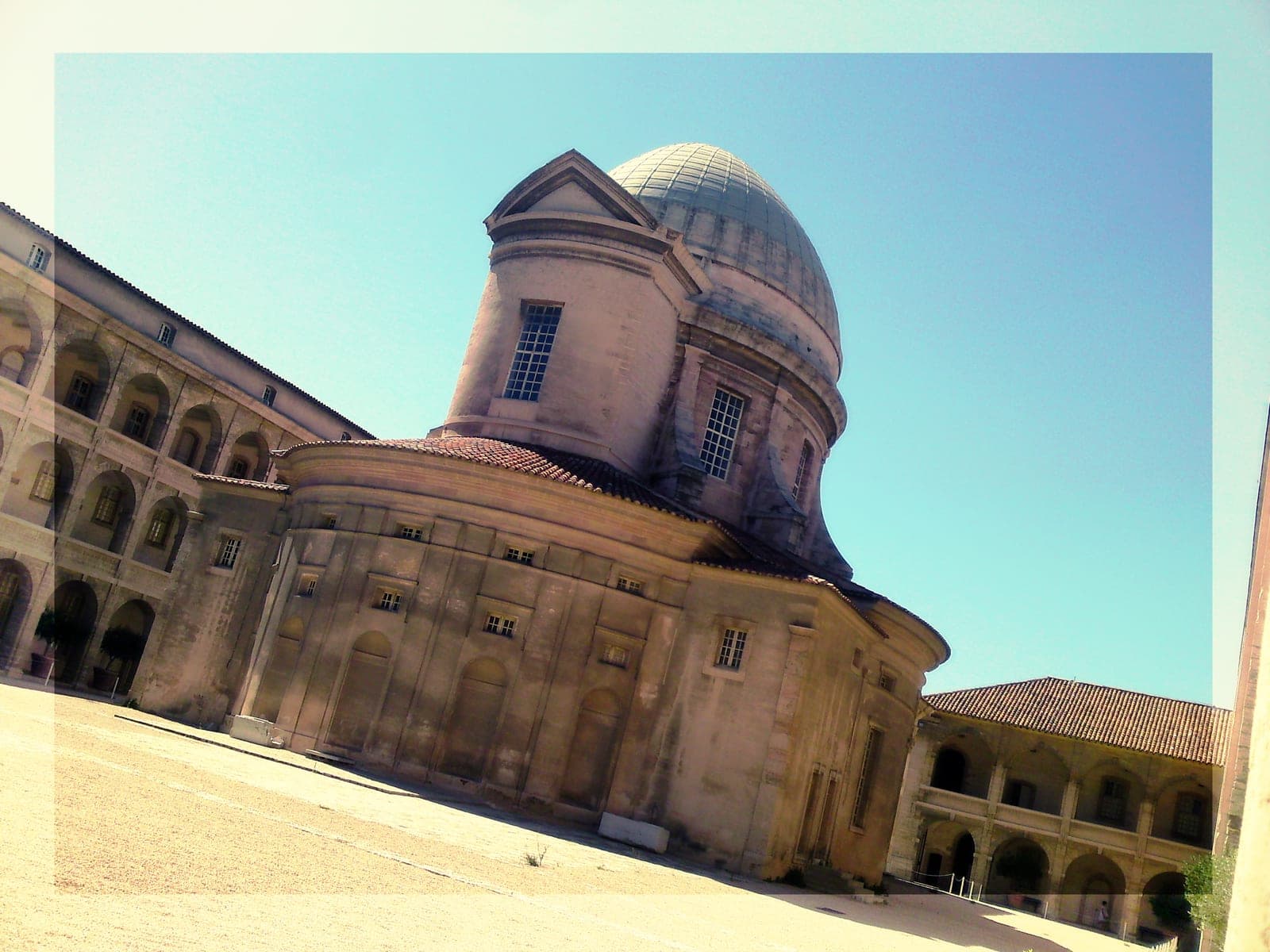
Pierre Puget's hospice, 1671 to 1749: three tiers of arcaded galleries round a courtyard with an oval domed chapel. Poorhouse, barracks, then homeless families, now museums.
A bookshop and tea room on rue Caisserie, wood panelling and a shaded terrace with a long list of leaf teas. A reading and talking place rather than a takeaway counter.
The Panier pizzeria, on rue de Lorette since 1943, wood oven at the back. No menu, no telephone, no cards, so bring cash and expect to wait. Full of people who live nearby.
The fish market on the quai de la Fraternite, about ten stalls every morning selling what came in overnight straight off the boats. Five minutes down the hill.
Checked August 2026. Places close and change, so tell us if something here is out of date.
Schools and families
The thing that decides it here is the pram. The lanes are steep, several are staircases, and the flat ground with the shops on it is at the bottom of the hill, so a school run from the upper streets is a climb both ways with whatever you are carrying. Families who make it work here tend to do it with a sling for the first two years and a child who walks early.
What the quarter does give a family is unusual for a city centre. Traffic is barely a factor in the lanes, which changes how much you have to watch a six-year-old. There are small squares, a shared garden and a playground inside the boundary, and the courtyard of the Vieille Charité is a large, calm, walled space where children can actually run. The water is close: the esplanade below the Cathédrale de la Major, the Fort Saint-Jean and the museum quarter are a few minutes downhill, and the city beaches are a bus ride rather than an expedition. The flat itself is the real constraint, because these houses are narrow and tall, so a third bedroom is rarer here than the prices would lead you to expect.
Being straight about which of those things a number can capture and which it cannot is why Apraiz builds these Marseille guides the way it does. Walk the exact route from the front door to wherever your day starts, uphill, carrying something, on a hot afternoon as well as a cool morning, before you sign a lease or purchase.
Kids Restricted. Honest answer: a pram is the problem. The lanes are steep, several of them are staircases, and the flat ground with the shops on it is at the bottom of the hill, so every trip home is a climb with whatever you are carrying. In its favour there are small squares and a shared garden inside the quarter, a courtyard at the Vieille Charité big enough for children to actually run in, the sea and the esplanade a few minutes downhill, and a quarter where traffic is barely a factor. The flats are the other constraint: old, tall, narrow and usually walk-up, so a third bedroom is rarer here than the prices suggest.
Pet Restricted. Workable for a small dog and hard work for a large one. The quarter is almost car-free in practice, which is a real advantage, and the quays, the parvis of the Major and the esplanade below are a proper walk. Against that: there is next to no green inside the boundary, the whole place is stone and stairs, a lift is the exception rather than the rule in these buildings, and the lanes hold heat all through a Marseille August. Every walk that ends at home ends with a climb.
Green space, leisure and eating out
Green space is the quarter's thinnest resource and there is no point dressing it up. What exists is small and worth knowing: the jardin Francis Chirat at the top of the hill, the little green space by the library, the shared garden the residents run, and a couple of squares with a bench and a plane tree. Everything larger is outside the boundary. The esplanade below the Major, the Fort Saint-Jean and the walk out along the sea wall are the real open air, the parc du Pharo is a walk around the basin, and the calanques are not a local amenity at all: reaching them means crossing the city, metro plus a bus to Luminy, or the train from Saint-Charles toward Cassis. Living here means the sea is close and nature is not.
Culture, on the other hand, is absurdly dense for a quarter this size. The Centre de la Vieille Charité, begun in 1671 to Pierre Puget's plans and finished in 1749, is three storeys of arcaded galleries around a domed oval chapel, and it holds the archaeology and the African, Oceanian and Amerindian arts museums along with a cinema and a café. It was a hospice, then army property in 1905, then housing from 1922, and it took families made homeless by the 1943 demolitions; it was nearly lost before Le Corbusier drew the city's attention to it, and restoration ran from 1961 to a chapel finished in 1981 and a full reopening in 1986. Below the hill sit the Cathédrale de la Major, the MuCEM and the Fort Saint-Jean, so a resident here has a national museum within ten minutes on foot.
Eating and drinking splits by height. The quai du Port below is terraces, tourists and traffic noise; the lanes above are smaller, quieter and where the actual dinners happen, from the pizza at Chez Étienne on the rue de Lorette to a dozen small rooms around the place de Lenche and the rue du Panier. Two seasonal facts to price in. In July and August the lanes carry a steady flow of visitors and guided groups from about ten in the morning, in streets narrow enough that two people with backpacks constitute a queue. And on a warm night, sound in a lane two metres wide goes straight up the façade and in through your window, so view any flat here in the evening, not at eleven on a Tuesday morning.
What it costs
The number to start from is 3 052 EUR / m² ≈ $330 / sq ft, the median price per square metre actually paid across 76 recorded apartment sales inside these four IRIS in 2025. That is DVF, the register of what was really paid, not an asking price. The same median over flats sold with nothing attached, no cellar and no parking space, is 2,981.
Treat that figure with more care than most on this site, because 76 sales is the thinnest pool of the five Marseille districts covered here. It is enough to publish and it is not enough to rank with: a gap of about 100 EUR/m² between this district and another is noise, not a finding.
What the wider numbers do support is a much bigger point. Across the five districts covered here the 2025 medians run from 2,774 EUR/m² in the Joliette to 5,074 in Endoume, and Endoume is 83% above the Joliette while sitting about four kilometres away. That is the widest spread of the three French cities covered so far, and it is the honest headline: Marseille is not priced as one market. The north and the south of the city trade as two different things, and a figure quoted for "Marseille" without a district attached tells you almost nothing.
On rent the advertised number comes first, and it needs its label read carefully. The 2025 Carte des loyers puts asking rents in the 2e at 16.6 EUR/m² a month, and three things follow. It is an asking rent modelled from listings rather than a rent anyone is recorded as paying. Charges are included in it and cannot be pulled back out, so a building with heavy communal costs is flattered by the comparison. And it is published per arrondissement, so it covers the whole 2e: the Joliette carries exactly the same 16.6, not because the two districts are identical but because nothing finer than the arrondissement exists. Marseille is also not in the encadrement des loyers experiment, so unlike Paris and Lyon there is no legal ceiling for a listing here to breach.
The rent people actually pay is published at a finer grain than that, and it is the sharpest thing on this page. The Bouches-du-Rhône rent observatory splits these four streets-worth of hill across four of its zones: 12.9 EUR/m² a month at Dames, 12.7 around Charité-République, 12.0 in the Panier proper and 11.2 in Les Carmes, all excluding charges. One district, four different rental markets, and the cheapest of them is the second cheapest zone in the whole department. Set that against a single advertised 16.6 for the entire 2e and you can see how little an arrondissement figure tells you about a street here.
Finally the ratio, which is the part a listings site never shows you. Against a typical income across this district's small statistical areas of 15,220 EUR a year, one square metre at the 2025 median costs almost exactly a fifth of a full year of it. That is the arithmetic behind who buys on this hill and who rents, and it is the reason a low price per square metre and an affordable district are not the same thing here.
Weather and climate
Seasonal averages for Marseille, one representative month per season. Météo-France 1991-2020 normals for station Marseille-Marignane, the official station for the city, read 12 August 2026 via Infoclimat. Seasons are the representative months: January, April, July and October. Sunshine hours a day are the monthly totals divided by the days in the month (January 147.9 h, April 250.8 h, July 372.2 h, October 196.1 h). Annual figures: mean daily maximum 20.7 °C, mean daily minimum 11.1 °C, 532.3 mm of rain and 2,897.6 hours of sunshine. Rain days are left null because the monthly count of days at or above 1 mm is not filled in on the published normals table. What the numbers say about living here: this is the sunniest big city in France, close to 2,900 hours a year, and the driest, 532 mm of rain in a year against 820 mm in Lyon, with July averaging under 11 mm across the whole month. Summer is genuinely hot, 30.7 °C by day in July, and winter is mild, an 11.8 °C January day and a mean minimum of 3.6 °C. The station sits by the étang de Berre rather than in the city, so it misses the sea moderation on the corniche and the mistral is not in these numbers at all, though it is the thing residents talk about most.
The honest downsides
Everything you own has to come up the stairs, and so does everything you buy. The lanes are steep, several are staircases, and a lift in these buildings is the exception. That turns ordinary life into logistics: shopping, prams, deliveries, bicycles, bin day, and a removal that gets quoted differently here than anywhere flat, often with a sofa going through a window. Indoors it continues. Rooms are narrow and tall, party walls are shared, a north-facing lane wall can hold damp all winter, and a top floor under an old roof in August, in a quarter of stone that gives its heat back all night, is punishing without something fitted to cool it. The Vieux-Port district around the basin is flat; this one is not, and no amount of charm changes what a crate of water weighs on the fourth floor.
It is one of the most photographed quarters in France and also a poor one, and both of those show on the street. In high summer the lanes carry a steady stream of visitors and guided groups through streets that were built for handcarts, past doorways people actually live in, and short-let flats take stock out of the residential market in a district that has little to spare. Underneath the photographs the numbers are hard: a typical income across these small areas of 15,220 EUR a year, the second lowest of the five districts covered here, and an arrondissement that records theft from the person at 504.6 per 10,000 residents against a national 91.0, and violence inside the family at 79.6 against a national 37.6, the highest figure in the French set. None of that makes the quarter unliveable, and plenty of people have lived here happily for decades. It does mean anybody moving here on the strength of a photograph of a painted staircase is deciding on the wrong evidence.
Crime and safety
The boundary comes first, because it is not this hill. France's finest published grain for Marseille is the arrondissement, so every figure here covers the whole 2e. The 2e is not only the Panier: it runs north through the Joliette and Arenc to the working port, which is why the Joliette article carries an identical set of numbers. Neither page is a measurement of its own streets, and saying so is the only honest way to publish them.
The denominator matters as much as the boundary. These are rates per resident: offences recorded in the arrondissement, divided by the people who sleep there. The central arrondissements of Marseille have small resident populations and enormous daytime footfall, and the 2e holds the north quay of the Vieux-Port, the cathedral, the museum quarter and the ferry and cruise terminals. That is most of the reason the 1er, 2e and 6e read at three to five times the city rate.
With that stated, the shape is clear. Theft from the person runs at 504.6 per 10,000 residents, against 193.2 for Marseille and 91.0 nationally. Non-domestic assault is 100.1 against 50.3 for the city and 31.6 nationally, and unarmed robbery is 63.6 against 28.8 and 7.2. That is a crowd-and-street-theft profile, concentrated where the crowds are, which in practice means the quays, the tram stops and the busy approaches rather than the upper lanes.
Two indicators need separating from that. Home burglary is 9.9 per 1,000 dwellings, a different base that must be read on its own, against 9.3 for Marseille and 5.6 nationally, so close to the city level and above the French one. And violence inside the family sits at 79.6 per 10,000 residents against a national 37.6, more than double, and the highest figure in the French set covered here. That indicator counts victims, which means it moves with how much gets reported as well as with how much happens, and a high figure can reflect either. It should not be quietly folded into a street-safety impression, and it should not be left out either. The four indicators are never added together, because SSMSI counts them in three different units.
In practice, treat the quays and the tram stops the way you would treat any busy city centre in Europe, keep your phone in a pocket you can feel, and understand that a second-floor flat behind a locked lane door is a different proposition from a ground floor opening onto the tourist route.
Is this you?
If you want to live inside the oldest part of a great Mediterranean city, on foot, with a fish market five minutes down the hill and a national museum ten, and you are honestly willing to climb to your own front door every day for years, the Panier is the best version of that in France. At 3,052 EUR/m² it is also, by the standards of central Marseille, not expensive.
If the stairs are the part you cannot live with, the Vieux-Port is the flat alternative around the basin, at 4,118 EUR/m², a cost level of 54 against 44 here, with a walking score of 87 and a getting-around score of 84 against 84 and 80. You gain level ground, the ferries and metro line 1; you give up quiet, because the quays carry traffic and tourist density all summer. If money is the binding constraint, the Joliette is the cheapest of the five at 2,774 EUR/m² and a cost level of 42, with two metro stations and six tram stops behind a getting-around score of 82, but a walking score of 72 and the lowest shopping score of the five at 60, and it carries the same 2e crime figures for the same reason this page does. If what you actually want is street life without the climb, the Cours Julien is the plateau above the Canebière at 3,468 EUR/m², walking 88 and shopping 84, with no park at all inside its boundary and the noise that comes with the densest bar street in the city.
Want to know what homes here are actually worth?
Join the waitlistHow we source this
How we put this together. Gathered on the ground by our local field team and written up by the Apraiz research team. Every figure above carries its own source and date. The scores are not computed by the build; walking and transport will use open map and transit data first, then Apraiz's own model. We update prices quarterly, transport and amenities twice a year, and school data when the source publishes.
Sources: DVF (Demandes de valeurs foncières), data.gouv.fr, Carte des loyers 2025, DHUP and ANIL, Observatoire des loyers des Bouches-du-Rhône, via the Observatoires des loyers network, INSEE, Filosofi 2021, SSMSI, bases statistiques communale et départementale de la délinquance enregistrée, Wikipedia (fr), Le Panier, Wikipedia (fr), Hôtel de Cabre, Office de tourisme de Marseille.
Safety and crime in Marseille →Nearby: Vieux-Port · Cours Julien · Endoume