
Long Story ShortReadHide
- What it is: three quarters on the right bank of the Saône, Saint-Paul, Saint-Jean and Saint-Georges, under the Fourvière hill: a Renaissance quarter of about half a square kilometre, protected since 1964 and visited by everyone who comes to Lyon.
- Who it suits: people who want to live inside the oldest, handsomest streets in the city, walk everywhere, and will trade a lift, a supermarket and a quiet Saturday for it.
- What it costs: 4 683 EUR / m² to buy, on the price actually paid in 104 recorded sales; sitting tenants pay 14.0 to 14.4 EUR/m² a month excluding charges, while listings ask 16 EUR / m² across the 5e with charges included.
- What people complain about: the weekend crowds on rue Saint-Jean, the stairs, and how far you walk for a proper food shop.
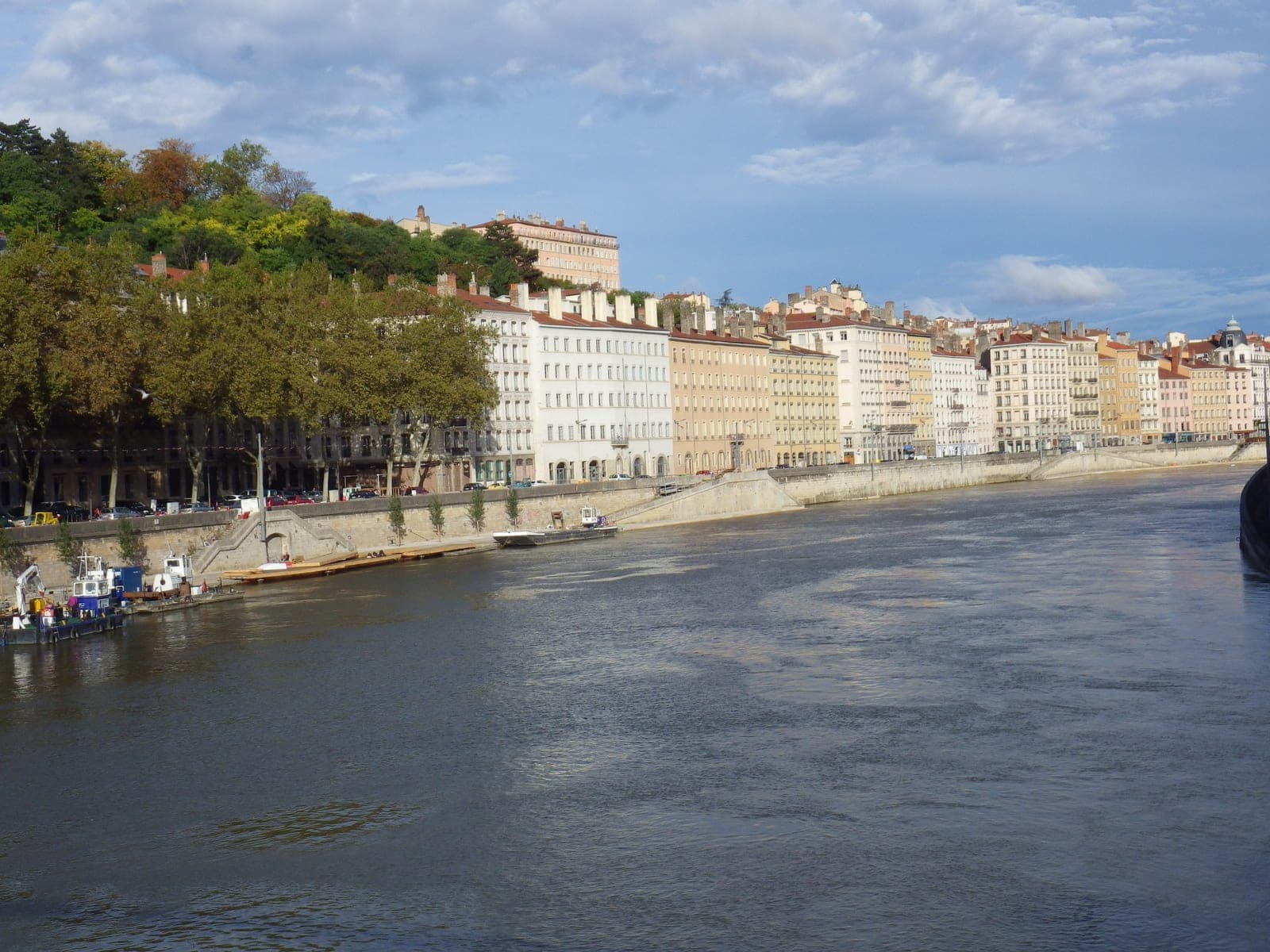
First impressions
Vieux Lyon is not one place, it is three, laid end to end along the right bank of the Saône under the hill of Fourvière. Saint-Paul at the north end, around the church and the little railway station. Saint-Jean in the middle, with the cathedral, the main pedestrian street and almost all of the visitors. Saint-Georges at the south end, quieter, narrower, and where most people who actually live here would tell you to look first. Those three are the boundary behind every figure on this page.
The first thing that surprises people is the scale. This is a small district, the smallest of the five Lyon quarters Apraiz covers, and you can walk from the gare Saint-Paul to the church of Saint-Georges in a quarter of an hour without hurrying. Everything is close because everything was built before anyone owned a carriage.
The second is the building stock, which is unlike anywhere else in France. These are Renaissance houses, four to six floors of stone with courtyards behind them, spiral staircases inside them, and traboules cut straight through them from one street to the next. It is beautiful and it is a set of practical facts you will live with: lifts are rare and hard to add to a listed building, the stairs are stone and steep, the windows are small, the walls are thick, and the ground floors and courtyards on the river side can be damp. Ask about the damp. Ask about the stairs. Ask which floor.
The third is the hill. Fourvière rises immediately behind the district to the west, which means the sun goes off these streets early on a winter afternoon and the district is genuinely sheltered from the wind that funnels down the Rhône corridor on the other side of town. It also means that the walk up to the basilica, the Roman theatres and the gardens starts at the end of your own street, either by a long staircase or by the funicular.
And the fourth is the noise, which nobody mentions until they have signed. On a Saturday in season, rue Saint-Jean is a slow-moving crowd. In the evening it is terraces and groups, and after midnight it is wheeled suitcases on cobbles, which is a sound that carries up a stone canyon remarkably well.
Who lives here, and what the streets look like
A typical figure across the district's small statistical areas is 26,440 EUR a year of disposable income per consumption unit, the median of its three IRIS medians in Filosofi 2021, none of them suppressed. It is unweighted, so read it as a level rather than as a precise average of the people here. What it describes is a comfortable but not wealthy quarter: professional couples, long-settled owners who bought before the quarter became a destination, people who work in the restaurants and hotels of the district itself, and the short-term lets that any quarter this visited attracts.
Households are small. The stock is small: Renaissance and seventeenth-century buildings divided and redivided into flats, with the largest apartments in the grand houses on the rue Juiverie and the rue du Bœuf and a great many one and two-room flats everywhere else. Families with school-age children are visibly thinner on the ground here than in the Croix-Rousse or the Guillotière, and the reason is mostly the floor plan.
The three streets that carry the district run parallel to the river. Rue Saint-Jean is the spine and the busy one. Rue du Bœuf, one block west, is the same architecture with a fraction of the crowd, and holds the tour rose and the cour des Loges behind their doors. Rue Saint-Georges continues south past the church into the quietest part of the quarter. On the water side, quai Romain Rolland and quai Fulchiron are traffic streets with a walkway below them, and on the north end the place du Change and the rue Juiverie are where the merchants and the money were in the sixteenth century, which is why the doorways are the size they are.
Two practical questions on every viewing, in this order. Which floor and is there a lift. And which street: a flat on rue du Bœuf and a flat on rue Saint-Jean, thirty metres apart, are two different lives on a Saturday.
Getting around
The district has one metro station, Vieux Lyon, on line D, and it does most of the work. Line D is the driverless line that runs under the Saône and the Presqu'île, so Bellecour is one stop and the Guillotière, Saxe-Gambetta and Gare de Vénissieux follow. Change once for the Part-Dieu side of the city, where the offices actually are: the Presqu'île is the shopping and eating heart of Lyon, but the working day for a lot of people happens across the Rhône.
The same station building holds the two funiculars, the ficelles: one up to Fourvière, one up to Saint-Just, both part of the TCL network and covered by an ordinary ticket. That matters more than it sounds. They are how you get up the hill with shopping, and the Saint-Just line is a real commuter route for people living on the plateau above.
At the north end, the small gare Saint-Paul is the terminus of the western suburban lines, useful if your work takes you out toward Tassin, Brignais or Sain-Bel and irrelevant otherwise.
On foot, the district is a walk from a great deal of Lyon. The footbridges and the pont Bonaparte put the Presqu'île five to ten minutes away, and the Saône walkway runs flat and car-free for a long way north and south, which is the pleasant way to walk to the Confluence or up toward the Croix-Rousse.
Cycling is a two-part answer. Along the river it is easy and well provided for, with lanes and Vélo'v stands on the quays. Inside the quarter it is not: the cobbles are punishing, the streets are full of people, and the moment you turn west you are climbing Fourvière, which defeats an ordinary bike. Driving is worse. The old streets were not built for cars, several are closed to them, parking is scarce and expensive, and a resident permit does not conjure a space. Most people who live here well do not keep a car.
Typical weekday minutes from Place Saint-Jean, with the icon showing how. Measured door to door for a typical weekday morning from the place Saint-Jean, in front of the cathedral; the icon shows the fastest sensible way., 2026-08.
Daily life
This is the honest weak spot of the district. There are very few food shops inside these three quarters, and a great many restaurants, and the ratio tells you what the ground floors have been given over to.
What you get day to day is the small-format city supermarket, a Carrefour City or a Franprix sort of shop, plus a good baker, a butcher, a couple of greengrocers and a cheesemonger scattered along rue Saint-Jean and the quays. That covers dinner. It does not cover a weekly stock-up, and for that people cross the water: the Monoprix on rue de la République and the bigger formats of the Presqu'île are one metro stop or a walk over the bridge.
The market matters more than the supermarket in Lyon, and the one this district uses is straight across the Saône: the marché Saint-Antoine, the long food market on the quai that runs most mornings of the week. It is a five-minute walk from the cathedral over the footbridge, and it is the reason the thin shopping inside the boundary is survivable. For the full Lyon version of a market morning, the boulevard de la Croix-Rousse market is the one everybody means, and it is across the water and up the other hill, a metro ride rather than an outing.
For delivery, Uber Eats and Deliveroo both cover the district.
One local thing to plan for. The fête des Lumières takes over central Lyon for four nights in early December, around the 8th, and this quarter and the hill above it are at the centre of it. Streets close, the metro and the funiculars run at capacity, and getting home with shopping on those evenings takes planning. It is wonderful. It is also four nights when your front door is inside somebody else's event.
Local Places Worth Knowing
Independent and close by, chosen on merit. Nobody pays to appear here.
Two museums in one Renaissance mansion off place du Petit College: the history of Lyon downstairs, the world puppet collection above. The hanging garden is the resident's reason.
A bouchon on rue Tramassac run by a Meilleur Ouvrier de France, doing the Lyon repertoire straight. Bouchons here run from serious to souvenir; this is the serious end.
An old room on rue du Boeuf whose weekday lunch menu is the best value in the district. Where people who work nearby actually eat, in a street of boards aimed at visitors.
The bakery by the law courts, with a queue out of the door most mornings and a pain au levain worth it. In a quarter with few food shops, a good baker is not a luxury.
Checked August 2026. Places close and change, so tell us if something here is out of date.
Schools and families
For small children the quarter works better than its reputation. Maternelles and élémentaires sit inside the boundary, the walk to them is short and mostly car-free, and the flat, wide Saône walkway is the everyday outdoor space, with the Fourvière gardens up the funicular for a Sunday.
The change comes with the lycée. There is no lycée inside Saint-Paul, Saint-Jean or Saint-Georges, so a teenager here leaves the district for school, most often across the river to the Presqu'île or up the hill in the wider 5e. French lycée placement follows sector rules and school choice rather than the nearest front door, so if you are moving for a particular school, ask the rectorat and the mairie about the exact address rather than about the neighborhood.
The other family question is the flat, not the school. A third bedroom in a Renaissance building usually comes with a stone spiral staircase and no lift, and the quarter's small flats are what keep the price where it is. Working out what your money actually buys per square metre, in this district against the ones you are also considering, is the whole reason Apraiz builds these Lyon guides the way it does, and it is worth walking these streets at 23:00 on a Saturday as well as at 09:00 on a Tuesday before you sign a lease or purchase.
Kids Restricted. There is more here for small children than the postcards suggest, and less for teenagers. Maternelles and élémentaires sit inside the quarter, the quays are flat and car-free for a long stretch, the funicular is a daily treat that costs a normal ticket, and the museums are on the doorstep. Against that: no lycée stands inside the district, so a teenager commutes; the cobbles defeat a pram on rue Saint-Jean and rue du Bœuf; green space inside the boundary is small and scattered rather than a park; the flats are old, often walk-ups, and rarely large; and the weekend crowds turn the main streets into a queue.
Pet Restricted. Lyon is easy about dogs and the walk above the district is genuinely good: the montées and the gardens on the Fourvière slope start at the top of the street, and the Saône quays run flat for kilometres in both directions. What is against it is the ground you cross to get there. The streets are cobbled, narrow and pedestrianised in name rather than in fact, the weekend crowds on rue Saint-Jean are shoulder to shoulder, and the buildings are Renaissance blocks of four to six floors reached by a stone spiral staircase, which is a hard daily climb for an older or a large dog. A small dog and a routine work here. A big one wants the plateau or the riverbank.
Green space, leisure and eating out
Green space inside the boundary is thin and comes in small pieces: courtyards, a few squares, planting along the quays. The real open space is on two edges. The Saône walkway runs below the quais Romain Rolland and Fulchiron, flat and car-free, and it is where the district runs, cycles and walks the dog. And the Fourvière slope starts at the top of the street: the montée des Chazeaux and the montée du Gourguillon are staircases rather than paths, and above them are the gardens, the Roman theatres and the view over the whole city.
Leisure is unusually dense for a quarter this size. The cathédrale Saint-Jean with its astronomical clock, the archaeological garden beside it, the Musées Gadagne, the Roman theatres and the Gallo-Roman museum on the hill, the puppet theatres, the cinemas and concert rooms across the river, and the traboules themselves, a number of which are open to walk through. Living here means most of this is free and on your way home.
Eating out is where you have to be a local rather than a visitor. This quarter has an enormous restaurant trade for its size, and it is aimed squarely at people who are here for two days. The genuine bouchons, the small Lyon restaurants serving quenelle, andouillette, tablier de sapeur and cervelle de canut, are worth learning to spot, and the tell is a short handwritten card, a room full of people speaking French, and prices that are not printed on a board in four languages. Away from rue Saint-Jean, the streets around Saint-Georges and the quiet end of rue du Bœuf are where residents eat, and the Presqu'île is five minutes away when you want something that is not Lyonnais at all.
What it costs
The number to start from is what people actually paid: 4 683 EUR / m², the median of 104 recorded apartment sales inside these three quarters in 2025, from the state's own register of transfers rather than from asking prices. It is the smallest sales pool of the five Lyon districts here, where the Croix-Rousse recorded 639, so read it as a firm level rather than a precise one. Where a cellar or a parking space came with the flat, the recorded price includes it: the same median over flats sold with nothing attached is 4,581 EUR/m².
The useful thing about the Lyon numbers is how close together they are. The five districts Apraiz covers sit within 7% of each other, from 4,597 in the Guillotière to 4,919 in the Presqu'île. Central Lyon is priced as one market, and the difference a buyer feels is the building, the floor and the view, not the district. Nobody should pay a premium for a postcode here, and nobody should expect a bargain from one either.
Put that against the income. At 4,683 EUR/m², a 45 m² one-bedroom is roughly 211,000 EUR, about eight times the 26,440 EUR a year that a typical one of this district's small statistical areas records as median disposable income per consumption unit. That is the arithmetic worth doing against your own salary rather than against a listing, and it is the reason a small flat here changes hands more often than a large one.
On renting there are two figures, and the difference between them is the point. What sitting tenants actually pay is 14 EUR / m² a month in Saint-Jean and 14 EUR / m² in Saint-Paul and Saint-Georges, excluding charges, from the Lyon rent observatory's 2024 survey of the occupied private stock. Those are medians with real spread behind them, quartiles of 12.4 to 16.3 and 12.3 to 16.1, so a quarter of flats let for less than about 12.4 and a quarter for more than about 16.3. The observatory works at the scale of its five city zones rather than by quarter, which is why this district carries two numbers instead of one.
The asking rent is the other figure: 16 EUR / m² a month, charges included, modelled from listings for the whole 5e. It is not the same quantity, and the gap is not a scandal: an advert asks more than a lease signed three years ago, and the charges sit inside the advertised number and cannot be pulled back out. Read the paid figure to know what the street costs to live on, and the asking figure to know what you will be quoted. It is the lowest of the five Lyon districts here, which run from 15.8 to 17.6 on the same file and method, partly because the 5e stretches well beyond this quarter into Point du Jour and Ménival.
One thing a tenant should know before signing, and it comes with a number. Lyon caps rents under the same time-limited national scheme as Paris. The arrêté in force, DDT 69-2025-10-23-00004, runs from 1 November 2025 to 31 October 2026, and a listing above the ceiling for its own category of flat is unlawful. For an unfurnished two-room flat built before 1946, which is most of what is let here, the ceiling is 18.0 EUR/m² a month in Saint-Jean and 16.9 in Saint-Paul and Saint-Georges. Those are ceilings, not going rates: what tenants actually pay sits around 14.0 to 14.4. The cap is set per zone, per room count, per building era and per régime, so the only figure that matters is the one for the exact flat, and the landlord must state it in the lease.
Weather and climate
Seasonal averages for Lyon, one representative month per season. Météo-France 1991-2020 normals for station Lyon-Bron, the reference station for the city, read 12 August 2026 via Infoclimat. Seasons are the representative months: January, April, July and October. Sunshine hours a day are the monthly totals divided by the days in the month (January 71.1 h, April 197.7 h, July 288.1 h, October 131.4 h). Annual figures: mean daily maximum 17.5 °C, mean daily minimum 8.6 °C, 820.8 mm of rain and 2,049.5 hours of sunshine. Rain days are left null because the monthly count of days at or above 1 mm is not filled in on the published normals table. What the numbers say about living here: Lyon is a degree or so warmer than Paris by day and colder at night in winter, with a January mean minimum of 1.1 °C, so frost is routine rather than occasional. It is also markedly sunnier, about 2,050 hours against 1,717 in Paris, and July days average 28.2 °C, which in a dense stone city with a river through it is felt as real summer heat. October is the wettest month at 99.8 mm, not the winter, which is the Rhône valley pattern rather than the northern one.
The honest downsides
You would be living inside the most visited quarter in Lyon, and the crowd does not stop at the shopfront. Rue Saint-Jean on a Saturday afternoon in season is a queue, the streets between the cathedral and the funicular are the busiest few hundred metres in the city, and a large part of the ground-floor trade exists for people who will be gone by Monday. That is why the food shopping is thin, why the restaurant boards are in four languages, and why the noise at midnight is suitcases and groups rather than neighbors. It also means four nights in December when the whole thing is dialled up. Choose the street carefully: Saint-Georges and rue du Bœuf are a different proposition from Saint-Jean.
A Renaissance building is a beautiful place to live and an expensive one to run. Lifts are rare and cannot easily be retrofitted into a protected staircase, so the cheap flats are at the top of four to six floors of stone steps. Windows are small and often listed, which limits what you can change and what you can insulate. Ground floors and courtyard flats on the river side can be damp. And the same protection that keeps the quarter standing means works go through the heritage process, which is slower and dearer than a normal renovation. The compensation is real, thick walls hold the heat out in summer, but nobody should buy here expecting to solve a problem with a weekend and a builder.
Crime and safety
Every crime figure here is an arrondissement figure, because the arrondissement is the finest grain France publishes. It covers the whole 5e, which is far bigger than this district: Fourvière, Saint-Just, Point du Jour and Ménival are all inside the number, and those are residential hillside streets rather than the quarter this article describes.
The shape is unusual and worth reading properly. Theft from the person runs at 229.8 per 10,000 residents, against 393.2 for Lyon as a whole and 91.0 for France. That is the lowest of the five Lyon districts Apraiz covers, and it is still two and a half times the national rate. Unarmed robbery is 25.5, against 61.0 for Lyon and 7.2 nationally, again the lowest of the five here. Non-domestic assault is 32.7, against 53.1 for Lyon and 31.6 nationally. Domestic violence is 23.2, below both Lyon at 28.5 and France at 37.6, and all five Lyon districts here sit below the national rate on that indicator.
The exception is the one that touches a home. Home burglary is 8.4 per 1,000 dwellings, against 6.9 for Lyon and 5.6 for France, so this is half again the national rate and the highest of the five Lyon districts Apraiz covers. Note the different denominator: burglary is rated per 1,000 dwellings, the basis the ministry itself uses, and it cannot be read on the same scale as the four figures above. Put the two facts side by side and you have the honest picture of the 5e: comparatively little happens to people on the street here, and comparatively more happens to their front doors. In a quarter of old buildings, shared courtyards, doors propped open for deliveries and a constant flow of strangers who have a legitimate reason to be in the street, that is not a surprise. It is an argument for taking the door, the lock and the ground-floor flat seriously.
Two cautions on the arithmetic. The denominator is people who sleep in the 5e, and this arrondissement mixes a heavily visited riverside quarter with a quiet residential hillside, so the average softens the visited half and overstates the residential one. And there is no total to quote: France counts these indicators in three different units, an infraction for burglary and robbery, a victime for assault and domestic violence and a victime entendue for theft from the person, so adding the rows would be adding victims to offences.
Is this you?
If you want to live inside the best-preserved Renaissance quarter in France, walk to everything, take a funicular home with the shopping and eat in a proper bouchon on a Tuesday, this is the address in Lyon and there is no substitute for it. It suits a couple or a single professional, it suits someone who works on the Presqu'île or one metro change from Part-Dieu, and it suits anybody who would rather have a courtyard and a stone staircase than a lift and a balcony.
If what draws you is the old streets and the sense of a real neighborhood, but the weekend crowds and the thin food shopping are what you keep catching on, look at the Croix-Rousse instead. It has the highest quality-of-life score of the five Lyon districts Apraiz covers, five markets including the boulevard, and a cost level a point below this one, so you are not paying for the trade. You give up the cathedral at the end of the street and the metro at the door, and you take on a hill of your own.
Want to know what homes here are actually worth?
Join the waitlistHow we source this
How we put this together. Gathered on the ground by our local field team and written up by the Apraiz research team. Every figure above carries its own source and date. The scores are not computed by the build; walking and transport will use open map and transit data first, then Apraiz's own model. We update prices quarterly, transport and amenities twice a year, and school data when the source publishes.
Sources: DVF (Demandes de valeurs foncières), data.gouv.fr, Carte des loyers, DHUP and ANIL with leboncoin and Groupe SeLoger, via data.gouv.fr, Observatoire local des loyers de l'agglomération lyonnaise (Urbalyon), via the Observatoires des loyers network, Préfecture du Rhône, published as open data by the Métropole de Lyon, INSEE, SSMSI, via data.gouv.fr, Wikipedia (en).
Safety and crime in Lyon →Nearby: Presqu'île · Croix-Rousse · Confluence