
Long Story ShortReadHide
- What it is: the hill above Lyon, in two halves. A flat plateau in the 4e with a market down the middle of its boulevard, and the pentes dropping into the 1er in steep streets and staircases.
- Who it suits: someone who wants a village on top of a city, will do the climb every day, and would rather have the market and the view than a flat street.
- What it costs: 4 853 EUR / m² ≈ $520 / sq ft to buy; sitting tenants pay 14.0 to 14.4 EUR/m² a month excluding charges, while listings ask 17.1 in the 1er and 16.9 in the 4e.
- What people complain about: everything ends in a climb, the buildings are beautiful and hard work, and you pay central Lyon prices while the offices are at Part-Dieu.
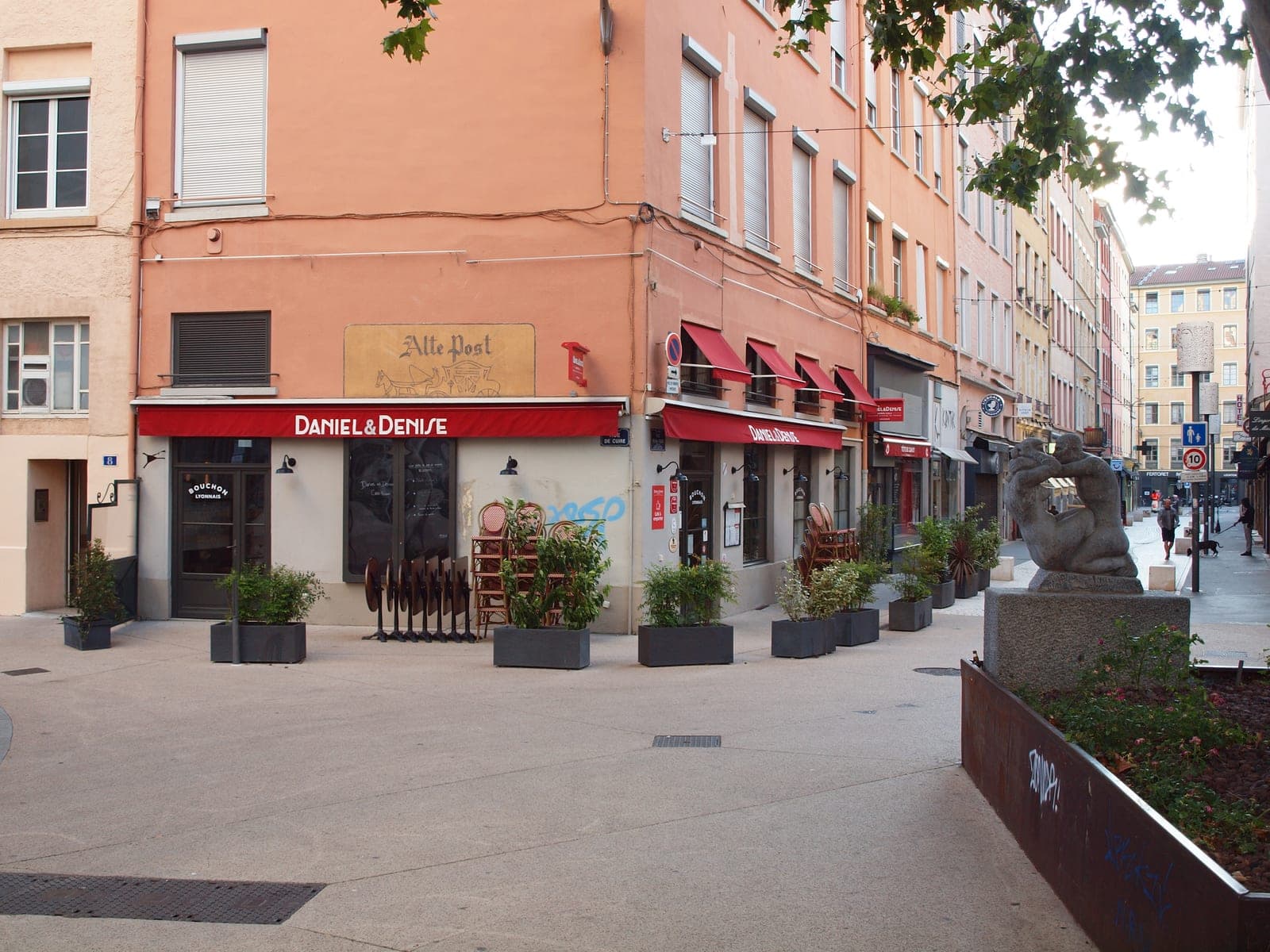
First impressions
Lyon publishes no boundary for "la Croix-Rousse", so this article uses a named set of INSEE's statistical areas: 18 IRIS, 2.50 km², the pentes climbing out of the 1er and the plateau in the 4e. Lyon talks about it as one hill and prices the two halves differently, which is why this page keeps saying which half it means.
The first thing you notice is that the hill is a working object rather than a view. Lyon's two hills got their nicknames from what happened on them: Fourvière is la colline qui prie, the hill that prays, and this one is la colline qui travaille, the hill that works. Silk did the working. The canuts, the weavers, moved up here in the early nineteenth century, and the buildings went up around their looms: tall windows, ceilings around four metres because a Jacquard loom stood about that high, floors braced with oak beams. The canut revolt of 1831 started in these streets and is generally counted among the first workers' uprisings anywhere.
The second thing is the seam. The boulevard de la Croix-Rousse was laid out in 1865 along the line of the demolished ramparts, and until a decree of 24 March 1852 it marked the edge of a separate town of about 30,000 people. It still reads that way. North of it the plateau is level, wide and ordinary in the best sense. South of it the pentes fall away in montées, ramps and staircases, and the montée de la Grande Côte is the one everybody uses, straight down toward the Terreaux with a view over the roofs at the top.
The third thing is the doors. The pentes are threaded with traboules, covered passages and stairwells cut through the blocks so that silk could be carried down the hill under shelter. The Cour des Voraces off place Colbert, with its monumental open staircase, and the passage Thiaffait are the two most people know. They are not a museum. Many are in use, several are private, and some open on a code.
One boundary detail worth knowing before you fall in love with a listing: the UNESCO inscription of 1998 covers the pentes up to the boulevard, not the plateau beyond it. Same hill, two different sets of rules about what you may change.
Who lives here, and what the streets look like
The income figure for this district is 28,110 EUR a year. That is the median of the 17 usable IRIS medians inside the boundary, one being suppressed, on INSEE's Filosofi 2021 data. Read it as a typical figure across the district's small statistical areas rather than as a household survey of the Croix-Rousse: it is unweighted, so it runs above the published area median, and Lyon has no arrondissement anchor published beside it.
Who that is, in practice: people who have been up here for decades and call themselves croix-roussiens, a real population of artists, designers and small makers, families who chose the plateau on purpose and stayed, and renters filling the smaller flats in the pentes. The making is not decorative. The Village des Créateurs in the passage Thiaffait puts young fashion and design labels into workshops on the way down the hill, which is the same trade the pentes have always run, in different materials.
The building stock is the thing to look at hardest. A canut building gives you tall windows, ceilings near four metres and often a mezzanine cut into that height, which is why so many flats up here are sold as duplexes. It also gives you stone stairs, four or five floors and frequently no lift. Before you commit, ask which floor, ask whether the ascenseur exists at all, ask what a four-metre room costs to heat in February, and ask what the top floor is like in August with a zinc roof over it. The plateau mixes those buildings with later nineteenth and twentieth century blocks and some 1970s infill, so lifts are more common there than in the pentes.
Getting around
Three metro stations sit inside the boundary, all on line C: Croix-Rousse and Hénon on the plateau, Croix-Paquet down in the pentes. Line C is unlike anything else in the network. It began as a funicular, one of the ficelles that hauled Lyon up its hills, and it still climbs on a rack, which makes it the only rack-operated metro in the country. Croix-Paquet, on a gradient of about 17%, is regularly called one of the steepest metro stations in the world, and it is a slightly comic thing to use twice a day.
Buses run along the boulevard and across the plateau, and the Croix-Rousse tunnel under the hill gained a second tube in 2013 given over to buses, bikes and pedestrians, which is the sane way through if you are on two wheels.
For everything else, you walk, and the direction matters. Down to the Terreaux and the Presqu'île is a pleasure. Back up is a climb whatever you take, and the pentes have staircases where a street would be elsewhere. An electric bike changes this district more than it changes almost any other. A car is the weakest option: the plateau streets are narrow, resident parking is tight, and the pentes were laid out for handcarts and looms.
One geography point a newcomer misses. The offices are not below you in the Presqu'île, they are at Part-Dieu, east across the Rhône, so a working commute from here is usually a cross-city one rather than a walk down the hill.
Typical weekday minutes from Place de la Croix-Rousse, with the icon showing how. Times are measured door to door for a typical weekday morning from place de la Croix-Rousse; the icon shows the fastest sensible way., 2026-08.
Daily life
The market is not a weekend attraction here, it is the shopping. It sets up along the middle of the boulevard de la Croix-Rousse on Tuesday, Friday, Saturday and Sunday mornings, roughly 06:00 to 13:30, with the smaller market on the petite place covering most of the remaining mornings, so the only day without one is Monday. Fruit and vegetables, cheese, fish, charcuterie, bread, flowers and plants, at the volume of a district that actually buys its food this way.
Supermarkets are the backup rather than the plan. The Monoprix at 7 rue de Cuire, with a second entrance on boulevard des Canuts, is the big one on the plateau. There are Carrefour City branches on rue du Mail and rue Janin, a Casino Shop on the boulevard and a smaller Casino on place de la Croix-Rousse. Anything larger means going down the hill, and going down is the easy half of that trip.
What the district really runs on is the independent trade: bakers, cheesemongers, butchers, greengrocers and cave à vin on the Grande rue de la Croix-Rousse and around the place, at a density that is genuinely unusual for a French city centre. That is also the practical case for living on the plateau rather than in the pentes, because it is level ground with a trolley.
For delivery, Uber Eats and Deliveroo both cover the hill, and they are the two that matter in France.
Local Places Worth Knowing
Independent and close by, chosen on merit. Nobody pays to appear here.
About 1,200 m2 of trompe l'oeil on boulevard des Canuts that reads as a real staircase until you get close. Repainted twice since 1987, the painted people ageing each time.
The market along the boulevard, and the real centre of daily life up here rather than a weekend attraction. Tuesday, Friday, Saturday and Sunday mornings; Monday is quiet.
View on Google MapsA Lyon roaster's coffee shop in the pentes, pouring single-origin as espresso, V60 and Chemex since 2011. Where the city's specialty coffee habit started; sells beans too.
View on Google MapsA small room on rue Belfort going thirty years, formica bar and a wall of clocks. Traditional French with a quiet Japanese turn, at set-menu prices. Closed Sunday and Monday.
View on Google MapsChecked August 2026. Places close and change, so tell us if something here is out of date.
Schools and families
France publishes a school indicator worth understanding before you read the bar. It is the taux d'accès de la seconde au bac: of the pupils who start seconde at a given lycée, the share who go on to reach the baccalauréat at that same lycée. It is a better question than a raw pass rate, because a pass rate can be flattered by moving weaker pupils out before the exam and this cannot.
On that measure the seven lycées inside this district come out at 76, pooled over the 943 pupils who start seconde at them, so the biggest school counts for the most. The spread behind that number is the useful part, and it splits cleanly in two. The général et technologique route here is heavily private: Institution des Chartreux reaches 89 on a cohort of 317, Saint Louis-Saint Bruno 84 on 214, Aux Lazaristes La Salle 81 on 91, all three private under contract. The professionnel route is heavily public: Jacques de Flesselle 63 on 121 and Camille Claudel 53 on 68 are public, Diderot 50 on 76 is public, and Saint Louis-Saint Bruno professionnel 53 on 56 is private. The district's headline sits between two quite different systems, which is why the single figure tells a parent less here than the list does.
One caveat holds for all of it. A Lyon lycée recruits well beyond its own streets, so these numbers describe the schools that stand on the hill, not the children who live on it. Being straight about what a number measures and what it does not is why Apraiz builds these Lyon guides the way it does, and it is worth walking the school run yourself, uphill, at eight in the morning, before you sign a lease or purchase.
Kids Friendly. This is the family half of central Lyon and it does not pretend otherwise. The plateau has playgrounds, the parc de la Cerisaie, the widest pavements in the district along the boulevard, a market four mornings a week and seven lycées inside the boundary. Against that: the flats are canut buildings with tall ceilings and stairs rather than lifts, getting a pram up the pentes is a genuine obstacle rather than an inconvenience, and the general and vocational school routes here run through two quite different systems, so the choice needs looking at school by school rather than by the headline.
Pet Friendly. A good dog district, with one condition: your dog has to be able to do stairs, and so do you. The plateau is level, has wide pavements along the boulevard, and holds the parc de la Cerisaie and a run of small gardens, and the Rhône and Saône banks are a proper walk down and a long climb back. The pentes are the opposite: staircases, steep narrow streets and very little green until you reach the top. Add the building stock, where a fourth floor with no lift is normal, and a large dog becomes a daily piece of physical work rather than an occasional one.
Green space, leisure and eating out
Green space is one of the reasons people move up here and stay. The parc de la Cerisaie on the plateau is a former orchard around a bourgeois house, the jardins de la Grande Côte step down the slope in terraces, and there are small squares and playgrounds scattered across the plateau in a way the denser districts below cannot match. The jardin Rosa Mir is the oddity and the one to plan around: a 400 m² courtyard garden of stones and shells behind 83 Grande rue de la Croix-Rousse, built between 1957 and 1983 by Jules Senis, a Spanish republican exile and tiler, listed as a monument historique since 1987, and open on Saturday afternoons in the warmer half of the year. And the edge of the plateau is a viewing gallery over the whole city, which is what the Gros Caillou end of the boulevard is really for.
History up here is not behind glass. The amphithéâtre des Trois Gaules, at the foot of the slopes, was built in 19 AD by C. Julius Rufus for the assembly of the Gallic tribes and later enlarged; it is where Blandina and Pothinus were martyred in 177 AD, and it has been a listed monument since 1961. The Maison des Canuts on rue d'Ivry still runs nineteenth-century Jacquard hand looms for visitors, which is the fastest way to understand why the ceilings in your flat are so tall.
Eating and drinking splits by half. The plateau is bistros, bouchons, wine bars and a few good tables around the place and the Grande rue, and it goes quiet at a civilised hour. The pentes get louder the further down you go, until you reach the bar streets around the Terreaux at the bottom, which are loud at the weekend in the way any city-centre bar street is. If you are viewing a flat in the lower pentes, view it late on a Saturday, not on a Tuesday afternoon.
Two seasonal things. In December the fête des Lumières fills the Presqu'île and Fourvière with installations, and the hill keeps the older habit of lumignons, small candles in the windows, along with a share of the crowd walking up and down. And the plateau is exposed, so when the wind comes down the Rhône corridor in winter it finds you up here well before it finds the streets below.
What it costs
The number to start from is 4 853 EUR / m² ≈ $520 / sq ft, the median price per square metre actually paid across 639 recorded apartment sales inside these 18 IRIS in 2025. That is DVF, the register of what was really paid, not an asking price. It is also the deepest sales pool of the five central Lyon districts we cover, which makes it the most solid of the five medians. The same median over flats sold with nothing attached, no cellar and no parking space, is 4,679.
Now the honest headline, and it is not a ranking. The five central districts run from 4,597 to 4,919 EUR/m², a spread of under 7%. Central Lyon is priced as one market, and the difference a buyer actually feels is the building, the floor and the view rather than the name of the district. Anyone selling you a Croix-Rousse premium over the Presqu'île is selling you about 300 EUR/m².
Rent needs two numbers here, because the district spans two arrondissements and the source publishes them separately. On the 2025 Carte des loyers the 1er asks 17.1 EUR/m² a month and the 4e asks 16.9. Two things to hold on to. These are modelled asking rents built from listings rather than rents anyone is recorded as paying, and charges are included in them and cannot be pulled back out, so a flat with heavy communal heating charges is flattered by the comparison. Averaging the two arrondissements would produce a number that describes neither half of the hill.
What tenants actually pay is published too, and lower. The Lyon rent observatory puts the median at 14.4 EUR/m² a month on the plateau and 14.0 on the pentes, both excluding charges, with quartiles of 12.4 to 16.3 and 12.3 to 16.1 behind them. The split is not the arrondissement line: the observatory works in its own city zones, and seven of this district's statistical areas fall in the dearer one, eleven in the other. The 0.4 EUR/m² between them is about 18 EUR a month on a 45 m² flat, which is the honest size of the plateau premium once you are already living here rather than looking at listings.
Lyon also caps rents under the same time-limited national experiment Paris runs, so a listing priced above the ceiling for its own category is unlawful. The arrêté in force is DDT 69-2025-10-23-00004, from 1 November 2025 to 31 October 2026, and the hill is split by it exactly as the rents are: for an unfurnished two-room flat built before 1946 the ceiling is 18.0 EUR/m² a month on the plateau and 16.9 on the pentes. The cap is a category, not a district: it also depends on the number of rooms, the age of the building and whether the flat is furnished, so check the flat's own category against the arrêté before signing rather than against any single figure quoted for the area.
Finally the ratio, which no listing shows you. Against the district's income figure of 28,110 EUR a year, one square metre at the 2025 median costs a little over 17% of a full year of it. That is the arithmetic behind who buys up here, and it is why so many canut flats change hands between people who already own something.
Weather and climate
Seasonal averages for Lyon, one representative month per season. Météo-France 1991-2020 normals for station Lyon-Bron, the reference station for the city, read 12 August 2026 via Infoclimat. Seasons are the representative months: January, April, July and October. Sunshine hours a day are the monthly totals divided by the days in the month (January 71.1 h, April 197.7 h, July 288.1 h, October 131.4 h). Annual figures: mean daily maximum 17.5 °C, mean daily minimum 8.6 °C, 820.8 mm of rain and 2,049.5 hours of sunshine. Rain days are left null because the monthly count of days at or above 1 mm is not filled in on the published normals table. What the numbers say about living here: Lyon is a degree or so warmer than Paris by day and colder at night in winter, with a January mean minimum of 1.1 °C, so frost is routine rather than occasional. It is also markedly sunnier, about 2,050 hours against 1,717 in Paris, and July days average 28.2 °C, which in a dense stone city with a river through it is felt as real summer heat. October is the wettest month at 99.8 mm, not the winter, which is the Rhône valley pattern rather than the northern one.
The honest downsides
Everything here ends in a climb, and the buildings do the same thing indoors. The pentes are not "sloping", they are stepped, and a street that looks like a two-minute walk on a map is a staircase with a bend in it. Shopping, prams, deliveries and furniture all become logistics: removals up here get quoted differently, and a sofa often goes through a window. Indoors, a canut flat means stone stairs and usually no lift, tall rooms that are wonderful to look at and expensive to heat in winter, and a top floor under zinc that is punishing in August with no easy way to fit anything to a protected façade. The plateau is far kinder than the pentes on all of this, which is exactly why the two halves do not price the same.
You pay central Lyon money for a district that is not central to the working day. At 4,853 EUR/m² this sits inside a band of under 7% with the Presqu'île, Confluence, Vieux Lyon and the Guillotière, so the discount for being up a hill is small, while the offices are across the river at Part-Dieu and every commute starts with a descent and ends with a climb. There is noise too, in specific places: market mornings on the boulevard begin with lorries before six, and the lower pentes inherit the weekend of the bar streets at the bottom. And on the recorded figures, unarmed robbery in this pair of arrondissements runs above the city rate rather than below it.
Crime and safety
The numbers need their boundary stated first, because it is not this district. France's finest published grain for Lyon is the arrondissement, so these figures cover the whole 1er and the whole 4e together. That means the plateau and the pentes, and it also means the bottom of the hill where the city centre begins, with all the footfall that comes with it. Nothing on this page was computed for the 18 IRIS on their own.
They also need their denominator. These are rates per resident: offences are recorded where they happen and divided by the people who sleep there, which is why anywhere with a crowd passing through it reads high.
With that said, the shape is clear. Theft from the person runs at 363.6 per 10,000 residents, below the Lyon figure of 393.2 and about four times the national 91.0. Unarmed robbery is 70.0 against 61.0 for the city and 7.2 nationally, one of the few indicators here that sits above the city. Non-domestic assault is 53.1, exactly level with Lyon and above the national 31.6. That is a theft-and-crowds profile, and in practice it thins as you climb: the busy end is the bottom of the pentes, not the plateau.
The other half of the picture is the half nobody quotes. Domestic violence, at 22.2 per 10,000 residents, sits below the city's 28.5 and well below the national 37.6, and it is the lowest of the five Lyon districts we cover. Home burglary is 7.4 per 1,000 dwellings, a different base that must be read on its own, against 6.9 for Lyon and 5.6 nationally, so slightly above the ordinary French level, as it is across all five of these districts. A district that runs four times the national rate on one indicator and below it on another is not described by a single number, and there is none to construct here because the ministry counts these things in three different units.
In practice: treat the crowded bottom of the hill the way you would treat any city centre in Europe, keep your phone in a pocket you can feel on the metro, and know that a ground-floor flat behind a courtyard door is a different proposition from a fourth floor in the same building.
Is this you?
If you want a village with a market on top of a European city, and you are honestly willing to climb to it every single day, this is the best version of that in Lyon. You are buying tall rooms, a real high street, the highest quality-of-life score of the five districts we cover here, and a view over the whole city from the end of your own boulevard.
If the climb is the part you cannot live with, the Presqu'île is the flat alternative and costs almost the same, 4,919 EUR/m² against 4,853, with a walking score of 93 and a getting-around score of 92 against 82 and 80 up here. What you give up is quiet: its quality-of-life score is 76 against 84. If the priority is money rather than gradient, the Guillotière is the cheapest of the five at 4,597 EUR/m² and a cost level of 58 against 63, flat, dense and much closer to the working city, with a quality-of-life score of 70. In a market this tightly priced, the choice is really between a hill, a crowd and a river.
Want to know what homes here are actually worth?
Join the waitlistHow we source this
How we put this together. Gathered on the ground by our local field team and written up by the Apraiz research team. Every figure above carries its own source and date. The scores are not computed by the build; walking and transport will use open map and transit data first, then Apraiz's own model. We update prices quarterly, transport and amenities twice a year, and school data when the source publishes.
Sources: DVF (Demandes de valeurs foncières), data.gouv.fr, Carte des loyers 2025, DHUP and ANIL with leboncoin and Groupe SeLoger, Observatoire local des loyers de l'agglomération lyonnaise (Urbalyon), Préfecture du Rhône, published as open data by the Métropole de Lyon, INSEE, Filosofi 2021, Ministère de l'Éducation nationale, IVAL 2025, SSMSI, bases statistiques communale et départementale de la délinquance enregistrée, Wikipedia (fr and en), Ville de Lyon, marchés alimentaires.
Safety and crime in Lyon →Nearby: Vieux Lyon · Presqu'île · Confluence