
Long Story ShortReadHide
- What it is: the flat strip of city between the Saône and the Rhône, from place des Terreaux down to Perrache, holding Lyon's shopping streets, its opera, its biggest square and five metro stations.
- Who it suits: someone who wants to own no car, walk to everything including work, and does not need a garden or a quiet Saturday night.
- What it costs: 4 919 EUR / m² ≈ $530 / sq ft to buy; sitting tenants pay 14.4 EUR/m² a month excluding charges, while listings ask 17.1 in the 1er and 17.6 in the 2e with charges included.
- What people complain about: the noise, the weekend crowds on rue de la République, and old flats with no lift under a zinc roof in August.
First impressions
The Presqu'île is exactly what the name says: an almost-island, a peninsula about a kilometre wide with the Saône on one side and the Rhône on the other. Lyon publishes no boundary for it, so this article uses 14 IRIS, the statistical areas INSEE publishes for the whole country, running from Terreaux in the 1er down through Bellecour and Ainay to Perrache in the 2e. That is 1.79 km², which you can walk end to end in about twenty minutes.
Where it stops matters. The Presqu'île ends at Perrache station. Everything south of the tracks is Confluence, built in the last thirty years on the old goods yards, and treating the two as one place would average a nineteenth-century shopping quarter with a redevelopment.
The first thing you notice is that it is flat. Lyon is a city of hills, Fourvière on one side and the Croix-Rousse rising straight out of the top of this district, and the peninsula between them is level ground on a grid. After a week here you stop thinking about distance at all.
The second is that it is a shopping quarter first and a residential one second. Rue de la République, universally shortened to la Ré, and rue Victor Hugo are the long pedestrian axes, and they carry the whole city on a Saturday. Between them sit Cordeliers, the Opéra with Jean Nouvel's black glass barrel vault dropped onto a nineteenth-century façade, the Musée des Beaux-Arts in a former Benedictine abbey on the Terreaux, and place Bellecour, which is enormous, pink and almost completely bare.
The third is what is not here. The offices are at Part-Dieu, across the Rhône, which is where the towers, the head offices and the TGV station are. The Presqu'île has a commercial core of its own around Cordeliers and the Grande Poste with very few residents in it, but the city's business district is on the other side of the river, and that is why this district empties of workers and fills with everybody else in the evening.
Much of the peninsula is inside the Historic Site of Lyon, inscribed by UNESCO on 5 December 1998 along with Vieux Lyon, the Fourvière hill and the slopes of the Croix-Rousse. In practice that means the façades are protected and the works you can do to a flat are not entirely your own decision.
Who lives here, and what the streets look like
The income figure for this district is 30,825 EUR a year, which is the median of the IRIS medians inside it on INSEE's Filosofi 2021 data. Two things to hold on to. It is unweighted, a typical figure across the district's small statistical areas rather than a survey of the district itself. And four of the fourteen IRIS are suppressed, because too few households live in them to publish safely, which is the commercial core around Cordeliers and the Grande Poste. Those four are excluded from the median rather than counted as nothing. On that basis this is the highest of the five central Lyon districts covered here, and the widest gap in the set is with Confluence at 22,460 EUR, fifteen minutes' walk south and the newest and most expensive-looking of the five.
The building stock is mostly eighteenth and nineteenth century, and it is not Paris. Fewer uniform Haussmann blocks, more tall narrow plots with a deep courtyard, stone stairs and a caretaker's door. The long straight commercial streets were driven through the older fabric in the nineteenth century, so a flat on la Ré is a different animal from a flat two streets behind it: taller ceilings, bigger windows, more noise. Ask which floor, ask whether the ascenseur exists and actually reaches the top, and ask what the courtyard is like, because in a building this deep the courtyard is where your light comes from.
Two Lyonnais things a newcomer should know, both of which belong to the hill rather than to this district. The traboules, the covered passages that cut straight through a block from one street to the next, are a Croix-Rousse and Vieux Lyon speciality: they were built so silk could be carried down the hill under cover, and the Presqu'île has only a handful. So are the canut buildings, the tall silk-weavers' flats with four-metre ceilings built to take a Jacquard loom, which are the great cheap-space bargain of Lyon and are almost all up the slope in the 1er and the 4e, usually with no lift and a long climb to reach them at all.
The population is a mix of long-settled owners, professional couples without children, renters in small old flats, and the shopkeepers and restaurateurs who work the streets they live on. Students are part of it too: the Université Catholique de Lyon sits at the Perrache end, and the Lyon 3 quays campus is one bridge across the Rhône.
Getting around
Five metro stations sit inside the boundary, and between them they cover three of the four lines. Line A runs the length of the peninsula, Perrache to Ampère-Victor Hugo to Bellecour to Cordeliers-Bourse to Hôtel de Ville-Louis Pradel. Line D, the automatic one, crosses at Bellecour and takes you under the Saône to Vieux Lyon or under the Rhône to the Guillotière. Line C, which is a rack railway, climbs out of Hôtel de Ville to the Croix-Rousse. The one line that does not come here is B, which runs down the left bank through Part-Dieu.
Perrache at the southern tip is the district's own mainline station, with trams and the coach station stacked on top of it, and Part-Dieu across the Rhône is the bigger one where most TGVs actually stop. That split catches people out: the station named after Lyon's peninsula is not the station most long-distance trains use.
For everything inside the district you walk, and most people do. Vélo'v, the city's bike share and one of the first large schemes of its kind in Europe, has stands every few hundred metres. Driving is the opposite story. The peninsula is a bottleneck with rivers on both sides and a limited number of bridges, the main axes are pedestrianised, resident parking is scarce and the underground car parks are expensive. A car here is something you pay to store and use at weekends.
Typical weekday minutes from Place des Jacobins, with the icon showing how. Times are measured door to door for a typical weekday morning from place des Jacobins; the icon shows the fastest sensible way., 2026-08.
Daily life
Food shopping is small-format and daily rather than weekly. The full-size store is the Monoprix in the Grand Bazar building at 27 rue de la République, and it is the one most people on the peninsula mean when they say they are going to the supermarket. Beyond it you have a Carrefour City on the same street, Casino Shop and Le Petit Casino convenience branches at roughly one every few blocks through the 1er and the 2e, and a Monop' for the ten-o'clock-at-night end. The discounters, Lidl and Aldi, sit on the edges rather than in the middle, and the nearest hypermarket with a trolley and a car park is at the Confluence mall, south of Perrache. Nobody here walks home with a week's shopping, because the whole rhythm of the district is against it.
The market matters more than any of the supermarkets. The marché Saint-Antoine runs along quai Saint-Antoine and quai des Célestins on the Saône side, Tuesday to Thursday from 06:00 to 13:00, Friday and Saturday until 13:30 and Sunday until 14:00, and it is the biggest food market in the city, with roughly three times as many stalls at the weekend as midweek. If you want the market everyone in Lyon actually means when they say le marché, that is the boulevard de la Croix-Rousse, up the hill in the 4e, and it is worth the climb once a week.
The specialist trades are still here and they are the reason people put up with the crowds: bakeries on most blocks, cheesemongers, a butcher or two, chocolate, and the bouchons clustered behind the Terreaux and around rue Mercière.
For delivery, Uber Eats and Deliveroo both operate here, and between them they are the practical choice in France.
Local Places Worth Knowing
Independent and close by, chosen on merit. Nobody pays to appear here.
One of France's largest art museums, in a former Benedictine abbey on place des Terreaux, Egyptian antiquities through to the twentieth century. The cloister garden is free.
View on Google MapsA New Zealand-inspired coffee house in the Jacobins quarter, open since 2015, roasting its own beans and doing proper food. One of the places specialty coffee in Lyon started.
View on Google MapsA bouchon behind the Terreaux trading since 1872 and generally counted the oldest. Paper tables, quenelles, cervelle de canut, a set menu rather than a carte. Book it.
View on Google MapsThe biggest food market in Lyon, strung along the Saone quays. Tuesday to Sunday mornings, with roughly three times as many stalls at the weekend as midweek.
View on Google MapsChecked August 2026. Places close and change, so tell us if something here is out of date.
Schools and families
France publishes a school indicator that is worth understanding before you read the bar. It is the taux d'accès de la seconde au bac: of the pupils who start seconde at a given lycée, the share who go on to reach the baccalauréat at that same lycée. It is a better question than a raw pass rate, because a pass rate can be flattered by moving weaker pupils out before the exam and this cannot.
On that measure the seven lycées inside this district come out at 76, pooled over the 1,152 pupils who start seconde at them, so the biggest school counts for the most. Saint Marc, private under contract, reaches 84 on a cohort of 306. Ampère, public, is 80 on 269. Juliette Récamier, public, is 78 on 210, and La Martinière Diderot, public, is 74 on 226.
The headline is dragged down by the other end, and it is worth saying plainly rather than hiding it in an average. Saint Marc professionnel is 72 on 59 pupils, Japy professionnel 39 on 60, and the Arts de la Coiffure vocational lycée 38 on 22. Those last two are small specialised vocational schools, and together they pull the pooled figure down by several points. A parent looking at the general route here is looking at the top four schools, which run 74 to 84; a parent looking at a specialised trade is looking at something quite different that the same number also contains.
One caveat holds for all of it. A Lyon lycée recruits well beyond its own streets, so these numbers describe the schools that stand in the district, not the children who live in it. Being straight about what a number measures and what it does not is why we build these Lyon guides the way we do, and it is worth walking the school run yourself, at eight in the morning, before you sign a lease or purchase.
Kids Restricted. The schooling is genuinely there, with seven lycées inside the boundary and everything else within a short walk, and a child here grows up able to reach the whole city on foot or on one metro line. Against that: the flats are old, small and frequently without a lift, there is no large park inside the district, the pavements on the main axes are crowded and hard work with a pushchair, and the streets are noisy late on Friday and Saturday. Families who make it work here tend to have one or two children, a flat off the main axes in Ainay or the streets behind the Terreaux, and no car.
Pet Restricted. A dog can live here and plenty do, but the district is stone and crowds. There is no large park inside the boundary, the pavements on the shopping streets are busy from mid-morning until late, and place Bellecour is gravel with no shade. What saves it is water on both sides: the Saône quays along the western edge are a proper walk, and the Berges du Rhône, the long redeveloped riverside promenade, are one bridge away on the eastern side. Small and medium dogs suit the flats, which are old, tall and often up several flights of stairs. The nearest real running space is the Parc de la Tête d'Or, across the Rhône in the 6e.
Green space, leisure and eating out
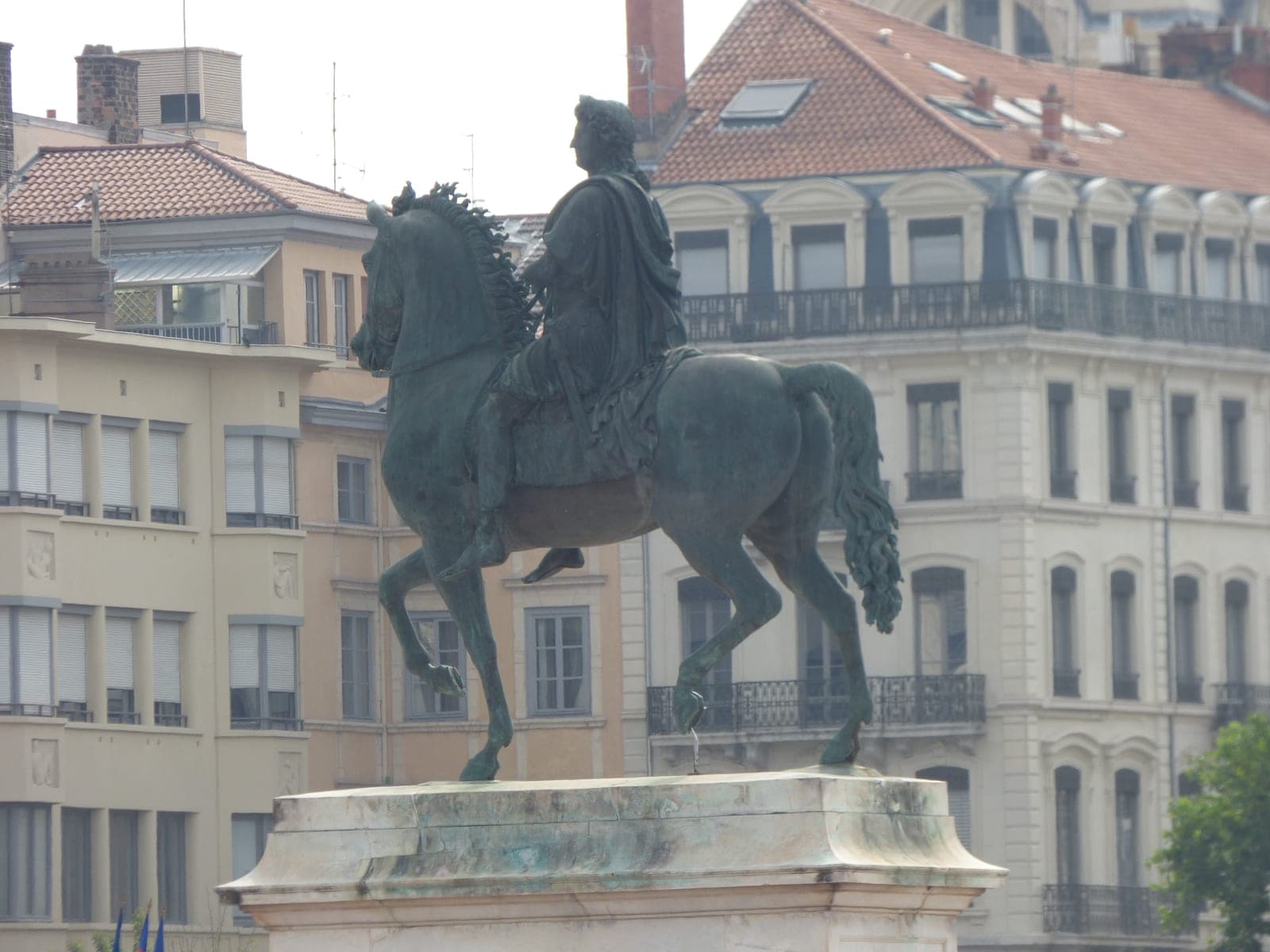
Green space is the honest weak point. Place Bellecour, the biggest open space in the district by a distance, is pink gravel with an equestrian Louis XIV in the middle and no shade where you want it. What the peninsula has instead is water on both sides: the Saône quays on the western edge, low and close to the river, and the Berges du Rhône on the eastern side, the long redeveloped promenade with lawns, a bike path and the péniche bars moored along it. The Rhône bank is one bridge away rather than at your door, and it is the real public space of this part of Lyon. For anything larger you cross the Rhône to the Parc de la Tête d'Or in the 6e, which is the city's big park.
Culture is dense and most of it is inside the boundary. The Musée des Beaux-Arts on place des Terreaux occupies a seventeenth-century Benedictine abbey and holds one of the largest collections in France, with a free cloister garden in the middle of it. The Opéra de Lyon sits a hundred metres away behind Nouvel's glass vault. The Théâtre des Célestins is the other great room in the district. There are cinemas on and around rue de la République, and the whole thing is walkable in an evening.
Eating and drinking splits by street, and if you are viewing a flat you should know which street you are on. Rue Mercière and rue des Marronniers are wall-to-wall terraces and are loud, busy and aimed squarely at people who do not live here. Rue Sainte-Catherine, behind the Terreaux, is the bar street, and it is the noisiest address in central Lyon at two in the morning. The Terreaux itself fills up on a warm evening and empties slowly. Then you walk five minutes south into Ainay, and it is a quiet nineteenth-century residential quarter with a Romanesque church and almost nothing open after ten. Both are the Presqu'île. View the flat on a Saturday night, not a Tuesday afternoon.
What it costs
The number to start from is 4 919 EUR / m² ≈ $530 / sq ft, the median price per square metre actually paid across 374 recorded apartment sales inside these 14 IRIS in 2025. That is DVF, the register of what was really paid, not an asking price and not an arrondissement average.
One sharpener, and it runs the opposite way to what people expect. The same median over flats sold with nothing attached, no cellar and no parking space, is 5,134, which is higher, not lower. That is the reverse of the Paris pattern, and it reflects newer flats that sell with a parking space as standard rather than a discount for a cellar. Do not read the gap as money saved.
The bigger point is what it says about central Lyon as a market. The five districts covered here sit within 7% of each other, 4,597 at the bottom and 4,919 here at the top. There is no meaningful price ladder between them. What a buyer actually feels in the price is the building, the floor and the view, not the name of the district, and anyone selling you a 300 EUR/m² gap as a quality difference is selling you noise.
Rent needs two numbers, not one, because this district spans two arrondissements and Lyon's rent data is published per arrondissement. The 1er asks 17.1 EUR/m² a month and the 2e asks 17.6, on the 2025 Carte des loyers. Three things about that. These are asking rents, modelled from listings, not rents that tenants are recorded as paying. Charges are included in them and cannot be separated out, so the figure is not comparable with a rent quoted excluding charges. And they are never averaged into one number here, because the source does not publish one.
The rent people actually pay is a different figure and a lower one. The Lyon rent observatory surveys the occupied private stock and puts the median here at 14.4 EUR/m² a month excluding charges, with quartiles of 12.4 to 16.3 behind it, from 3,237 observations. All 14 of this district's statistical areas sit in the observatory's dearest city zone, so unusually there is one number rather than two. The gap to the asking rents above is not a scandal: an advert asks more than a lease signed three years ago, and the advertised figure has the charges baked into it. Read the paid figure for what the district costs to live in, and the asking figure for what you will be quoted.
There is also a ceiling, and here it is a single one. Lyon caps rents under the same time-limited national experiment as Paris, by arrêté DDT 69-2025-10-23-00004, in force from 1 November 2025 to 31 October 2026, and a listing above the ceiling for its own category is unlawful. All 14 of this district's statistical areas sit in the same rent zone, so unlike most of Lyon there is one cap to remember: for an unfurnished two-room flat built before 1946 it is 18.0 EUR/m² a month, against 14.4 actually being paid. The cap still varies by room count, by the age of the building and by whether the let is furnished, so ask the landlord to state the figure for your flat in the lease, which the law requires.
Finally the ratio, which is the thing a listing never shows you. Against the district's income figure of 30,825 EUR a year, one square metre at the 2025 median costs about 16% of a full year's income. That is the honest case for Lyon: a major European city centre at a price a professional salary can still reach. The rent side says the same thing. On the same file, the same year and the same method, Lyon's asking rents run at roughly half the Paris level.
Weather and climate
Seasonal averages for Lyon, one representative month per season. Météo-France 1991-2020 normals for station Lyon-Bron, the reference station for the city, read 12 August 2026 via Infoclimat. Seasons are the representative months: January, April, July and October. Sunshine hours a day are the monthly totals divided by the days in the month (January 71.1 h, April 197.7 h, July 288.1 h, October 131.4 h). Annual figures: mean daily maximum 17.5 °C, mean daily minimum 8.6 °C, 820.8 mm of rain and 2,049.5 hours of sunshine. Rain days are left null because the monthly count of days at or above 1 mm is not filled in on the published normals table. What the numbers say about living here: Lyon is a degree or so warmer than Paris by day and colder at night in winter, with a January mean minimum of 1.1 °C, so frost is routine rather than occasional. It is also markedly sunnier, about 2,050 hours against 1,717 in Paris, and July days average 28.2 °C, which in a dense stone city with a river through it is felt as real summer heat. October is the wettest month at 99.8 mm, not the winter, which is the Rhône valley pattern rather than the northern one.
The honest downsides
This is where the whole city comes out, and you live inside it. From Thursday evening to Sunday night the main axes belong to everybody else: shopping crowds on la Ré and rue Victor Hugo by day, and the terraces of rue Mercière and the bars of rue Sainte-Catherine running until two. Add the deliveries, which start before seven for shops that open at ten, and the market setting up on the quai from six in the morning. Then there is December: the Fête des Lumières, which grew out of the night of 8 December 1852 when Lyon put candles in its windows, now fills the central streets for four nights with a crowd that the city plans for months. It is genuinely wonderful and it is not optional if you live on the route. None of this is visible in a listing photograph taken at eleven on a Tuesday morning.
The flats are older and harder work than the price suggests, and August is the test. Expect stairs, expect a lift that stops one floor short if it exists at all, expect small rooms behind a handsome window, and expect a protected façade to limit what you may fit to the outside of the building. A top floor under zinc, on a peninsula that traps heat between two rivers, is punishing in a Lyon summer, and the only breeze that reliably arrives is the cold one funnelling down the Rhône corridor in winter, which is not the season you wanted it. Add a car you cannot realistically park, and the honest version is that this district rewards people who own little, walk everywhere and are out most evenings.
Crime and safety
The numbers here need their boundary stated first, because it is not the district. France's finest published grain for Lyon is the arrondissement, so these figures cover the whole 1er and the whole 2e together, which includes Perrache station and the Confluence redevelopment alongside the streets this article is about. Nothing on this page was computed for these 14 IRIS alone.
They also need their denominator stated, and here it does most of the work. These are rates per resident. This is the district the entire city comes to for its shops, its trains and its nights out, and it has a small resident population, part of which is a commercial core where almost nobody sleeps. Offences are recorded where they happen and then divided by the people who live there, so a shopping and station quarter reads high on anything that happens to people in crowds. That is a real risk to understand, and it is not the same as a dangerous place to live.
With that said, the shape is clear. Theft from the person runs at 927.3 per 10,000 residents, against 393.2 for Lyon and 91.0 for France. Unarmed robbery is 126.2 against 61.0 for the city and 7.2 nationally. Non-domestic assault is 106.0 against 53.1 and 31.6. That is a pickpocketing, phone-snatching and bag-snatching profile attached to dense crowds, concentrated exactly where the crowds are: the metro at Bellecour and Hôtel de Ville, the pedestrian shopping streets, and the bar streets late.
Now the other half, which almost nobody quotes. Home burglary is 8.3 per 1,000 dwellings, a different base that must be read on its own: Lyon is 6.9 and France 5.6, so burglary here is above the ordinary French level but nothing like the multiple the theft figure is. And domestic violence, at 30.0 per 10,000 residents, sits below the national 37.6, close to the Lyon figure of 28.5. A district that runs ten times the national rate on one indicator and below it on another is not described by a single score, and there is no total to construct, because the ministry counts these things in three different units.
In practice: carry your phone the way you would at a station, watch the terrace table and the metro platform rather than the dark street, and treat Bellecour and Hôtel de Ville the way you would treat any big interchange in Europe.
Is this you?
If you want a real European city centre where you can sell the car, walk to work, the opera, the market and the train, and you can live with noise and old stairs, the Presqu'île does it better than anywhere else in Lyon and at a price Paris cannot match. You are buying flat ground, five metro stations, the best shopping in the city and two rivers, and you are accepting crowds and a small flat.
If what you want is the same city with more air and a neighborhood feel, the Croix-Rousse is the obvious alternative and it is effectively the same money: 4,853 EUR/m² against 4,919, with the highest quality-of-life score of the five districts here, 84 against 76, and the strongest independent food retail in Lyon. What you give up is the flat ground, because the pentes are a genuine climb and you do the climb whatever transport you take. If you want new-build space and river on both sides instead of history, Confluence is the other direction: 4,843 EUR/m², a redevelopment rather than an old quarter, and a district where a typical income runs 22,460 against 30,825 here.
Want to know what homes here are actually worth?
Join the waitlistHow we source this
How we put this together. Gathered on the ground by our local field team and written up by the Apraiz research team. Every figure above carries its own source and date. The scores are not computed by the build; walking and transport will use open map and transit data first, then Apraiz's own model. We update prices quarterly, transport and amenities twice a year, and school data when the source publishes.
Sources: DVF (Demandes de valeurs foncières), data.gouv.fr, Carte des loyers 2025, DHUP and ANIL with leboncoin and Groupe SeLoger, Observatoire local des loyers de l'agglomération lyonnaise (Urbalyon), Préfecture du Rhône, published as open data by the Métropole de Lyon, INSEE, Filosofi 2021, SSMSI, bases statistiques communale et départementale de la délinquance enregistrée, Ministère de l'Éducation nationale, IVAL 2025, Wikipedia (en), Ville de Lyon.
Safety and crime in Lyon →Nearby: Vieux Lyon · Croix-Rousse · Confluence