
Long Story ShortReadHide
- What it is: the northern half of Lyon's 7e, flat, dense and mixed, running from the Rhône to the railway and from the old bridgehead down to Jean Macé.
- Who it suits: people who want a central Lyon address at the lowest price of the five districts here, who cook, and who would rather live in a working quarter than a handsome one.
- What it costs: 4 597 EUR / m² ≈ $490 / sq ft to buy on the price actually paid, the cheapest of these five, with paid rents of 12.5 to 14.0 EUR/m² a month excluding charges and an advertised rent of 16 EUR / m² / mo across the 7e, charges included.
- What people complain about: place Gabriel Péri and the streets around it, and the least green space of the five.
First impressions
The Guillotière is the piece of Lyon people argue about hardest, and the argument is worth understanding before you look at a flat here.
Start with what it is. This page describes the northern 7e, the nine statistical areas between the Rhône and the railway: Pasteur, Universités, Centre Berthelot, Saint-Michel, Domer, Jean Macé, Yves Farges, Le Fleuve and Le Rhône. In ordinary speech the name spills north over cours Gambetta into the 3e, and that part is not counted here. South of avenue Berthelot the 7e keeps going into Gerland, which is a different place again, laboratories and sports grounds and the Halle Tony Garnier, and that is not counted either.
The first thing you notice is that it is flat. After the Croix-Rousse and Vieux Lyon, that is a bigger deal than it sounds: everything here is on foot, with shopping bags, in either direction, at any age. The second is the density. The Grande rue de la Guillotière, rue Pasteur, rue de Marseille and cours Gambetta carry a run of small shops, grocers, bakeries, phone repairers, butchers and restaurants that is unlike anywhere else in the city, and the food shops are Algerian, Moroccan, Tunisian, Turkish, Chinese, Vietnamese, Thai, Indian and West African, sometimes all in one block.
The third thing is place Gabriel Péri, which nobody calls that. It is place du Pont, it is the crossing point of the whole district, it has a metro entrance, tram tracks, buses and a constant crowd, and it has been the focus of a long public argument about drug dealing, street drinking, crowding and who the square is for. The Métropole de Lyon and the Ville de Lyon have spent years and public money rebuilding it, phase by phase from 2023 through 2026, widening pavements, planting the cours Gambetta, calming rue Paul Bert and turning a car park by the post office into a small green square. Some of that has landed. The square is not fixed.
The building stock is 19th-century faubourg, four to six storeys, plainer than the Presqu'île: no grand haussmannien frontages, stone stairs, inner courtyards, shops on the ground floor and a lot of small flats above them. Between and behind it sits post-war and 1970s infill, which is where the lifts are. Two flats a hundred metres apart can be completely different propositions, so ask on every viewing: which floor, whether there is a lift, whether the windows give onto the street or the courtyard, and whether the glazing is single. On an axis like cours Gambetta or the quays, that last answer decides whether you can sleep with the window open.
And ask about August. Very little of this housing has air conditioning, top floors under zinc get genuinely hot, and the courtyard side is several degrees kinder than the street. In winter the wind funnels down the Rhône corridor and the quays are the coldest walk in the city, which is the trade for having the river as your front garden.
Who lives here, and what the streets look like
This is a mixed district in the literal sense, not the estate-agent sense. Students from the Université Lumière Lyon 2 campus on the quai Claude Bernard and the Lyon 3 buildings beside it, families whose grandparents arrived from North Africa or from China, a Chinatown of grocers and restaurants around rue Passet and rue Pasteur, shopkeepers who live over the shop, young renters priced out of the Presqu'île, and a long-settled population that has watched all of it happen.
The money picture is the one to be plain about. A typical figure across this district's nine small statistical areas is 24,310 EUR a year of disposable income per consumption unit on the Filosofi 2021 figures, none of the nine suppressed. That is the median of the district's IRIS medians rather than a single published area median, it is unweighted, and a median of medians of this kind runs above the figure for the area taken as a whole, so read it as a typical level and not as a precise one. Across the river, the Presqu'île is 30,825 on the same measure. That gap is most of what separates how the two places look.
The streets to know are the Grande rue de la Guillotière, the old road east, rue Pasteur and rue de Marseille running parallel to the river, cours Gambetta and avenue Berthelot crossing them, and place Jean Macé at the southern end, which is the calmer, more bourgeois half of the district and prices itself accordingly.
At 2am the district splits in two. The axes and the squares are awake: traffic, late food, people coming out of the metro. Streets like rue Chevreul, rue Jaboulay and the blocks behind Jean Macé are quiet in a way that surprises people who only know the Guillotière from the boulevard. View a flat at both hours before you decide which one you are buying.
Getting around
This is the district's strongest card, and it is the reason people put up with the rest.
Three metro stations stand inside the boundary. Guillotière is on line D, the driverless one, which runs under the river to Bellecour and Vieux Lyon in one direction and out to the eastern suburbs in the other. Saxe-Gambetta is on lines B and D together, which makes it the interchange that matters here. Jean Macé is on line B, and line B is the office commute: it runs straight to Part-Dieu, which is where Lyon's offices and its main railway station actually are, not the Presqu'île.
Jean Macé is also a TER station, so regional trains stop inside the district, which is unusual and useful. Two tram lines cross the quarter: T1 along the quai Claude Bernard and rue de l'Université, through place Gabriel Péri and on toward the Part-Dieu side, and T2 through Centre Berthelot and Jean Macé and down to Perrache. For the airport, the Rhônexpress tram leaves from Part-Dieu, which is two metro stops away on line B.
Cycling works here in a way it does not on the hills: the district is flat, Vélo'v stands are dense, and the quays and the new Voies Lyonnaises give you segregated routes north and south. A car is the one thing that does not work. Parking is scarce and metered, and the through routes are congested most of the day.
Typical weekday minutes from Place Gabriel Péri, with the icon showing how. Times are measured door to door for a typical weekday morning from place Gabriel Péri; the icon shows the fastest sensible way., 2026-08.
Daily life
Food shopping is what this district is genuinely, unambiguously good at.
The markets first. Place Jean Macé holds the big one on Wednesday and Saturday mornings, roughly 6.00 to 13.30, with fruit and vegetables, butchers, charcuterie, cheese and flowers. Place Saint-Louis runs a smaller food market on Tuesday, Friday and Sunday mornings. Between the two you can shop five days a week without going near a supermarket.
For the chains, everything is a small central format. There is an Auchan on rue de l'Université, a Lidl on place Hevrin Khalaf, Carrefour City on avenue Jean Jaurès and on rue Renan, a Franprix on rue Saint-Jérôme, U Express on rue de Marseille and rue de la Madeleine, an Intermarché Express on rue Marc Bloch and a Petit Casino on rue Sébastien Gryphe. Organic is Biocoop on rue Jaboulay and avenue Jean Jaurès, and Naturalia on the Grande rue de la Guillotière.
But the chains are not the point. The independents are: Asian supermarkets and traiteurs along rue Passet and rue de Marseille, North African bakeries, butchers and spice shops along the Grande rue de la Guillotière and rue Pasteur, West African grocers scattered between them, and small general shops open when everything else is shut. This is the widest range of North African and Asian food retail in Lyon, and it is the single thing residents cite when they are asked why they stay. A short walk north over cours Gambetta, in the 3e rather than in this district, the Bahadourian épicerie on rue Villeroy is the city's landmark for the same trade.
For delivery, Uber Eats and Deliveroo both serve this district, and between them they cover most of what is worth ordering.
Local Places Worth Knowing
Independent and close by, chosen on merit. Nobody pays to appear here.
The city's Resistance museum on avenue Berthelot, in the former military health school Klaus Barbie's Gestapo occupied in 1943. Filmed testimony throughout the permanent galleries.
View on Google MapsThe district's big food market, Wednesday and Saturday mornings: produce, butchers, charcuterie, cheese and flowers, at prices that are not Presqu'ile prices.
A neighbourhood bookshop on rue de Marseille since 2004, with a deep shelf on the Maghreb, Arabic language and African studies alongside the general stock.
A small day restaurant on rue Chevreul: breakfast, a short market-led lunch that changes daily, then pastry and tea. Closed Tuesday and Wednesday; book for lunch.
View on Google MapsChecked August 2026. Places close and change, so tell us if something here is out of date.
Schools and families
The Guillotière scores 77 on schools, the highest of the five Lyon districts we cover, and the number needs explaining before it is useful.
It is the taux d'accès de la seconde au bac: of the pupils who start seconde at a lycée standing in this district, the share who reach the baccalauréat there. That is a harder question than a pass rate, because a school cannot flatter it by moving weaker pupils out before the exam. It is pooled over pupils rather than averaged over schools, so a small lycée cannot outweigh a large one.
Now the thin part. Two lycées stand inside the boundary, 304 pupils in seconde between them, and they are 20 points apart. Belmont-Capdepon, private under contract, reaches 85 with 181 pupils in seconde. Louise Labé, a public lycée professionnel, reaches 65 with 123. A headline built on two schools is a fragile thing, and which of the two your child would actually attend matters far more than the district figure does. A Lyon lycée also recruits well beyond its own streets, so this measures the schools that stand here, not the children who live here.
Below lycée age the district is dense with maternelles and écoles, and the carte scolaire decides which one an address feeds, so the street matters more than the neighborhood. Ask the mairie du 7e which school a specific address is assigned to before you sign a lease or purchase, and read the rest of our Lyon guides alongside it, because in Lyon the school question and the price question tend to be the same question in different clothes. Knowing what a flat is actually worth before you commit is the whole reason Apraiz exists.
Kids Restricted. Honest answer: better than its reputation, worse than its price suggests. In its favour, the everyday shopping is cheap and close, there are maternelles and écoles at short walking distance right across the district, the riverside is a genuine open space, and public transport is good enough that you never need a car for the school run. Against it, this is the least green of the five Lyon districts we cover, the through routes are busy and unpleasant to cross with a pushchair, the flats are small and often walk-up, and the streets around place Gabriel Péri are not somewhere most parents would let a young child wander. Families here tend to use the river and the parks across it rather than anything inside the boundary.
Pet Restricted. Workable, with one real asset and one real constraint. The asset is the berges du Rhône along the whole western edge, a wide car-free riverside promenade that is the best dog walk in this half of Lyon and is reachable from most of the district on the flat. The constraint is everything else: this is a dense quarter with narrow pavements, constant traffic on cours Gambetta, avenue Berthelot and the quays, very little grass away from the river, and a set of busy squares where a dog underfoot is a nuisance to everybody. Flats run small and the older buildings often have no lift, which argues for a small or medium dog. If the river walk is your daily route, it works well. If you want your dog to be off the lead somewhere green, it does not.
Green space, leisure and eating out
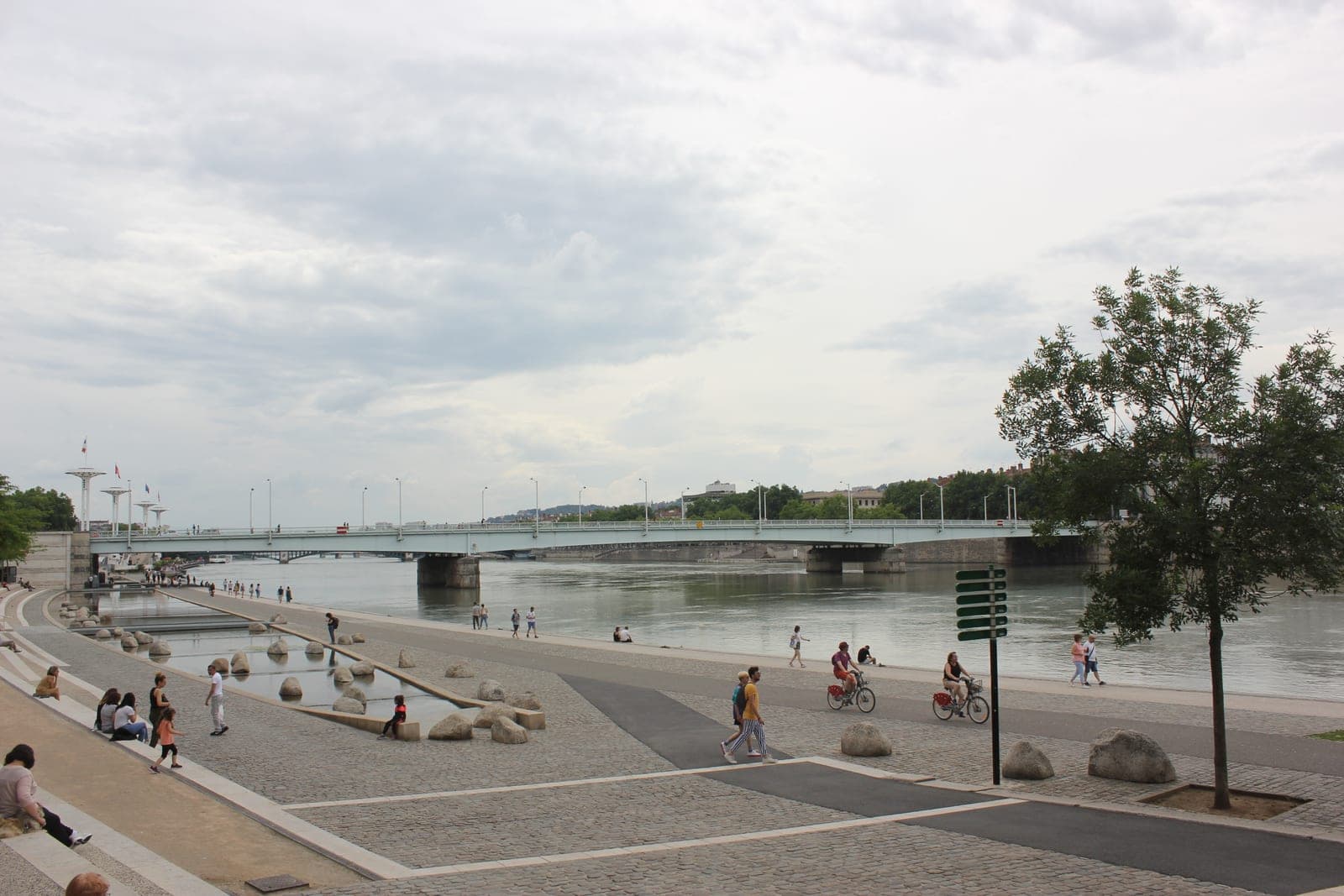
The green space here is the river, and there is not much else. The berges du Rhône run the whole western edge of the district: the old quayside car parking was cleared and rebuilt as a continuous car-free promenade of lawns, benches, playgrounds and moored péniches that serve as bars, and it links north toward the Parc de la Tête d'Or and south toward Gerland. In practice it is the district's park, its running track and its summer evening. Inside the built streets there are squares and school yards and the new planting around cours Gambetta, and that is close to the whole of it. This is the least green of the five districts here, and the sidebar's quality of life score reflects it.
Leisure leans on institutions rather than parks. The Centre d'Histoire de la Résistance et de la Déportation on avenue Berthelot is one of the serious museums in Lyon. The Université Lumière Lyon 2 campus on the quai Claude Bernard puts lectures, libraries and a student rhythm inside the district. Down in Gerland, in the same arrondissement but not in this district, the Halle Tony Garnier is where the big concerts happen. And every December the fête des Lumières turns the whole city into a four-night event: the crowds concentrate on the Presqu'île and Fourvière, and what you get here is the bridges, the crossing and the walk home through it.
Eating out has two distinct halves that barely overlap. Along the Grande rue, rue Pasteur and rue Passet it is Chinese, Vietnamese, Thai, Indian and North African, cheap, generous and open late. Around rue Chevreul, rue Jaboulay and the Jean Macé end it is small bistros, wine bars and day cafés that the rest of Lyon now crosses the river for. Both halves are five minutes apart, and the fact that the district contains both is the best short description of it.
What it costs
Start with the price actually paid, because France records it. 4 597 EUR / m² ≈ $490 / sq ft is the median of 515 apartment sales inside this district's own boundary in 2025, the lowest of the five Lyon districts here. Flats sold with nothing attached, no cellar and no parking space, come in at 4,545, so the headline is not being propped up by garages.
Do not build a story out of that ranking, though. All five of these districts sit within 7% of each other, which means central Lyon is priced as one market and the difference a buyer actually feels is the building, the floor and the view rather than the name of the quarter. Two flats at the same price on the same street can be twenty years apart in condition, so read the procès-verbaux of the last few assemblées générales of the copropriété before you commit to anything here. Deferred maintenance is the real price and it never appears in the listing.
On rent the advertised number needs its label attached: 16 EUR / m² / mo is a modelled asking rent, what landlords advertise rather than what sitting tenants pay, and charges are included in it and cannot be separated out. It is published per arrondissement, so it covers the whole 7e, Gerland included.
The rent actually paid is published at a finer grain than the advert, and it is the widest spread of any district on these pages. The Lyon rent observatory splits this district across four of its five city zones: 14.0 EUR/m² a month around the universities and Centre Berthelot, 13.6 through Pasteur, Saint-Michel and Jean Macé, 13.2 at Yves Farges and Le Fleuve, and 12.5 by the Rhône, all excluding charges. That 1.5 EUR/m² range is roughly 68 EUR a month on a 45 m² flat, and it maps onto what walking the district tells you: the closer to the river and the campus, the dearer the lease. On the same file and method, Lyon runs at roughly half the Paris level, which is the plainest statement of why people move here from the capital.
Rents in Lyon are also capped, by arrêté DDT 69-2025-10-23-00004, in force 1 November 2025 to 31 October 2026, and a listing above the ceiling for its own category is unlawful. This district spans four rent zones, so it carries four ceilings for the same flat: for an unfurnished two-room flat built before 1946 they run 16.1 to 16.9 EUR/m² a month, a much narrower band than the rents people are actually paying across the same ground. Check the arrêté in force for the specific address, on the day, before you sign anything.
Now the relationship that matters more than any single figure. A square metre here costs 4,597 EUR. A typical disposable income across the district's small statistical areas is 24,310 EUR a year, so one square metre runs to a bit under a fifth of that. Put another way, a modest two-room flat is several years of the middle income of the people already living in these streets. That is the arithmetic behind everything else on this page, including the shops, the small flats and the number of people sharing them.
Weather and climate
Seasonal averages for Lyon, one representative month per season. Météo-France 1991-2020 normals for station Lyon-Bron, the reference station for the city, read 12 August 2026 via Infoclimat. Seasons are the representative months: January, April, July and October. Sunshine hours a day are the monthly totals divided by the days in the month (January 71.1 h, April 197.7 h, July 288.1 h, October 131.4 h). Annual figures: mean daily maximum 17.5 °C, mean daily minimum 8.6 °C, 820.8 mm of rain and 2,049.5 hours of sunshine. Rain days are left null because the monthly count of days at or above 1 mm is not filled in on the published normals table. What the numbers say about living here: Lyon is a degree or so warmer than Paris by day and colder at night in winter, with a January mean minimum of 1.1 °C, so frost is routine rather than occasional. It is also markedly sunnier, about 2,050 hours against 1,717 in Paris, and July days average 28.2 °C, which in a dense stone city with a river through it is felt as real summer heat. October is the wettest month at 99.8 mm, not the winter, which is the Rhône valley pattern rather than the northern one.
The honest downsides
Place du Pont and the streets around it are the most contested public space in Lyon, and you should walk them before you commit. Street dealing, drinking and crowding around the square have been a live problem for years, and they are why the Métropole is rebuilding it. The recorded crime supports the concern on one specific indicator: unarmed robbery in the 7e runs at 88.2 per 10,000 residents against 61.0 across Lyon and 7.2 for France. That is an arrondissement figure, not a street one, and it is the number here that stands furthest above its own city. What that means practically is ordinary caution about phones and bags near the square late, and a flat viewing done after dark as well as at eleven in the morning.
It is the least green and the most trafficked of the five districts here, and the flat you can afford is probably on an axis. Cours Gambetta, avenue Berthelot, the Grande rue and the quays carry a lot of vehicles, the pavements are narrow, and the district's real open space is a riverbank rather than a park. Quality of life reads 70 here against 84 for the Croix-Rousse. A flat on a quiet inner street solves most of this and costs more per square metre than the listing average suggests, so budget for the courtyard side rather than the cheapest square metres you can find.
Crime and safety
Every crime figure on this page is an arrondissement figure, the whole 7e, because that is the finest grain France publishes. It covers this district together with Gerland to the south, which is a quarter of laboratories, student residences and sports grounds, and none of it was computed for these streets.
With that said, the shape is more interesting than the reputation. Theft from the person runs at 392.3 per 10,000 residents in the 7e, against 393.2 for Lyon as a whole and 91.0 for France. The 7e sits at the city figure almost exactly. That is worth sitting with, because the Guillotière is talked about as if it were an outlier and on this indicator it is the city average. The arrondissements that read alarming are the ones with a small resident population and an enormous daily crowd: the 2e, holding the shops and the stations, reads 1,244.8 in Confluence and 927.3 across the Presqu'île on the same measure, because the rate divides a whole city's throughput by the people who sleep there.
Non-domestic assault is 54.9 against a city figure of 53.1 and a national one of 31.6, so again roughly at the Lyon level. Home burglary is 6.3 per 1,000 dwellings, note the different base, against 6.9 in Lyon and 5.6 nationally: the lowest of the five Lyon districts here, and still above the national rate, as all five are. Domestic violence is 28.6 per 10,000 residents, against 28.5 for the city and 37.6 for France, so it sits at the city level and below the country. Recorded violence inside the family also tracks reporting and local services, so a lower figure is not purely good news.
The exception is the one already stated. Unarmed robbery is 88.2 against 61.0 for Lyon, and that is where the district's concentration of street problems shows up in the data rather than in the arguing. It is a real gap, it is not a rounding error, and it belongs in the decision.
There is no total to quote and France publishes none: these indicators count infractions, victims and victimes entendues, three different things, so adding them would add different quantities together. The city page carries the full rates.
Is this you?
If you want to live in central Lyon on the lowest budget the centre allows, shop and eat better than that budget should buy, and you are unbothered by a busy, unpolished, genuinely mixed quarter, the Guillotière is the best value on this side of the river. It suits people who use their neighborhood rather than pass through it: the market twice a week, the river most evenings, the metro rather than a car.
If the square and the traffic are the problem, the Croix-Rousse is the swap to look at. It reads 84 on quality of life against 70 here, it has the strongest independent food shopping in the city, and it costs 4,853 EUR/m² against 4,597, which on these numbers is a small premium for a different daily life. What you give up is the flat ground, the metro density and a district that is awake at every hour, and what you take on is a hill you will climb twice a day. If what you want is flat ground and a polished centre rather than a working one, the Presqu'île is the other direction: 4,919 EUR/m², the best-connected walking district in the city, and the noisiest nights in Lyon outside your window.
Want to know what homes here are actually worth?
Join the waitlistHow we source this
How we put this together. Gathered on the ground by our local field team and written up by the Apraiz research team. Every figure above carries its own source and date. The scores are not computed by the build; walking and transport will use open map and transit data first, then Apraiz's own model. We update prices quarterly, transport and amenities twice a year, and school data when the source publishes.
Sources: DVF (Demandes de valeurs foncières), data.gouv.fr, Carte des loyers, DHUP/ANIL with leboncoin and Groupe SeLoger, via data.gouv.fr, SSMSI, via data.gouv.fr, Ministère de l'Éducation nationale, Observatoire local des loyers de l'agglomération lyonnaise (Urbalyon), Préfecture du Rhône, published as open data by the Métropole de Lyon, INSEE, Wikipédia (fr), Métropole de Lyon.
Safety and crime in Lyon →Nearby: Vieux Lyon · Presqu'île · Croix-Rousse