
Long Story ShortReadHide
- What it is: Lyon's newest district, built since the 2000s on the goods yards, the old river port and the wholesale market south of Perrache, on the spit of land where the Saône runs into the Rhône.
- Who it suits: people who want a new flat with a lift, a balcony and real daylight, on flat ground between two rivers, and who do not need an old street to walk down.
- What it costs: a recorded median of 4 843 EUR / m² to buy, paid rents of 13.6 to 14.0 EUR/m² a month excluding charges, and asking rents across the 2e of about 18 EUR / m² a month with charges included.
- What people complain about: the wind off the water, and how much of daily life happens inside one shopping centre.
First impressions
Everything Lyon did not want to look at used to be here. The tip of the Presqu'île south of Perrache held a marshalling yard, the river port at Rambaud, the city's wholesale food market, which stayed until 2009, and two prisons. It is a 150 hectare operation, launched in the 1990s, and it is still going.
The first thing that strikes anyone walking in is that the district begins with a wall. Perrache station and its bus and road decks sit right across the neck of the peninsula, and to get here on foot from Bellecour you go under and through it. The T1 tram slips through in seconds and the walk does not: it is the single most important thing to try before you sign anything, because it is the difference between living a fifteen-minute walk from the middle of Lyon and living behind a railway.
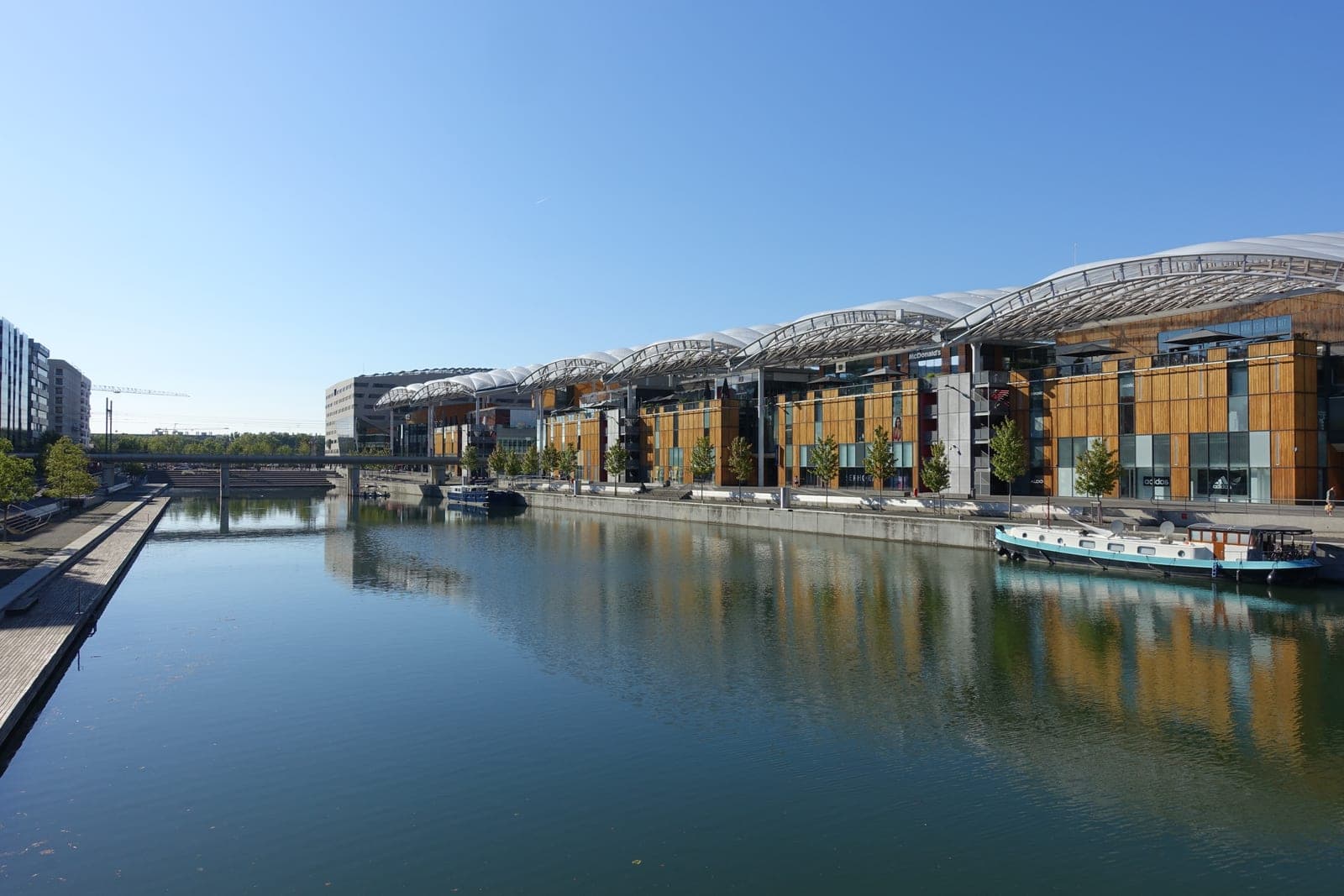
Past it, the district is unmistakably built rather than grown. Long blocks, wide streets, glass and coloured render, a darse cut into the land as a small marina with flats around it, the orange Cube and the green one standing out on the Saône bank at quai Rambaud, La Sucrière, the old sugar warehouse that now takes exhibitions, the regional government's building, and at the very point the Musée des Confluences. The shopping centre and its cinema sit in the middle of it and, honestly, act as the town square.
The other half is older than the brochure suggests. North of the new quarter, around cours Bayard, cours Suchet and rue Casimir Périer, is nineteenth-century Sainte-Blandine: plainer streets, smaller flats, stairs instead of lifts, a food market twice a week and shops that were here long before anyone drew a masterplan. Which of the two halves you live in decides your daily life far more than the arrondissement number does.
Who lives here, and what the streets look like
The mix is deliberate and it is not what the architecture photographs suggest. A large share of the housing built here is let or sold below the market, through social tenancies and the bail réel solidaire, which is why the newest and most expensive-looking district in central Lyon is also the one with the lowest incomes of the five on these pages.
The number needs its label. Three of the district's four small statistical areas carry a published income figure and one is suppressed, and the median of those three IRIS medians is 22,460 EUR a year in disposable income per consumption unit (Filosofi 2021). That method is unweighted, so a small area counts the same as a large one. Read it as a typical figure across those areas rather than as a published median for the district as a whole. Set it beside the Presqu'île at 30,825 EUR on exactly the same method, fifteen minutes' walk north through the station, and you have the most useful fact about who actually lives here.
The stock splits with the streets. In the new quarter: post-2005 blocks with lifts, insulation, big glazing, a balcony or a loggia, a bike room, underground parking as standard, and courtyards that are shared rather than private. In Sainte-Blandine and along cours Suchet: nineteenth-century buildings of four to six storeys, a courtyard that decides how dark the flat is, small rooms, and a lift only if somebody paid for one. Viewing one tells you nothing about the other, and the two are a few streets apart.
Getting around
For a district that reads as remote from the map, the connections are good, and they are all concentrated at one end. Perrache is a mainline station, the southern terminus of metro line A, and the hub for trams T1 and T2 and a large part of the bus network. Long-distance trains mostly call at Part-Dieu rather than here, so treat Perrache as the local and regional station and Part-Dieu as the one you leave the country from.
Inside the district the T1 is the spine. It runs the length of cours Charlemagne with stops at Place des Archives, Sainte-Blandine, Hôtel de Région Montrochet and Musée des Confluences, and northwards it goes through the Guillotière to Part-Dieu, which is where Lyon's offices actually are. That single line does more for this district than the metro does. The airport tram to Lyon-Saint-Exupéry leaves from Part-Dieu, so the airport run is a change rather than a through ride.
The ground is flat and the two banks are continuous, so cycling is genuinely serious here and not a hobby. The eastern edge is the other story: the through road along the Rhône side, the old A7, was downgraded from motorway to metropolitan road and is now the M7, and it is still the way a large part of the region drives south. Flats facing it hear it.
Typical weekday minutes from Place Nautique, with the icon showing how. Times are door to door for a typical weekday morning from the place Nautique, and the icon shows the fastest sensible way., 2026-08.
Daily life
This is the one district in central Lyon where the weekly shop happens the way it does in the suburbs. There is a full-size Carrefour at 7 rue Paul Montrochet, inside the shopping centre, with a car park under it, and for a lot of households that settles the question. Around it: a Lidl on rue Casimir Périer, a Vival on cours Charlemagne, a Petit Casino on cours Bayard, La Vie Claire on allée Lucien Bégule and a Biocoop on rue Bichat for organic.
The thing that stops the week feeling like an out-of-town retail park is the marché alimentaire Bayard on cours Bayard, Thursday and Sunday from 6am to 1pm: thirteen traders with fruit and vegetables, cheese, meat, rotisserie chicken, charcuterie, fish, bread and flowers. In Lyon the market matters more than the supermarket, and this is the district's one. Bakeries are spread thinly but real, on cours Charlemagne, around rue Casimir Périer and along cours Suchet, and there are pharmacies at both ends of the district.
Be honest about the shape of it, though. Outside the shopping centre, the two river banks and the older northern streets, whole blocks have no shopfront at all: the ground floors are offices, lobbies and car ramps. Milk at nine on a Sunday evening is a walk rather than a corner.
For delivery, Uber Eats and Deliveroo are the two services that cover this address.
Local Places Worth Knowing
Independent and close by, chosen on merit. Nobody pays to appear here.
The deconstructivist crystal in glass and steel standing where the Saone runs into the Rhone. Inside is a science and anthropology museum, and the point is worth the walk.
View on Google MapsThe district's food market on cours Bayard, Thursday and Sunday mornings. Thirteen traders covering produce, cheese, meat, fish and bread, which the new quarter otherwise lacks.
View on Google MapsAn intergenerational cafe on cours Suchet run as an association: long shared tables and a deliberate policy of seating people who would not otherwise meet together.
View on Google MapsA restaurant and bar in a rehabilitated industrial building on the Saone bank, with the biggest terrace on this side and a Mediterranean menu. It runs late at weekends.
View on Google MapsChecked August 2026. Places close and change, so tell us if something here is out of date.
Schools and families
This district is easier with small children than almost anything else this close to the middle of Lyon, and the reasons are physical rather than academic. The pavements are flat and wide, a pram works everywhere, much of the new quarter is closed to through traffic, there are playgrounds and water gardens between the blocks, and the new stock has lifts. Crèches, écoles maternelles and élémentaires sit on the same streets as the flats: the groupe scolaire Germaine Tillion on rue Denuzière in the new quarter, and the collège Jean Monnet on rue Seguin in the older half, are the two names people mean when they talk about school here.
The change comes with the lycée. None stands inside the district, so a teenager here travels, over the Rhône or north through Perrache, and French lycée placement follows the académie's sector rules for the exact address rather than the neighborhood. If you are moving for a particular school, ask about the address, not the area, and ask before you commit to it.
The other family question is the flat rather than the school. A third bedroom in the new quarter is priced as new build with parking attached, and in the older streets it usually comes with stairs. Working out what your money actually buys per square metre here against the districts you are also considering is the whole reason Apraiz builds these Lyon guides the way it does, and it is worth walking these streets on a grey weekday evening as well as a bright Sunday before you sign a lease or purchase.
Kids Friendly. Built for it, more than most of central Lyon. Flat pavements a pram can actually use, playgrounds and water gardens between the blocks, crèches and écoles on the same streets as the flats, lifts in the new stock, and much of the district is closed to through traffic. Two limits are worth knowing. No lycée stands inside the district, so a teenager will travel. And the older northern streets around cours Bayard and cours Suchet are a different proposition from the new quarter: nineteenth-century stock, smaller rooms, stairs rather than lifts, and the traffic of the quai on the eastern edge.
Pet Friendly. One of the easier central addresses in Lyon for a dog. Both river banks are walkable for kilometres from the door, the ground is flat, the new streets are wide, and the paths along the Saône at quai Rambaud and along the Rhône on the eastern edge give you a proper walk rather than a lap of a square. The honest caveats are surface and shade: much of the public realm is stone, concrete and decking, the young trees do not cast much of it yet, and midday in July on the quays is hot going. In the new blocks a lift is normal, which matters more with a large dog than people expect.
Green space, leisure and eating out
The rivers are the public space, and there are two of them. On the west, quai Rambaud runs along the Saône past the Sucrière and the two Cubes, with the pontoons, the water gardens and the small planted squares between the blocks. On the east, the green walk along the Rhône bank runs south to the point. At the very tip, the garden around the Musée des Confluences gives you the confluence itself, which is a genuinely strange thing to have at the end of your street: two rivers of different colours meeting in front of you.
Leisure is concentrated and slightly unusual for a residential district. The museum, the exhibitions at the Sucrière, the cinema and the shopping centre, and the darse with its capitainerie and its moored boats. What is missing is the small stuff: this is not a district of little galleries and back-street bars.
Eating out has two clear addresses and not much in between. The Saône bank at quai Rambaud is the destination side, terraces and late licences that draw the whole city on a warm evening and go quiet in November. The older northern streets around cours Bayard, cours Suchet and rue Casimir Périer are the everyday side, small restaurants that feed the people who live here. In the middle, the shopping centre does what shopping centres do. For a bouchon and the classic Lyonnais evening you go north through Perrache, which is a tram ride and a genuine outing rather than a walk downstairs.
What it costs
Start with the price actually recorded. In 2025 the median of the 144 registered apartment sales inside this district was 4 843 EUR / m², which is what buyers paid and had stamped, not what sellers asked.
The interesting part is what comes with the flat, and here it runs backwards from most cities. Take out the sales that carry a cellar or a parking space and the median of what is left is 5,346 EUR/m², which is higher, not lower. New flats here are normally sold with a parking space as standard, so the handful sold with nothing attached is a different and dearer set. Do not read that gap as a discount available to you.
The wider context matters more than the headline. Across the five central Lyon districts on these pages the medians run from about 4,600 to about 4,900 EUR/m², a spread of under 7%, so central Lyon is priced as one market and the difference a buyer actually feels is the building, the floor and the view rather than the name of the district. Anyone selling you a Confluence premium or a Confluence bargain is selling you 300 EUR/m².
On rent the advertised number comes first, and it needs three qualifications. Advertised rents in the 2e run at 18 EUR / m² a month. It is an asking rent modelled from listings rather than what sitting tenants pay, charges are included in it and cannot be separated out, and it is published for the whole 2e, which means the southern Presqu'île and Perrache as well as here. It is the top of the five Lyon districts on these pages, which run from 15.8 up to this figure, and the Presqu'île carries the same number where it too sits in the 2e.
There is a second rent figure, and it is the one that describes living here rather than arriving here. The Lyon rent observatory's 2024 survey of the occupied private stock puts the median at 13.6 EUR/m² a month excluding charges across the three statistical areas that hold the redevelopment itself, and 14.0 in the fourth, Verdun-Suchet, which reaches back up towards Perrache. Quartiles run 12.0 to 15.9 and 12.3 to 16.1. So the district that carries the highest advertised rent in Lyon carries one of the lower paid ones, which is what a new-build quarter looks like in the data: the adverts are for the new towers, the survey covers everyone already in a lease. On the same file and method, Lyon runs at roughly half the Paris level, which is the comparison most people arriving from the capital want.
Lyon also caps what a landlord may ask, under the same time-limited national experiment as Paris. The arrêté in force is DDT 69-2025-10-23-00004, running 1 November 2025 to 31 October 2026, and a listing above the ceiling for its own category is unlawful rather than merely expensive. The building era matters more here than anywhere else in Lyon, because almost nothing in this district is old: for an unfurnished two-room flat built after 2005 the ceiling is 17.5 EUR/m² a month across the three areas that make up the redevelopment, and 18.1 at Verdun-Suchet behind it.
Now hold the price against what people here earn: a typical figure across the district's small statistical areas of 22,460 EUR a year, against 30,825 in the Presqu'île fifteen minutes north. That is the shape of the place. New build at central Lyon prices, a large slice of it let or sold below the market on purpose, and a resident population whose incomes are the lowest of the five districts on these pages.
Weather and climate
Seasonal averages for Lyon, one representative month per season. Météo-France 1991-2020 normals for station Lyon-Bron, the reference station for the city, read 12 August 2026 via Infoclimat. Seasons are the representative months: January, April, July and October. Sunshine hours a day are the monthly totals divided by the days in the month (January 71.1 h, April 197.7 h, July 288.1 h, October 131.4 h). Annual figures: mean daily maximum 17.5 °C, mean daily minimum 8.6 °C, 820.8 mm of rain and 2,049.5 hours of sunshine. Rain days are left null because the monthly count of days at or above 1 mm is not filled in on the published normals table. What the numbers say about living here: Lyon is a degree or so warmer than Paris by day and colder at night in winter, with a January mean minimum of 1.1 °C, so frost is routine rather than occasional. It is also markedly sunnier, about 2,050 hours against 1,717 in Paris, and July days average 28.2 °C, which in a dense stone city with a river through it is felt as real summer heat. October is the wettest month at 99.8 mm, not the winter, which is the Rhône valley pattern rather than the northern one.
The honest downsides
The street life is thin, and a lot of it is indoors. This is a planned district about twenty-five years old, and it shows on a wet Tuesday in February: long blocks, ground floors given over to offices and parking ramps, and a social centre of gravity that is a shopping centre with a car park under it. The two river banks fill up in June and empty in November. Everything the city is famous for, the bouchons, the traboules, the canut lofts with their four-metre ceilings and the small independent trade, is north of the station, a tram ride and a walk under a railway away. If what drew you to Lyon is the old city, you will be commuting to it.
The wind and the hard surfaces are real, and nobody mentions them at a viewing. Two open river corridors meet here, there is very little between them, and in winter the wind comes down the Rhône corridor and finds every one of these wide new streets. In summer the same open ground, stone, decking and large glazing, holds heat, and a top-floor flat with big south or west windows and no shutters is a serious proposition in a Lyon August; check the blinds, the orientation and whether the building has cooling before you fall in love with the light. The trees planted through the new quarter will fix a lot of this and have not grown enough to fix it yet. Add the M7 traffic along the eastern edge if you are looking at a flat on that side.
Crime and safety
The number on this page needs its caveat before it needs anything else. France publishes recorded crime by arrondissement, which is the finest grain available, so these figures cover the whole 2e: the shopping streets of the southern Presqu'île, place Bellecour, the Grand Hôtel-Dieu and Perrache station, all of them a kilometre or more north of these blocks. They were not computed for this district, and what drives them is not what happens on cours Charlemagne at eleven at night.
With that said, the figures are high and worth understanding. Theft from the person runs at 1,244.8 per 10,000 residents, against 393.2 for Lyon as a whole and 91.0 nationally. That is not a statement that one resident in eight is robbed. It is the arithmetic of a station and shopping district: offences are recorded where they happen, the denominator is the people who sleep in the 2e, and the 2e has a small resident base and an enormous daily throughput of shoppers, commuters and travellers. Pickpocketing at Perrache and along the shopping streets is what the number is made of.
The rest follows the same pattern. Assault outside the family is 124.7 against a city 53.1 and a national 31.6, and unarmed robbery 126.4 against 61.0 and 7.2. Both are concentrated in the same busy, transient, northern part of the arrondissement.
Two indicators behave differently and they are the ones that describe a home. Physical violence inside the family is 36.4, above the Lyon figure of 28.5 and just below the national 37.6, and recorded family violence tracks reporting as much as incidence. Home burglary is rated on a different basis and must be read that way: 8.1 per 1,000 dwellings, against 6.9 across Lyon and 5.6 nationally, so the 2e sits above the national rate on the crime people ask about most, as does every central Lyon district on these pages. It is never comparable with the per-resident rates above, and the indicators are never added together, because France counts them in three different units.
Is this you?
If you want a new flat that works, on flat ground, with a lift, light, a balcony, a parking space, water on two sides and a tram that puts you in Part-Dieu without changing, Confluence does something no old district in Lyon can. It suits families with small children, people who cycle, people whose office is at Part-Dieu, and anyone who has decided that a functioning building beats a handsome one.
If what you actually want is the Lyon of the postcards, the Presqu'île is fifteen minutes north through the station at a recorded median of 4,919 EUR/m², which is within a few per cent of the price here and buys a nineteenth-century flat over a shop instead of a new one over a car park. If you want the hill, the village and the markets, that is the Croix-Rousse. And if you want Confluence itself, settle one question before anything else: whether you belong in the new quarter or in the older streets of Sainte-Blandine behind it, because they are two different places wearing one name.
Want to know what homes here are actually worth?
Join the waitlistHow we source this
How we put this together. Gathered on the ground by our local field team and written up by the Apraiz research team. Every figure above carries its own source and date. The scores are not computed by the build; walking and transport will use open map and transit data first, then Apraiz's own model. We update prices quarterly, transport and amenities twice a year, and school data when the source publishes.
Sources: Demandes de valeurs foncières (DVF), data.gouv.fr, Carte des loyers, DHUP and ANIL with leboncoin and Groupe SeLoger, via data.gouv.fr, SSMSI, via data.gouv.fr, Observatoire local des loyers de l'agglomération lyonnaise (Urbalyon), Préfecture du Rhône, published as open data by the Métropole de Lyon, INSEE, Ville de Lyon, Wikipedia (fr), SPL Lyon Confluence.
Safety and crime in Lyon →Nearby: Vieux Lyon · Presqu'île · Croix-Rousse