
Long Story ShortReadHide
- What it is: Tallinn's medieval UNESCO core, a walled warren of cobbled lanes, gabled merchant houses and church spires, still lived in above the shops.
- Who it suits: owners who want to live inside one of Europe's best-preserved Hanseatic towns, and can accept crowds, stairs and tourist prices for the setting.
- What it costs: the top of the market with Kadriorg, about 6 250 EUR / m² ≈ $670 / sq ft to buy.
- What people complain about: tourist crowds, stag-party nightlife, thin everyday grocers, and the cost and hassle of renovating protected medieval flats.
First impressions
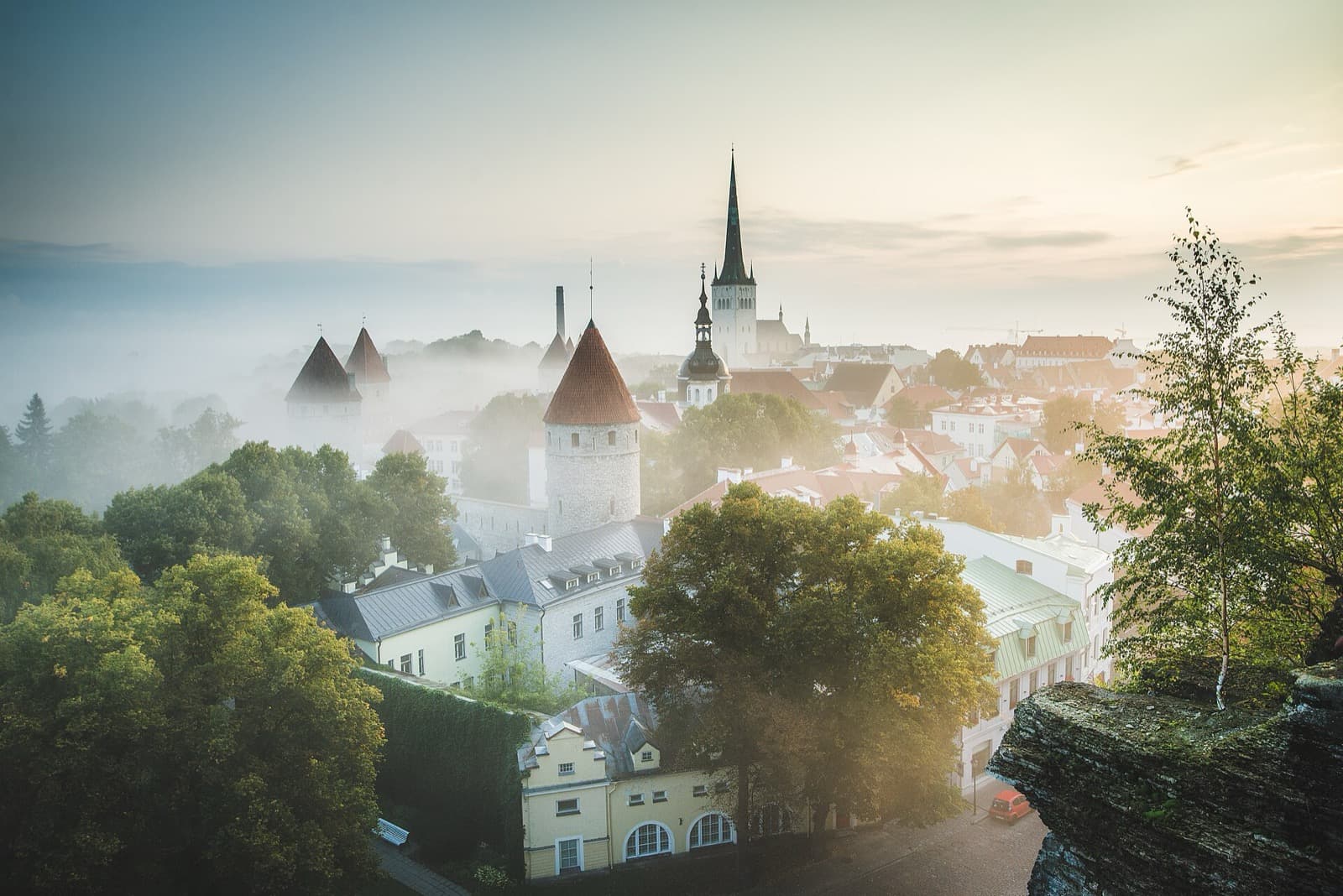
Vanalinn is a walled 113-hectare town that has kept its shape for seven centuries. It splits into the aristocratic upper town on Toompea hill, where the castle, the cathedral and Parliament sit beside viewing platforms over the roofs, and the burgher lower town around Raekoja plats, the Town Hall Square. Much of the fabric is 13th to 16th century, wrapped by the surviving town wall and its towers.
It reads as a living museum: dense, beautiful and busy with visitors by day. Part of the Kesklinn central district, it is a small residential pocket inside a place the whole country treats as its front room, so the streets belong to tourists and office workers as much as to the people who sleep here.
The honest caveat is that beauty and quiet do not always come together. The lanes are gorgeous and the setting is unmatched, but the crowds, the noise and the cramped old housing are the price of living in the middle of the postcard.
Who lives here, and what the streets look like
For somewhere so famous, few people actually live in Vanalinn. It is a small, wealthy, mixed pocket: owners in converted medieval flats, older long-term residents, some diplomats and expats, and a large share of apartments run as short-lets. That mix keeps the resident community thin and the daytime population dominated by visitors.
The streetscape is the whole point. Cobbled lanes thread between gabled houses and guild halls, the town wall and its towers close off the edges, and around every corner is a church spire or a courtyard. It is one of the most complete medieval townscapes in Europe, and you feel it on every walk to the shop.
Getting around
The heart of Vanalinn is pedestrian, with no cars on most lanes. That is a feature, not a flaw: almost everything central is on foot. Trams 1, 2, 3 and 4 and many bus and trolleybus lines ring the edges at Viru, Vabaduse väljak, Balti jaam and Mere puiestee, so the rest of the city is a short ride away, and both the passenger port and Balti jaam are about a ten-minute walk.
Typical weekday minutes from Vanalinn, with the icon showing how. Times are indicative for a typical weekday morning, measured from the neighborhood centre; the icon shows the fastest sensible way. Minutes were measured with the Google Routes API for a typical weekday around 08:00., 2026-08.
Daily life
Everyday shopping inside the walls is limited and skews tourist-priced. There is a Rimi and a scatter of small Coop and convenience shops, bakeries and delis, but for a real weekly shop most residents walk a few minutes out to the big supermarkets at Stockmann, Solaris or Viru Keskus. For food delivery, Wolt and Bolt Food both cover the Old Town well, which softens the thin grocery picture.
Local Places Worth Knowing
Independent and close by, chosen on merit. Nobody pays to appear here.
Tallinn's oldest café, open since 1864, with an Art Nouveau interior barely changed in a century and a famous marzipan room.
View on Google MapsA beloved independent Estonian and European bistro, consistently one of the Old Town's best-rated and hardest-to-book tables.
View on Google MapsNorthern Europe's only surviving Gothic town hall, completed in 1404 and crowned by the Old Thomas weathervane, on the medieval main square.
A restored multi-level station market just outside the wall with fresh produce, fish, meat, street food and vintage stalls, the everyday market Old Town residents actually use.
View on Google MapsChecked August 2026. Places close and change, so tell us if something here is out of date.
Schools and families
A handful of schools serve the central districts, and Estonian families are not tied to a single catchment. Estonia publishes no per-school quality ranking. It is the sort of gap we would rather flag than fill, which is part of why we build these Tallinn guides the way we do. Check the specific schools and their admission before you sign a lease or purchase.
Kids Restricted. Beautiful to grow up near, but cramped flats, stairs, crowds and few playgrounds inside the walls mean most families choose greener districts nearby. The moat parks and the Danish King's Garden help.
Pet Restricted. Dogs are welcome on transit and in the moat-side parks, but the cobbles, the crowds and the lack of green inside the walls make it less comfortable than Tallinn's leafy districts.
Green space, leisure and eating out
There is no large park inside the walls, but a green belt rings the town along the old moat: Toompark, the Snelli pond, and the Tornide väljak garden below the towers, with viewpoints at Harjumägi and the Danish King's Garden. Kadriorg park and the sea are a short tram ride away. Eating out is the Old Town's strength, from Tallinn's oldest café to genuine independents like Rataskaevu 16 tucked among the tourist spots.
What it costs
Vanalinn sits at the top of the Tallinn market, level with Kadriorg. Buying runs about 6 250 EUR / m² ≈ $670 / sq ft on the Land Board transaction band, well above the city average of around €3,051 per square metre. Estonia publishes no per-district monthly rent, so we show the premium-central band, roughly 850 EUR / mo for a one-bed, as a guide rather than a Vanalinn-specific figure.
Weather and climate
Seasonal averages for Tallinn, one representative month per season. Estonian Weather Service (Riigi Ilmateenistus) 1991-2020 normals (Tallinn) via Wikipedia climate box.
The honest downsides
The tourism never really stops. Crowds, noise, stag-party nightlife and tourist-priced everyday shopping come with living inside the country's main attraction, and the quiet you imagine is mostly a winter-morning thing.
Protected medieval buildings are hard to live in. Cramped layouts, stairs, parking headaches and costly, tightly regulated renovation are the trade for the setting, and genuine grocery and quiet-life amenities are thin on the ground.
Crime and safety
Tallinn is a safe, low-violent-crime capital, and Vanalinn is no exception, but it is the one district where the everyday risk is real: pickpocketing and petty theft cluster where the tourists do. Estonia publishes crime only nationally, with no clean Tallinn-only or per-district figure. Reporting and trust in the police are reasonably high, so the national numbers track real incidence fairly closely. Keep an eye on your pockets in the crowds and it reads as calm.
Is this you?
If you want to live inside one of Europe's great medieval towns, can pay the top of the market and will trade quiet and convenience for the setting, Vanalinn is unmatched. If you want the same atmosphere with room to breathe, real grocers and lower prices, Kalamaja next door gives you character and the sea without the crowds.
Want to know what homes here are actually worth?
Join the waitlistHow we source this
How we put this together. Gathered on the ground by our local field team and written up by the Apraiz research team. Every figure above carries its own source and date. The scores are not computed by the build; walking and transport will use open map and transit data first, then Apraiz's own model. We update prices quarterly, transport and amenities twice a year, and school data when the source publishes.
Sources: Investropa (Estonian Land Board data), Investropa, Realting (Statistics Estonia data), Wikipedia, Estonian Ministry of Justice, Justice Statistics portal.
Safety and crime in Tallinn →