
Long Story ShortReadHide
- What it is: Jūrmala's resort heart, built around the pedestrian Jomas iela, with the central railway station, the main promenade and a Blue Flag beach, the busiest and most walkable address on the strip.
- Who it suits: people who want a seaside high street on foot, a 30-minute train to Riga, and do not mind a town that fills up in July and empties in January.
- What it costs: premium for the coast, about 2 350 EUR / m² ≈ $250 / sq ft to buy in the central segment, with beachfront villas far higher.
- What people complain about: the strong summer-and-winter swing, and peak-season crowds, traffic and parking pressure around Jomas.
First impressions
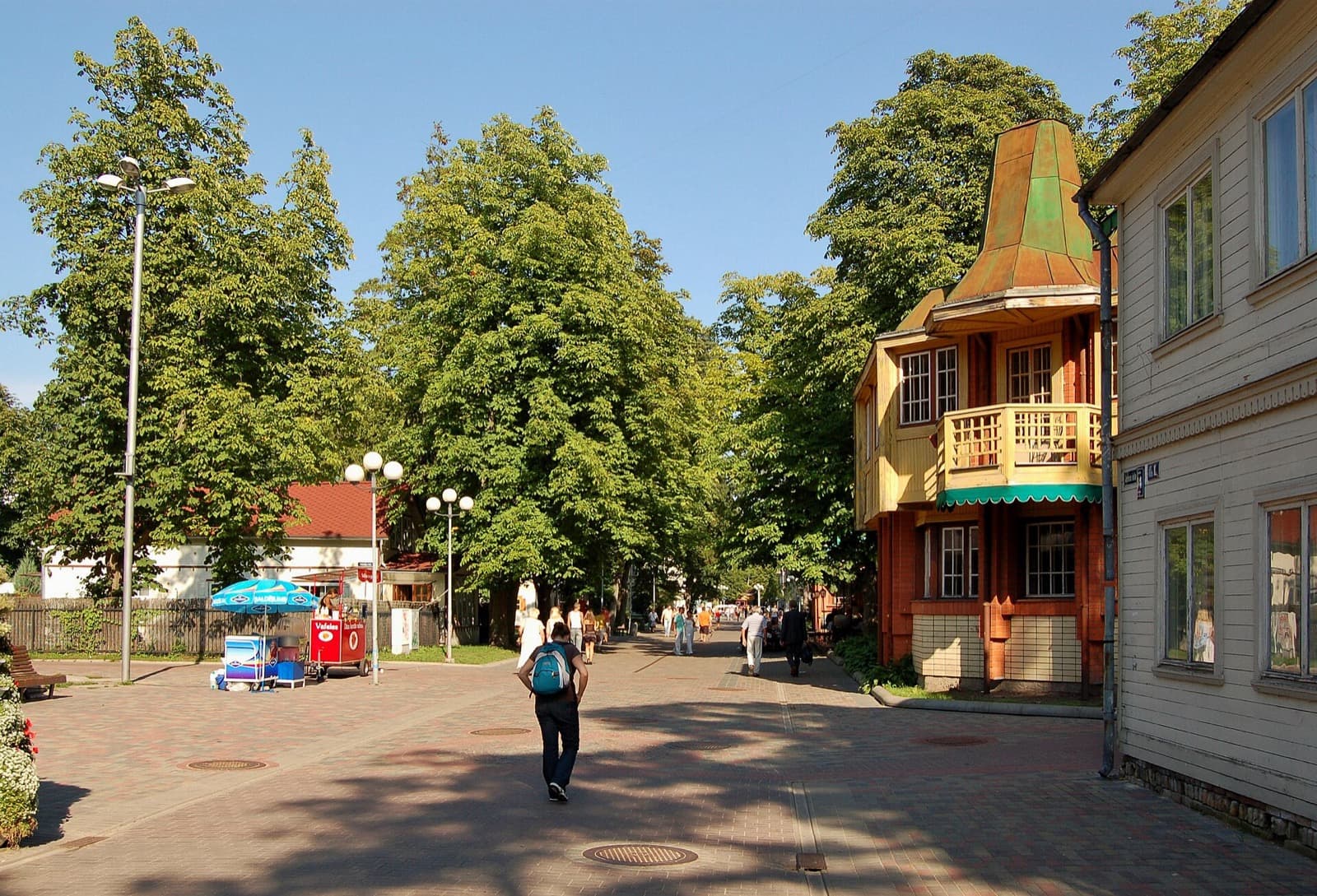
Majori is what most people picture when they think of Jūrmala. Jomas iela runs as a pedestrian spine of cafés, restaurants, boutiques and, in summer, street performers, threaded through late-19th and early-20th-century wooden resort architecture. Jūras iela runs down to the sea as an axis of refined wooden villas, and Jomas itself follows the natural line of the old dunes.
It is the most mixed and most year-round of the four districts, but it is still a resort. The population and the street life swell through July and August, then quieten sharply once the season ends and the seasonal terraces close.
The honest caveat is that this is a seaside high street, not a city centre. It is lively and pricey in summer, much quieter in winter, and the short-let turnover can make it feel less residential than the villa districts to the west.
Who lives here, and what the streets look like
Majori draws the widest mix on the strip: locals, professionals, holiday-flat owners and short-let operators, over a heavy summer tourist overlay. It is the everyday centre of gravity for the eastern half of Jūrmala.
The streetscape is the point. Jomas is low, pedestrian and lined with wooden resort buildings, the station sits a few hundred metres inland, and the beach and promenade close the picture at the seaward end. Everything a resident needs day to day is within a short flat walk.
Getting around
Majori runs on the train. Majori station is the central stop of the electrified Riga to Tukums line, operated by Vivi, and puts Riga about 30 minutes away for roughly one to one and a half euros. Within the district you walk: Jomas, the station, the beach and the promenade are all within a few hundred metres of each other. It is flat and bike-friendly the length of the coast, though summer brings crowds and parking pressure.
Typical weekday minutes from Majori, with the icon showing how. Times are indicative for a typical weekday morning, measured from the neighborhood centre; the icon shows the fastest sensible way. Minutes were measured with the Google Routes API for a typical weekday around 08:00., 2026-08.
Daily life
This is the densest retail on the strip: Jomas shops, grocers and seasonal terraces make the everyday shop easy, and it is where residents of Dzintari and Bulduri come for a full run. It is still resort-thin next to a real city, and much of it is seasonal. For food delivery, Wolt and Bolt Food both cover Majori, each with its own grocery market, and this central belt is where their coverage is strongest before it thins toward the western end.
Local Places Worth Knowing
Independent and close by, chosen on merit. Nobody pays to appear here.
The pedestrian resort spine and the city's heart, lined with cafés, restaurants, boutiques and summer street performers.
Seafront modern Italian at the Baltic Beach Hotel on Jūras iela, with a Neapolitan pizza oven and sea and sunset views.
View on Google MapsA long-standing Jomas iela eatery at number 80 with a broad menu, a reliable year-round table on a street that empties off-season.
Specialty coffee on Jomas iela, with beans selected and roasted in Latvia.
Checked August 2026. Places close and change, so tell us if something here is out of date.
Schools and families
Several schools serve the Majori area, and families here draw on the wider Jūrmala school network rather than a single catchment. Latvia has a per-school ranking, built on centralised-exam results, that is not drawn to neighborhood lines. It is the sort of gap we would rather flag than fill, which is part of why we build these Jūrmala guides the way we do. Check the specific schools and their admission before you sign a lease or purchase.
Kids Friendly. The safe pedestrian core, the Blue Flag beach and the promenade make it easy with children in summer, though the winter quiet and short-let turnover mean fewer year-round families than a city district.
Pet Friendly. Walkable streets, the promenade and summer café terraces suit a dog. Under the 2024 city rule dogs are allowed on the beach on a leash from 1 Nov to 31 Mar and banned in bathing season, 1 Apr to 31 Oct; the nearest off-leash beach area is at Dzintari.
Green space, leisure and eating out
Green space here is really the sea. The Blue Flag Majori beach and the promenade are the district's open space, and a short train or cycle hop reaches Dzintari's concert hall and forest park. Jomas is the events-and-festivals stage through summer, and eating out leans toward the beachfront hotels and the Jomas terraces, with genuine independents like the Zangezur kitchen among them.
What it costs
Majori is premium for Latvia. There is no clean Majori-only figure, so we show the city's central premium segment, about 2 350 EUR / m² ≈ $250 / sq ft (Latvia Sotheby's, 2025), with beachfront and villa stock reaching three and a half to seven thousand euros a square metre and above (Investropa, 2026). Rent is reported only as listings, not an index; sample long-let houses asked about 1 800 EUR / mo (Latio and EstateLatvia, 2024), which we show as a snapshot, not a median.
Weather and climate
Seasonal averages for Jūrmala, one representative month per season. LVĢMC 1991-2020 normals (shared coastal normal, Riga station, ~25 km east on the same Gulf of Riga shore) via Wikipedia climate box; no separate long-run Jūrmala normal is published.
The honest downsides
It is strongly seasonal. Majori is buzzing and pricey in summer and much quieter in winter, with venues shut and short-let turnover that can make it feel less like a neighborhood than a resort address.
Peak season is crowded. Through July and August, crowds, traffic and parking pressure build on and around Jomas, exactly the months you would most want to be near the beach.
Crime and safety
Latvia publishes recorded crime by municipality, in CSP table NOR020, but no clean per-district or per-year Jūrmala figure was retrieved here, so the national picture stands in. Nationally, Latvia recorded 35,609 crimes in 2023, roughly 191 per 10,000 inhabitants, and it carries the EU's highest homicide rate at about 4.2 per 100,000. For a beach-resort high street the intuitive risk is petty, opportunist theft in summer, when footfall peaks; treat that as qualitative, since no Jūrmala seasonal series was sourced.
Is this you?
If you want a walkable seaside high street, the best train link on the coast and do not mind the summer-and-winter swing, Majori is Jūrmala at its most convenient. If you want quiet, greenery and villa architecture over café buzz, Dzintari or Bulduri a few minutes west will suit you better.
Want to know what homes here are actually worth?
Join the waitlistHow we source this
How we put this together. Gathered on the ground by our local field team and written up by the Apraiz research team. Every figure above carries its own source and date. The scores are not computed by the build; walking and transport will use open map and transit data first, then Apraiz's own model. We update prices quarterly, transport and amenities twice a year, and school data when the source publishes.
Sources: visitjurmala.lv, official tourism, Wikipedia; LiveRiga electric trains, Latvia Sotheby's International Realty, Investropa, Crime in Latvia / CSP.
Safety and crime in Jūrmala →