
Long Story ShortReadHide
- What it is: the Contades half of the Neustadt, 0.82 km² of imperial German boulevards running from place de la République up the avenue de la Liberté to a 1764 park, listed by UNESCO in 2017.
- Who it suits: households who want space, quiet and green inside a city centre, and who will do their shopping at a market or on the way home.
- What it costs: no price to buy exists anywhere in Alsace, so this page carries none; sitting tenants pay 12.8 EUR/m² a month excluding charges and listings ask 15.6 with charges included, which against this district's income is the lightest rent of the three covered here.
- The catch: five food shops and one pharmacy in the whole district, and an evening so quiet that some people find it dull.
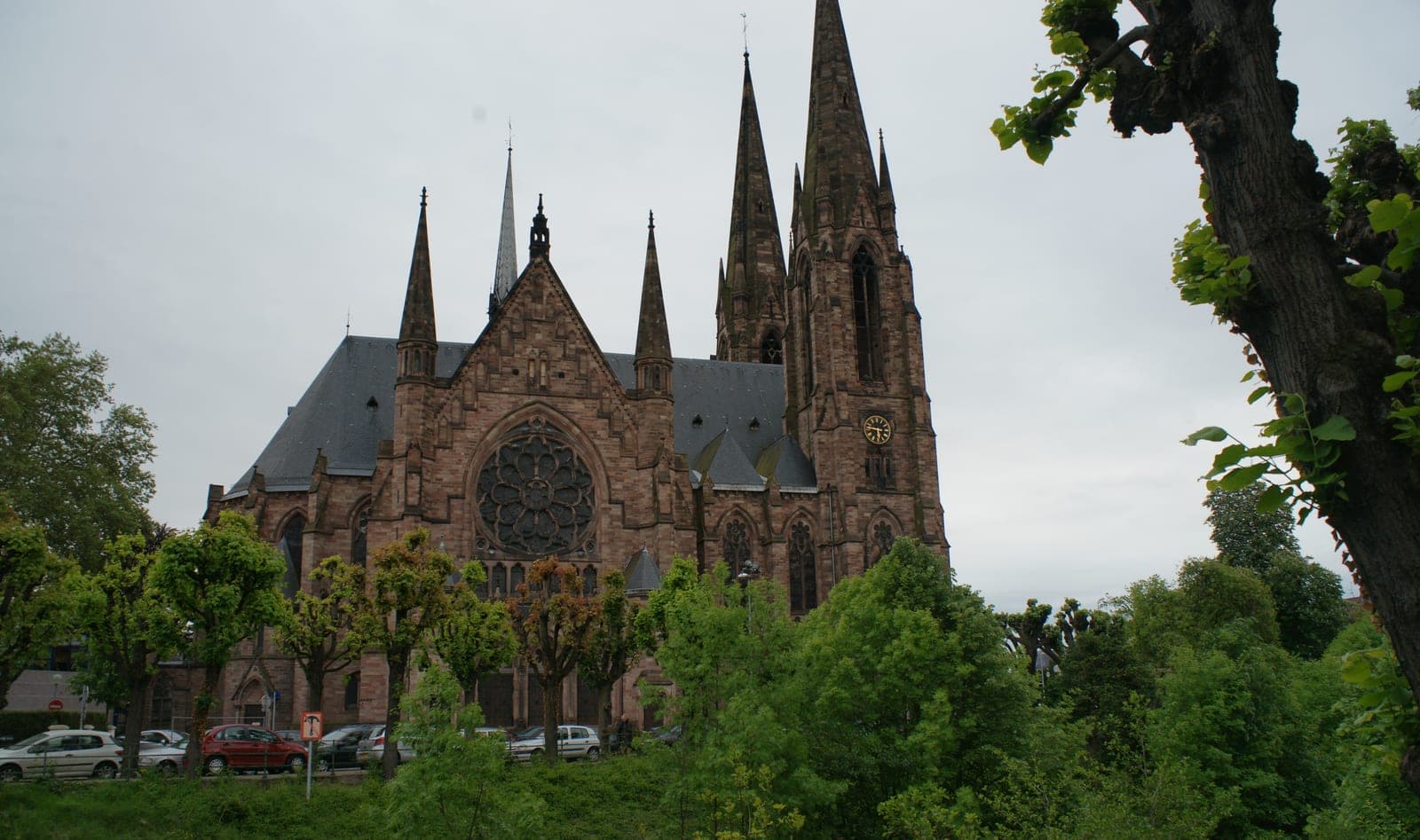
First impressions
The Neustadt is the strangest thing about Strasbourg and the easiest to miss, because it looks like a normal grand European quarter until you notice that none of it is French. Germany annexed Alsace in 1871 and then, over the next forty-odd years, built an entire capital-scale city around the medieval island: boulevards twice the width of anything inside the walls, monumental squares, a university, a library, ministries and a palace for the Kaiser. UNESCO added its heart to the Grande Île's World Heritage listing in 2017.
This district is the Contades half of it: two statistical areas, 0.82 km², running from place de la République in the south, where the Palais du Rhin sits under its dome, up the avenue de la Liberté to the Parc du Contades. Contades Nord, which is larger than this whole district and runs out past the quarter, is not part of it, so nothing on this page is measured up there.
What you notice walking in from the island is space. The blocks are big, the avenues are broad and planted with mature trees, the buildings are five and six storeys of confident stone with bay windows and gables, and there is sky. It is the opposite experience to the Krutenau, five minutes away in the other direction.
The second thing you notice is the quiet. There is one bar in the entire district. Ground floors here are consulates, offices, doctors' rooms and residential entrances rather than shopfronts, and by nine in the evening the avenue de la Liberté belongs to people walking dogs.
Who lives here, and what the streets look like
A typical figure across this district's two small statistical areas is 34,855 EUR a year of disposable income per consumption unit, comfortably the highest of the three Strasbourg districts covered here and well above the island's 25,250 and the Krutenau's 21,675. That gap is the district in one number, and it is visible on the street.
The building stock is the reason. Imperial-era blocks were built for large households: high ceilings, deep plans, real entrance halls, and flats that run to four and five rooms as a matter of course. Many have lifts, which the island's medieval stock mostly does not, and a good share have been renovated since. What that produces is a rarity in a European city centre, genuinely family-sized flats within walking distance of a cathedral.
Who lives in them is what you would expect: professional households, a layer of civil servants and staff from the European institutions and consulates the quarter is full of, academics from the university a few streets south, families who moved in and stayed, and long-settled owners. It is not a young district and it does not turn over.
One consequence worth naming early. A quarter of palaces, institutions and large flats is a quarter with very few shops, and the figures below are blunt about it.
Getting around
This is the strongest part of the district's practical case. Seven tram stops sit inside the boundary and 16 bus stops fill in around them, with place de la République and place Broglie both on the southern edge, which puts almost the whole Strasbourg network within a few minutes. There is no metro in Strasbourg and no plan for one, so the tram is the network, and here it is close.
Walking is genuine too, though not for shopping. Place Kléber and the cathedral are ten to fifteen minutes away on foot down the avenue de la Liberté and across the water, on flat, wide, well-kept pavement. This is one of the more pleasant walks into a city centre in France, and in practice a lot of residents do it rather than wait for a tram.
Two things to plan for. The airport takes a change: Entzheim is reached by rail shuttle from the Gare de Strasbourg, so the journey is a tram, then a train. And the European institutions are close but not walkable: the Parliament and the Wacken campus are north-east of here, a short tram ride, which matters because a fair number of this district's residents work at them.
Typical weekday minutes from Place de la République, with the icon showing how. Measured door to door for a typical weekday morning from place de la République, on this district's southern edge; the icon shows the fastest sensible way., 2026-08.
Daily life
This is where the Neustadt asks something of you. There are five food shops in the entire district, which works out at six per square kilometre, against 54 on the island and 39 in the Krutenau. There is one pharmacy. For a district of 0.82 km² with this many residents, that is a genuine constraint on daily life rather than a rounding error, and it is the reason the Everyday shopping bar sits where it does.
What saves it is the weekly market on place de Bordeaux, inside the boundary, which is where the quarter's fruit, vegetables, cheese and fish actually come from. Build a week around it and the district works. Assume you can buy dinner on the way home at eight on a Tuesday and it does not.
The other half of the answer is geography. The island's 47 food shops are ten to fifteen minutes away on foot or two tram stops, and the streets immediately south and west of this boundary carry more retail than the boundary itself does. Most residents shop on the way in or on the way back rather than inside the quarter, which is a perfectly workable arrangement and is simply not the same as having a grocer downstairs.
What the district does have, and the other two do not, is a library, the Bibliothèque nationale et universitaire on place de la République, one of the largest in France and open to the public.
Local Places Worth Knowing
Four places that tell you what the district is actually like, chosen because a resident would use them rather than because a visitor would photograph them.
The former Kaiserpalast on place de la Republique, domed, enormous and unmistakably not French. The building that explains the district: Germany annexed Strasbourg in 1871.
The weekly market on place de Bordeaux, and the single most important amenity in a district with five food shops in it. It is why the everyday shopping here works at all.
On rue Strauss-Durkheim, a few minutes off place de la Republique, and one of only two cafes in the whole district. That is the point of listing it.
An Italian kitchen on rue Rene Hirschler, beside the synagogue and a minute from the park. With twelve restaurants in the district, the question is which is near, not which is best.
Checked August 2026. Places close and change, so tell us if something here is out of date.
Schools and families
Two lycées stand inside this district, teaching 364 pupils in seconde between them, and the district's Schools figure of 90 is the pooled share of those pupils who reach the baccalauréat at the same school they started at. Both run the general and technological track, so there is no vocational figure inside this boundary.
The two are the lycée international des Pontonniers at 90, with 318 pupils in seconde, and the lycée École Aquiba at 87, with 46. The public international lycée supplies seven of every eight pupils in the pooled figure, so the district's number is effectively that school's, and it is worth saying what that school is: a selective international lycée with language sections, recruiting from the whole agglomeration and beyond. It stands here, but it is not a catchment school in the way a suburban lycée is, and living on the avenue de la Liberté does not admit anyone to it.
For younger children this is the most straightforwardly family-friendly of the three districts here. Sixteen garden spaces and two playgrounds inside the boundary, the Parc du Contades, a major public library, wide pavements, and a district with a single bar in it. The flats are large enough for a family without leaving the centre, which is the thing that keeps households here.
The honest counterweight is the shopping. Five food shops and one pharmacy is a real constraint when you have small children and no car, and it is the one thing a family should test before committing.
Kids Friendly. This is where Strasbourg households with children live if they want to stay central. Sixteen garden spaces and two playgrounds inside the district, a major public library on place de la République, the Parc du Contades, the international lycée inside the boundary, wide pavements and almost no nightlife. The building stock is generous by central standards, with genuinely family-sized flats in the imperial blocks. The real caveat is shopping: five food shops and one pharmacy across the whole district, so the everyday errand run is longer here than the address suggests.
Pet Friendly. The best of the three Strasbourg districts here for a dog and it is not close. Sixteen garden spaces inside 0.82 km², one of which is the Parc du Contades, a proper nineteenth-century public park with mature trees and room to run. The avenues are wide, tree-lined, flat and quiet, the pavements are generous enough for a lead at any hour, and with a single bar in the whole district there is no crowded evening pavement to negotiate. The caveats are ordinary: the boulevards carry real traffic, and the park is busy with other dogs on a Sunday morning.
Green space, leisure and eating out
Green space is the district's best asset and one of the best in central Strasbourg. Sixteen garden spaces inside 0.82 km², and unlike the island's twelve, one of them is a proper park: the Parc du Contades, laid out in 1764 on an old shooting ground, older than the imperial quarter that grew around it, with mature trees, room to run and a bandstand. The avenues themselves function as green space too, planted their full length. The Orangerie, the city's other big park, is a short walk further east.
Leisure is institutional rather than commercial, which suits some people exactly and bores others. The Bibliothèque nationale et universitaire on place de la République, the Musée Tomi Ungerer in a villa on the avenue de la Marseillaise, the Grande synagogue de la Paix, the opera and the theatres a few minutes south on the island. There is no cinema inside the boundary.
Eating out is thin by design. Twelve restaurants, two cafés and one bar across the whole district. That is a tenth of the Krutenau's restaurant count in a larger area. What it means in practice is that you eat at home, or you walk fifteen minutes. What it also means is that nobody is drinking under your window, and for a large part of this district's population that trade is the entire point.
What it costs
There is no price to buy on this page, and there will not be one. Bas-Rhin, Haut-Rhin and Moselle kept the Livre foncier when the rest of France moved to the cadastral system, so DVF, the national register of recorded sales, does not cover Alsace at all. This district almost certainly holds some of the most valuable residential stock in Strasbourg, and there is no public register that will tell you by how much. Rather than borrow an asking price and call it a sale, this page carries no purchase figure.
What can be measured is renting, and there are two figures measuring different things. What sitting tenants actually pay is 12.8 EUR/m² a month excluding charges, the median across the whole occupied private rental stock in the Strasbourg rent observatory's 2024 survey, with quartiles of 10.7 to 15.4 and 2,952 observations behind it. The observatory works at the scale of its zone de prix rather than the district, and both of this district's statistical areas sit in zone 01, so one number covers the Neustadt cleanly. The island and the Krutenau are in the same zone, which is why all three carry 12.8.
The asking rent is 15.6 EUR/m² a month with charges included, from the 2025 Carte des loyers, modelled from advertisements and published per commune, so it describes the whole city rather than this quarter.
The gap between the two is not a markup, it is two different quantities, and in this district the charges half of it matters more than anywhere else on these pages. Charges on imperial-era blocks are heavy: big communal areas, old collective heating, lifts, and high ceilings that cost money to warm in a city whose January averages a 5.2 °C day. Those sit inside the 15.6 where you cannot see them and outside the 12.8 entirely. The rest of the gap is timing, because the 15.6 describes what is being advertised now and the 12.8 describes the whole occupied stock, long leases included, and this quarter's leases are long.
Set the paid rent against the income and this is the lightest ratio of the three. At 12.8 EUR/m² a 45 m² one-bedroom is roughly 575 EUR a month before charges, about 6,900 EUR a year, close to a fifth of the 34,855 EUR a year a typical one of these statistical areas records as disposable income per consumption unit, against a quarter on the island and a third in the Krutenau. Treat the ratio as rough: the income is per consumption unit rather than per household, and it is a median of two area medians, which runs a little above the published area figure.
One warning about reading any of that as cheapness, because it is not. A rate per square metre applied to a district of large flats understates what living here costs, for the simple reason that almost nobody rents 45 m² in this quarter. The typical unit is two or three times that size, so the monthly figure a household here actually pays is a multiple of the example above even at the same rate per square metre.
Weather and climate
Seasonal averages for Strasbourg, one representative month per season. Météo-France 1991-2020 normals for station Strasbourg-Entzheim, read 12 August 2026 via Infoclimat. Seasons are the representative months: January, April, July and October. Sunshine hours a day are the monthly totals divided by the days in the month (January 55.5 h, April 186.9 h, July 239.7 h, October 100.4 h). Annual figures: mean daily maximum 16.0 °C, mean daily minimum 6.9 °C, 635.7 mm of rain and 1,747.3 hours of sunshine. Rain days are left null because the count of days at or above 1 mm is not filled in on the published normals table. What the numbers say about living here: this is the coldest and darkest city on these French pages, and it is not close. January averages a 5.2 °C day and a mean minimum of -0.2 °C, so freezing nights are the norm rather than the exception, and the month gets 55.5 hours of sunshine in total, under two a day. The year takes only 1,747 hours of sun, below Paris. Summer compensates properly, 26.4 °C in July, and the Rhine plain is sheltered enough that the rain, 635.7 mm, is modest and falls mostly in summer thunderstorms.
The honest downsides
The shopping is genuinely thin. Five food shops and one pharmacy across 0.82 km². The market on place de Bordeaux carries the week and the island carries the rest, but if you want a grocer downstairs this is the wrong district and no amount of park makes up for it.
It is quiet in a way that some people dislike. One bar, two cafés, twelve restaurants, no cinema. After nine the avenues are empty. That is the selling point for most of the people who live here and it is genuinely dull for anyone who wanted street life.
The flats are large, which means they are expensive to run. High ceilings, collective heating and big communal areas in a city that is the coldest and darkest on these French pages. The rent actually paid excludes those charges and the advertised rent hides them inside itself, so neither figure shows you the bill.
Nothing tells you what a home is worth. In Alsace no register of recorded sales exists, so a buyer here is working from asking prices and an agent's word, in a district where the stock is unusual enough that comparables are scarce anyway.
Traffic on the boulevards is real. They are beautiful and they are also main roads, which is a different proposition from the car-free lanes on the island.
Crime and safety
France publishes recorded crime per commune, and Strasbourg is a single commune, so there is no Neustadt figure and nobody, ourselves included, can honestly give you one. The numbers beside this section are for the whole city, from the SSMSI 2025 base.
The city's profile is street theft high, home crime low. Theft from the person runs at 258.1 per 10,000 residents against 91.0 for France, nearly three times the national rate. Assault outside the family is 49.1 against 31.6, and unarmed robbery 12.8 against 7.2. Against those, home burglary is 4.3 per 1,000 dwellings against a national 5.6, meaningfully below the country, which is unusual for a city this size and is what a housing stock of flats behind coded doors tends to produce. Domestic violence, 41.3 against 37.6, is slightly above the national rate.
Reasoning about this district rather than asserting a number for it: street theft is a crowd phenomenon, and this district has almost no crowd of its own. Twelve restaurants, two cafés and one bar across 0.82 km², ground floors that are offices and consulates, and empty avenues by nine. The city's theft rate is generated on the island, at the tram interchanges and in the December market crowds, and place de la République at this district's southern edge is the one point where that footfall touches it.
The honest counterpoint is the mirror image of the same fact. A large park and long, quiet, well-lit avenues are not busy places after dark, and quiet is not the same thing as overlooked. That is a familiar trade in any grand nineteenth-century quarter and it is worth walking the route from your nearest tram stop at eleven at night before deciding how you feel about it.
Is this you?
The Neustadt suits a household that wants the things a city centre normally cannot offer: a flat big enough to live in properly, a real park at the end of the street, a library, a tram stop three minutes away and silence at night, all fifteen minutes on foot from a cathedral. For families staying central, for people working at the European institutions, and for anyone who has decided that space and quiet beat street life, it is the obvious choice in Strasbourg and there is not a close second.
It is the wrong place if you want to walk downstairs and buy dinner, if you need a bar or a cinema within reach on foot, or if you are one person looking for a small cheap flat, because that is the Krutenau. And it is the wrong place to buy blind, because in Alsace no public register will tell you what the last flat in the building actually sold for. Whether you lease or purchase, do a week's shopping from the address before you sign, and see how far you walked.
Want to know what homes here are actually worth?
Join the waitlistHow we source this
How we put this together. Gathered on the ground by our local field team and written up by the Apraiz research team. Every figure above carries its own source and date. The scores are not computed by the build; walking and transport will use open map and transit data first, then Apraiz's own model. We update prices quarterly, transport and amenities twice a year, and school data when the source publishes.
Sources: Observatoire des loyers de l'agglomeration strasbourgeoise, via the Observatoires des loyers network, Carte des loyers 2025, DHUP and ANIL with leboncoin and Groupe SeLoger, DVF (Demandes de valeurs foncières), data.gouv.fr, INSEE, Ministère de l'Éducation nationale et de la Jeunesse, SSMSI, via data.gouv.fr, INSEE via OpenDataSoft (georef-france-iris), Wikipedia (en), Wikipédia (fr), OpenStreetMap contributors, via the Overpass API.
Safety and crime in Strasbourg →Nearby: Grande Île · Krutenau