
Long Story ShortReadHide
- What it is: the island Strasbourg was built on, 0.86 km² of five statistical areas holding the cathedral, place Kléber, place Broglie and the northern half of Petite France, listed by UNESCO in 1988.
- Who it suits: people who want to live inside a European city centre without a car, and who can live alongside a visitor crowd that never really leaves.
- What it costs: no price to buy exists anywhere in Alsace, so this page carries none; sitting tenants pay 12.8 EUR/m² a month excluding charges, while listings ask 15.6 across the city with charges included.
- The catch: 236 restaurants and 52 bars inside a district you can cross in a quarter of an hour, and the noise, footfall and prices that follow from it.
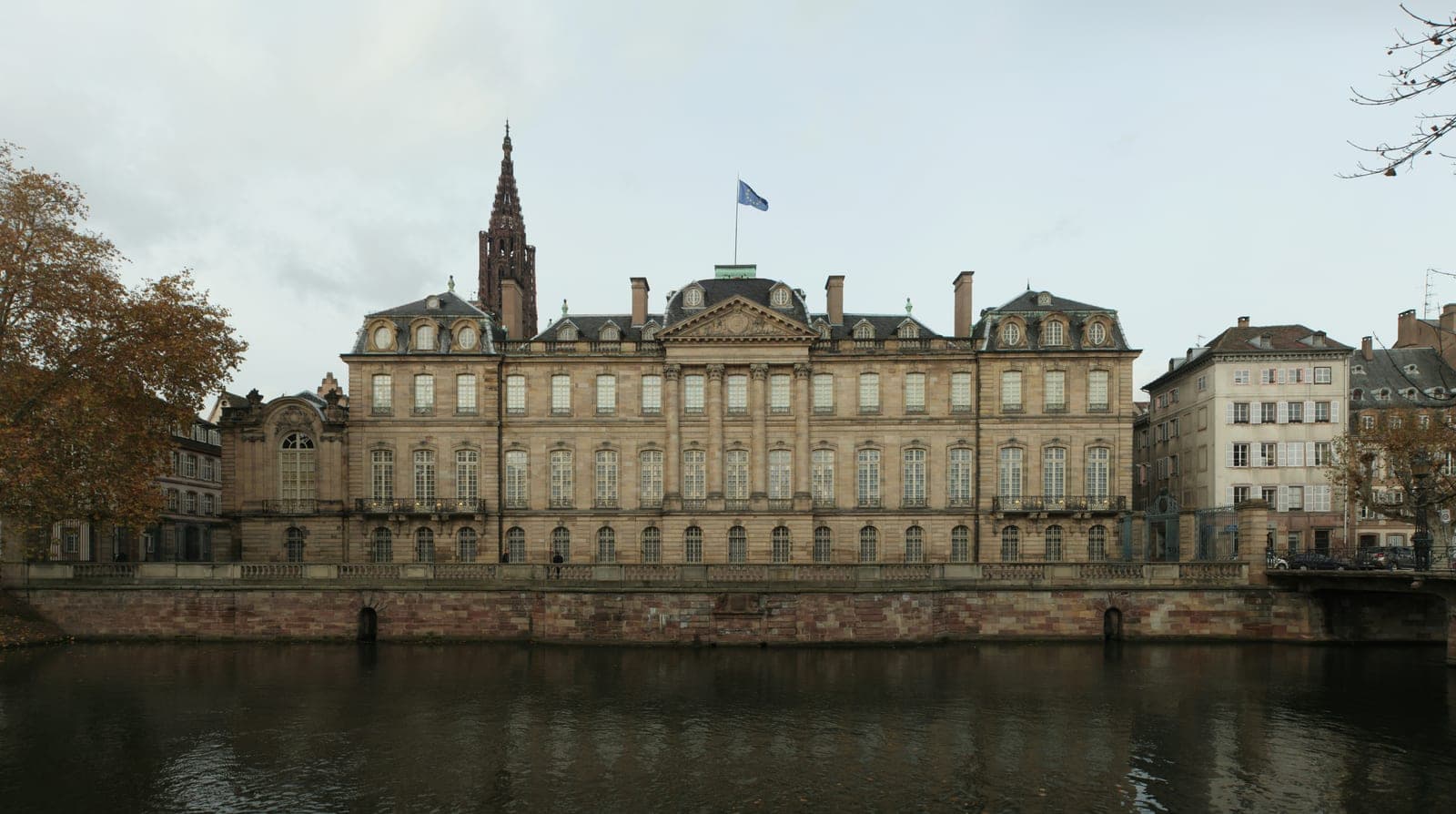
First impressions
The Grande Île is exactly what its name says, an island, and that is the single most useful thing to know about it. The Ill splits above the city and closes again below it, and everything inside the loop is the medieval town: about 0.86 km² of sandstone and timber that you can walk across in a quarter of an hour without ever meeting a hill.
What you notice first is that the ground is mostly not for cars. The lanes around the cathedral, the Grand'Rue and the half-timbered streets of Petite France are pedestrian or nearly so, and the traffic that does exist is slow, hemmed in and largely local. The second thing you notice is the crowd. This is the busiest square kilometre in eastern France, and it is busy in April as well as in December.
The island has four centres of gravity rather than one. Place de la Cathédrale is the obvious one, dominated by a single 142 metre spire and the Maison Kammerzell beside it. Place Kléber is the civic square, big, flat and used for everything the city does in public. Place Broglie at the north-east end is where the market sets up and where the opera and the Hôtel de Ville stand. And Petite France, at the western end, is the picture-postcard quarter of tanners' houses on the water, the part of the district a visitor comes for and the part a resident learns to walk around at midday.
One boundary note, because it changes what this page is about. This district is the five statistical areas of the island core. Petite France Sud, which is twice the size of any of them and crosses the water, is not part of it, so the Ponts Couverts and the barrage Vauban sit just outside the line that everything here is measured inside.
Who lives here, and what the streets look like
A typical figure across this district's five small statistical areas is 25,250 EUR a year of disposable income per consumption unit. That sits between the Krutenau at 21,675 and the Neustadt at 34,855, which is the honest position of a historic core: comfortable but not wealthy, because the flats are small and the households in them are mostly one or two people.
The building stock is the reason. This is sandstone and timber, four to five storeys, much of it sixteenth to eighteenth century and some of it older, cut and re-cut into flats over three hundred years. Lifts are the exception. Ceilings are high, staircases are narrow, and a 45 m² one-bedroom with a beam across it is the standard product. Genuinely family-sized flats exist but they are rare and they are expensive, and a listing that promises one is usually on the top floor of a building with no lift.
Ground floors are almost entirely commercial, which is what gives the island its life at street level and its thinness as a place to keep a household. There are 47 food shops inside the boundary and 236 restaurants. That ratio is the district in one line.
Who that produces is predictable: people in their twenties and thirties renting small flats, a layer of long-settled owners who bought before the listing pushed values up, staff from the restaurants and hotels, and a genuinely small number of families. The one group the island has more of than you would guess is teenagers, because four lycées stand inside it.
Getting around
This is the centre, so most of the time the answer is that you walk. Nine tram stops sit inside the boundary and the whole Strasbourg network crosses at Homme de Fer on the island's edge, which means every tram line in the city is reachable on foot from anywhere in the district. There is no metro in Strasbourg and no plan for one, so the tram is the network and it is a good one: frequent, quiet, and running late enough to be useful.
Six bus stops fill in the gaps, mostly for the routes the tram does not cover. Cycling is genuinely fast here because the ground is flat and the city's cycle network is among the best in France, but the island itself is the one part of Strasbourg where a bike is often slower than walking, because of the crowds.
Two honest weak points. The airport takes a change: Entzheim is served by a rail shuttle from the Gare de Strasbourg rather than from the island, so the journey is a walk or a tram stop, then a train. And the European Parliament and the Wacken institutions are on the far side of the Neustadt, a tram ride rather than a walk, which matters if the job that brought you here is at one of them.
Typical weekday minutes from Place Kléber, with the icon showing how. Measured door to door for a typical weekday morning from place Kléber, in the middle of the island; the icon shows the fastest sensible way., 2026-08.
Daily life
This is the district's strongest suit and it is not close. Forty-seven food shops inside 0.86 km², which is 54 per square kilometre, along with six pharmacies and a market on place Broglie. In practice that means bakeries, two or three small supermarkets, a fishmonger, cheese, and the sort of specialist shop that only survives where footfall is permanent.
The market on place Broglie is the thing to build a week around. It is the only market inside this boundary, and it is the clearest daily-life difference between the island and the quarters around it: a weekly shop here does not require leaving the district.
The caveat is the one every listed city centre has. A good share of the retail is aimed at people who are here for two days, not two years. The Grand'Rue and the streets between place Kléber and the cathedral carry the usual chains plus a long parade of gift shops, and the genuinely useful shops are one street back from all of them. Sunday is thin, as it is across Alsace, and a Sunday plan that assumes a supermarket will be open is a plan that fails.
Local Places Worth Knowing
Four places that tell you what the district is actually like, chosen because a resident would use them rather than because a visitor would photograph them.
The food market on place Broglie at the island's north-east end, and the only market inside this district. It is what makes a weekly shop possible without leaving the Grande Ile.
On rue du Bain-aux-Plantes in the half-timbered streets, which is the last place you would expect a room that works on a Tuesday morning. It does: proper coffee and breakfast.
A winstub on rue du Sanglier, two minutes behind the cathedral, doing the Alsatian card the way it is supposed to be done rather than the way the square outside sells it.
A general bookshop at the far end of the Grand'Rue, with a serious literature section and staff who read. The sort of shop a district keeps only if people actually use it.
Checked August 2026. Places close and change, so tell us if something here is out of date.
Schools and families
This is where the island surprises people. Four lycées stand inside the boundary, teaching 937 pupils in seconde between them, and the district's Schools figure of 94 is the pooled share of those pupils who reach the baccalauréat at the same school they started at. That is a very high number by any European standard, and it is worth understanding where it comes from.
The four are Institution La Doctrine Chrétienne at 96, Lycée Fustel de Coulanges at 94, Lycée Le Gymnase Jean Sturm at 93 and Collège Épiscopal Saint-Étienne at 93. All four run the general and technological track, so there is no vocational figure inside this boundary and the headline describes the academic route. Three of the four are private under contract, which is unusually high and is a fact about the island rather than about Strasbourg as a whole. A city-centre lycée also recruits from the whole agglomeration, so this measures the schools that stand here, not the children who live here.
For younger children the picture is more ordinary. There are two playgrounds and twelve garden spaces inside the district, the car-free lanes are a real asset when a five-year-old wants to walk to the bakery alone, and primary provision sits in the surrounding streets. What works against a family is the housing rather than the schooling: small flats, narrow stairs, no lift, and a permanent crowd outside the door.
Kids Restricted. Small children do better here than teenagers do, and both do better than the flats allow for. The car-free lanes mean a five-year-old can walk to the bakery without crossing a road, there are two playgrounds and twelve garden spaces inside the boundary, and four lycées stand on the island itself, which is rare. Against that: the flats are old, small and often without a lift, the district is 47 food shops and 236 restaurants, which tells you what the ground floors are for, and the crowd and the noise are permanent rather than seasonal.
Pet Restricted. The ground is flat and much of it is closed to cars, which is easy on a lead and easy on an old dog. Everything else is against it. There are twelve garden spaces inside the boundary and not one of them is a run, the pavement café tables leave little room to pass on a summer evening, the visitor crowd is constant from March to January, and the stone holds the heat in July. A small dog whose real exercise happens on the quays or at the Orangerie will be fine here. A large one will not.
Green space, leisure and eating out
Twelve garden spaces sit inside the boundary and none of them is a park in the sense of somewhere to spend an afternoon. They are squares, churchyards and pockets along the water. What actually functions as the district's outdoor space is the river itself: the Ill runs around the whole district, the quays are walkable for most of the loop, and the Orangerie and the Contades, the city's real parks, are fifteen to twenty minutes away on foot or one tram ride.
Leisure is the compensation. Four cinemas inside 0.86 km², the opera and the Hôtel de Ville on place Broglie, the museums along the water, and a concentration of theatre and music that no other district here comes close to. There is no library inside the boundary, which is the one gap worth naming.
Eating out is an embarrassment of choice and a warning at the same time. 236 restaurants, 52 bars and 48 cafés. The range from the top to the bottom of that number is very wide, the streets nearest the cathedral and Petite France are aimed squarely at visitors, and the rooms residents actually use are one or two streets off the obvious route. The winstub tradition, the small Alsatian room with a short card and shared tables, is alive here and it is the thing to learn first.
What it costs
There is no price to buy on this page, and there will not be one. Bas-Rhin, Haut-Rhin and Moselle kept the Livre foncier when the rest of France moved to the cadastral system, so DVF, the national register of recorded sales, does not cover Alsace at all. Every other district page on this site opens with what people actually paid per square metre. This one cannot, and rather than borrow an asking price from a portal and dress it up as a sale, it carries nothing.
What can be measured is renting, and there are two figures that measure different things. What sitting tenants actually pay is 12.8 EUR/m² a month excluding charges, the median across the whole occupied private rental stock in the Strasbourg rent observatory's 2024 survey, with quartiles of 10.7 to 15.4 behind it and 2,952 observations. The observatory works at the scale of its zone de prix rather than the district, and all five of this district's statistical areas sit in zone 01, so one number covers the island cleanly. The same zone holds the Krutenau and the Neustadt, which is why all three carry 12.8.
The asking rent is 15.6 EUR/m² a month with charges included, from the 2025 Carte des loyers, modelled from advertisements and published per commune, so it describes the whole city rather than the island.
The 2.8 EUR/m² gap between the two is not a scandal, it is two different quantities. The 15.6 has charges baked into it and cannot be separated out, and on this stock, with old buildings, shared courtyards and often collective heating, charges are a substantial part of it. The 15.6 also describes what is being advertised this year, while the 12.8 describes what the whole occupied stock is paying, including long leases signed years ago at rates the market has since left behind. Expect a new lease to land nearer the asking figure than the paid one.
Set the paid rent against the income and you get the ratio a listing never shows. At 12.8 EUR/m² a 45 m² one-bedroom is roughly 575 EUR a month before charges, about 6,900 EUR a year, which is a little over a quarter of the 25,250 EUR a year a typical one of this district's statistical areas records as disposable income per consumption unit. Treat that as a rough ratio rather than a household budget: the income is measured per consumption unit and per person, not per household, and it is a median of five area medians, which runs a little above the published area figure.
One cost appears in neither number. Renovation is constrained, because the whole island is inside a UNESCO inscription and a protected sector, so what you may change on a façade, a window or a roof is not up to you, and the work costs more when you are allowed to do it.
Weather and climate
Seasonal averages for Strasbourg, one representative month per season. Météo-France 1991-2020 normals for station Strasbourg-Entzheim, read 12 August 2026 via Infoclimat. Seasons are the representative months: January, April, July and October. Sunshine hours a day are the monthly totals divided by the days in the month (January 55.5 h, April 186.9 h, July 239.7 h, October 100.4 h). Annual figures: mean daily maximum 16.0 °C, mean daily minimum 6.9 °C, 635.7 mm of rain and 1,747.3 hours of sunshine. Rain days are left null because the count of days at or above 1 mm is not filled in on the published normals table. What the numbers say about living here: this is the coldest and darkest city on these French pages, and it is not close. January averages a 5.2 °C day and a mean minimum of -0.2 °C, so freezing nights are the norm rather than the exception, and the month gets 55.5 hours of sunshine in total, under two a day. The year takes only 1,747 hours of sun, below Paris. Summer compensates properly, 26.4 °C in July, and the Rhine plain is sheltered enough that the rain, 635.7 mm, is modest and falls mostly in summer thunderstorms.
The honest downsides
The crowd is permanent. This is not a summer problem. The island carries visitors from March through the Christmas market and out the other side, and the December weeks in particular turn the streets between place Broglie, place Kléber and the cathedral into something you plan around rather than walk through.
The flats are old and small. Narrow stairs, no lift, high ceilings that are expensive to heat, and a protected setting that limits what can be done about any of it. A family-sized flat here is a genuinely scarce object.
Sunday is closed. Alsace keeps Sunday closing seriously, and a district full of restaurants is not the same as a district where you can buy milk.
There is no library and no real park. Twelve garden spaces sound generous until you try to use one, and the nearest place to run properly is the Orangerie, fifteen minutes away.
Noise is structural, not incidental. 52 bars and 236 restaurants inside a district this size means the ground floor under your flat is probably serving somebody until late.
Crime and safety
France publishes recorded crime per commune, and Strasbourg is a single commune, so there is no Grande Île figure and nobody, ourselves included, can honestly give you one. The numbers beside this section are for the whole city, from the SSMSI 2025 base.
Read together they say something quite specific. Strasbourg's theft from the person rate, 258.1 per 10,000 residents against 91.0 for France, is nearly three times the national rate, and robbery, 12.8 against 7.2, runs the same way though far less dramatically. Assault outside the family is 49.1 against 31.6. But home burglary is 4.3 per 1,000 dwellings against 5.6 nationally, which is not merely close to normal, it is meaningfully below the country, and that is unusual for a city this size. Domestic violence, 41.3 against 37.6, sits slightly above the national rate.
The pattern is street theft high, home crime low. That describes a city where the risk is to your pockets in a crowd rather than to your flat while you are out, and the burglary figure is what you would expect from a housing stock of flats behind coded doors rather than houses with gardens.
Now apply it here, which is the only honest way to use a city number on a district page. This district is the crowd. 236 restaurants, 52 bars, 48 cafés, the cathedral, the main squares, the tram interchange at Homme de Fer and the Christmas market, all inside 0.86 km². Street theft tracks footfall, so the city's high theft rate describes this ground more than it describes a quiet residential street two kilometres out. Keep a phone out of a back pocket around the cathedral, on the tram and in the December crowds, and treat the burglary figure, which is a genuinely good one, as the better guide to leaving a flat here for a week.
Is this you?
The Grande Île suits someone who wants to live in the middle of a real city, on foot, with a tram network under their feet and a market, four cinemas and 236 restaurants inside a quarter of an hour's walk. If you are one or two people, you do not own a car and never want to, and you can be cheerful about a crowd, it is one of the most complete city centres in France. If you have a teenager, the four lycées on the island are an argument almost no other historic core in this country can make.
It is the wrong place if you need space, quiet or a garden, if a Sunday shop is part of how your week works, or if you want the cheapest way into central Strasbourg, which is the Krutenau. And it is the wrong place if you need to know what a flat is worth before you buy, because in Alsace that number does not exist in public. Whether you lease or purchase, walk the exact street on a Saturday in December before you decide the island is quiet enough.
Want to know what homes here are actually worth?
Join the waitlistHow we source this
How we put this together. Gathered on the ground by our local field team and written up by the Apraiz research team. Every figure above carries its own source and date. The scores are not computed by the build; walking and transport will use open map and transit data first, then Apraiz's own model. We update prices quarterly, transport and amenities twice a year, and school data when the source publishes.
Sources: Observatoire des loyers de l'agglomeration strasbourgeoise, via the Observatoires des loyers network, Carte des loyers 2025, DHUP and ANIL with leboncoin and Groupe SeLoger, DVF (Demandes de valeurs foncières), data.gouv.fr, INSEE, Ministère de l'Éducation nationale et de la Jeunesse, SSMSI, via data.gouv.fr, INSEE via OpenDataSoft (georef-france-iris), UNESCO World Heritage Centre, Wikipedia (en), OpenStreetMap contributors, via the Overpass API.
Safety and crime in Strasbourg →