
Long Story ShortReadHide
- What it is: the old market gardeners' and fishermen's quarter immediately south-east of the island, 0.59 km² of four statistical areas, and today the centre of Strasbourg student life.
- Who it suits: people who want to be five minutes from the middle of the city on foot and pay less for it, and who do not mind that the street outside is busy until late.
- What it costs: no price to buy exists anywhere in Alsace, so this page carries none; sitting tenants pay 12.8 EUR/m² a month excluding charges and listings ask 15.6 with charges included, which against this district's income is the heaviest rent of the three covered here.
- The catch: 33 bars in a district you can cross in ten minutes, no market, no library and no cinema inside it, and the lowest income of the three.
First impressions
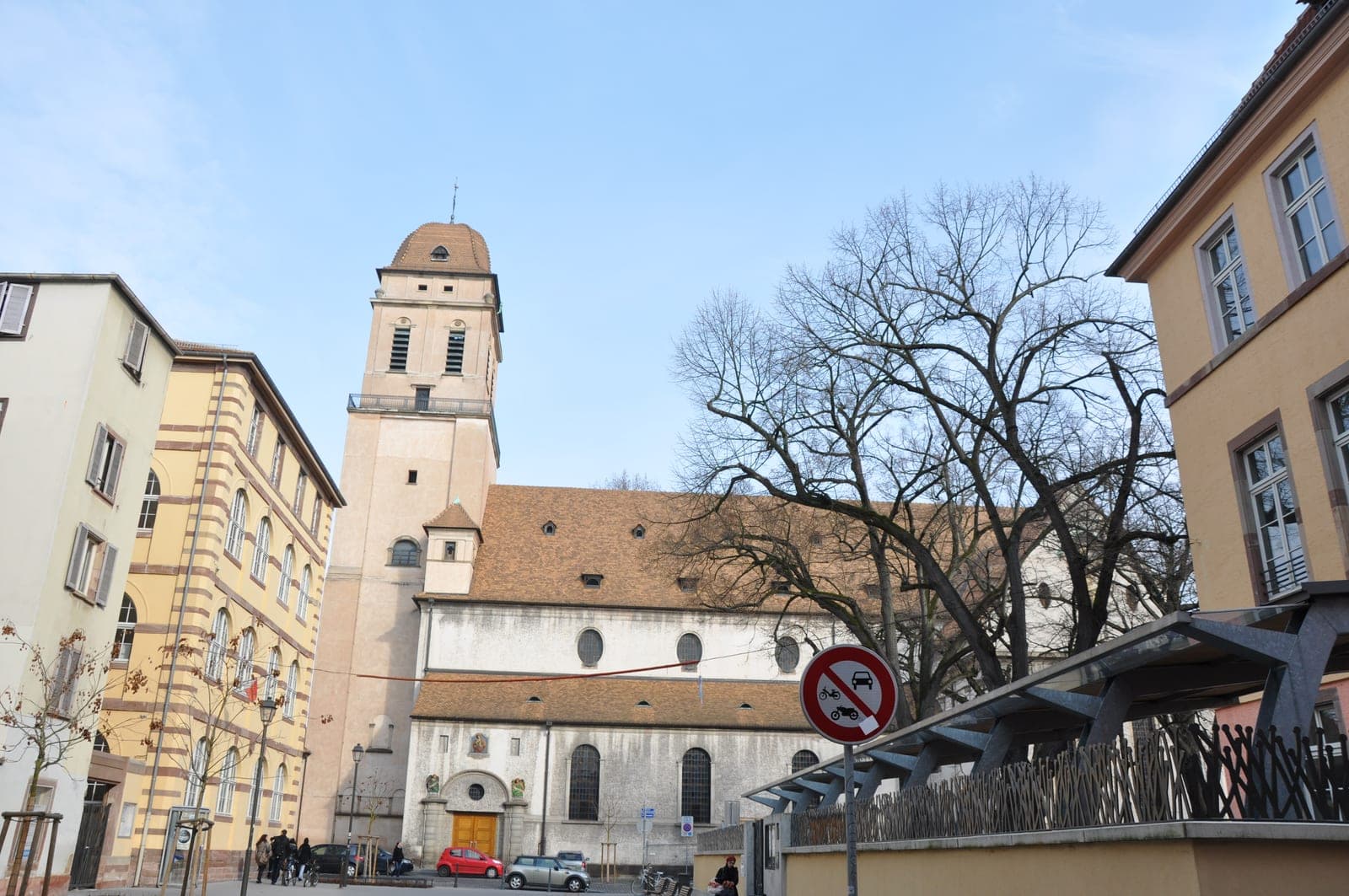
The Krutenau starts where the island stops. Cross one of the bridges south-east from the Grande Île and the scale changes immediately: the streets get narrower and less grand, the buildings get plainer, the shopfronts get younger, and the crowd stops being visitors and starts being students. It is 0.59 km², the smallest of the three Strasbourg districts on these pages, and you can walk from one end of it to the other in ten minutes.
The name is the history. Krut and Au, cabbage and meadow: this was marsh outside the city walls, drained by canals and turned into market gardens, and before the gardeners it belonged to boatmen and fishermen working an arm of the Rhine. The quai des Pêcheurs along the northern edge still says so. Then came barracks in the eighteenth century, a tobacco factory in the nineteenth, and the slow conversion of both into schools and studios, which is why the institutional buildings here look military and are used for teaching.
What that leaves on the ground is a quarter with two speeds. Rue de Zurich and the streets around place d'Austerlitz are the busy face: small restaurants, bars, kebab counters, and a pavement that fills the moment the weather turns. Behind them, towards the rue des Orphelins and the southern end, the streets are ordinary residential blocks where nothing much happens after nine. Which of the two you live on will matter more to your daily life than any figure on this page.
Who lives here, and what the streets look like
A typical figure across this district's four small statistical areas is 21,675 EUR a year of disposable income per consumption unit, and it is the lowest of the three Strasbourg districts covered here, against 25,250 on the island and 34,855 in the Neustadt. That is not a poor quarter. It is a young one, and the arithmetic of student households does most of the work: small flats, single occupancy, high turnover, and incomes measured in a year when a lot of the residents were not yet earning.
The building stock is mixed in a way the island's is not. There is genuine old fabric near the water, plainer nineteenth-century blocks through the middle, and a good deal of post-war and later infill where the quarter was rebuilt after being judged insubstantial. That mix is the district's practical advantage: it holds more small, cheap, modernised flats than anywhere else this close to the centre, and a share of them have lifts, which the island mostly does not.
Who lives here follows from that. Students from the Esplanade campus next door and from the art school on rue de l'Académie, researchers and junior academics, young professionals renting their first flat in the city, and a settled layer of long-term residents in the quieter southern streets who watch the rest of it turn over every September. Families are conspicuously rare.
Getting around
The honest answer for this district is that the centre is a walk. Place Kléber, the cathedral and the whole island are ten minutes away on foot across a bridge, and for most daily journeys nothing else is faster. That single fact carries the score here more than the network does.
The network itself is thinner than you would expect this close in. Only two tram stops sit inside the boundary, at the western and northern edges, and the interior of the quarter leans on 16 bus stops instead. That is a lot of bus stops, and the routes are frequent, but it means that if you commute by tram you will walk five to eight minutes to reach it, which is a real difference from the island, where nine tram stops sit inside 0.86 km². There is no metro in Strasbourg and no plan for one.
Cycling is the quiet winner. The ground is flat, the city's cycle network is among the best in France, and the Krutenau is close enough to everything that a bike removes the tram question entirely. For the airport, Entzheim is reached by rail shuttle from the Gare de Strasbourg, so the journey is a tram or a fifteen-minute walk, then a train.
Typical weekday minutes from Place d'Austerlitz, with the icon showing how. Measured door to door for a typical weekday morning from place d'Austerlitz, in the middle of the district; the icon shows the fastest sensible way., 2026-08.
Daily life
Twenty-three food shops and five pharmacies inside 0.59 km² is a good showing for a district this small, and in practice the daily shop works well: bakeries, small supermarkets, a few grocers on rue de la Krutenau and rue de Zurich, and enough turnover that the shelves are fresh. Density works out at 39 food shops per square kilometre, noticeably below the island's 54, but the district is small enough that the difference is a two-minute walk rather than a problem.
The gap is specific and worth stating plainly: there is no market inside this boundary. The nearest is on place Broglie on the island, ten minutes away on foot, and residents here use it. In a French city that is a genuine absence rather than a technicality, because the market is where the week's fruit, vegetables and fish are supposed to come from.
Two other absences. No library inside the district and no cinema, both of which the island has and neither of which is far. What the Krutenau has instead is 19 cafés, 98 restaurants and 33 bars, which is to say that its ground floors are built for the evening rather than for the errand.
Local Places Worth Knowing
Four places that tell you what the district is actually like, chosen because a resident would use them rather than because a visitor would photograph them.
On rue de Zurich, in the middle of the quarter rather than on its edge, and the room the Krutenau uses in the daytime. Breakfast, decent coffee and enough tables to sit at.
A small kitchen on rue Klein doing a short, changing French card at a level the street outside does not advertise. The district's answer to being written off as student food.
A barge moored on the quai des Pecheurs, which is about as Krutenau as an address gets: restaurant, bar and terrace on the water at once, and loud. The default for years.
A working chocolatier on rue de la Brigade Alsace-Lorraine, small, old-fashioned and very good. The sort of shop that survives only where the resident population is settled.
Checked August 2026. Places close and change, so tell us if something here is out of date.
Schools and families
Three lycées stand inside this district, teaching 453 pupils in seconde between them, and all three run the professional track. The district's Schools figure of 65 is therefore the vocational route, pooled over those pupils: Lycée Jean Rostand at 75, Lycée professionnel Jean-Frédéric Oberlin at 69 and Lycée professionnel Jean Geiler at 53.
That number should be read for what it is. A vocational figure and a general one are not the same measurement, and a district whose lycées are general will show a higher number without any of its schools being better run. What the 65 actually tells you about living here is a structural fact: the secondary provision inside these four streets is vocational, and a child on the general and technological route will go to school on the island or in the Neustadt, both of which are within a fifteen-minute walk.
For younger children the everyday picture is reasonable. Two playgrounds and twelve garden spaces inside the boundary, 23 food shops, five pharmacies, flat streets and short distances. What thins the family count is the rest of it: no library, no cinema, a housing stock built around one and two-person flats, and 33 bars whose customers walk home past your window. Families who do stay are almost all in the southern half, away from rue de Zurich and place d'Austerlitz.
Kids Restricted. The practical things are here: two playgrounds, twelve garden spaces, 23 food shops, five pharmacies, flat streets, and a ten-minute walk to everything on the island. The reasons families are thin on the ground are just as real. The three lycées inside the boundary are all vocational, so a child on the general route commutes, though only as far as the island. There is no library and no cinema inside the district. And 33 bars in an area this small produces a term-time noise level on the busy streets that a family bedroom notices.
Pet Restricted. Flat ground, short streets and twelve garden spaces inside 0.59 km², with the Ill along two sides of the district and a quay you can actually walk. That is a decent start. What holds it back is that none of the twelve is a run, the nearest proper open space is the Orangerie or the Esplanade campus lawns rather than anything inside the boundary, and the district carries 33 bars, so a summer evening on the busy streets is crowded pavement rather than a walk. Good for a small dog, workable for a large one only if you are prepared to leave the district daily.
Green space, leisure and eating out
Twelve garden spaces sit inside 0.59 km², which is a high count for the area, but they are squares, courtyards and strips rather than parks. The real open ground is at the edges: the Ill runs along two sides of the district, the quai des Pêcheurs is walkable, and the Esplanade campus lawns and the Orangerie are a short walk east and north. Nothing inside the boundary is big enough to run a lap of.
Leisure here is social rather than institutional. There is no cinema and no library inside the district, and the cultural anchor is the art school on rue de l'Académie rather than a museum. What the quarter has instead is the densest concentration of small, cheap, good places to eat and drink in Strasbourg: 98 restaurants and 33 bars in an area you can cross in ten minutes, running from student kebab counters through Vietnamese and Turkish rooms to a handful of serious kitchens.
That is genuinely one of the reasons to live here, and it comes with a term-time rhythm you should know about before you sign. The quarter fills in October, is loud until June, and empties dramatically in July and August, when a third of the shopfronts close for the holidays.
What it costs
There is no price to buy on this page, and there will not be one. Bas-Rhin, Haut-Rhin and Moselle kept the Livre foncier when the rest of France moved to the cadastral system, so DVF, the national register of recorded sales, does not cover Alsace at all. Rather than borrow an asking price from a listings portal and present it as a sale, this page carries no purchase figure.
What can be measured is renting, and there are two figures measuring different things. What sitting tenants actually pay is 12.8 EUR/m² a month excluding charges, the median across the whole occupied private rental stock in the Strasbourg rent observatory's 2024 survey, with quartiles of 10.7 to 15.4 and 2,952 observations behind it. The observatory works at the scale of its zone de prix rather than the district, and all four of this district's statistical areas sit in zone 01, so one number covers the Krutenau cleanly. The island and the Neustadt are in the same zone, which is why all three carry 12.8.
The asking rent is 15.6 EUR/m² a month with charges included, from the 2025 Carte des loyers, modelled from advertisements and published per commune, so it describes the whole city rather than this quarter.
The gap between them is two different quantities rather than a landlord's markup. The 15.6 has charges inside it and they cannot be separated out, and it describes what is being advertised now, while the 12.8 describes what the entire occupied stock is paying, long-standing leases included. In a quarter that turns over every September, the practical consequence is that a new tenant here sees the higher number far more often than the lower one.
Set the paid rent against the income and this district's real cost problem appears. At 12.8 EUR/m² a 45 m² one-bedroom is roughly 575 EUR a month before charges, about 6,900 EUR a year, which is close to a third of the 21,675 EUR a year a typical one of these statistical areas records as disposable income per consumption unit. That is the heaviest of the three Strasbourg districts on these pages, and it is heaviest precisely because the incomes are lowest, not because the rent is higher. Treat the ratio as rough: the income is per consumption unit rather than per household, and it is a median of four area medians, which runs a little above the published area figure.
The practical version of that arithmetic is the flatshare. A large share of this quarter's rental stock is let by the room or shared between two or three people, and the district's advertised rents behave accordingly: small flats carry a higher price per square metre than large ones, so the headline understates what a studio costs and overstates what a three-bedroom costs. If you are moving here alone, budget from the room rather than from the per-square-metre figure.
Weather and climate
Seasonal averages for Strasbourg, one representative month per season. Météo-France 1991-2020 normals for station Strasbourg-Entzheim, read 12 August 2026 via Infoclimat. Seasons are the representative months: January, April, July and October. Sunshine hours a day are the monthly totals divided by the days in the month (January 55.5 h, April 186.9 h, July 239.7 h, October 100.4 h). Annual figures: mean daily maximum 16.0 °C, mean daily minimum 6.9 °C, 635.7 mm of rain and 1,747.3 hours of sunshine. Rain days are left null because the count of days at or above 1 mm is not filled in on the published normals table. What the numbers say about living here: this is the coldest and darkest city on these French pages, and it is not close. January averages a 5.2 °C day and a mean minimum of -0.2 °C, so freezing nights are the norm rather than the exception, and the month gets 55.5 hours of sunshine in total, under two a day. The year takes only 1,747 hours of sun, below Paris. Summer compensates properly, 26.4 °C in July, and the Rhine plain is sheltered enough that the rain, 635.7 mm, is modest and falls mostly in summer thunderstorms.
The honest downsides
It is loud in term and half-shut in August. Thirty-three bars in 0.59 km² is a student quarter's density, and the noise is not concentrated on a single street the way it is in some centres. It travels.
There is no market, no library and no cinema inside the district. All three are on the island, ten minutes away, and none of them is a hardship. But if you assumed a French quarter of this size would have its own market, it does not.
The tram is at the edges. Two stops inside the boundary against nine on the island. Sixteen bus stops make up for it, and the walk to the centre makes up for it further, but a rainy commute from the middle of the district is a walk first.
Rent takes the biggest bite here. The city rent against this district's income is the heaviest ratio of the three, and the stock is skewed to small flats, which cost more per square metre.
The building stock is uneven. Fine older fabric near the water, and a lot of plain post-war and later infill through the middle. Look at the specific building, not the quarter.
Crime and safety
France publishes recorded crime per commune, and Strasbourg is a single commune, so there is no Krutenau figure and nobody, ourselves included, can honestly give you one. The numbers beside this section are for the whole city, from the SSMSI 2025 base.
The city's profile is street theft high, home crime low. Theft from the person runs at 258.1 per 10,000 residents against 91.0 for France, nearly three times the national rate. Assault outside the family is 49.1 against 31.6, and unarmed robbery 12.8 against 7.2, above the national rate but far below what several southern French cities record. Against that, home burglary is 4.3 per 1,000 dwellings against a national 5.6, which is meaningfully below the country and unusual for a city this size. Domestic violence, 41.3 against 37.6, is slightly above the national rate.
Applying that here means reasoning about what this district actually is, not inventing a number for it. The Krutenau is a crowd, but a different crowd from the island's: it is local and nocturnal rather than touristic and daytime, concentrated on rue de Zurich, place d'Austerlitz and the quays on term-time evenings, and it thins to almost nothing in the southern residential streets and in August. Street theft tracks exactly that pattern, so the sensible reading is to be careful on the busy streets late and on the walk home over the bridges, and to treat the daytime quarter as ordinary.
The burglary figure is the one that applies evenly, and it is a good one. A stock of flats behind coded doors is a large part of why Strasbourg sits below the national rate, and that description fits this district as well as anywhere in the city.
Is this you?
The Krutenau suits someone who wants to be inside Strasbourg without paying for the island: five minutes from the cathedral on foot, a shorter walk to a bar than to a bus stop, and a stock of small modernised flats that the historic core simply does not have. For a student, a researcher, or anyone in their first years in the city, it is the obvious choice and has been for decades.
It is the wrong place for a family that wants a library, a cinema and a market inside the boundary, for a light sleeper on one of the busy streets, and for anyone whose budget assumes a flatshare will not be the local norm. And it is the wrong place if you want to know what a flat is worth before you buy, because in Alsace that figure does not exist in public. Whether you lease or purchase, walk the exact street twice, once on a Wednesday in November and once on a Sunday in August, before you decide which Krutenau you are moving to.
Want to know what homes here are actually worth?
Join the waitlistHow we source this
How we put this together. Gathered on the ground by our local field team and written up by the Apraiz research team. Every figure above carries its own source and date. The scores are not computed by the build; walking and transport will use open map and transit data first, then Apraiz's own model. We update prices quarterly, transport and amenities twice a year, and school data when the source publishes.
Sources: Observatoire des loyers de l'agglomeration strasbourgeoise, via the Observatoires des loyers network, Carte des loyers 2025, DHUP and ANIL with leboncoin and Groupe SeLoger, DVF (Demandes de valeurs foncières), data.gouv.fr, INSEE, Ministère de l'Éducation nationale et de la Jeunesse, SSMSI, via data.gouv.fr, INSEE via OpenDataSoft (georef-france-iris), Wikipédia (fr), Haute école des arts du Rhin, OpenStreetMap contributors, via the Overpass API.
Safety and crime in Strasbourg →Nearby: Grande Île · Neustadt