
Long Story ShortReadHide
- What it is: the old town of Nice, half a square kilometre of tall ochre lanes between the castle hill and the sea, with a market square down the middle of it.
- Who it suits: people who want to live inside a city rather than beside one, who eat out constantly and who do not need a car, a lawn or silence.
- What it costs: 6 400 EUR / m² ≈ $690 / sq ft to buy on the price actually paid; sitting tenants pay 14.6 to 18 EUR/m² a month excluding charges, depending on which end of the quarter they are in.
- The catch: 155 restaurants, 50 bars and 34 cafés inside those lanes, and the summer crowd that comes with them.
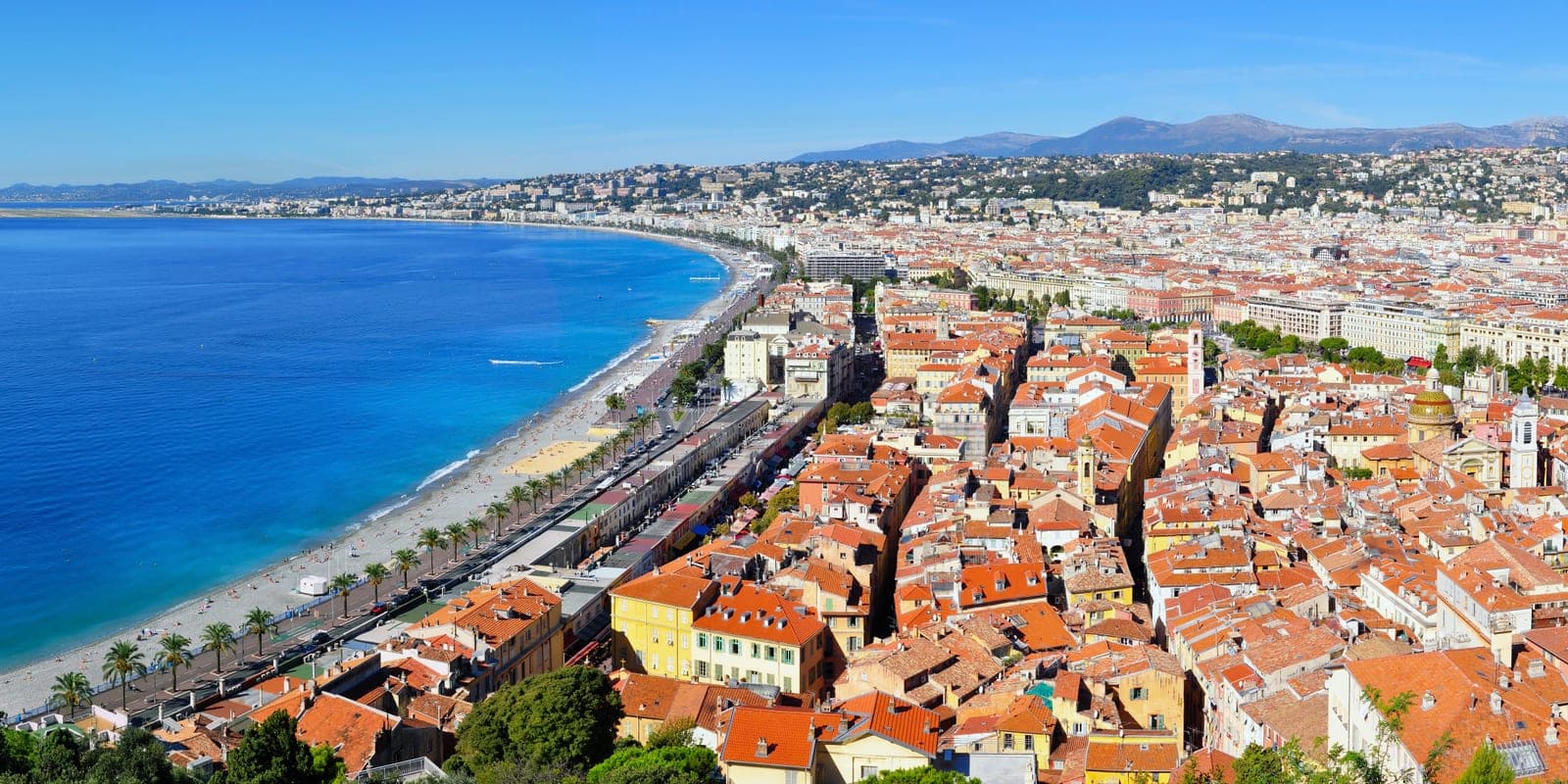
First impressions
Vieux Nice does not look French, and there is a reason for that. Nice belonged to the House of Savoy and then to the Kingdom of Sardinia, and it only became French in 1860, by the Treaty of Turin and a plebiscite held on 15 and 16 April that year. Everything you notice on the first walk was built before that: the tall narrow houses in ochre and terracotta, the shutters, the washing lines, the baroque church fronts squeezed into lanes too narrow to see them properly.
The plan is medieval and it has barely moved. Rue Droite, which is not straight, runs the length of the quarter. The lanes off it are wide enough for a scooter and nothing else, and above them the buildings meet the light in a way that keeps the ground cool in August and dark in December. Then the quarter opens twice: at the Cours Saleya, a long flat market square that faces the sea wall, and at place Rossetti, where the cathedral finally has room to be looked at.
The castle explains the rest. The hill on the eastern side held a fortress until the siege of 1706, when a cannonball landed in the citadel's powder store and the whole thing went up in an afternoon. It was never rebuilt, which is why Nice has a castle hill with a park and a waterfall on it and no castle. When the ramparts came down, the city grew north into place Garibaldi, with its arcades and its yellow façades, and west across the Paillon into the streets that became the modern centre. The old town simply stayed as it was, which is the whole reason it is worth living in and most of the reason it is difficult.
Who lives here, and what the streets look like
A typical figure across this district's three small statistical areas is 18,830 EUR a year of disposable income per consumption unit, the lowest of the three Nice districts covered here and well under Cimiez at 31,230. That is not a poor quarter so much as a young and mobile one: small flats, a lot of one-person households, seasonal work in the restaurants downstairs, and a high share of the stock let rather than lived in by its owner.
The buildings are four to six storeys, stone and rendered brick, built before lifts existed and mostly still without them. Flats have been divided and redivided, so a 35 m² one-bedroom with a beam and a stone wall is the standard product and a family-sized flat is genuinely rare. Ground floors are almost entirely commercial. That is what makes the quarter feel alive at street level and thin on residents' amenities, and it is also why the noise arrives through the floor as well as the window.
Getting around
You mostly walk. The quarter is 0.50 km² and flat, the lanes take no cars in practice, and place Masséna, the Promenade des Anglais and the port are all a few minutes out on foot.
For anything further there are three tram stops and six bus stops inside the boundary. Line 1 opened in 2008 and runs through Masséna and Garibaldi, both on the quarter's edge. Line 2 matters more than it looks: it runs underground beneath the centre from Port Lympia in the east to Nice Côte d'Azur airport in the west, so the airport is one ride with no change, which very few European old towns can say. There is no metro in Nice and no rail station inside the district, so the Gare de Nice-Ville is a tram ride rather than a walk.
The local detail worth knowing is about the car. Owning one here is a decision rather than a default: the lanes take no through traffic, so a car lives in a garage on the edge of the quarter, and every delivery, removal or bulky purchase ends with a carry. People who move here from a suburb usually sell the car within a year.
Typical weekday minutes from Cours Saleya, with the icon showing how. Measured door to door for a typical weekday morning from the Cours Saleya, in the middle of the quarter; the icon shows the fastest sensible way., 2026-08.
Daily life
This is the quarter's strongest suit. Twenty-three food shops inside 0.50 km², which is 46 per square kilometre, plus six pharmacies and the market on the Cours Saleya. Rue Pairolière at the northern end is the practical spine, the market square is the weekly shop, and the olive oil house on rue Saint-François-de-Paule is the address residents send visitors to.
The honest caveat is that a good share of those shopfronts are aimed at people on holiday. Soap, lavender, printed aprons and a socca stand every thirty metres are not a weekly shop. The trick residents learn quickly is which streets are for them, and it is the ones running north from the market rather than the ones facing it.
Local Places Worth Knowing
Four places that tell you what the district is actually like, chosen because a resident would use them rather than because a visitor would photograph them.
The market that organises the quarter's morning, the length of the cours between the sea wall and the baroque facades: flowers at one end, produce, olives and cheese at the other.
A tiny room on rue Raoul Bosio cooking the Nicois repertoire straight. No telephone, no cards, and you book by walking in and asking, which tells you the kind of place it is.
The oyster and shellfish institution under the arcades of place Garibaldi, and one of the busiest rooms in Nice at any hour. One of the few big tables locals still use.
The olive oil house on rue Saint-Francois-de-Paule, selling its own oil, olives and the blue and yellow tins that leave Nice in half the suitcases. Trading since 1868.
Checked August 2026. Places close and change, so tell us if something here is out of date.
Schools and families
No lycée stands inside this district's boundary. That is a fact about the place rather than a surprise: the quarter is half a square kilometre of largely commercial ground floors, and secondary education happens in the quarters around it. A teenager living here commutes, on foot or by tram, and a family should count that journey rather than assume it.
For younger children the picture is better than the numbers suggest. The lanes take no cars, which is worth more day to day than any playground, and there are two playgrounds and four garden spaces inside the quarter, with the castle hill above it and the beach across the quai. The constraints are the flats, small, old and usually walk-up, and the evening. Families who stay here tend to be on the eastern lanes towards the Visitation rather than around the Cours Saleya.
Kids Restricted. Small children manage here better than teenagers. The lanes take no cars, so a five-year-old can walk to the bakery without a road crossing, there are two playgrounds and four garden spaces inside the quarter, and the sea is at the end of the street. Against that: 155 restaurants, 50 bars and 34 cafés inside half a square kilometre, which is a noise level a family bedroom cannot ignore, no lycée inside the boundary, and flats that are old, narrow and usually walk-up.
Pet Restricted. Flat, short and almost entirely car-free, which is easy on a lead and easy on an old dog. Everything else is against it: there are four small garden spaces in the whole quarter and no lawn worth the name, the stone holds heat right through a Nice August, the lanes fill with tables and people from six in the evening, and the nearest proper run is the climb up the castle hill or the pebble beach across the quai. Fine for a small dog whose exercise happens elsewhere, hard work for a large one.
Green space, leisure and eating out
Green space inside the boundary is four small garden spaces and no park. What saves the quarter is what sits on either side of it: the climb up the castle hill, which is a proper park with shade, views and a waterfall, and the sea itself, reached in two minutes across the quai des États-Unis. Nice's beaches are pebble, which is a real thing to know before you picture the swim.
Eating out is the opposite problem, an embarrassment of it. 155 restaurants, 50 bars and 34 cafés inside a quarter you can cross in ten minutes. The quality range is very wide. The rule of thumb residents use is that the tables filling a photogenic square are not the ones to book, and the good rooms are one lane back with eight tables and a written card.
What it costs
The number to start from is what people actually paid: 6 400 EUR / m² ≈ $690 / sq ft, the median across 197 recorded apartment sales inside these three statistical areas in 2025, from the state's register of transfers rather than from asking prices. Unusually, the median over flats sold with nothing attached is identical at 6,400, because a cellar or a parking space is rare in this stock. In a city where a parking space is a real asset, that tells you something about the buildings.
Against the three Nice districts covered here, this sits in the middle: 5,641 in Cimiez, 6,400 here, 7,728 in the Carré d'Or.
On renting there are two kinds of figure and they measure different things. What sitting tenants pay runs from 14.6 to 18 EUR/m² a month excluding charges, from the Nice rent observatory's 2024 survey of the occupied private stock. The spread is the local detail worth knowing: this quarter straddles three of the observatory's price zones, so the seaward side around the Cours Saleya sits in the dearest zone in the agglomeration at 18, while the lanes further from the water sit at 14.7 and 14.6. That is about 150 EUR a month on a 45 m² flat for a walk of a few hundred metres, and the observatory's zones are never averaged together here. The asking rent is 20.4, charges included and not separable, published per commune, so it describes the whole of Nice rather than this quarter.
Set the price against the income and you get the ratio a listing never shows. At 6,400 EUR/m², a 45 m² one-bedroom is roughly 288,000 EUR, about fifteen times the 18,830 EUR a year a typical one of this district's small statistical areas records. That gap is the reason the quarter is full of tenants and thin on owner-occupier families, and it is the widest of the three Nice districts on these pages.
Weather and climate
Seasonal averages for Nice, one representative month per season. Météo-France 1991-2020 normals for station Nice-Côte d'Azur, read 12 August 2026 via Infoclimat. Seasons are the representative months: January, April, July and October. Sunshine hours a day are the monthly totals divided by the days in the month (January 156.7 h, April 229.2 h, July 349.3 h, October 191.1 h). Annual figures: mean daily maximum 19.8 °C, mean daily minimum 12.8 °C, 791.3 mm of rain and 2,760.8 hours of sunshine. Rain days are left null because the count of days at or above 1 mm is not filled in on the published normals table. What the numbers say about living here: this is a mild winter rather than a warm one, a 13.3 °C January day and nights that rarely freeze at a 5.8 °C mean minimum, with 2,761 hours of sun a year. The rain does not arrive in winter: October is by far the wettest month at 127.9 mm, often in a few violent Mediterranean episodes, while July takes 13.6 mm across the whole month. Summer nights are the thing newcomers underestimate, averaging 20.8 °C in July, so a flat without shutters or a sea breeze stays warm after dark.
The honest downsides
The noise is not a rumour. Fifty bars and 155 restaurants in half a square kilometre are loud from Thursday to Sunday, late, and the stone throws the sound upward into the flats. A room over a terrace is a different proposition from one on a lane three turns in, and the difference does not always show in the price.
The flats are old and small. Narrow rooms, no lift, stone that holds July heat all night, and works that are slow and expensive in a protected setting. Charges on an old building can be heavy and they sit inside an advertised rent where you cannot see them.
Summer is a crowd. The quarter is one of the most walked pieces of the Côte d'Azur, and from June to September the lanes, the market and the beach are full. Residents adjust their hours rather than their habits.
There is almost no green. Four small garden spaces. The castle hill and the sea do the work, and both involve leaving the quarter.
Crime and safety
France publishes recorded crime per commune, and Nice is a single commune, so there is no Vieux Nice figure and nobody, including us, can honestly give you one. The numbers beside this section are for the whole city.
Read together they say something specific. Nice's theft from the person rate, 159.7 per 10,000 residents against 91.0 for France, is about three quarters above the national rate, and robbery, 12.6 against 7.2, runs the same way. Home burglary, at 6.1 per 1,000 dwellings against 5.6, is close to normal. Assault is 49.2 against 31.6, and domestic violence 46.0 against 37.6, where the comparison needs a caveat: recorded domestic violence rises when reporting rises, so a higher number can reflect more trust in the police rather than more violence.
The pattern, elevated street theft and ordinary burglary, describes a city where the risk is to your pockets in a crowd rather than to your flat while you are out. This district is the densest crowd in Nice: a market square, a beachfront edge, and 205 restaurants and bars between them. Apply the city figure here with that in mind, keep a phone out of a back pocket around the Cours Saleya and the tram stops late, and treat the rest as ordinary city life.
Is this you?
Vieux Nice suits someone who wants the middle of a city with no compromise and is honest about what that costs. If your evening starts by walking three minutes to a table, if you will use a morning market properly, and if you can either sleep through noise or afford a lane away from it, there are few places in France that give you this much city and a beach at the end of the street.
It is the wrong place for a family that needs space and a lycée within walking distance, for anyone who wants a garden, and for a light sleeper on a budget, because the cheap flats here are the loud ones. Whether you lease or purchase, stand on the exact street at eleven on a Friday night in July before you decide.
Want to know what homes here are actually worth?
Join the waitlistHow we source this
How we put this together. Gathered on the ground by our local field team and written up by the Apraiz research team. Every figure above carries its own source and date. The scores are not computed by the build; walking and transport will use open map and transit data first, then Apraiz's own model. We update prices quarterly, transport and amenities twice a year, and school data when the source publishes.
Sources: DVF (Demandes de valeurs foncières), data.gouv.fr, Observatoires des loyers, agglomération niçoise (L0600), Carte des loyers 2025, DHUP and ANIL with leboncoin and Groupe SeLoger, INSEE, SSMSI, via data.gouv.fr, Wikipédia (fr), Wikipedia (en), OpenStreetMap contributors, via the Overpass API.
Safety and crime in Nice →Nearby: Carré d'Or · Cimiez