
Long Story ShortReadHide
- What it is: the green hill above Nice, 0.68 km² of olive groves, Roman ruins, museums and large villas, a short ride from the sea and a world away from it.
- Who it suits: people who want quiet, space and trees inside the city limits, and who will accept doing their shopping somewhere else.
- What it costs: 5 641 EUR / m² ≈ $610 / sq ft to buy, the cheapest of the three Nice districts here; sitting tenants pay 16.3 to 18 EUR/m² a month excluding charges.
- The catch: two food shops, one café and no tram. This is the least convenient district in this set by a wide margin.
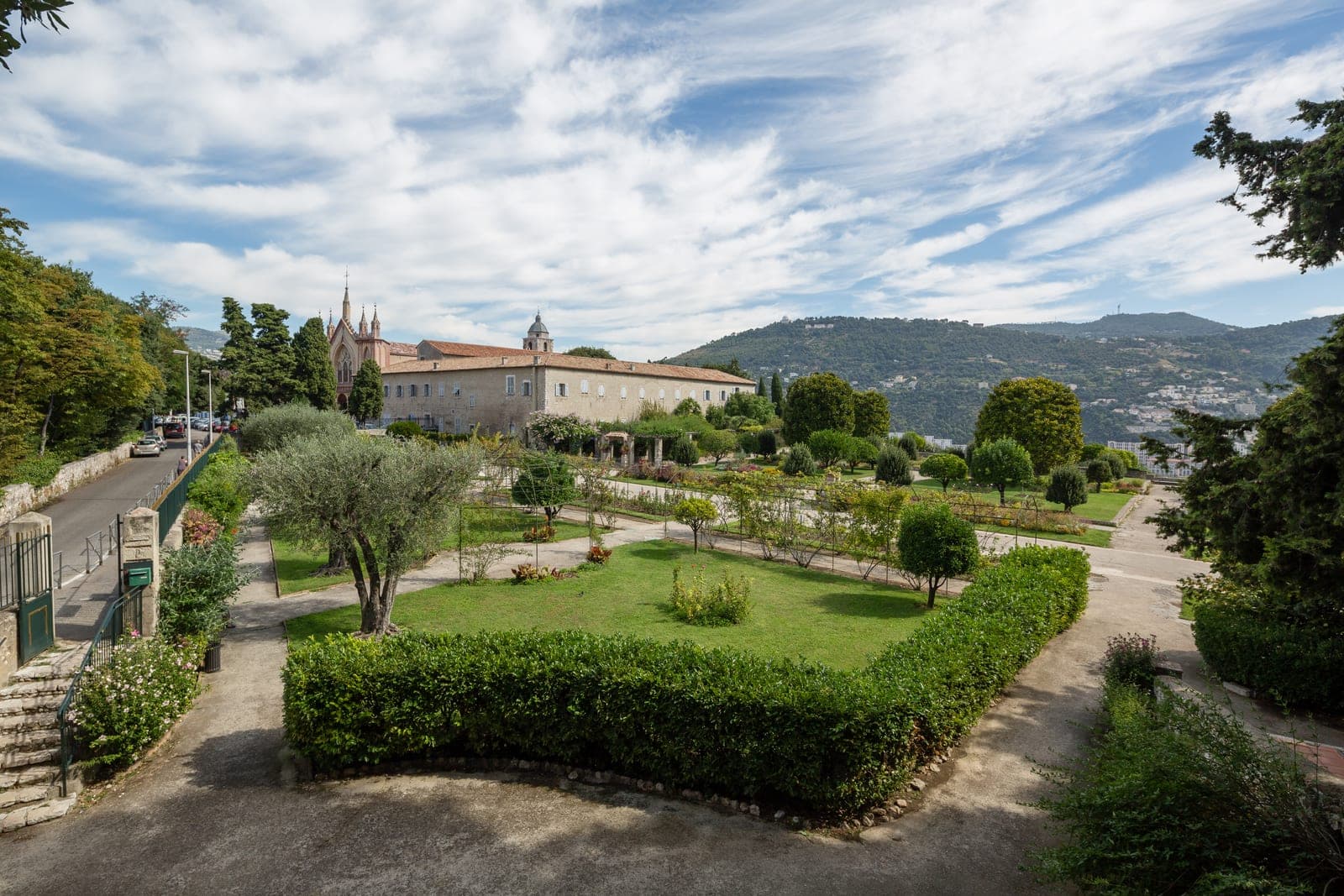
First impressions
Cimiez is the oldest address in Nice and it does not look it. The hill was a Roman city, Cemenelum, capital of the province of Alpes Maritimae, and the arena, the thermal baths and an early Christian basilica are still in the ground beside the museum. You can walk across a public garden here and be walking on a street plan from the second century.
What you see first, though, is the nineteenth century. When the Riviera's winter season took off, Nice built its grandest hotels not on the seafront but up here, where the air was thought to be better. The Excelsior Régina went up between 1895 and 1897, and Queen Victoria spent three springs in its left wing, in 1897, 1898 and 1899. The hotel did not survive the century that followed: its 400 bedrooms were cut into 98 flats in 1937, and one of the people who bought in was Henri Matisse, who kept an apartment and studio there from 1938 to 1943. He is buried a few hundred metres away, in the cemetery beside the Franciscan monastery, along with the painter Raoul Dufy.
The result is a district that reads as a park with buildings in it. The Villa des Arènes, built between 1670 and 1685 as the Gubernatis palace, is now the Musée Matisse, bought by the city in 1950 and opened as a museum in 1963. The monastery gardens look south over the whole city to the sea. Between them lies the olive grove where the Nice Jazz Festival was held every summer from 1974 to 2010. Almost everything else is villas, garden walls and hedges, and the streets are wide, shaded and quiet in a way no other district in this set is.
Who lives here, and what the streets look like
A typical figure across this district's two small statistical areas is 31,230 EUR a year of disposable income per consumption unit, the highest of the three Nice districts covered here and two thirds above Vieux Nice at 18,830. That gap is the district in one number, and it shows in the fabric rather than in the shopfronts: this is a quarter of large flats in interwar and belle époque blocks, of villas behind gates, and of long-settled owners rather than a moving tenant population.
The building stock is the opposite of the old town's. Blocks of five or six storeys standing in their own grounds, with lifts and deep balconies, plus villas behind gates on the side streets. Flats are big, ceilings are high, and a three-bedroom is a normal product here rather than a rarity. Ground floors are residential, so the streets have no commercial life at all, which is the trade you are making.
Getting around
There is no tram, no rail station and no metro inside the district. What there is, is bus: 29 stops inside 0.68 km², which is dense coverage by any standard, running down the hill to the centre and across it to the neighbouring quarters. The ride to place Masséna is short, the frequency is decent in the daytime, and the buses are the only public transport here, which is why this district scores well below the two down in the centre.
The local detail worth knowing is the direction of the hill. Cimiez sits well above the seafront, and the bus stop is never the problem: the problem is which way you are carrying things. Going down to the shops is a pleasure and coming back up with two bags is not, and residents choose their side of the hill accordingly. Before signing anything, walk from the flat to the nearest stop and then back up from the nearest supermarket, once, with weight in your hands. That five minutes will tell you more than any transport map.
Cycling is possible but it is a hill, and an electric bike changes the answer completely. Most households here keep a car, and unlike the centre, they have somewhere to put it.
Typical weekday minutes from Jardin des Arènes de Cimiez, with the icon showing how. Measured door to door for a typical weekday morning from the arena gardens, in the middle of the district; the icon shows the fastest sensible way., 2026-08.
Daily life
This is where the district asks something of you. There are two food shops inside 0.68 km², which is three per square kilometre, no market, no restaurant beyond a single room and exactly one café. There are two pharmacies. That is the whole of it.
In practice, life runs on three things. A weekly supermarket run by car or bus, usually to the bigger streets north and east of the boundary. A short walk to the small parade of shops just outside the district on the avenues, where there is a bakery, a grocer and a tabac. And delivery, which in a district of this income is not a novelty.
It works, and plenty of people prefer it. But be honest with yourself about the arithmetic: if the idea of walking out for bread at eight in the evening is part of why you want to live in a Mediterranean city, this is the wrong hill.
Local Places Worth Knowing
Four places that tell you what the district is actually like, chosen because a resident would use them rather than because a visitor would photograph them.
The seventeenth-century Villa des Arenes, bought by the city in 1950, holding the collection Matisse and his heirs gave to Nice: paintings, drawings, sculptures and his own objects.
A restaurant on the Rue du Professeur Maurice Sureau in Cimiez. 4.2 on Google across 201 reviews.
The only cafe inside the boundary, near the monastery gate, an ordinary neighbourhood bar of a kind disappearing from Nice. Not a coffee destination; it is what there is.
A small grocer on avenue des Arenes de Cimiez. Being straight about it: it sits a few doors beyond the boundary this page draws, and it is still the closest food shop.
Checked August 2026. Places close and change, so tell us if something here is out of date.
Schools and families
For families with small children this is the easiest district in this Nice set. There are two playgrounds and 19 garden and park spaces inside the boundary, the olive grove is large enough for a proper afternoon, traffic on the residential streets is light, and the evening is quiet. The museums are on the doorstep, and the arena gardens are the sort of open ground children get sent to rather than taken to.
The trade is everything that is not green. There is no library inside the district, no cinema and no café life to build a routine around, and the shops are down the hill, so the school run, the sports club and the birthday party all involve a bus or a car. Families who thrive here tend to have two things: a vehicle, and the view that a garden and quiet are worth more than convenience.
Kids Friendly. Quiet, green and slow, which is most of what small children need. Two playgrounds, 19 garden and park spaces, olive groves big enough to lose sight of each other in, museums that are free to walk past and cheap to walk into, and residential streets where traffic is a minor factor. The trade is convenience: two food shops in the whole district, no café life to speak of, and a hill between you and everything else, so this is a bus or a car household rather than a walking one.
Pet Friendly. The best district in this Nice set for a dog, and it is not close. Nineteen garden and park spaces inside 0.68 km², the olive groves of the arena gardens, the monastery gardens, wide pavements and streets with very little traffic on them. Two honest caveats: the whole thing is on a hill, so every walk is a climb in one direction, and with one café and no restaurants inside the district there is nowhere to tie up and sit down at the end of it.
Green space, leisure and eating out
Green space is the reason to come. Nineteen garden and park spaces inside 0.68 km² is a number no other district in this set approaches, and the quality is better than the count suggests: the arena gardens with their olive trees, the monastery gardens looking out over the roofs to the bay, the archaeological site, and the grounds of the museums themselves. It is genuinely possible to spend a whole Sunday here on foot and never leave shade.
Eating out barely exists. One restaurant, one café, no bars. The compensation is that the whole centre is a short ride away and you go down for dinner rather than out for it. What that means day to day is that the evening here is domestic. People eat at home, on balconies and in gardens, and if you want the sound of a busy street below your window you will have to buy it somewhere else.
What it costs
The number to start from is what people actually paid: 5 641 EUR / m² ≈ $610 / sq ft, the median across 125 recorded apartment sales inside these two statistical areas in 2025, from the state's register of transfers rather than from asking prices. Where a cellar or a parking space came with the flat the price includes it, and the same median over flats sold with nothing attached is 5,542, so that choice moves the figure by under 2%.
That makes this the cheapest of the three Nice districts on these pages, which run 5,641 here, 6,400 in Vieux Nice and 7,728 in the Carré d'Or. It is also, per euro, the most house you can buy inside Nice in this set: the flats are larger, they have lifts and balconies, and many of them come with a garden or a parking space attached.
On renting there are two kinds of figure. What sitting tenants pay runs from 16.3 to 18 EUR/m² a month excluding charges, from the Nice rent observatory's 2024 survey of the occupied private stock, with quartiles of 13.9 to 19.1 in the cheaper zone and 14.9 to 21.2 in the dearer one. The district straddles two of the observatory's price zones and they are never averaged. The asking rent is 20.4, charges included and not separable, published per commune, so it describes the whole of Nice rather than this hill.
Set the price against the income and the picture changes completely. At 5,641 EUR/m², a 45 m² flat is roughly 254,000 EUR, about eight times the 31,230 EUR a year a typical one of this district's statistical areas records. The same size of flat in Vieux Nice costs about fifteen times the income figure recorded there. That ratio, not the headline price, is why Cimiez reads as the sensible address in Nice rather than the expensive one.
One local cost detail people miss: some of the grandest addresses here sit inside protected buildings. The Régina has been listed as a monument historique since 6 July 1992, and buying inside a listed building means works, windows and façades are constrained in ways an ordinary co-ownership never has to think about. Ask what has been done, what has been refused, and what is scheduled, before you fall in love with the crown on the roof.
Weather and climate
Seasonal averages for Nice, one representative month per season. Météo-France 1991-2020 normals for station Nice-Côte d'Azur, read 12 August 2026 via Infoclimat. Seasons are the representative months: January, April, July and October. Sunshine hours a day are the monthly totals divided by the days in the month (January 156.7 h, April 229.2 h, July 349.3 h, October 191.1 h). Annual figures: mean daily maximum 19.8 °C, mean daily minimum 12.8 °C, 791.3 mm of rain and 2,760.8 hours of sunshine. Rain days are left null because the count of days at or above 1 mm is not filled in on the published normals table. What the numbers say about living here: this is a mild winter rather than a warm one, a 13.3 °C January day and nights that rarely freeze at a 5.8 °C mean minimum, with 2,761 hours of sun a year. The rain does not arrive in winter: October is by far the wettest month at 127.9 mm, often in a few violent Mediterranean episodes, while July takes 13.6 mm across the whole month. Summer nights are the thing newcomers underestimate, averaging 20.8 °C in July, so a flat without shutters or a sea breeze stays warm after dark.
The honest downsides
Two food shops. There is no way to soften this. Daily errands mean the hill, a bus, a car or a delivery, every day, all year.
The evening is silent. One café and one restaurant in the whole district. That is a feature for some readers and a genuine problem for others, and it is worth being honest about which one you are.
No tram. Buses are frequent and the ride is short, but there is a real difference between a tram every few minutes and a bus in the evening, and this district is on the wrong side of it.
The hill. Everything you carry, you carry uphill. It is fine at thirty-five and it is a factor at seventy-five, and this is a district with a lot of long-settled older owners for whom it already is one.
Crime and safety
France publishes recorded crime per commune, and Nice is a single commune, so there is no Cimiez figure and nobody, including us, can honestly give you one. The numbers beside this section are for the whole city.
Nice's theft from the person rate is 159.7 per 10,000 residents against 91.0 for France, and robbery 12.6 against 7.2, both well above national. Home burglary is 6.1 per 1,000 dwellings against 5.6, close to normal, assault 49.2 against 31.6, and domestic violence 46.0 against 37.6, where a higher recorded figure partly reflects more reporting rather than more violence.
Reasoning from what is observable rather than from any measurement of this district: street theft tracks crowds, and the crowds are at the bottom of the hill. There are no bars here, one café, one restaurant and 19 garden spaces, and the streets empty in the evening. The city's headline theft figure is describing the seafront, the markets and the tram, not avenue du Monastère. The flip side of that same structure is the one worth taking seriously. Quiet streets, gated gardens, hedges and blocks that are empty for part of the year are the classic burglary profile, and while Nice's burglary rate is only slightly above the national one, it is the indicator that applies to a house here more than any of the others. Lighting, a real lock and a neighbour who notices are the ordinary answers.
Is this you?
Cimiez suits someone who has decided that space, trees and quiet beat convenience, and who is honest about the cost of that decision in car journeys. It is the obvious district in this set for a family with young children, for anyone who works from home and wants a room to do it in, and for a buyer who wants a lift, a balcony and a parking space inside a city where those things are rare.
It is the wrong place if you want to walk out for dinner, if you do not want a car, or if you are moving to the Mediterranean for the street life rather than for the garden. Whether you lease or purchase, do the walk up from the nearest supermarket in July before you decide the view settles it.
Want to know what homes here are actually worth?
Join the waitlistHow we source this
How we put this together. Gathered on the ground by our local field team and written up by the Apraiz research team. Every figure above carries its own source and date. The scores are not computed by the build; walking and transport will use open map and transit data first, then Apraiz's own model. We update prices quarterly, transport and amenities twice a year, and school data when the source publishes.
Sources: DVF (Demandes de valeurs foncières), data.gouv.fr, Observatoires des loyers, agglomération niçoise (L0600), Carte des loyers 2025, DHUP and ANIL with leboncoin and Groupe SeLoger, INSEE, SSMSI, via data.gouv.fr, Wikipedia (en), Wikipédia (fr), OpenStreetMap contributors, via the Overpass API.
Safety and crime in Nice →Nearby: Vieux Nice · Carré d'Or