
Long Story ShortReadHide
- What it is: the polished quarter behind the seafront, 0.24 km² of belle époque frontages, fashion streets and one large public garden, wedged between the Promenade des Anglais and the centre.
- Who it suits: people who want the best-kept part of central Nice, will use the sea and the garden daily, and do not need space, a school run or a bargain.
- What it costs: 7 728 EUR / m² ≈ $830 / sq ft to buy, the dearest of the three Nice districts here; sitting tenants pay 18 EUR/m² a month excluding charges, in the dearest rent zone in the agglomeration.
- The catch: four food shops in the whole district, no playground, and a price per square metre that buys fewer rooms than anywhere else in the city.
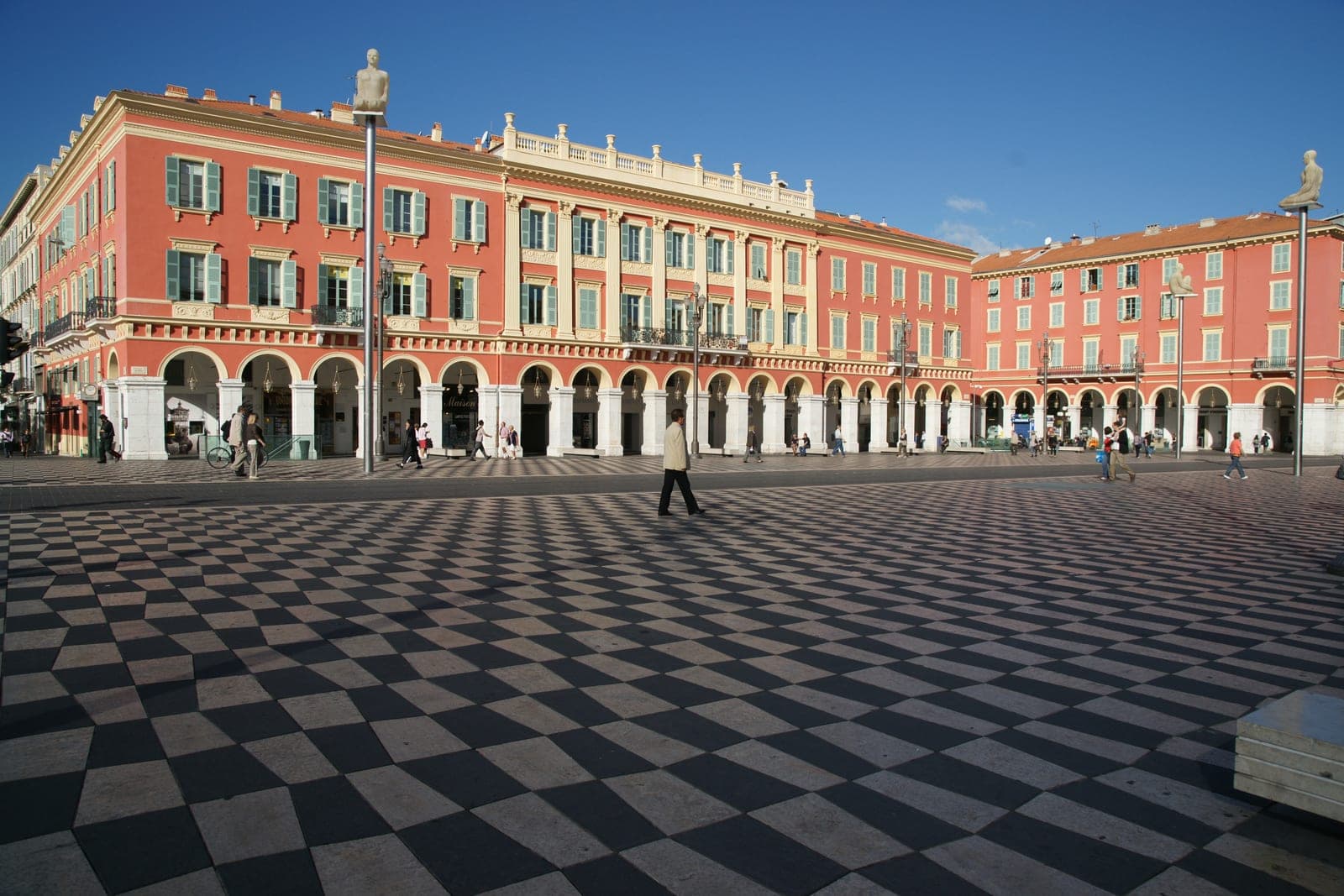
First impressions
The Carré d'Or is not an old quarter pretending to be smart. It is the city Nice built for its winter visitors after it became French in 1860, laid out west of the Paillon on flat ground, in straight streets, with wide pavements and tall pale façades that were designed to be looked at. Walk out of the old town and the change is immediate: the lanes stop, the sky opens, and everything is suddenly rectangular.
The seafront explains the plan. English visitors had been wintering here since the previous century, and the promenade they paid for along the shore, known locally as the Camin dei Anglès, was renamed the Promenade des Anglais in 1823. Everything behind it was built to face that walk. Hotels first, then apartment buildings with balconies and shutters, then the shops that serve people staying in both. The name Carré d'Or, the golden square, is a trade name for the grid of luxury retail that grew in those ground floors, and it stuck.
The other side of the district is the garden. The Jardin Albert 1er was laid out in 1852 on about a hectare beside the sea, and roughly doubled in 1890 when the Paillon, the torrent that used to split the city, was covered over below place Masséna. That single engineering decision is why central Nice has a green spine instead of a river, why the Théâtre de Verdure of 1946 sits in the middle of it, and why a district of this density has three hectares of plane trees at its corner. Nice's belle époque city, the villas, the hotels and the promenade that came out of that era, was inscribed by UNESCO in 2021 as Nice, Winter Resort Town of the Riviera.
Who lives here, and what the streets look like
A typical figure across this district's single statistical area is 23,670 EUR a year of disposable income per consumption unit, above Vieux Nice at 18,830 and well below Cimiez at 31,230. That middle position surprises people who read the shop windows, and the explanation is in the housing: the buildings hold many small flats, a good number of them let short or lived in for part of the year, so the resident population is not the same as the customer population.
The stock is late nineteenth and early twentieth century, five to seven storeys, stone or rendered, with balconies, high ceilings and, more often than in the old town, a lift. Upkeep is visibly better than in the lanes to the east: cleaned façades, working shutters, lit entrances. Ground floors are almost entirely commercial and almost none of it is food, which is the fact that shapes daily life here more than any other.
Getting around
This is as central as Nice gets, so most days you do not use transport at all. Place Masséna, the old town, the garden and the beach are all inside a ten-minute walk on flat, wide pavements.
For everything else there are three tram stops and two bus stops inside 0.24 km², with line 1 running along place Masséna at the eastern edge. Line 2 matters more: it runs in a tunnel under the centre from Port Lympia to Nice Côte d'Azur airport, so a flight is one ride and no change, which counts in a city where a good share of residents fly regularly. There is no metro. The Gare de Nice-Ville is a short tram ride or a brisk walk north, and it is the mainline station for Marseille, Paris and the coast towards Italy.
Cars are the awkward part. The boulevards on two sides carry real traffic, on-street parking is scarce and expensive, and most buildings of this era have no garage. Residents either pay for a space in a public car park or do without.
Typical weekday minutes from Jardin Albert 1er, with the icon showing how. Measured door to door for a typical weekday morning from the Jardin Albert 1er, at the eastern corner of the district; the icon shows the fastest sensible way., 2026-08.
Daily life
Here is the district's honest weakness. There are four food shops inside the boundary, which is 17 per square kilometre, against 46 in Vieux Nice, and there is no market. There are four pharmacies, so that side is covered, but the weekly shop is not.
What the district has instead is a high street of a different kind: fashion, jewellery, watches, opticians, a cinema, and 49 restaurants and 15 cafés in a space you can cross in five minutes. It is a place to spend money rather than to stock a fridge.
The local detail worth knowing follows from that. Almost everybody here does their food shopping outside the district, and the standard solution is the Cours Saleya market and the grocers of the old town, five to ten minutes east on foot. Before you sign anything, walk that route with two bags in your hands and decide whether you will actually do it twice a week, or whether you will end up eating out at Carré d'Or prices every night, which is how this district quietly gets more expensive than the rent suggests.
Local Places Worth Knowing
Four places that tell you what the district is actually like, chosen because a resident would use them rather than because a visitor would photograph them.
One of the oldest public gardens in Nice and why this district feels less hemmed in than its size suggests: three hectares of plane trees, palms, a bandstand and an open-air theatre.
A small bistro on rue Grimaldi, a handful of tables and a kitchen that cooks to order, so it fills and is worth booking. A rarity in a district priced for people passing through.
The old-school Nicois family restaurant on rue Grimaldi, cooking the local repertoire in a room redesigned to please nobody. The counterweight to the fashion streets south.
A patisserie on rue de la Liberte, on the walk between the tram and the flats. In a district with four food shops in total, that is a useful address rather than a treat.
Checked August 2026. Places close and change, so tell us if something here is out of date.
Schools and families
No lycée stands inside this district's boundary. In a district of 0.24 km² with commercial ground floors on nearly every street, that is unremarkable rather than alarming, but it does mean a teenager living here travels to school, and the journey is worth timing before a move rather than after.
For younger children, the honest reading is that this is a district of adults. There is no playground inside the boundary, and the flats, while often handsome, are priced by the square metre at a level that makes a third bedroom a serious decision. What works in its favour is the ground: flat, lit, well kept, with two garden spaces inside the district, the Promenade du Paillon and its water mirror a few minutes north, and the sea at the end of the street. Families who choose this quarter are usually choosing the walk to school along a promenade over the extra room they would get further out.
Kids Restricted. Workable for a small child and thin for a teenager. In its favour: two garden spaces inside a district of 0.24 km², the Promenade du Paillon and its water mirror a few minutes away, the sea at the end of the street, and streets that are lit, busy and well kept. Against it: no playground inside the boundary, no lycée either, four food shops for a weekly shop, prices that buy fewer rooms here than anywhere else in Nice, and boulevard traffic on two sides.
Pet Friendly. About as easy as a dense city centre gets. The Jardin Albert 1er is inside the boundary, the Promenade du Paillon runs from its top corner, the seafront promenade is flat and continuous for kilometres, and the pavements here are wide enough to pass a café terrace on a lead. The caveats are the season and the surface: July and August fill the promenade shoulder to shoulder, the pavements hold heat, and this is a district of flats without gardens, so every walk is a real walk rather than a door opened.
Green space, leisure and eating out
For a district this small the green is unusually good, because one of the two garden spaces inside it is the Jardin Albert 1er. Three hectares of plane trees, palms and lawns, an open-air theatre, and a continuous green route north along the covered Paillon towards the Promenade du Paillon. Add the seafront on the southern edge and this quarter has more usable outdoor space per resident than the old town, without owning a single park of its own.
Eating out is plentiful and skewed. Forty-nine restaurants, 15 cafés and only 8 bars, which is the profile of a district that dines rather than drinks: the noise curve here falls away after eleven in a way it does not two hundred metres east. Quality tracks the street. The rooms on the fashion streets are priced for the address, and the ones people here go back to are on the quieter cross streets like rue Grimaldi.
What it costs
The number to start from is what people actually paid: 7 728 EUR / m² ≈ $830 / sq ft, the median across 78 recorded apartment sales inside this statistical area in 2025, from the state's register of transfers rather than from asking prices. Where a cellar or a parking space came with the flat the price includes it, and the same median over flats sold with nothing attached is 7,500, so that choice moves the figure by about 3%.
That makes this the dearest of the three Nice districts on these pages, which run 5,641 in Cimiez, 6,400 in Vieux Nice and 7,728 here. The spread across the three is about 37%, which is wide for one city, and what the money buys at this end is the address, the upkeep and the garden rather than more room.
On renting there are two figures and they are not the same quantity. What sitting tenants actually pay is 18 EUR/m² a month excluding charges, from the Nice rent observatory's 2024 survey of the occupied private stock, with quartiles of 14.9 to 21.2 behind it. This district's statistical area sits entirely inside the observatory's dearest zone, so unusually there is one number rather than a range. The asking rent is 20.4, charges included and not separable, and it is published per commune, so it covers the whole of Nice rather than this quarter. Do not read the gap between 18 and 20.4 as a market move: one is what tenants pay net of charges, the other is what listings ask with charges folded in.
Set the price against the income and a 45 m² one-bedroom at 7,728 EUR/m² is roughly 348,000 EUR, about fifteen times the 23,670 EUR a year this district's statistical area records. In monthly terms, that same 45 m² let at the observatory's median costs about 810 EUR a month before charges.
Weather and climate
Seasonal averages for Nice, one representative month per season. Météo-France 1991-2020 normals for station Nice-Côte d'Azur, read 12 August 2026 via Infoclimat. Seasons are the representative months: January, April, July and October. Sunshine hours a day are the monthly totals divided by the days in the month (January 156.7 h, April 229.2 h, July 349.3 h, October 191.1 h). Annual figures: mean daily maximum 19.8 °C, mean daily minimum 12.8 °C, 791.3 mm of rain and 2,760.8 hours of sunshine. Rain days are left null because the count of days at or above 1 mm is not filled in on the published normals table. What the numbers say about living here: this is a mild winter rather than a warm one, a 13.3 °C January day and nights that rarely freeze at a 5.8 °C mean minimum, with 2,761 hours of sun a year. The rain does not arrive in winter: October is by far the wettest month at 127.9 mm, often in a few violent Mediterranean episodes, while July takes 13.6 mm across the whole month. Summer nights are the thing newcomers underestimate, averaging 20.8 °C in July, so a flat without shutters or a sea breeze stays warm after dark.
The honest downsides
You are paying for the ground floor. The premium here is for the address, the upkeep and the garden, not for the flat. A comparable building ten minutes north costs meaningfully less and has the same tram.
The food shopping is somewhere else. Four food shops and no market inside the district. It works, but only because the old town is close, and it means the fridge run is a permanent small chore.
No playground, no library. This is a district built for adults with money and it shows in the public furniture.
Season and traffic. July and August fill the promenade and the pavements, and the boulevards on two sides carry the traffic the pedestrian streets do not. A flat facing a boulevard is a different product from one on a cross street.
Crime and safety
France publishes recorded crime per commune, and Nice is a single commune, so there is no Carré d'Or figure and nobody, including us, can honestly give you one. The numbers beside this section are for the whole city.
Nice's theft from the person rate, 159.7 per 10,000 residents against 91.0 for France, is about three quarters above the national rate, and robbery, 12.6 against 7.2, runs the same way. Home burglary, 6.1 per 1,000 dwellings against 5.6, is close to normal. Assault is 49.2 against 31.6, and domestic violence 46.0 against 37.6, an indicator where more reporting pushes the recorded number up, so it is not read straight.
What is structurally true here is a daytime crowd rather than a nightlife one. Eight bars in the whole district, a seafront that carries the largest visitor flow in the city, and streets of high-value retail. Street theft follows crowds and distraction, and both peak on the promenade and the shopping streets in the afternoon, not on rue Grimaldi at midnight. The practical version is ordinary: bag in front of you on the promenade in August, and treat the burglary figure, which is near the national rate, as the one that describes your flat.
Is this you?
The Carré d'Or suits someone who wants the best-kept, best-lit, flattest part of central Nice, who will use the garden and the sea most days, and who is comfortable buying fewer square metres to get it. It is a strong fit for a professional couple, for a part-year owner who wants the door to open onto a working city, and for anyone who has decided that walking everywhere is worth paying for.
It is the wrong place if you want space per euro, a market at the end of the street, or a district that looks after small children. Whether you lease or purchase, do the food shop walk to the old town once, in August, with bags, before you decide the location sells itself.
Want to know what homes here are actually worth?
Join the waitlistHow we source this
How we put this together. Gathered on the ground by our local field team and written up by the Apraiz research team. Every figure above carries its own source and date. The scores are not computed by the build; walking and transport will use open map and transit data first, then Apraiz's own model. We update prices quarterly, transport and amenities twice a year, and school data when the source publishes.
Sources: DVF (Demandes de valeurs foncières), data.gouv.fr, Observatoires des loyers, agglomération niçoise (L0600), Carte des loyers 2025, DHUP and ANIL with leboncoin and Groupe SeLoger, INSEE, SSMSI, via data.gouv.fr, Wikipédia (fr), Wikipedia (en), UNESCO World Heritage Centre, OpenStreetMap contributors, via the Overpass API.
Safety and crime in Nice →Nearby: Vieux Nice · Cimiez