
Long Story ShortReadHide
- What it is: the medieval core of Bordeaux, two statistical areas and 0.38 km² of car-free stone between the cathedral quarter and the Garonne.
- Who it suits: people who want to live in the middle of a city and eat out constantly, and who do not need grass, silence or a school run.
- What it costs: 4 532 EUR / m² ≈ $490 / sq ft to buy on the price actually paid; sitting tenants pay 14.8 EUR/m² a month excluding charges, while listings ask 16.0 across the city with charges included.
- The catch: 147 restaurants and 41 bars inside a quarter this size, and the noise that implies on a Friday night.
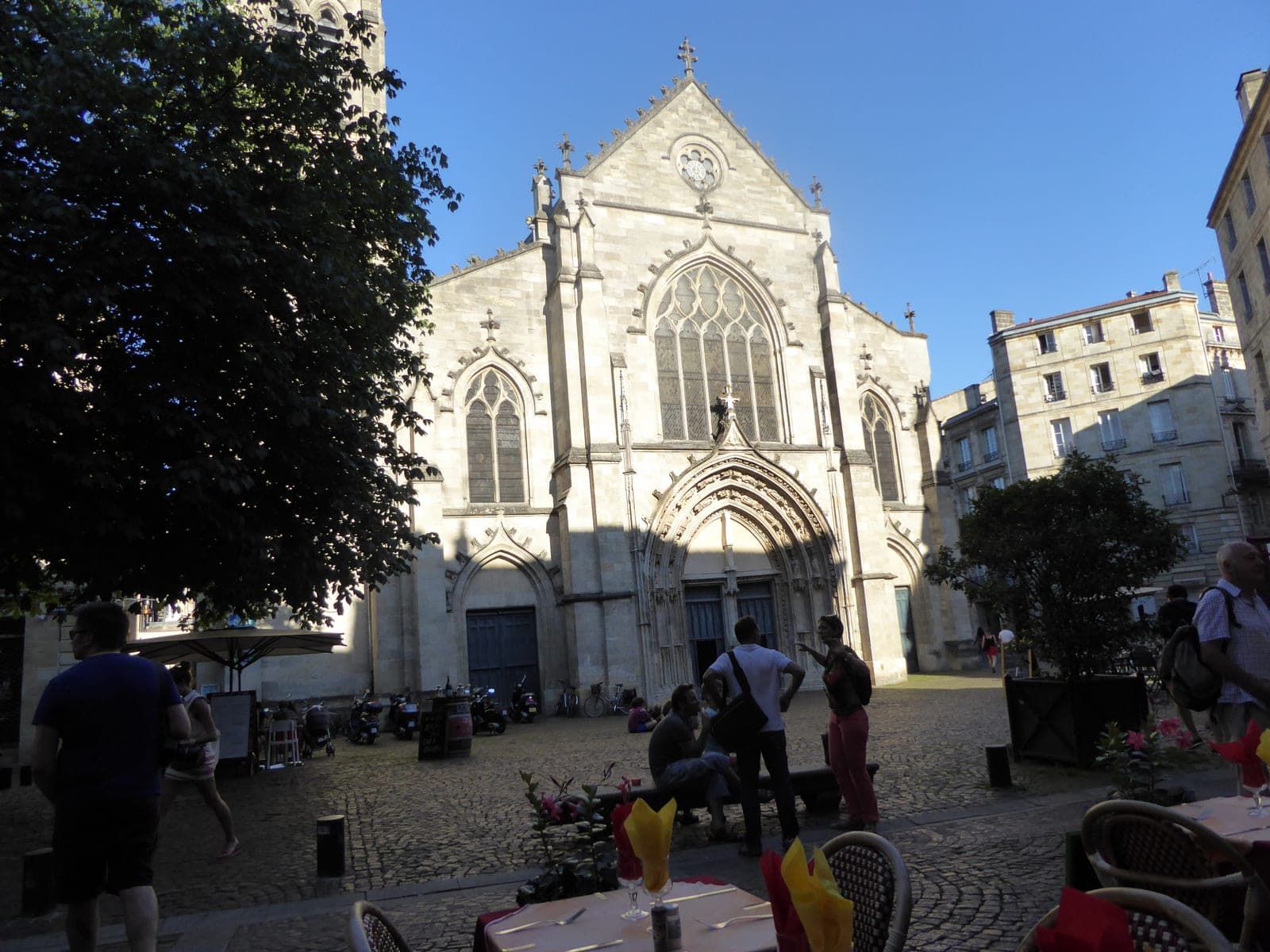
First impressions
Saint-Pierre is what people mean when they say the old town, and it is smaller than they expect: you can cross it in seven minutes. The street plan is medieval, the buildings on top of it are eighteenth-century limestone, and almost none of it takes cars. That combination is the whole character of the place. You walk out of a stone doorway onto a street with tables down the middle of it, and the noise is people rather than traffic.
The four squares do the work here. Place du Parlement is the postcard one, a closed rectangle of arcaded façades with a fountain in the middle and restaurant tables filling the rest. Place Saint-Pierre in front of the church is smaller and calmer. Place du Palais has the Porte Cailhau, the 1490s gate that survived the rebuild of the city around it. And place Fernand Lafargue, at the eastern edge, is where the students end up. Everything else is the lanes between them.
Who lives here, and what the streets look like
A typical figure across this district's two small statistical areas is 22,735 EUR a year of disposable income per consumption unit, which is the lowest of the three Bordeaux districts covered here and well under the Chartrons at 27,995. That is not a poor quarter, it is a young one: small flats, high turnover, a lot of one-person households, and students from the two central campuses. Families are conspicuously rare.
The building stock is stone, four to five storeys, and old. Lifts are the exception. Many flats have been cut out of larger ones, so a 40 m² one-bedroom with a beam and a stone wall is the standard product, and a large family flat is genuinely hard to find. Ground floors are almost entirely commercial, which is why the district feels alive at street level and thin on residents' amenities: there are ten food shops in the whole quarter, against 147 restaurants.
Getting around
This is the centre, so the honest answer is that you mostly do not use transport at all. Three tram lines run along the district's edges, six tram stops sit within its boundary, and tram A, B and C between them reach the station, the university and the northern quays. There is no metro in Bordeaux and there is no plan for one.
Two things to know. The airport is a genuine trek: Mérignac is west of the city and the direct bus takes about the same time as the tram plus a connection, which is why the figure below is the honest door-to-door one rather than a timetable segment. And the Bat3 river shuttle runs across the Garonne from the quays, which is a pleasant way to reach the right bank and the Cité du Vin, and a slow one in bad weather.
Typical weekday minutes from Place du Parlement, with the icon showing how. Measured door to door for a typical weekday morning from the place du Parlement, in the middle of the district; the icon shows the fastest sensible way., 2026-08.
Daily life
Ten food shops inside 0.38 km² sounds thin, and in practice it works because they are the right ten: two small supermarkets, a couple of bakeries, a cheesemonger, a fishmonger and three pharmacies. What the district does not have is a market of its own. The Marché des Capucins is a ten-minute walk outside this boundary, in the Saint-Michel quarter, and it is where residents actually do a weekly shop.
Rue Sainte-Catherine runs along the western edge and is about 1.2 km of pedestrian high street, commonly called the longest in Europe. It is useful and it is relentless: chain retail, heavy footfall, and the one street here that a resident learns to cross rather than walk down.
Local Places Worth Knowing
Four places that tell you what the district is actually like, chosen because a resident would use them rather than because a visitor would photograph them.
The 1490s city gate on place du Palais, with a small climb inside and a view down onto the quays and the Pont de pierre. The medieval city that survived the eighteenth-century rebuild.
A fish restaurant on rue Parlement Saint-Pierre, the district's reliable table for years, working off the Arcachon and Atlantic catch rather than a card of regional standards.
A cafe and second-hand English bookshop on rue Saint-James, small and quiet with a back room people work in. One of few ground floors here not aimed at the evening trade.
Canneles on rue Saint-James, the fluted rum-and-vanilla cake Bordeaux invented. Worth knowing as a resident because the gap between a good one and a bad one is wide.
Checked August 2026. Places close and change, so tell us if something here is out of date.
Schools and families
No lycée stands inside this district, so the Schools bar is not drawn. That is a real fact about the place rather than a gap in the data: the quarter is 0.38 km² of largely commercial ground floors, and secondary education happens in the quarters around it, at Montaigne and Camille Jullian, both a ten to fifteen minute walk away.
For younger children the picture is better than the statistics suggest. The car-free grid is genuinely useful, a four-year-old can walk to the bakery without crossing a road, and there is a playground inside the quarter. The constraints are the flats themselves, small, old and often without a lift, and the noise. Families who stay tend to be on the quieter eastern lanes rather than around place du Parlement.
Kids Restricted. Small children do better here than teenagers. The car-free grid means a four-year-old can walk to the boulangerie without a road crossing, there is a playground inside the district and the quays are five minutes away. Against that: no lycée inside the boundary, one playground for the whole quarter, flats that are old and often without a lift, and a Friday night noise level on the restaurant streets that a family bedroom cannot ignore.
Pet Restricted. The streets are flat, car-free and short, which is easy on an old dog and easy on a lead. What is against it is everything else: there is almost no grass inside the district, the nearest real running space is the Jardin Public or the quays across the boulevard, the stone heats up hard in July, and the pavement café tables leave little room to pass on a busy evening. Fine for a small dog whose exercise happens elsewhere; a poor fit for a large one.
Green space, leisure and eating out
Green space is the weakest thing about Saint-Pierre. There are four small garden spaces inside the boundary and none of them is a park in the sense of somewhere to spend an afternoon. The Jardin Public is fifteen minutes north, the quays are five minutes east, and the river walk is the thing that actually functions as this district's outdoor space: a continuous car-free promenade along the Garonne, wide enough to run on.
Eating out is the opposite problem, an embarrassment of it. 147 restaurants, 41 bars and 22 cafés inside a quarter you can cross in seven minutes. The quality range is wide, the streets around place du Parlement are aimed squarely at visitors, and the good rooms are one street back.
What it costs
The number to start from is what people actually paid: 4 532 EUR / m² ≈ $490 / sq ft, the median across 105 recorded apartment sales inside these two statistical areas in 2025, from the state's register of transfers rather than from asking prices. Unusually, the median over flats sold with nothing attached is identical, because cellars and parking spaces barely exist in this stock. In a city where a parking space is a real asset, that tells you something about the flats.
Against the three Bordeaux districts covered here, this is the middle one: 4,278 in the Bassins à Flot, 4,532 here, 4,969 in the Chartrons. The spread is about 16%, which is narrow, and what a buyer feels in the price is the building and the floor rather than the district.
On renting there are two figures and they measure different things. What sitting tenants actually pay is 14.8 EUR/m² a month excluding charges, from the Bordeaux rent observatory's 2024 survey of the occupied private stock, with quartiles of 12.6 to 18.0 behind it. Both of this district's statistical areas sit in the observatory's dearest zone, so unusually there is one number rather than two. The asking rent is 16.0, charges included and not separable, and it is published per commune, so it covers the whole city rather than this quarter.
One thing a tenant should know. Bordeaux caps rents under the same national scheme as Paris and Lyon, and a listing above the ceiling for its own category is unlawful. The arrêté in force was signed on 6 July 2026 and runs to 24 November 2026. This page carries no ceiling figure, because the only machine-readable table published for Bordeaux is the 2023 edition and quoting a stale cap would be worse than quoting none: check the current arrêté for the flat's own sector, room count, era and régime before signing.
Set the price against the income and you get the ratio a listing never shows: at 4,532 EUR/m², a 45 m² one-bedroom is roughly 204,000 EUR, about nine times the 22,735 EUR a year a typical one of this district's small statistical areas records. That ratio is the reason the quarter is full of renters in their twenties and thin on owner-occupier families.
Weather and climate
Seasonal averages for Bordeaux, one representative month per season. Météo-France 1991-2020 normals for station Bordeaux-Mérignac, the official station for the city, read 12 August 2026 via Infoclimat. Seasons are the representative months: January, April, July and October. Sunshine hours a day are the monthly totals divided by the days in the month (January 89.8 h, April 186.0 h, July 256.0 h, October 150.3 h). Annual figures: mean daily maximum 18.9 °C, mean daily minimum 9.6 °C, 924.9 mm of rain and 2,069.9 hours of sunshine. Rain days are left null because the count of days at or above 1 mm is not filled in on the published normals table. What the numbers say about living here: Bordeaux is mild and wet rather than sunny and dry, which surprises people who file it under south-west France. It takes 924.9 mm of rain a year, more than Lyon and nearly twice Marseille, spread evenly with no dry season, and January is both the wettest month and the darkest at under three hours of sun a day. Summer is warm rather than fierce, 27.1 °C by day in July, and winter frost is occasional at a 3.7 °C mean minimum. The Atlantic is an hour away and the weather comes from it.
The honest downsides
The noise is not a rumour. A quarter with 41 bars in it is loud from Thursday to Saturday, late, and the stone amplifies it. A flat on place du Parlement or rue du Parlement Saint-Pierre is a different proposition from one three streets east, and the difference does not show in the price.
There is almost no green. Four small garden spaces and no park. If a daily walk in grass matters to you, this is the wrong quarter and no amount of riverfront makes up for it.
The flats are old. Small rooms, no lift, stone that holds heat in July, and renovation constrained by a UNESCO-inscribed setting. Charges on an old building with a courtyard can be heavy, and they sit inside the advertised rent where you cannot see them.
Street theft tracks the crowds, and this is where the crowds are. See below.
Crime and safety
France publishes recorded crime per commune, and Bordeaux is a single commune, so there is no Saint-Pierre figure and nobody, including us, can honestly give you one. The numbers beside this section are for the whole city.
Read together they say something specific. Bordeaux's theft from the person rate, 390.6 per 10,000 residents against 91.0 for France, is more than four times the national rate, and that is the number a newcomer should take seriously. Robbery, 38.3 against 7.2, runs the same way. But home burglary is 6.9 per 1,000 dwellings against 5.6 nationally, close to normal, and domestic violence is at the national rate.
That pattern, high street theft and ordinary burglary, describes a city where the risk is to your pockets in a crowd rather than to your flat while you are out. This district is the densest crowd in the city: 147 restaurants and 41 bars in 0.38 km², a pedestrian high street along one edge and the busiest squares in Bordeaux inside it. Apply the city figure here with that in mind, keep a phone out of a back pocket on rue Sainte-Catherine and around place du Parlement late, and treat the rest as ordinary city life.
Is this you?
Saint-Pierre suits someone who wants the middle of a city with no compromise and is honest with themselves about what that costs. If your ideal evening starts by walking three minutes to a table, if you do not own a car and never want to, and if you can sleep through noise or afford a flat on a quiet lane, it is one of the best-value historic centres in France at 4,532 EUR/m².
It is the wrong place for a family that needs a lycée within walking distance, for anyone who wants a garden or a park, and for a light sleeper on a budget, because the cheap flats here are the loud ones. Whether you lease or purchase, walk the exact street on a Friday at eleven at night before you commit to it.
Want to know what homes here are actually worth?
Join the waitlistHow we source this
How we put this together. Gathered on the ground by our local field team and written up by the Apraiz research team. Every figure above carries its own source and date. The scores are not computed by the build; walking and transport will use open map and transit data first, then Apraiz's own model. We update prices quarterly, transport and amenities twice a year, and school data when the source publishes.
Sources: DVF (Demandes de valeurs foncières), data.gouv.fr, Observatoire des loyers de l'agglomération bordelaise, via the Observatoires des loyers network, Carte des loyers 2025, DHUP and ANIL with leboncoin and Groupe SeLoger, INSEE, SSMSI, via data.gouv.fr, Préfecture de la Gironde, UNESCO World Heritage Centre, Wikipedia (en), Wikipédia (fr), OpenStreetMap contributors, via the Overpass API.
Safety and crime in Bordeaux →Nearby: Chartrons · Bassins à Flot