
Long Story ShortReadHide
- What it is: two nineteenth-century wet docks with a new residential quarter built around them, 0.67 km² between the Chartrons and Bacalan.
- Who it suits: first-time buyers and young families who want space, light and a lift, and who will trade a thin high street for 700 EUR/m² off the Chartrons price.
- What it costs: 4 278 EUR / m² ≈ $460 / sq ft to buy, the cheapest of the three districts here; tenants pay 12.5 EUR/m² a month excluding charges.
- The catch: seven food shops in the entire district, and parts of it are still a building site.
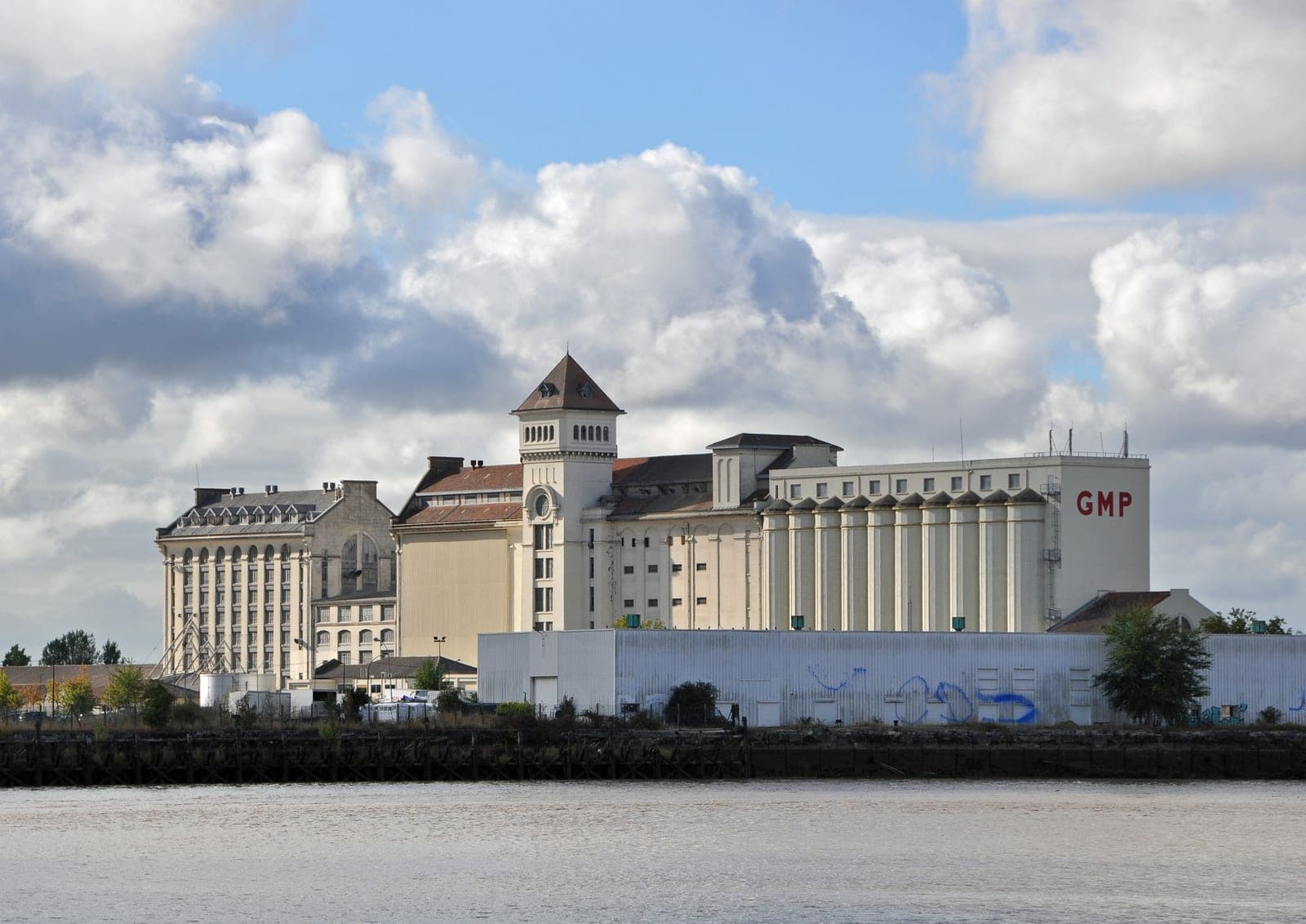
First impressions
The Bassins à Flot does not look like the rest of Bordeaux and it is not trying to. Two rectangular docks, dug in the 1880s so sailing ships could sit level while the Garonne's five-metre tide went in and out, are still full of water and still full of boats. Around them, on what was port and industrial land until about fifteen years ago, is the largest piece of new housing in the city.
The effect is open sky and hard edges. Wide streets, tall new blocks in render and metal, cranes still working on some plots, and water at the end of most views. Against that, the surviving industrial pieces, the hangars, the U-boat pens further north, the lock gates, give the quarter a scale nothing else in central Bordeaux has.
Who lives here, and what the streets look like
A typical figure across this district is 21,960 EUR a year of disposable income per consumption unit, the lowest of the three Bordeaux districts covered here, below Saint-Pierre's 22,735 and well under the Chartrons at 27,995. Read that with the price rather than on its own: this is the cheapest way into central-ish Bordeaux, and the people buying here are doing it because of that.
The housing is almost entirely built since 2010: four to eight storeys, lifts, balconies, insulation that meets a modern standard, and parking underneath. That is the trade the district offers. You give up the stone and the cellar and the location, and you get a flat that is warm, quiet inside, and has a room your child can actually sleep in.
Getting around
Tram B runs along rue Lucien Faure at the district's edge, with two stops inside the boundary and nine bus stops filling in, and the centre is roughly fifteen to twenty minutes. That is the honest number, and it is the district's main compromise: not far, but not walkable to the centre the way the Chartrons is.
The quay compensates. It is flat and continuous, so cycling south into town is quick and pleasant, and the Pont Jacques Chaban-Delmas gives a direct crossing to the right bank. As everywhere in Bordeaux, the airport is the awkward journey.
Typical weekday minutes from Bassin à flot n°1, with the icon showing how. Measured door to door for a typical weekday morning from the first basin, in the middle of the district; the icon shows the fastest sensible way., 2026-08.
Daily life
This is where the district is weakest and it should be said plainly: seven food shops and one market inside 0.67 km², against thirteen shops and two markets in the Chartrons. A weekly shop means a supermarket run, and the small everyday stuff, the good baker, the fishmonger, the cheese counter, is thinner than a resident of the old city would expect.
It is improving as the ground floors fill, and the Bord'eau Village hangars carry a grocer and a handful of other trade, but nobody should move here expecting the Chartrons' street life. What the district does have is a market once a week, nineteen restaurants along the water, and Cap Sciences.
Local Places Worth Knowing
Four places that tell you what the district is actually like, chosen because a resident would use them rather than because a visitor would photograph them.
The science centre in Hangar 20 on the quay, running exhibitions aimed squarely at children without being childish. The district's one genuine cultural anchor, older than the housing.
A restaurant on rue Lucien Faure that doubles as an insertion project, training people back into work in the kitchen and dining room. Straightforward food, and worth the visit.
On the quai de Bacalan at the southern edge, a big room doing brasserie standards well and late, which in a quarter this new is not a given. The default when nobody can decide.
A small grocer in the Bord'eau Village hangars. With seven food shops in the whole district, knowing which one is good is most of the battle.
Checked August 2026. Places close and change, so tell us if something here is out of date.
Schools and families
No lycée stands inside the boundary, so the Schools bar is not drawn. In a quarter that was industrial land twenty years ago that is not surprising: the housing arrived faster than the institutions, and secondary schooling means a tram ride.
For younger children the calculation is different and better. The flats are the best in central Bordeaux for a family, on the plain grounds of size, insulation and a lift, there is open space and a playground, and Cap Sciences at the end of the quay is a real asset. The two honest warnings are the thin food shopping, which makes daily life with small children more of a logistics problem, and the unfenced water.
Kids Restricted. Good for the youngest and thin for the rest. New flats are bigger and better insulated than anything in the old centre, there is open space and a playground, and Cap Sciences is a genuinely useful thing to have at the end of the street. Against that: only seven food shops in the whole district, no lycée inside the boundary, unfenced water, and blocks still under construction with the noise and lorries that implies.
Pet Friendly. Space is the thing this district has that the centre does not. Wide pavements, a lot of open ground around the docks, quays that run for kilometres in both directions, and new buildings that are more relaxed about animals than an eighteenth-century syndic tends to be. Two warnings: the water is unfenced in places, and the wind coming off the basins in winter is not a joke.
Green space, leisure and eating out
There is more open ground here than anywhere else in central Bordeaux, and it is worth being precise about what it is: quays, dock edges, wide verges and squares between new blocks rather than a park with old trees. It is space more than it is green. The quay running south to the Chartrons and north to Bacalan is continuous and flat, which makes this an unusually good district to run in.
Nineteen restaurants and five bars, mostly along the water and mostly recent, which is enough for a Friday and not enough to make the district a destination. The evening is quiet, and that cuts both ways.
What it costs
The number to start from is what people actually paid: 4 278 EUR / m² ≈ $460 / sq ft, the median across 103 recorded apartment sales inside this statistical area in 2025, from the state's register rather than from asking prices. The median over flats sold with nothing attached is identical, which in a district where most flats come with a parking space tells you the parking is priced into everything rather than sold at a premium.
That makes this the cheapest of the three Bordeaux districts here, 691 EUR/m² under the Chartrons and 254 under Saint-Pierre. For a 60 m² two-bedroom the gap to the Chartrons is about 41,000 EUR, which is the real question this district asks: is that worth a thinner high street and a longer walk to the centre?
On renting, sitting tenants pay 12.5 EUR/m² a month excluding charges, from the Bordeaux rent observatory's 2024 survey, with quartiles of 11.0 to 14.5 behind it and 7,256 observations, the deepest sample on any of these Bordeaux pages. The whole district sits in one zone, so one number covers it. The asking rent is 16.0, charges included and published for the whole commune. The gap between the two is the widest of the three districts here, and most of it is charges plus the difference between an advert and a sitting lease.
Bordeaux caps rents under the same national scheme as Paris and Lyon, and a listing above the ceiling for its own category is unlawful. The arrêté in force was signed on 6 July 2026 and runs to 24 November 2026. No ceiling figure is carried here because the only machine-readable table for Bordeaux is the 2023 edition; check the current arrêté for the flat's own sector, room count, era and régime.
Against income, a 45 m² one-bedroom at 4,278 EUR/m² is roughly 193,000 EUR, about nine times the 21,960 EUR a year a typical household unit here records. The ratio is similar to Saint-Pierre's despite the lower price, because incomes here are lower too.
Weather and climate
Seasonal averages for Bordeaux, one representative month per season. Météo-France 1991-2020 normals for station Bordeaux-Mérignac, the official station for the city, read 12 August 2026 via Infoclimat. Seasons are the representative months: January, April, July and October. Sunshine hours a day are the monthly totals divided by the days in the month (January 89.8 h, April 186.0 h, July 256.0 h, October 150.3 h). Annual figures: mean daily maximum 18.9 °C, mean daily minimum 9.6 °C, 924.9 mm of rain and 2,069.9 hours of sunshine. Rain days are left null because the count of days at or above 1 mm is not filled in on the published normals table. What the numbers say about living here: Bordeaux is mild and wet rather than sunny and dry, which surprises people who file it under south-west France. It takes 924.9 mm of rain a year, more than Lyon and nearly twice Marseille, spread evenly with no dry season, and January is both the wettest month and the darkest at under three hours of sun a day. Summer is warm rather than fierce, 27.1 °C by day in July, and winter frost is occasional at a 3.7 °C mean minimum. The Atlantic is an hour away and the weather comes from it.
The honest downsides
The shopping is genuinely thin. Seven food shops. This is the single thing most likely to make someone regret the move, and it is worth walking the streets on an ordinary weekday before deciding you can live with it.
Parts of it are still a building site. Cranes, hoardings, lorries and the noise that comes with them, on a timetable nobody controls.
The wind. Two open basins and a wide river, with new blocks channelling it. In February it is the defining feature of the walk to the tram.
It is new, and it reads new. If you are moving to Bordeaux for eighteenth-century stone, this is not that, and no amount of dock heritage changes it.
Crime and safety
France publishes recorded crime per commune, and Bordeaux is a single commune, so there is no Bassins à Flot figure. The numbers beside this section are for the whole city.
Bordeaux runs high on theft from the person, 390.6 per 10,000 residents against 91.0 for France, and on robbery, 38.3 against 7.2, while home burglary at 6.9 per 1,000 dwellings against 5.6 is close to normal and domestic violence is at the national rate.
Street theft follows crowds, and this district does not have them. The risk profile here is different rather than lower: long quays and unfinished plots that are empty and poorly overlooked after dark, and open surface parking, which is where residents' actual complaints sit. The city's headline theft figure describes the centre far better than it describes these streets; what applies here is the ordinary caution of walking somewhere with nobody else in it.
Is this you?
The Bassins à Flot suits someone who wants a modern flat in Bordeaux and has done the arithmetic honestly: 41,000 EUR less than the Chartrons for a two-bedroom, a lift, insulation, and space, in exchange for a fifteen-minute journey to the centre and a shopping street that is not there yet. For a first purchase or a young family, that is a real bargain rather than a compromise.
It is the wrong place for anyone who wants old Bordeaux, for a household without a car that shops daily, or for someone who will mind living beside construction for a few more years. Whether you lease or purchase, do one weekday afternoon shop here before committing, because that is the test this district either passes or fails for you.
Want to know what homes here are actually worth?
Join the waitlistHow we source this
How we put this together. Gathered on the ground by our local field team and written up by the Apraiz research team. Every figure above carries its own source and date. The scores are not computed by the build; walking and transport will use open map and transit data first, then Apraiz's own model. We update prices quarterly, transport and amenities twice a year, and school data when the source publishes.
Sources: DVF (Demandes de valeurs foncières), data.gouv.fr, Observatoire des loyers de l'agglomération bordelaise, via the Observatoires des loyers network, Carte des loyers 2025, DHUP and ANIL with leboncoin and Groupe SeLoger, INSEE, SSMSI, via data.gouv.fr, Préfecture de la Gironde, Wikipedia (fr), Cap Sciences, UNESCO World Heritage Centre, OpenStreetMap contributors, via the Overpass API.
Safety and crime in Bordeaux →Nearby: Saint-Pierre · Chartrons