
Long Story ShortReadHide
- What it is: an older inner district just north of the Uppsala centre on the west bank, strung along the historic Svartbäcksgatan approach road, everyday and unpretentious.
- Who it suits: people who want to live a short walk or bike ride from the middle of Uppsala, in a mixed, lived-in neighborhood, without paying a premium address price.
- What it costs: around the Uppsala norm, roughly 32,000 to 43,000 kr per m² to buy, close to the city middle.
- What people complain about: the traffic on the through-road, older and smaller flats, and not much of a proper high street.
First impressions
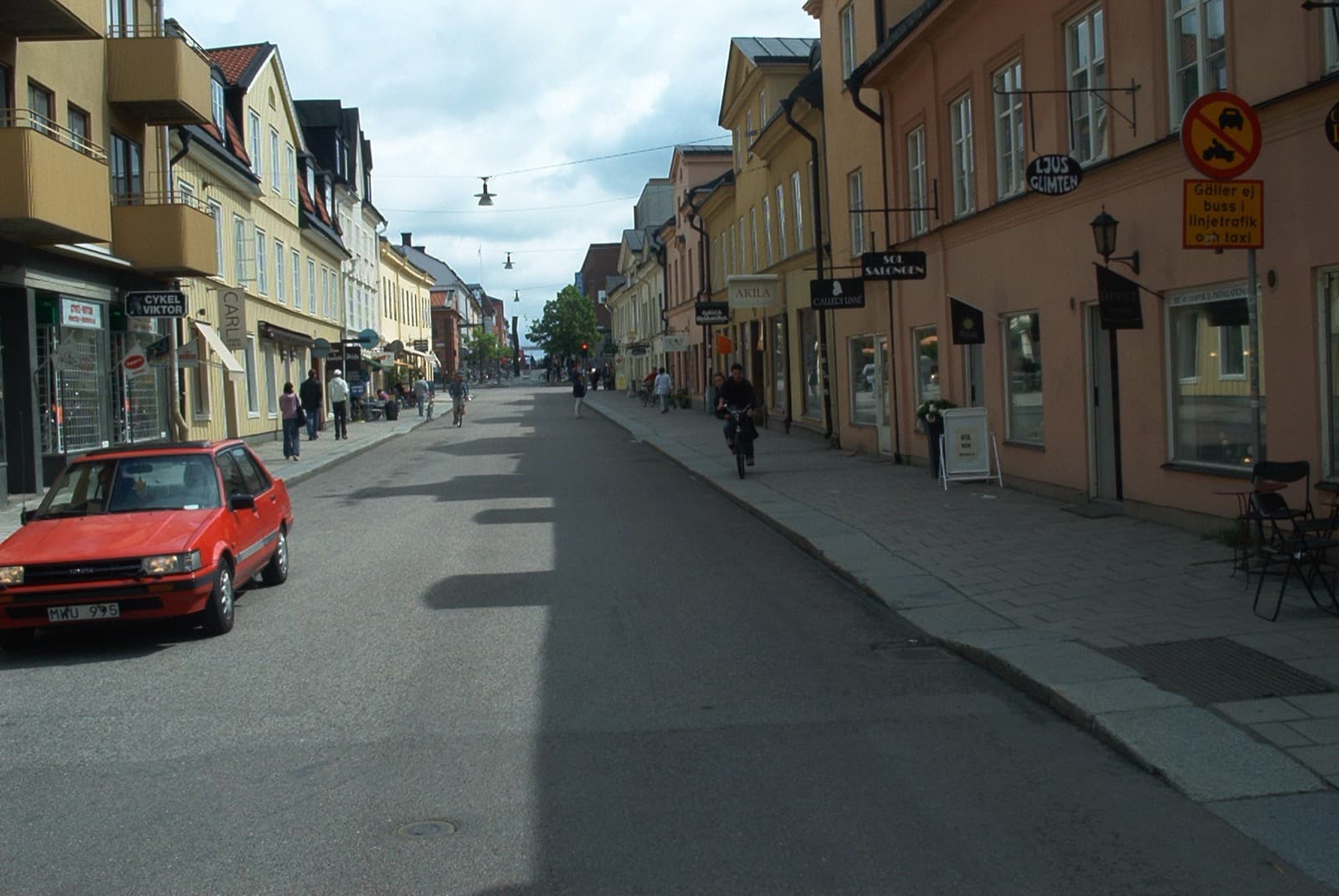
Svartbäcken starts where the old centre ends. Walk north from the cathedral quarter and the streets narrow into Svartbäcksgatan, one of Uppsala's oldest approach roads, and the character shifts from grand university city to something plainer and more lived-in. The southern stretch still keeps a small-town feel, low older buildings, a couple of famous cafés, and the entrance to the Linnaeus Garden set back behind a wall. Further up the road the district opens into early-1900s stone blocks, later apartment houses, and a scatter of small older wooden houses.
It is close to everything and quiet about it. The whole centre, the river Fyrisån, Stora torget and the Centralstation are a flat few minutes away on foot or by bike, yet the district itself is residential rather than showy. Students, families, older residents and people who have lived here for decades share the same streets.
This is an everyday, walkable, well-connected inner neighborhood that does not try to sell itself.
Who lives here, and what the streets look like
The mix is broad. Uppsala is a university city, so students are part of the picture, but they share the area with families, older residents and long-term owners who have stayed for years. It is not a student enclave and not a polished family suburb; it reads as a normal, mixed inner district.
The streetscape matches. Early-1900s stone blocks and later apartment houses make up most of it, with pockets of older wooden houses surviving between them. The buildings are older and often on the smaller side, the ground floors carry cafés, grocers and everyday shops rather than boutiques, and Svartbäcksgatan itself is a working through-road with real traffic on it.
Getting around
Svartbäcken's strength is how close it sits to the middle of Uppsala. From the southern end you are a short flat walk from Stora torget and the Centralstation, and the whole district is easy to cross on foot or by bike, which is how most of Uppsala moves; the city is flat and heavily cycled.
Public transport is UL city buses only, with no tram or metro anywhere in Uppsala, but several frequent central lines run along the corridor, and the Skolgatan stop at the south end is served by lines 5, 8 and 10. The bigger picture is the train: from Uppsala Centralstation the pendeltåg and regional trains reach Stockholm Arlanda in under twenty minutes and Stockholm Central in roughly forty to fifty-five, which is a large part of why people live here and commute.se and sj.se.
Typical weekday minutes from Skolgatan, with the icon showing how. Times via Google Routes API for a typical weekday ~08:00, measured from the neighborhood centre; the icon shows the fastest sensible way (walk, bike, transit or car), 2026-08.
Daily life
Day to day, Svartbäcken is a grocer, a bakery and a café within a short walk, with the fuller shopping of the centre a few minutes further on. Svartbäcksgatan carries most of the everyday retail, and the two side-by-side Linné cafés at the southern end are a genuine local fixture. It is a place for a normal weekly routine rather than a destination high street, and it is thinner on a Sunday. For food delivery, Foodora, Wolt and Uber Eats all cover the central city.
Local Places Worth Knowing
Independent and close by, chosen on merit. Nobody pays to appear here. Links are being confirmed.
A long-standing café at Svartbäcksgatan 22 in an old-fashioned, cosy setting, known for generous cake slices and its giant 'Linnébullen' cinnamon bun.
The second 'Linné' café, right next door on Svartbäcksgatan, with mismatched sofas and classic Swedish fika, bullar, princess cake and chokladbollar.
A neighborhood Indian restaurant at Svartbäcksgatan 73, up the street in Svartbäcken, serving a daily lunch and evening à la carte.
The Linnaeus Garden at Svartbäcksgatan 27, Sweden's oldest botanical garden, laid out to Linnaeus's 1745 plan, with the Linnaeus Museum in his former home.
Checked August 2026. Places close and change, so tell us if something here is out of date.
Schools and families
Svartbäcken works for families who want to be near the centre. The nearest municipal year-9 school is Tunabergsskolan on Väpnargatan, which runs grades 6 to 9 and posted a year-9 meritvärde of 250.6 out of 340 (Skolverket via Utbildningsguiden, läsåret 2024/25), above the national average. Uppsala has free school choice, so this is the nearest school rather than a fixed catchment, and places at popular schools fill early, so it is worth checking admission before you sign a lease or purchase. Only lower secondary has a clean local outcome, so that is the level we score.
Kids Friendly. Flat pavements make prams easy and the centre is walkable, and the larger cafés and nearby shops have changing tables and family toilets, though the traffic on Svartbäcksgatan means the through-road wants care.
Pet Friendly. Flat, walkable streets and quiet side lanes suit a dog, and the Fyrisån paths and the greenery around Linnéträdgården are a short walk south; flats are older and often on the smaller side, so private outdoor space is limited.
Green space, leisure and eating out
Svartbäcken is more street than park, but green is not far. The Linnaeus Garden at the southern end is a walled botanical retreat, and the Fyrisån river paths are a short walk south, with the larger city parks reachable on foot or by bike. Leisure here leans toward the cafés and the everyday fika culture along Svartbäcksgatan, with the full spread of Uppsala's restaurants, bars and culture a few minutes into the centre. Eating out in the district itself is modest and local rather than a late-night strip.
What it costs
Svartbäcken sits around the Uppsala middle. Flats trade at roughly 32,000 to 43,000 kr per m² in recent sold prices (Hemnet slutpriser, Svartbäcken, early 2026), close to the wider Uppsala average of about 40,000 to 50,000 kr per m² (Svensk Mäklarstatistik). It is not a premium address, so you pay for the location and the walk to the centre rather than for a fashionable one. First-hand rents are set city-wide rather than per neighborhood, so no Svartbäcken-specific figure is published, and there is no clean per-area second-hand average either. As with most bostadsrätter, expect a monthly housing-association fee (the avgift) on top of the price, which varies a lot by building and is easy to forget when comparing listings.
Weather and climate
Seasonal averages for Uppsala, one representative month per season. SMHI normals (Uppsala) via Wikipedia climate box.
The honest downsides
The through-road. Svartbäcksgatan is a working approach road, so parts of the district carry real car traffic and the noise and crossings that come with it.
Older, smaller flats. Much of the stock is early-1900s and later apartment housing, characterful but often compact, with limited private outdoor space.
Crime and safety
Svartbäcken is a calm inner district in a safe city, and daily life here is unremarkable. As in most of central Uppsala you will occasionally see someone asking for money near the shops or the busier stops, mostly low-level, while visible rough sleeping is uncommon. No standalone per-area crime rate is published for Svartbäcken, with the fuller picture on the Uppsala safety page.
Is this you?
If you want to live a short walk or bike ride from the middle of Uppsala, in a normal, mixed, lived-in neighborhood with a train to Arlanda and Stockholm close by, and you would rather not pay a premium-address price, Svartbäcken is an easy, sensible choice. If you want a quiet street with no traffic, a big weekly shop on the doorstep or a newer, larger flat, the outer districts will suit you better.
Want to know what homes here are actually worth?
Join the waitlistHow we source this
How we put this together. Gathered on the ground by our local field team and written up by the Apraiz research team. Every figure above carries its own source and date. The scores are not computed by the build; walking and transport will use open map and transit data first, then Apraiz's own model. We update prices quarterly, transport and amenities twice a year, and school data when the source publishes.
Sources: Hemnet (slutpriser), Svensk Mäklarstatistik, Skolverket, Utbildningsguiden, Uppsala University, Brå (National Council for Crime Prevention).
Safety and crime in Uppsala →