
Long Story ShortReadHide
- What it is: Uppsala's historic and commercial core, the dense quarter of Fjärdingen and the streets around Stora torget, the river and the cathedral.
- Who it suits: people who want to live in the middle of everything, on foot, and will trade space for a central address.
- What it costs: the priciest square metre in the city, roughly 50,000 to 62,000 kr per m².
- What people complain about: small flats, weekend crowds, and student nightlife noise near the bars.
First impressions
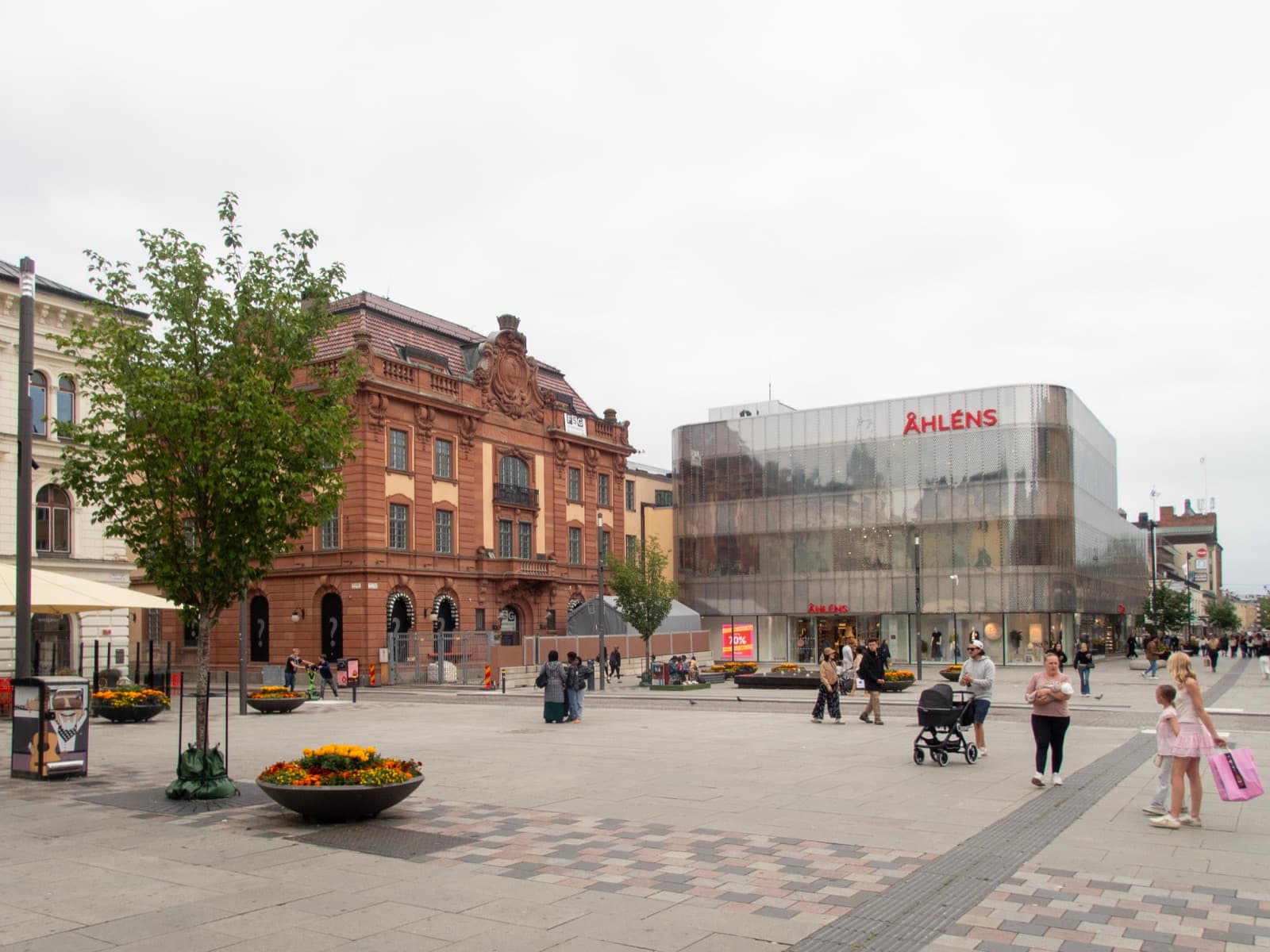
Central Uppsala is the whole city in walking distance. The Fyrisån runs through the middle, with the pedestrianised shopping streets and Stora torget on the flat east bank and the old town climbing the Fjärdingen side to the west, where Uppsala Cathedral, the university's main building, Gustavianum and the Carolina Rediviva library stand on the hill. Uppsala Centralstation sits a few minutes east of the square, so trains to Stockholm and Arlanda leave from inside the neighborhood.
It is dense, historic and busy by day, a mix of medieval churchscape and 19th-century stone streets with modern shops on the ground floors. Everything a resident needs, groceries, a doctor, the market hall, a department store, a bank, is a short flat walk away, and most of it is car-free.
This is the beating middle of a university city, lively and central, and it knows it is the address everyone else measures distance from.
Who lives here, and what the streets look like
The centre holds a real mix: working professionals who want the walk to the office, students drawn by the university on the doorstep, and older residents who have held their central flats for years. It is not a family-villa district; the housing is apartments, many of them small and period, in stone blocks above shops and cafés.
The streetscape is handsome and urban. Cobbled squares and paved shopping streets, the river with its low bridges and quaysides, the cathedral and university buildings up the Fjärdingen slope, and busy ground floors everywhere. It is lively during the day and into the evening near the bars, and quieter on the residential side streets at night.
Getting around
The centre is where Uppsala's transport meets. All the UL kärnlinjer city buses run through or past Stora torget, and Uppsala Centralstation, a short walk east, puts you 18 minutes from Arlanda and roughly 38 to 55 minutes from Stockholm C by train. There is no tram and no metro; local transit is buses, and you rarely need one, because the whole core is flat and walkable and famously good for cycling.
Typical weekday minutes from Stora torget, with the icon showing how. Times via Google Routes API for a typical weekday ~08:00, measured from the neighborhood centre; the icon shows the fastest sensible way (walk, bike, transit or car), 2026-08.
Daily life
Day to day, the centre is the easiest place in Uppsala to live without a car. Grocers, pharmacies, the department stores and the Uppsala Saluhall food hall are all within a few flat minutes, the pedestrian streets carry the everyday shopping, and the river paths and University Park give somewhere to walk. Fika culture is everywhere, from historic konditori to specialty roasters. For food delivery, Foodora, Wolt and Uber Eats all cover the central city.
Local Places Worth Knowing
Independent and close by, chosen on merit. Nobody pays to appear here. Links are being confirmed.
A historic konditori on Sysslomansgatan in Fjärdingen, serving since the 1870s, with panelled rooms, classic Swedish pastries and old-Uppsala atmosphere.
A long-running little café and konditori right on Stora torget, a fika stop in the middle of the square once frequented by Uppsala writers and artists.
The central food hall by the river on Sankt Persgatan, open since 1909, with independent fishmongers, delis, a cheese counter and lunch spots under one roof.
The twin-spired Gothic cathedral on Domberget, the tallest church in the Nordics, moments up the hill from the river and the square.
Checked August 2026. Places close and change, so tell us if something here is out of date.
Schools and families
The very core is more office and student territory than family district, and it has no year-9 school on the square. The nearest municipal year-9 school is Sverkerskolan on Sysslomansgatan, on the Fjärdingen side, whose leaving grades average a meritvärde of 249.4 out of 340 (Skolverket via Skolkoll, 2024/25), above the municipal mean. Uppsala has free school choice, so this is the nearest school rather than a fixed catchment, and it is worth checking admission before you sign a lease or purchase.
Kids Restricted. The ground is flat and the pavements are wide, so a pram is easy going here unlike a cobbled old town, and the department stores and Uppsala Saluhall have changing tables and family toilets; the trade-offs are small central flats, traffic and few dedicated playgrounds in the very core.
Pet Restricted. The flat riverside paths along the Fyrisån and University Park make for easy central dog walks, but the flats are small, there are no gardens, and the shopping streets are busy, so a real run means heading out toward the city parks.
Green space, leisure and eating out
Green space here is the river and the parks rather than private gardens. The Fyrisån quays run right through the middle, University Park sits below the cathedral, and the Botanical Garden and the Castle park are a short walk up the Fjärdingen slope. Leisure means the shops, the cafés, the cinemas and the culture around the university, with student nations and bars giving the centre most of its nightlife. Eating out ranges from the historic konditori and the market-hall lunch counters to sit-down restaurants along the river and the square.
What it costs
The centre is the most expensive place to buy in Uppsala. The Centrum band, Fjärdingen and the quarters around Stora torget, the river and the cathedral, runs roughly 50,000 to 62,000 kr per m² for apartments (Boio, 2026), well above the city average of about 40,243 kr per m² (Svensk Mäklarstatistik, Q1 2026). You are paying for the address and the walkability, and the flats tend to be older and smaller, so the premium is per square metre as much as per home. First-hand rents are set city-wide rather than per neighborhood, so no Centrum-specific figure is published.
Weather and climate
Seasonal averages for Uppsala, one representative month per season. SMHI normals (Uppsala) via Wikipedia climate box.
The honest downsides
The flats are small and pricey. The central housing is mostly older apartments, sought-after and dear per square metre, so space is the thing you give up.
It is busy, and can be noisy. The shopping streets draw crowds on weekends, and the student nightlife means some evening noise near the bars, which is the flip side of living where everything happens.
Crime and safety
Central Uppsala is a lively, generally safe city core, and the everyday risk here is opportunistic theft, the pickpocketing that follows shoppers and crowds, rather than violence. As in most city centres, you will sometimes see people asking passers-by for money around the square and the station, mostly low-key, while visible rough sleeping is uncommon on these streets. No standalone per-area crime rate is published for the centre, with the fuller picture on the Uppsala safety page.
Is this you?
If you want to live in the middle of Uppsala, walk to work, the train, the market and the cathedral, and you will trade a big flat for a central one, the centre is the most connected address in the city. If you want space, a garden and quiet evenings, the leafier residential districts out from the core will suit you better.
Want to know what homes here are actually worth?
Join the waitlistHow we source this
How we put this together. Gathered on the ground by our local field team and written up by the Apraiz research team. Every figure above carries its own source and date. The scores are not computed by the build; walking and transport will use open map and transit data first, then Apraiz's own model. We update prices quarterly, transport and amenities twice a year, and school data when the source publishes.
Sources: Boio, Svensk Mäklarstatistik, Skolverket, via Skolkoll, Wikipedia, Brå (National Council for Crime Prevention).
Safety and crime in Uppsala →Nearby: Luthagen · Kåbo · Kungsängen