
Long Story ShortReadHide
- What it is: a former industrial district on the Fyrisån beside Uppsala Centralstation, now the city's biggest inner regeneration zone, all new apartment blocks and converted works.
- Who it suits: young professionals and newcomers who want a modern flat, the train on the doorstep and the centre a short walk away.
- What it costs: at or a little above the Uppsala average, roughly 43,000 to 72,000 kr per m² for new production, small flats highest.
- What people complain about: it is still filling in, with construction, industrial edges and a thin street life in parts.
First impressions
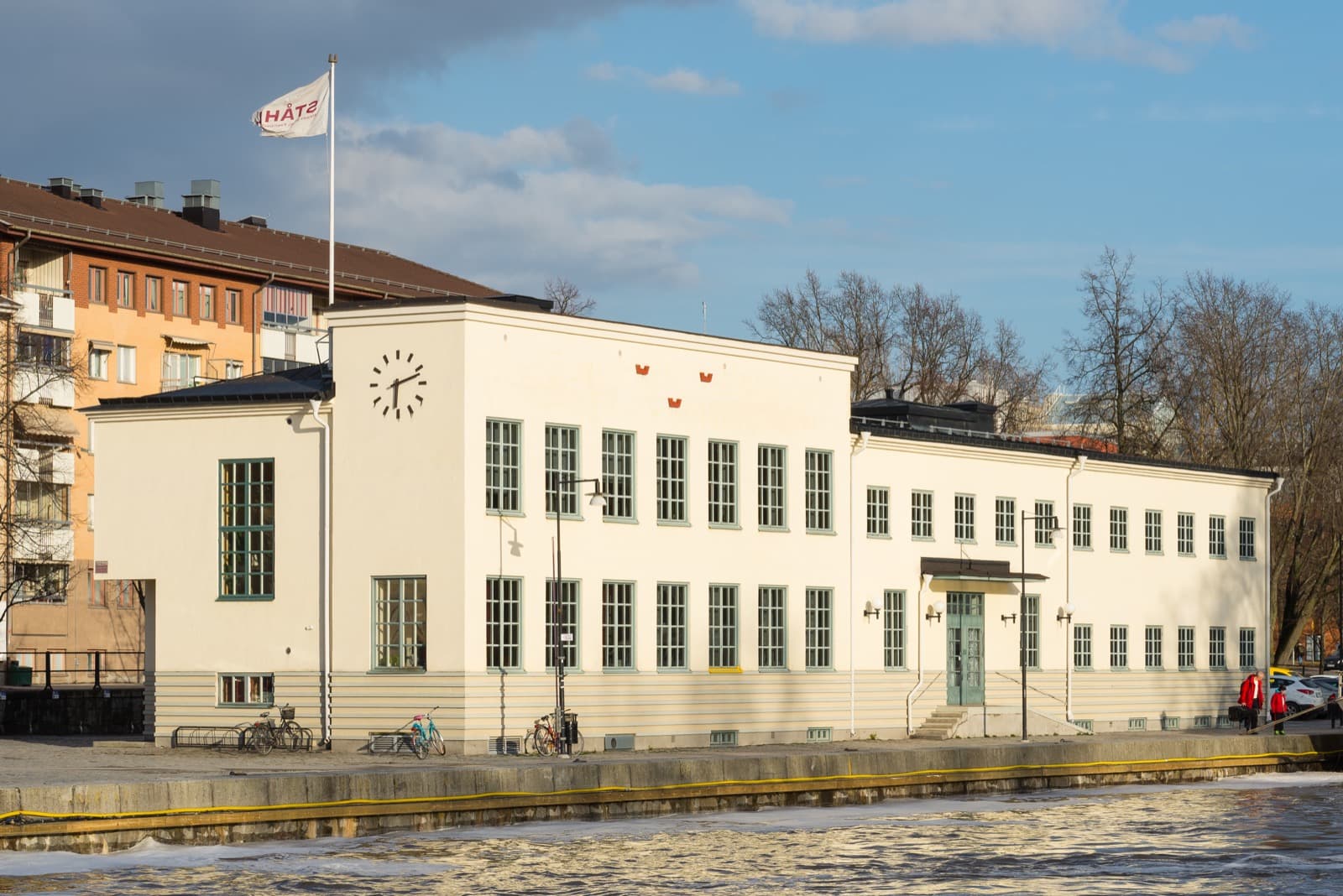
Kungsängen, usually called Industristaden, is the part of Uppsala that is being built in front of you. It lies just south and east of the centre, on the Fyrisån, wrapped around the back of Uppsala Centralstation, and until recently it was mills, foundries, sheds and rail sidings. Over the last decade it has become the city's biggest inner regeneration project: block after block of new apartments, converted industrial buildings, offices and freshly cut streets.
The feel is modern and unfinished in the best and the plainest sense. Some corners are handsome, brick and glass along the water with the old mill silhouettes kept; others are still cranes, hoardings and a street that does not quite have its cafés yet. What holds it together is the location. You are minutes from the station and the old centre, on the river, in a district that is visibly on its way up.
This is Uppsala's newcomer quarter, and it knows it is a work in progress.
Who lives here, and what the streets look like
The crowd here is young and mobile: professionals, commuters and people new to Uppsala, drawn by modern flats and the train. It is not an old-established community with deep roots; it is a district in the middle of forming one, filling up as each new block completes.
The streetscape swings between the two Kungsängens. Along the finished stretches you get clean modern facades, ground-floor glass and river views. Elsewhere you still get the working bones of the old Industristaden, plain industrial buildings, wide yards and the occasional building site. It is flat, open and easy to walk, if not yet pretty everywhere.
Getting around
This is Kungsängen's trump card. The district sits right beside Uppsala Centralstation, so you have the national rail network on your doorstep: fast trains to Stockholm Central and, in the other direction, the short hop out to Stockholm Arlanda Airport, plus the regional lines. Within the city it is served by UL's city buses, which is the whole of Uppsala's public transport, as the city has no tram or metro. It is also flat and compact, so a bike or a short walk covers the centre.
Typical weekday minutes from Kungsängen (Uppsala Centralstation), with the icon showing how. Times via Google Routes API for a typical weekday ~08:00, measured from the neighborhood centre; the icon shows the fastest sensible way (walk, bike, transit or car), 2026-08.
Daily life
Day to day, Kungsängen is a district you can just about run from the ground floor of the new blocks, with a grocer or two among them and the full shops of the centre a short walk over the river. The catch is that the retail is still filling in: some blocks have their café and their convenience store, others are waiting for them. For anything larger the centre is minutes away. For food delivery, Foodora, Wolt and Uber Eats all cover the central city and this district with it.
Local Places Worth Knowing
Independent and close by, chosen on merit. Nobody pays to appear here. Links are being confirmed.
A classic Uppsala konditori on Kungsängsgatan that has been baking for the city since 1887, from pastries and cakes to stone-oven sourdough and a light lunch.
Uppsala's first and only brewpub, brewing on site by the Fyrisån on Östra Ågatan, named for and rooted in the old Ångkvarn industrial quarter, with modern Swedish food to match the beer.
Classic, carefully cooked restaurant food on Östra Ågatan, set in a preserved building that was once the Tullgarn foundry and mechanical workshop.
The old Upsala Ångqvarn steam mill on Skeppskajen, a tall red-brick riverside landmark from Uppsala's industrial age, now the centrepiece of the district's conversion to homes, offices and shops.
Checked August 2026. Places close and change, so tell us if something here is out of date.
Schools and families
Kungsängen is a new-build district and has no year-9 school of its own. The nearest municipal school running the full grades is Vaksalaskolan, a central F-9 school whose leaving grades average a meritvärde of 253.4 out of 340 (Skolverket, 2024/25), comfortably above the national mean. Uppsala has free school choice, so this is the nearest school rather than a fixed catchment, and it is worth checking admission before you sign a lease or purchase.
Kids Friendly. About as pram-friendly as a district gets: flat, new and smooth-paved, with lifts in the new blocks, and the new cafés and restaurants have changing tables and family toilets, though live construction is a fact of life in parts.
Pet Friendly. The riverside paths along the Fyrisån are flat and easy, and the big Stadsträdgården city garden is right across the water over the Hamnspången footbridge, so there is real green for a dog close by, though the new blocks themselves have little private green yet.
Green space, leisure and eating out
The green here is the river. The Fyrisån runs right through the district with flat walking paths along it, and the Hamnspången footbridge carries you across to Stadsträdgården, Uppsala's big city garden, so proper park space is a short walk even if the new blocks themselves are still thin on their own green. Leisure leans on the water and the converted works: a brewpub in the old industrial quarter, restaurants in preserved foundry and mill buildings, and the whole of the centre a few minutes away. Eating out is growing rather than settled, newer places opening as the district fills.
What it costs
Kungsängen is priced at or a little above the Uppsala average. New-production flats here change hands at roughly 43,000 to 72,000 kr per m² (Booli, April 2026), with the smaller flats highest per square metre and the larger ones lowest, against a city average of about 40,800 kr per m² (Widerlöv, May 2026). The stock is almost all new build, so you pay a modern-flat premium but get lifts, insulation and the station next door. First-hand rents are set city-wide rather than per neighborhood, so no Kungsängen-specific figure is published.
Weather and climate
Seasonal averages for Uppsala, one representative month per season. SMHI normals (Uppsala) via Wikipedia climate box.
The honest downsides
It is still under construction. The upside of a regeneration zone is that everything is new; the downside is cranes, hoardings and half-finished streets while it all completes.
The street life is thin in parts. Some blocks have their café and their buzz; others are quiet, with the industrial past still showing and the daily high street yet to arrive.
Crime and safety
Kungsängen is a calm, modern district in a safe city, and the everyday risk is ordinary property crime rather than violence. Being right by the central station, you may occasionally see someone asking for money or sleeping rough near the station and the underpasses, as you would around most city termini. No standalone per-area crime rate is published for Kungsängen, with the fuller picture on the Uppsala safety page.
Is this you?
If you want a modern flat with the train on your doorstep and the centre a short walk over the river, and you do not mind living in a district that is still being finished, Kungsängen is one of the easiest places to land in Uppsala. If you want mature streets, a settled high street and greenery on the doorstep from day one, an older central quarter or a leafier area will suit you better.
Want to know what homes here are actually worth?
Join the waitlistHow we source this
How we put this together. Gathered on the ground by our local field team and written up by the Apraiz research team. Every figure above carries its own source and date. The scores are not computed by the build; walking and transport will use open map and transit data first, then Apraiz's own model. We update prices quarterly, transport and amenities twice a year, and school data when the source publishes.
Sources: Booli, Widerlöv Fastighetsmäklare, Skolverket, Utbildningsguiden, Uppsala kommun (Uppsala växer), Atrium Ljungberg, Brå (National Council for Crime Prevention).
Safety and crime in Uppsala →