
Long Story ShortReadHide
- What it is: Uppsala's grandest villa district, a leafy quarter of large early-1900s houses south-west of the centre, wrapped around the University's Botanical Garden and the hospital.
- Who it suits: senior academics, doctors and settled families who want a house, a garden and calm, within a walk or a short bike ride of the city.
- What it costs: among the most expensive addresses in Uppsala, with detached villas typically 12 to 20 million kr.
- What people complain about: almost no shops on the doorstep, few bostadsrätter, and hospital traffic on the northern edge.
First impressions
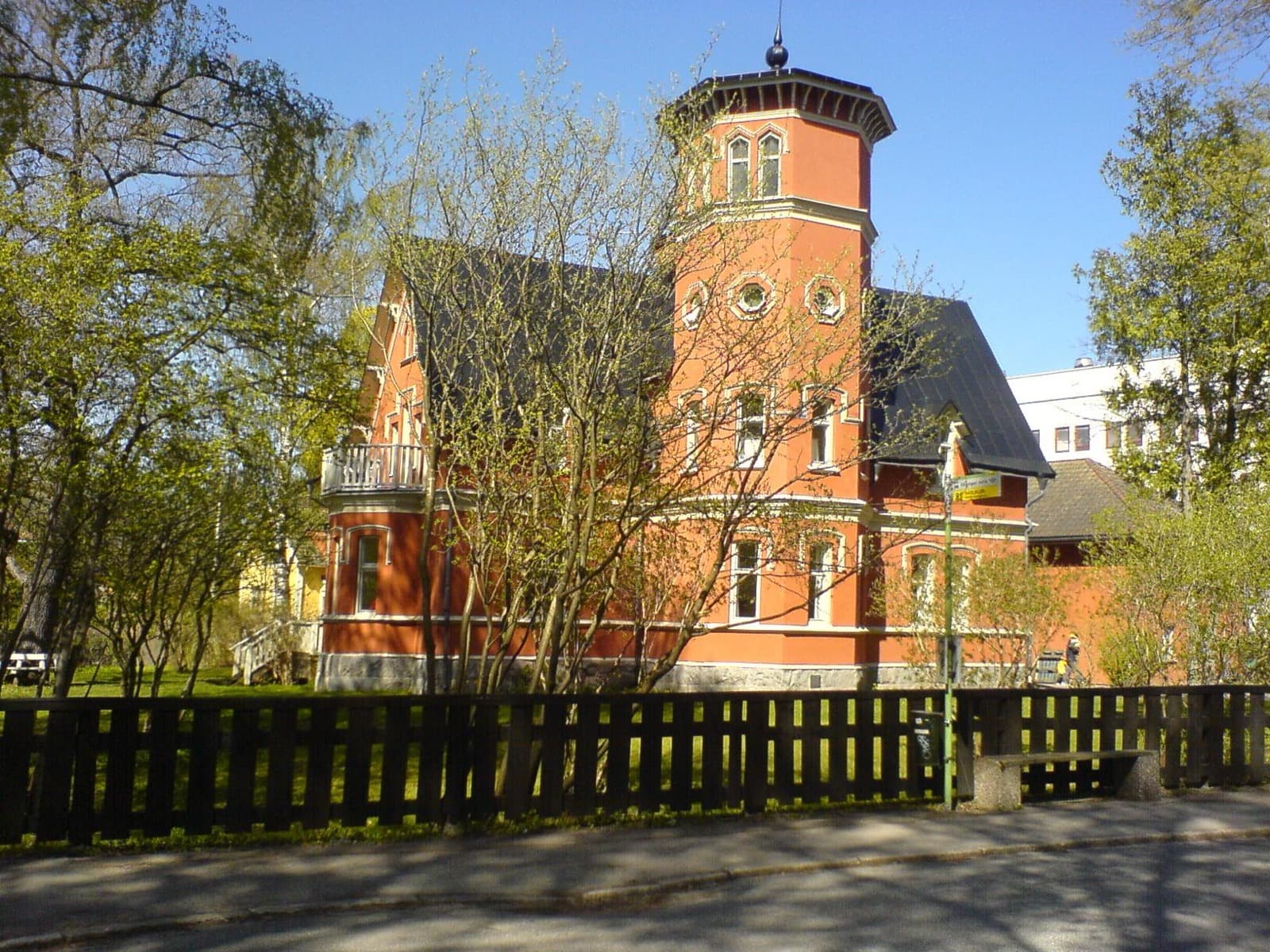
Kåbo is where Uppsala keeps its big houses. Laid out as a villa town from the early 1900s on the Kåbo gärde fields, with the oldest villas dating back to the 1880s, it is a grid of large detached houses behind hedges and mature gardens, quiet, green and unmistakably prosperous. It sits just south-west of the centre, folded between the Akademiska sjukhuset university hospital, the University's Botanical Garden and the Carolina Rediviva library hill, with the Kronparken pines close by.
The single biggest thing about living here is the calm and the greenery: broad leafy streets, park-like plots, and the Botanical Garden essentially as a front garden. It is grand and old-money in feel, home to professors, doctors and long-settled families, and it is expensive.
This is a grown-up, green, distinctly residential corner of the city, close enough to walk or cycle into the centre yet quiet enough to feel like a garden suburb.
Who lives here, and what the streets look like
Kåbo skews toward senior academics, hospital staff, doctors and established, well-off families, the kind of household that buys a villa and stays. It is a small district, about 2,670 residents, highly educated and affluent, with a good deal of old money in the grander houses.
The streetscape is leafy and calm: detached wooden and brick villas from around 1900 to 1925, some of real architectural note, set behind gardens on quiet streets, interleaved with University and hospital buildings toward the edges. It is green, low-rise and settled, more a garden suburb than a piece of the inner city.
Getting around
Kåbo is close in and easy to reach without a car. Akademiska sjukhuset on its northern edge is a major UL bus hub, so the centre is roughly ten to fifteen minutes by bus, and the flat, compact geography makes cycling to the centre and the University quicker still. Uppsala runs UL city buses only, no tram or metro, and evening service is thinner than the daytime, so many households here lean on the bike.
Typical weekday minutes from Akademiska sjukhuset, with the icon showing how. Times via Google Routes API for a typical weekday ~08:00, measured from the neighborhood centre; the icon shows the fastest sensible way (walk, bike, transit or car), 2026-08.
Daily life
Day to day, Kåbo is quiet and residential. There are almost no shops inside the villa streets themselves; for groceries and errands you walk toward Sjukhusvägen and the centre or cycle in, and the fuller shopping of central Uppsala is a short ride away. The real texture of life here is green: a walk in the Botanical Garden, the Kronparken pines and the Stadsskogen woods, and the University and hospital on the doorstep. For food delivery, Foodora, Wolt and Uber Eats all cover this part of Uppsala.
Local Places Worth Knowing
Independent and close by, chosen on merit. Nobody pays to appear here. Links are being confirmed.
The University's botanical garden on Villavägen, right beside Kåbo, with the baroque Linneanum orangery, a tropical greenhouse and Linnaeus-era planting.
The seasonal garden café (May to September) in a hundred-year-old bakery cottage inside the Botanical Garden, serving organic lunches and home baking with outdoor seating.
A café inside Akademiska sjukhuset, the university hospital on Kåbo's northern edge, a reliable everyday stop for staff, patients and neighbours.
A weekday lunch restaurant on Villavägen at the Geological Survey, one of the few sit-down tables inside the villa district.
Checked August 2026. Places close and change, so tell us if something here is out of date.
Schools and families
Kåbo is a family district but has no municipal year-9 school of its own. The nearest municipal year-9 school is Eriksbergsskolan (years 7 to 9) in adjacent Eriksberg, whose leaving grades average a meritvärde of 248 out of 340 (2024), a little above the Uppsala mean; its activity moved into the new Rosendals skola nearby in autumn 2024. Uppsala has free school choice, so this is the nearest school rather than a fixed catchment, and it is worth checking admission before you sign a lease or purchase.
Kids Friendly. Flat, leafy pavements suit a pram, the Botanical Garden and quiet roads are pleasant for small children, and the nearby hospital and garden have changing tables and family toilets.
Pet Friendly. Detached villas with gardens, quiet leafy streets and the Kronparken and Stadsskogen woods nearby make this an easy place for a dog; note the Botanical Garden itself restricts dogs, so use the surrounding parks for off-lead walks.
Green space, leisure and eating out
Green space is the whole point here, and it is excellent. The University's Botanical Garden, with its baroque Linneanum orangery and tropical greenhouse, sits right against the district, the Kronparken pines and the Stadsskogen city forest are a short walk, and the villa gardens themselves add to the leafiness. Leisure leans toward the calm and the cultural, a walk in the garden, a museum, the University quarter, rather than nightlife. Eating out is limited inside the villas: a seasonal garden café, the hospital café and a weekday lunch table or two, with the city's restaurants a short ride into the centre.
What it costs
Kåbo is an expensive place to live, and what you are mostly buying is a detached villa with a garden. Whole houses here typically change hands at roughly 12 to 20 million kr (Hemnet sold prices, 2026), well above the Uppsala villa average of about 41,600 kr per m² (Widerlöv, March 2026), which reflects both the size of the plots and the prestige of the address. Bostadsrätter are scarce in the district, trading at roughly 48,000 to 63,000 kr per m² where they come up. Budget for the running costs of a large old house, not just the purchase. First-hand rents are set city-wide rather than per neighborhood, so no Kåbo-specific figure is published.
Weather and climate
Seasonal averages for Uppsala, one representative month per season. SMHI normals (Uppsala) via Wikipedia climate box.
The honest downsides
Little on the doorstep. The villas are the whole point, but there is almost no high street inside Kåbo; for shops and services you head toward Sjukhusvägen or the centre.
Expensive, and hard to get into. Prices are among the highest in Uppsala, the housing is mostly large villas, and there are few flats, so options for smaller budgets are thin.
Crime and safety
Kåbo is a calm, affluent villa district in a safe university city, and as in quiet well-off areas anywhere the everyday concern is property crime, break-ins and the like, rather than violence. Visible street begging and rough sleeping are rare on these residential streets, seen mainly around the central squares and stations rather than here. No standalone per-area crime rate is published for Kåbo, with the fuller picture on the Uppsala safety page.
Is this you?
If you want a large house and a garden in a green, quiet setting, with the Botanical Garden at the door and the centre and University a walk or a short cycle away, Kåbo is one of the loveliest and most prestigious places to settle in Uppsala. If you want shops on the corner, a lively high street or a smaller, cheaper flat, the more central and mixed districts will suit you better.
Want to know what homes here are actually worth?
Join the waitlistHow we source this
How we put this together. Gathered on the ground by our local field team and written up by the Apraiz research team. Every figure above carries its own source and date. The scores are not computed by the build; walking and transport will use open map and transit data first, then Apraiz's own model. We update prices quarterly, transport and amenities twice a year, and school data when the source publishes.
Sources: Hemnet, Widerlöv Fastighetsmäklare, Skolverket, via Betygskartan, Wikipedia, Uppsala universitet, Brå (National Council for Crime Prevention).
Safety and crime in Uppsala →Nearby: Centrum · Luthagen · Kungsängen