
Long Story ShortReadHide
- What it is: an island of hills, coffee and second-hand shops, five minutes south of the old town. Stockholm's most walkable district, and it knows it.
- Who it suits: people who want a real neighborhood inside a capital city, and who do not mind stairs.
- What it costs: 114 405 SEK / m² (about €10,500 / m²) to buy (Svensk Mäklarstatistik, April to June 2026), among the most expensive districts in Stockholm. Rents run high too, and what you pay turns on whether you land a first-hand contract or rent second-hand.
- What people complain about: the noise on the big streets, the price, and the fact that everyone else also wants to live here.
First impressions
You arrive on Södermalm by crossing water, and then you go up. The island sits on a granite ridge, so the first thing your legs notice is the climb. The second thing you notice is that people are outside. On a normal Tuesday the pavements are busy with prams, dogs, delivery bikes and people carrying single paper bags from the bakery.
This was the poor side of Stockholm for most of its history. Workers, sailors and factories lived here while the money stayed on the other shore. You can still read that story in the buildings. Small wooden houses from the 1700s sit on the hill at Åsöberget, a few streets away from tall stone blocks from the 1920s and glass balconies from last year. Nothing matches, and that is the charm.
The area changed in the 1980s and 1990s. Artists and students moved in because it was cheap, the cafés followed, and then the prices followed the cafés. It is now one of the most expensive parts of the city, which is a joke that residents make often and quietly enjoy.
Who lives here, and what the streets look like
The mix is wide: young professionals, families who arrived ten years ago and stayed, older residents who never left, and a steady flow of people in creative and tech work. It is not a student district. Students live here, but they usually live here with three other people.
The streets are well kept. Ground floors are alive, which is the real test: on the main shopping streets you will find shops, cafés and studios rather than shuttered windows. There is graffiti, mostly on the industrial edges near the water, and it reads as part of the local look rather than neglect. Rubbish collection is reliable, the parks are maintained, and the lighting is good on the main routes. Some of the smaller side streets on the hills are dark at night, which is worth knowing if you walk home late.
Getting around
Södermalm is the easiest part of Stockholm to live in without a car. The metro runs through the island with several stations, and the central station is only a few minutes away. Buses cover the rest, and the ferry adds a slow, pleasant option in summer.
Cycling is good, but be honest with yourself about the hills. The flat routes run along the water on both sides. The routes across the middle do not. Electric bikes are popular here for a reason.
If you have a car, expect to pay for it. Street parking is limited and controlled, and the city charges a congestion fee to drive into and out of the center at busy times, up to 45 SEK (about €4) per passage at peak, capped at 135 SEK a day in high season (Transportstyrelsen, 2026).
Typical weekday minutes from Slussen, with the icon showing how. Times via Google Routes API for a typical weekday ~08:00, measured from the neighborhood centre; the icon shows the fastest sensible way (walk, bike, transit or car), 2026-07.
Daily life
You can do your whole week on foot. Supermarkets are spread across the island, so most homes have one within a five minute walk, and the smaller streets add bakeries, fishmongers and delis. Söderhallarna, the market hall at Medborgarplatsen, has been closed for a major renovation and is due to reopen in 2026, so for now the outdoor market on the square in front of it carries the fresh stalls, good in summer and stubborn in winter.
Götgatan is the main shopping street and runs the length of the island. The area east of it, known locally as SoFo, is where the independent shops sit: records, second-hand clothes, small design studios and a lot of coffee. This is where Södermalm earns its reputation.
Delivery apps that serve the area: Foodora, Wolt, Uber Eats. Coverage checked July 2026.
Local Places Worth Knowing
Independent, close by, and chosen on merit. Nobody pays to appear here.
A specialty roaster's concept café-bar on Swedenborgsgatan, near Mariatorget, with some of the best filter coffee on the island.
View on Google MapsA local all-day place on a leafy square, good for a long weekend brunch or a proper dinner.
View on Google MapsA grand old beer hall serving Swedish husmanskost under a painted ceiling, cheap by Söder standards.
View on Google MapsAn independent magazine and film boutique on Krukmakargatan, near Mariatorget, the browse-for-an-hour kind of place.
View on Google MapsChecked July 2026. Places close and change, so tell us if something here is out of date.
Schools and families
Södermalm is a normal choice for families, and prams are everywhere. Public preschools and primary schools are spread across the district, and there are independent schools as well. Sweden lets you apply outside your local area, but places at popular schools fill early, so it is worth checking before you sign a lease or purchase.
Playgrounds are plentiful and well used. Each school level is listed in the panel beside this article.
Sofia skola and Katarina Norra skola cover the primary years across the eastern half of the island; Södra Latin is the well-known upper-secondary school, and it is competitive enough that families plan around it.
Kids Friendly. The hills make a pram hard work in places, though cafés welcome children and the bigger food halls and department stores nearby have changing tables and family toilets.
Pet Friendly. Dog-friendly cafés, plenty of green at Tantolunden and Vitabergsparken, and dogs ride SL transit.
Green space, leisure and eating out
For a dense island, there is a lot of green. Tantolunden on the south shore is the big open park, with allotment gardens and small red cabins that look like a village. Vitabergsparken has an outdoor stage and a church on the hill. Långholmen, a short bridge away, has a swimming beach, forest paths and a former prison that is now a hotel.
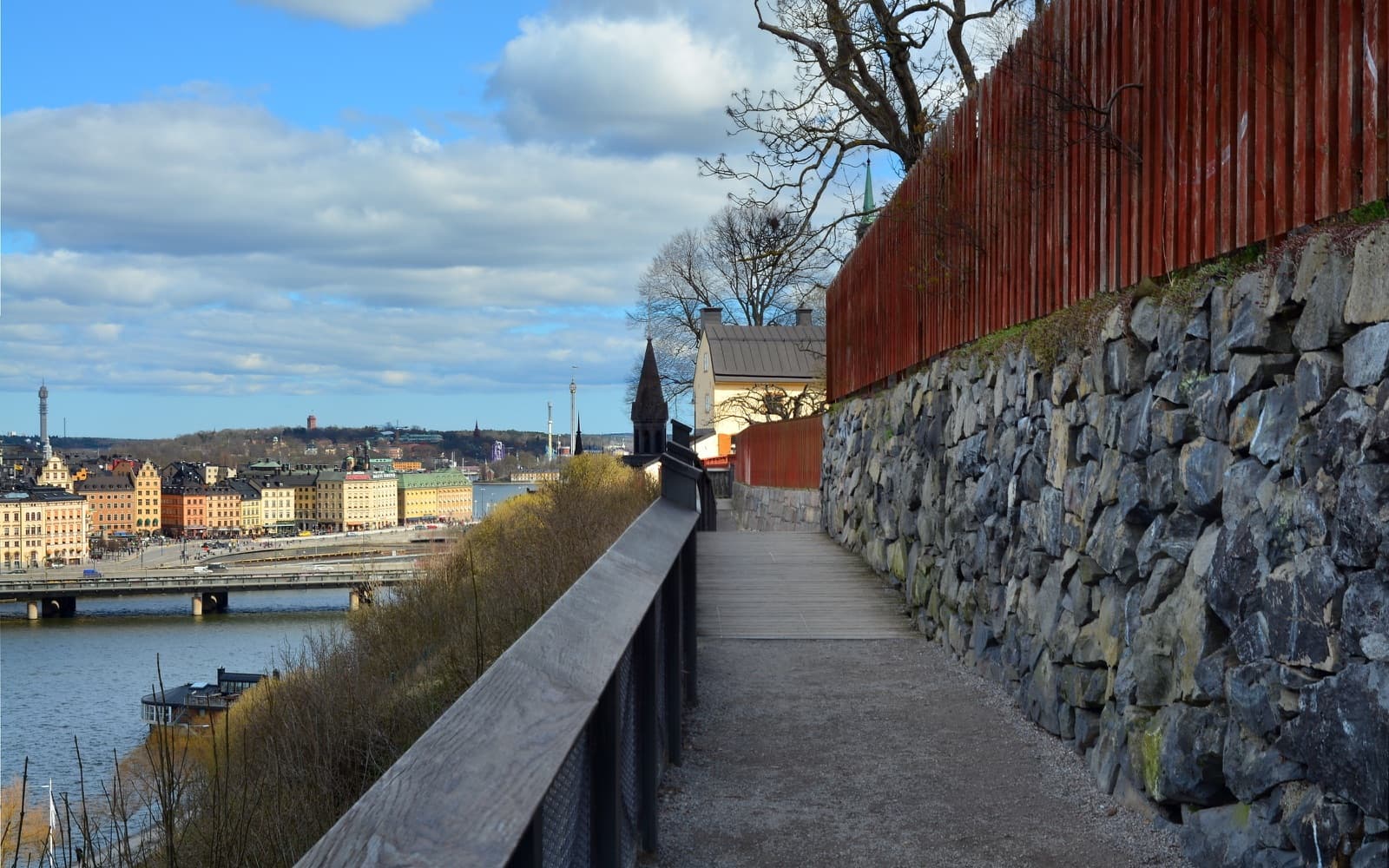
The cliff walks are the thing people photograph. Monteliusvägen and Fjällgatan look straight across the water at the old town, and both are free, which in this city is worth mentioning.
Eating out is a strength. The island covers everything from cheap lunch places to serious restaurants, and the bar scene runs late by Swedish standards. Start with a wander through the SoFo grid, a long lunch at Nytorget 6, or a show at the Södra Teatern cultural venue on the cliff above Slussen.
What it costs
Södermalm is expensive. Buying costs 114 405 SEK / m² (about €10,500 / m²), based on sales from April to June 2026 (Svensk Mäklarstatistik), which puts the average apartment here around 6.5 million SEK. Groceries cost about what they do across the city; they do not care which island you live on.
Renting cannot be reduced to a single figure, because a rent-controlled first-hand contract and an open-market second-hand let differ by thousands of kronor for the same flat. A first-hand two-room runs around 9,200 SEK a month, roughly a fifth of a typical local income before tax; the same flat second-hand runs closer to 15,000 SEK, more like a third. That gap, not the headline price, is the number worth working out for your own situation. The chart below shows what each takes from a typical local income.
One local detail worth knowing: most apartments here are cooperative (bostadsrätt) rather than directly owned, so on top of the price you pay a monthly fee to the housing association (the avgift). It varies a lot by building, it is part of the real cost, and it is easy to forget when comparing listings.
Monthly rent as a share of a typical local income (mean per earner, before tax). The same flat costs far more second-hand than on a first-hand contract. Prices and rents in figures are in the panel beside this article. Income: Stockholm stad, Områdesfakta Södermalm, 2024.
Weather and climate
Seasonal averages for Stockholm, one representative month per season. SMHI 1991-2020 normals (Stockholm) via Wikipedia climate box.
The honest downsides
It is loud in places. The big through-roads carry a lot of traffic, and apartments facing them are noticeably noisier and dustier than the ones facing a courtyard. Always ask which way the windows face.
The hills are real. Charming on a spring evening, less charming with shopping bags in February.
Nightlife cuts both ways. Living above a good bar is fun until the third weekend.
There is construction. Large rebuilding work at the northern end has run for years and is not finished, which means noise and detours on that side of the island.
You pay for all of it. The same money buys considerably more space one metro stop further out.
Crime and safety
Södermalm is a safe part of a safe city, and the figures that matter here are about theft, not violence. Pickpocketing and bike theft are the everyday risk, concentrated where crowds gather: the nightlife around Medborgarplatsen, the busy stretch of Götgatan, and the metro late at night. Serious violent crime is rare across the island. Stockholm's own local safety work reports that residents perceive Södermalm as safer than the city average, with exposure to violence falling against the previous survey (Stockholm stad, trygghetsmätning). The one practical thing to know is that the smaller streets on the hills are dark and quiet after midnight, so most people walking home late keep to the lit main routes. As in most central Stockholm districts you will also see some visible street life, a few people asking for money outside the shops around Medborgarplatsen and the odd bout of daytime street drinking near the squares, mostly low-level, while visible rough sleeping is uncommon. Once the per-area reported-crime figures are pulled from Brå, they will sit in the panel beside this article compared with the city average, with the fuller picture on the Stockholm safety page.
Is this you?
If you want to walk everywhere, eat well, and live somewhere with a personality of its own, Södermalm is worth the premium. If you want space, quiet, and a parking spot, the money goes further elsewhere and you can still be here in ten minutes.
Want to know what homes here are actually worth?
Join the waitlistHow we source this
How we put this together. Gathered on the ground by our local field team and written up by the Apraiz research team. Every figure above carries its own source and date. The scores are not computed by the build; walking and transport will use open map and transit data first, then Apraiz's own model. We update prices quarterly, transport and amenities twice a year, and school data when the source publishes.
Sources: Svensk Mäklarstatistik, Transportstyrelsen, Hyror i Stockholm / SCB; Qasa, Stockholm stad, Områdesfakta, Skolverket, via Skolkoll, Stockholm stad, SCB (Statistics Sweden), Brå (National Council for Crime Prevention).
Safety and crime in Stockholm →Nearby: Vasastan · Östermalm · Kungsholmen