
Long Story ShortReadHide
- What it is: Stockholm's most polished address, a flat grid of wide, tree-lined boulevards framed by grand stone buildings, with the Saluhall, the Strandvägen waterfront and the Stureplan nightlife all in walking reach.
- Who it suits: people who want elegance and easy walking in the middle of the city, and who can pay for it.
- What it costs: 125 362 SEK / m² (about €11,500 / m²) to buy (Svensk Mäklarstatistik via Boio, March 2026), the highest in Sweden. Confirm the live number on maklarstatistik.se before you rely on it.
- What people complain about: the price above all, the nightlife noise around Stureplan, and the fact that some blocks are quiet to the point of sleepy.
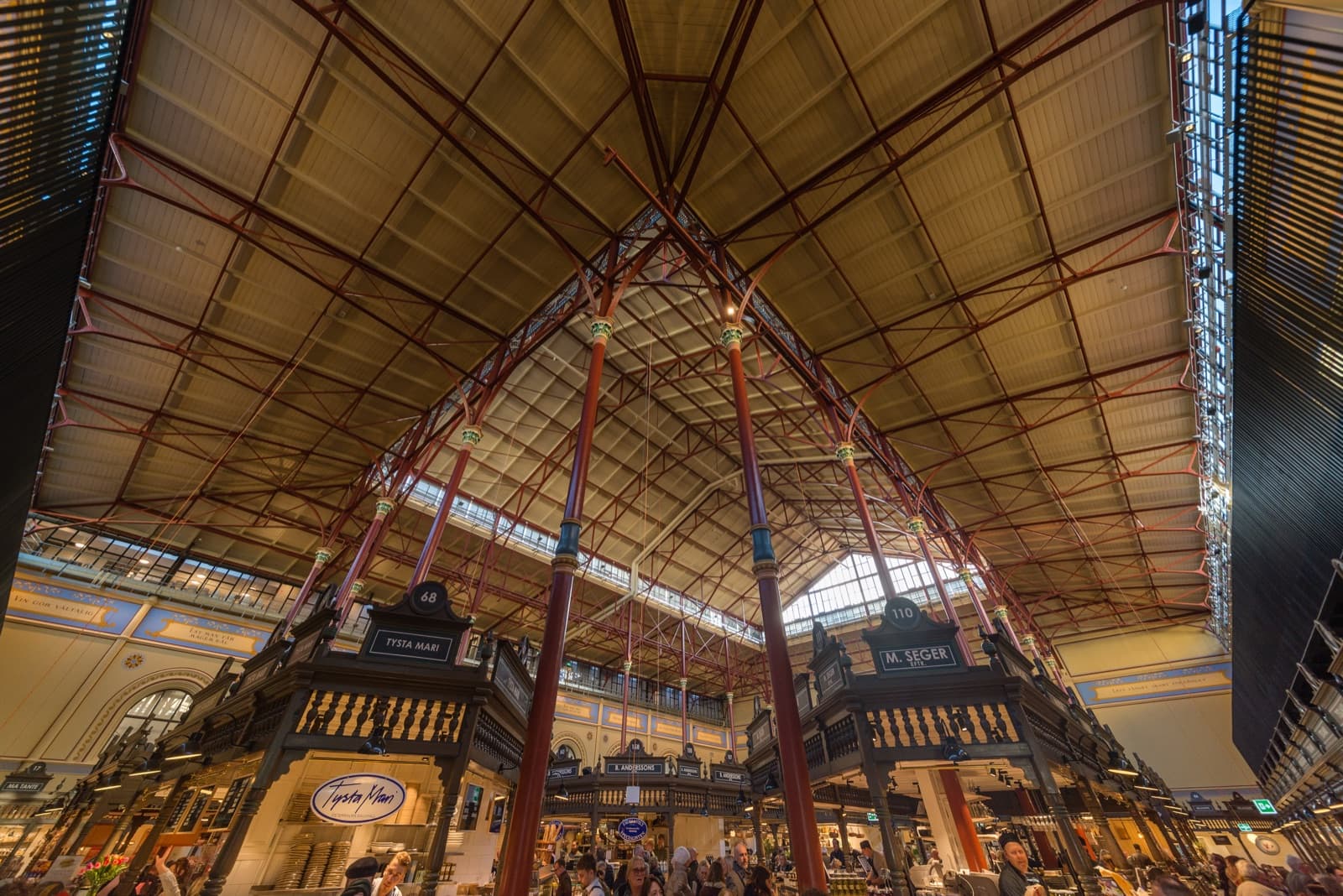
First impressions
Östermalm reads as money the moment you arrive, but the quiet, settled kind rather than the loud kind. It sits on a flat grid of wide boulevards laid out to a town plan from around 1880, framed by grand four to six storey stone buildings that Stockholmers call the "stenstaden," the stone city. There is no climb here, which is the first thing your legs notice if you have just come from Södermalm.
The set-pieces give the district its character. The red-brick Östermalms Saluhall from 1888 anchors the middle; the waterfront sweep of Strandvägen runs along Nybroviken with classic boats moored below; and Stureplan, where five streets meet under a concrete rain-shelter locals call the "Svampen," the mushroom, marks the social heart. "Let's meet under the mushroom" is still a normal thing to say here.
The name is newer than the place. Until the redevelopment of the 1880s this was Ladugårdslandet, roughly "the barn land," a plainer district on the edge of town. The granite outcrops that used to break up the ground were blasted away from the 1860s, which is why the streets run so straight and level today.
Who lives here, and what the streets look like
Östermalm is small but among the most exclusive districts in Sweden, and the mix reflects that. The crowd skews affluent professionals and old money, with a cluster of foreign embassies and diplomatic residences folded in, and established families near Humlegården, Gärdet and the stronger schools. Around Stureplan the scene tilts younger and louder, business, media and upper-class youth out late.
The streets are immaculate and the boulevards are broad. Ground floors are alive on the main runs, Biblioteksgatan, Nybrogatan, Sturegatan, where luxury shops, cafés and galleries keep the pavements busy. Karlavägen and the outer blocks are calmer, more residential, and noticeably quieter at night. The polish is real, but so is the reserve: this is not a district that spills onto the street the way Söder does.
Getting around
Östermalm is easy to live in without a car. The terrain is flat, so walking the grid is genuinely pleasant, and the red line threads the district with several stations: Östermalmstorg is the main hub, with Karlaplan, Stadion, Gärdet, Tekniska högskolan and Ropsten across the branches. T-Centralen is roughly one stop away. At Stockholms östra, next to Tekniska högskolan, the Roslagsbanan commuter rail heads north, and the bus network is dense on top of all of it.
Cycling is straightforward here in a way it is not on the hillier islands, because there is no hill to speak of. The boulevards are wide and the surface is level.
If you fly often, the airport is close in time if not in distance: the metro to T-Centralen plus the Arlanda Express, an 18-minute leg (Arlanda Express / Swedavia), gets you to Arlanda in a little over half an hour. The commuter train is the cheaper, slower alternative.
Typical weekday minutes from Östermalmstorg, with the icon showing how. Times via Google Routes API for a typical weekday ~08:00, measured from the neighborhood centre; the icon shows the fastest sensible way (walk, bike, transit or car), 2026-07.
Daily life
Everyday needs are close. Hemköp on Nybrogatan stays open till 23:00, and several ICA supermarkets sit around Karlaplan, so most homes have a full grocery run within a few minutes on foot. Above that sits Östermalms Saluhall, the premium food hall, good for a fishmonger, a cheese counter or a sit-down lunch among the stalls.
Shopping is where the district shows off. Biblioteksgatan, "Bibliotekstan," is Stockholm's luxury strip, Prada and Gucci and Chanel alongside Swedish names like Acne Studios and Byredo, and Sturegallerian is the arcade next door, with the historic Sturebadet spa from 1885 inside it. Nybrogatan and Sturegatan carry the independent end: boutiques, delis and design shops.
Delivery apps that serve the area: Wolt, Foodora, Uber Eats. Coverage checked July 2026.
Local Places Worth Knowing
Independent, close by, and chosen on merit. Nobody pays to appear here.
An old-fashioned konditori spread across the floors of an 18th-century townhouse on Riddargatan, all antique décor and classic Swedish pastries.
View on Google MapsA classic Stockholm brasserie by Nybroviken, founded in 1893 and still a haunt of the fashion and art crowd.
View on Google MapsThe iconic Swedish interior-design house founded in 1924, home of the Josef Frank prints, with its only shop on Strandvägen.
View on Google MapsThe grand tree-lined waterfront boulevard along Nybroviken, built for the 1897 exhibition and still Östermalm's showpiece for a slow walk past the moored boats.
Checked July 2026. Places close and change, so tell us if something here is out of date.
Schools and families
Östermalm is a strong district for schools, and families plan around it. The area average for year-9 leaving grades, the meritvärde, is 288.7 out of 340 (Skolverket via Skolkoll, 2024/25), well above the national mean of about 228, and every school in the area sits above that norm. Names range from municipal schools like Gärdesskolan and Engelbrektsskolan to a cluster of independents, several with an English or international profile.
One honest caveat: the strongest results here lean toward selective and independent schools, and popular places fill early. Sweden lets you apply outside your local area, but it is worth checking admission well before you sign a lease or purchase. The lower-secondary result is the one figure cleanly sourced for Östermalm; the other school levels have no verified area-specific metric yet, so they are left blank in the panel beside this article rather than guessed.
Kids Friendly. Flat and pram-friendly, most cafés welcome children, and the food hall, malls and department stores nearby have changing tables and family toilets.
Pet Friendly. Leafy and calm with Humlegården close by; dogs are welcome on transit and in many cafés.
Green space, leisure and eating out
For a dense inner district, Östermalm is well served for green and blue. Humlegården is the green lung, a public park since 1869 wrapped around the Royal Library. Djurgården's royal parkland sits on the edge, the open fields of Gärdet stretch out to the north-east, Karlaplan offers a fountain plaza, and Strandvägen delivers constant waterfront along Nybroviken.
Eating out runs from the classic to the very grand. Riche has been a fixture by Nybroviken since 1893, Sturekatten is the place for an old-fashioned pastry, and the Saluhall covers everything from a quick counter lunch to a proper sit-down. The bar and club scene concentrates around Stureplan, which is a feature or a nuisance depending on which side of it you sleep.
What it costs
Östermalm is the most expensive place to live in Sweden. Buying costs 125 362 SEK / m² (about €11,500 / m²), based on Svensk Mäklarstatistik data republished by Boio (March 2026); confirm the live figure on maklarstatistik.se before you rely on it, since the primary page is awkward to read straight. Groceries cost about what they do across the city; they do not care which district you live in.
Renting cannot be reduced to one number here, and honestly we cannot give you a clean Östermalm-only figure for all of it. A rent-controlled first-hand two-room runs around 9 564 SEK / mo (about €900 / mo) at the "Inre staden" level that Stockholm publishes (Hyror i Stockholm 2025 / SCB), but the city does not break Östermalm out on its own, and no aggregator publishes a trustworthy Östermalm-only second-hand average. The open-market second-hand rent is higher than the first-hand figure, sometimes by a lot, but we will not put a number on it until one is sourced.
One local detail worth knowing: most apartments here are cooperative (bostadsrätt) rather than directly owned, so on top of the price you pay a monthly fee to the housing association (the avgift). It varies a lot by building, it is part of the real cost, and it is easy to forget when comparing listings.
Weather and climate
Seasonal averages for Stockholm, one representative month per season. SMHI 1991-2020 normals (Stockholm) via Wikipedia climate box.
The honest downsides
You pay for everything. This is literally the priciest housing in Sweden, and the premium shows up in rent, in the avgift, and in a coffee.
Stureplan is loud at night. The nightlife around the square draws a late crowd, and apartments near it hear all of it on the weekend.
Some blocks are sleepy. The flip side of the calm is that parts of Karlavägen and the outer streets are quiet to the point of dull, with less street life than a first-time visitor expects from central Stockholm.
The polish can feel closed. This is a reserved, formal district. If you want the messy, mixed, spills-onto-the-street feel of Söder, you will not find it here.
Retail is drifting. As rents climb, some of the independents around Stureplan have given way to tourist-facing outlets, and the Saluhall area draws crowds.
Crime and safety
Östermalm is a calm, safe part of a safe city. The honest complication is that reliable crime figures for Östermalm on its own are not published, so we do not print a single number we cannot stand behind. The direction, though, is clear: Stockholm stad states plainly that most residents perceive the area as a safe place, and the everyday risk here is petty theft around the nightlife and shopping streets rather than violence. Local reporting bears the calm out; when police cordoned off Nybrogatan in March 2026 to examine a suspicious object, it turned out to be a harmless thermos (Mitt i, 2026-03-16), the kind of non-event that says more about the area than any statistic. In a polished, well-off district like this, visible rough sleeping and street begging are rare, and what little you see clusters around the Stureplan nightlife and the transport stops rather than the quiet residential blocks. Once verified per-area figures can be pulled from Brå, they will sit in the panel beside this article compared with the city average, and the city page carries the fuller safety picture.
Is this you?
If you want elegance, flat and easy walking, serious shopping and the best food hall in the city, and the budget is not the deciding factor, Östermalm is Stockholm at its most polished. If you want a livelier, more mixed street life, or you want the same money to buy more space, look one district over.
Want to know what homes here are actually worth?
Join the waitlistHow we source this
How we put this together. Gathered on the ground by our local field team and written up by the Apraiz research team. Every figure above carries its own source and date. The scores are not computed by the build; walking and transport will use open map and transit data first, then Apraiz's own model. We update prices quarterly, transport and amenities twice a year, and school data when the source publishes.
Sources: Svensk Mäklarstatistik (via Boio), Stockholm stad, Hyror i Stockholm 2025 / SCB, Stockholm stad, Områdesfakta, Skolverket, via Skolkoll, Arlanda Express / Swedavia, Stockholm stad (Norra innerstaden), Mitt i, Brå (National Council for Crime Prevention).
Safety and crime in Stockholm →Nearby: Södermalm · Vasastan · Kungsholmen