
Long Story ShortReadHide
- What it is: a proper inner-city island, west of the old town, that opens straight onto water on every side. Central Stockholm with the volume turned down.
- Who it suits: people who want a calm, settled neighborhood a couple of metro stops from the center, and who like water more than nightlife.
- What it costs: 103 869 SEK / m² (about €9,500 / m²) to buy (Svensk Mäklarstatistik via Boio, March 2026), the most affordable of Stockholm's central islands but still expensive. First-hand rents here are among the city's highest.
- What people complain about: the price, and the fact that it is quieter at night than the districts across the water.
First impressions
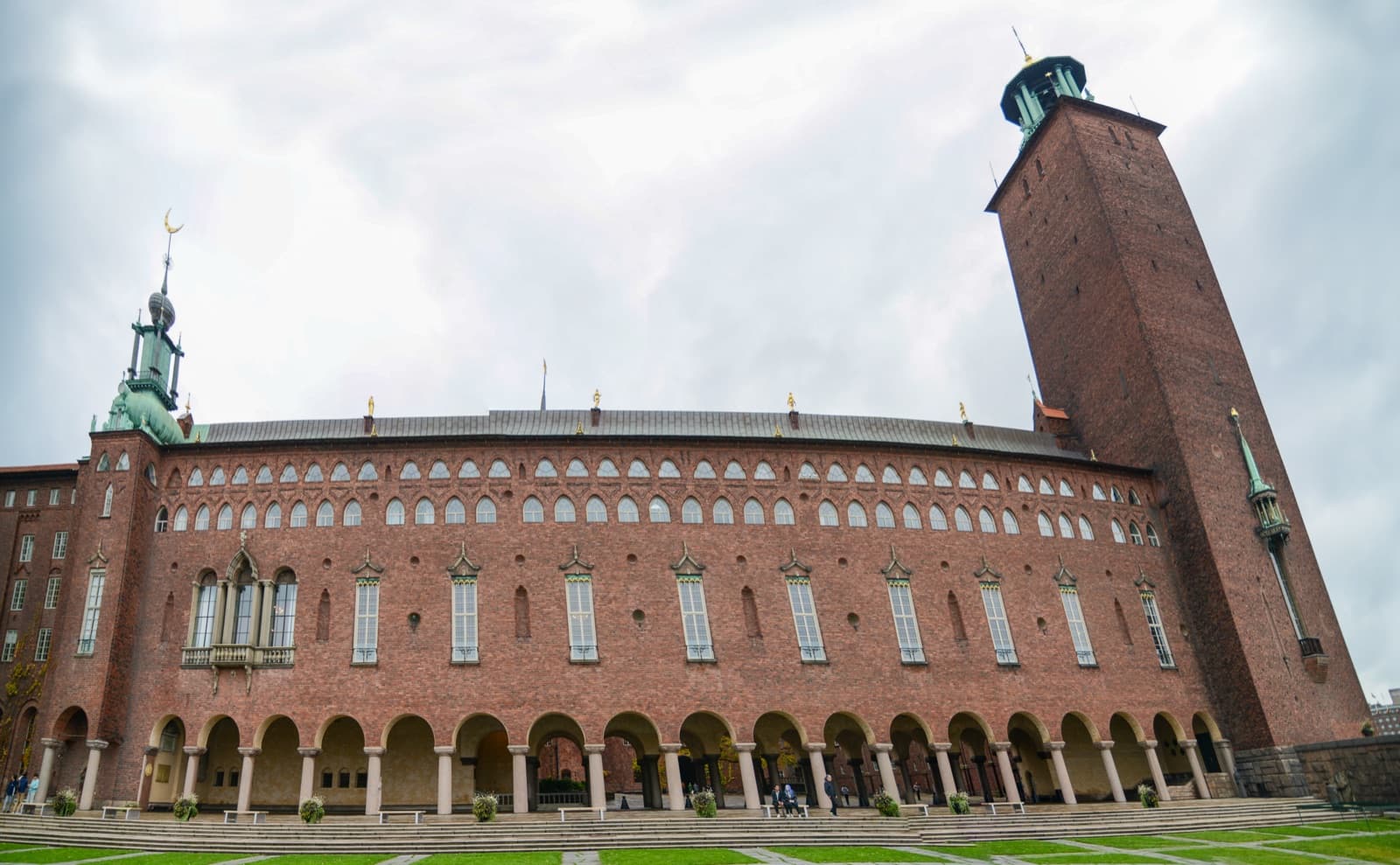
Kungsholmen reads as central Stockholm with the volume turned down. You reach it across water, like everywhere in this city, and then you are on a proper inner-city island of stone streets that opens onto the lake on every side. Its most famous building, Stockholm City Hall with the Nobel banquet hall, sits on the eastern tip, so a lot of people know the skyline of the island without ever having walked its streets.
The character is calm and settled rather than loud. Turn-of-the-century stone blocks and 1920s and 1930s buildings line a dense grid, ground floors are alive with grocers and cafés along the main streets, and the whole thing is ringed by shoreline. It is one of the flatter parts of central Stockholm, which its residents notice most when they visit hillier islands nearby.
This is a prosperous, grown-up part of town. It is not a student district and it is not a nightlife district. People move here to stay.
Who lives here, and what the streets look like
The people who live on Kungsholmen tend to be established: professionals and families rather than a transient or student crowd. The numbers back up the feel. Mean income per earner was 598,500 SEK in 2024, well above the city's 490,200 SEK, and the working-age employment rate was 85.0% against 79.9% citywide (Stockholm stad, Områdesfakta 2024).
The streets are well kept. Along Hantverkargatan, Fleminggatan and Sankt Eriksgatan the ground floors carry shops, cafés and services rather than shuttered windows, and the residential blocks behind them are quiet. It is a neighborhood that looks after itself, which is part of why it costs what it does.
Getting around
Kungsholmen is easy to live in without a car. Two metro lines thread the island and meet at Fridhemsplan, the main hub: the green line and the blue line, with the blue platform sitting deep below the green. From there T-Centralen is only about two stops on the blue line, and the rest of the network fans out from the center (stockholmstunnelbana.se).
There are more stops besides Fridhemsplan: Rådhuset and Stadshagen on the blue line, Thorildsplan and Kristineberg on the green, and Sankt Eriksplan on the northern edge, plus a dense bus network. For the airport, the Arlanda Express runs a published 20 minutes from Stockholm Central, which you reach on the blue line.
Exact weekday door-to-door times are worth confirming on sl.se before you rely on them, so the journey panel beside this article leaves them open rather than guessing.
Typical weekday minutes from Fridhemsplan, with the icon showing how. Times via Google Routes API for a typical weekday ~08:00, measured from the neighborhood centre; the icon shows the fastest sensible way (walk, bike, transit or car), 2026-07.
Daily life
You can do your whole week on foot. Supermarkets are spread along Fleminggatan, Sankt Eriksgatan and Hantverkargatan, so most of the built-up island is within a short walk of a grocer, and the smaller streets add cafés and independents. The commercial spine runs roughly from Fridhemsplan toward the City Hall, and that is where the concentration is highest.
For coffee, Volca Coffee Roaster on Hantverkargatan is an independent micro-roaster worth the detour. The waterfront promenade of Norr Mälarstrand, one of Stockholm's classic shoreline walks, runs along the south side toward Rålambshovsparken and Västerbron.
Delivery apps that serve the area: Foodora, Wolt. Coverage checked July 2026.
Local Places Worth Knowing
Independent, close by, and chosen on merit. Nobody pays to appear here.
An independent Latin-American micro-roaster with a café and bean boutique on Hantverkargatan, near the City Hall end of the island.
View on Google MapsA summer-season floating café, bar and garden on pontoons at Norr Mälarstrand 64, a Kungsholmen institution with waterfront views. Seasonal, so check opening dates.
View on Google MapsA classic independent neighborhood café on Hantverkargatan, brick walls and old-café furnishings, the read-a-paper kind of place.
The island's big riverside park, known locally as Rålis, with lawns, an outdoor stage and swimming spots along Riddarfjärden in summer.
Checked July 2026. Places close and change, so tell us if something here is out of date.
Schools and families
Kungsholmen is a settled family neighborhood, and schools are part of why people stay. Sweden lets you apply outside your local area, but places at popular schools fill early, so it is worth checking before you sign a lease or purchase.
On the one level with clean public results, the island reads well: the two local year-9 schools, Kungsholmens grundskola and Rålambshovsskolan, sit above the city average in Skolverket's meritvärde (Skolkoll, 2024/25). Each school level is listed in the panel beside this article, and only the levels with a verified Kungsholmen figure carry a score.
Kids Friendly. Flat and pram-friendly, most cafés welcome children, and the bigger cafés and department stores nearby have changing tables and family toilets.
Pet Friendly. Rålambshovsparken and the waterfront paths make it one of the easier central islands for a dog.
Green space, leisure and eating out
Being an island, water is never far. Rålambshovsparken, the flagship park locals call Rålis, stretches from Lilla Västerbron toward Riddarfjärden, with an amphitheatre, lawns, sports pitches and a playground, laid out from 1936 alongside the building of Västerbron. The Norr Mälarstrand promenade runs the south shore and is one of the best-known waterside walks in the city.
Eating and drinking lean toward the relaxed and the waterfront rather than the late and the loud. In summer, Mälarpaviljongen, a floating café and bar on pontoons at Norr Mälarstrand, is a Kungsholmen institution, though it is seasonal, so check the opening dates.
What it costs
Kungsholmen is expensive, but it is the most affordable of Stockholm's central islands. Buying costs 103 869 SEK / m² (about €9,500 / m²), based on Svensk Mäklarstatistik figures for March 2026 (read via Boio, confirm on maklarstatistik.se). Groceries cost about what they do across the city; they do not care which island you live on.
Renting cannot be reduced to a single figure, because a rent-controlled first-hand contract and an open-market second-hand let differ by thousands of kronor for the same flat. A first-hand two-room in the inner city runs around 9 564 SEK / mo (about €900 / mo), roughly a fifth of a typical local income before tax (mean per earner 598,500 SEK a year, Stockholm stad 2024). The second-hand figure for this specific island is not cleanly published yet, so the panel leaves it open rather than borrowing a citywide number. The chart below shows what the first-hand rent takes from a typical local income.
One local detail worth knowing: most apartments here are cooperative (bostadsrätt) rather than directly owned, so on top of the price you pay a monthly fee to the housing association (the avgift). It varies a lot by building, it is part of the real cost, and it is easy to forget when comparing listings.
Monthly rent as a share of a typical local income (mean per earner, before tax). The same flat costs far more second-hand than on a first-hand contract. Prices and rents in figures are in the panel beside this article. Income: Stockholm stad, Områdesfakta Kungsholmen, 2024.
Weather and climate
Seasonal averages for Stockholm, one representative month per season. SMHI 1991-2020 normals (Stockholm) via Wikipedia climate box.
The honest downsides
You pay for it. Kungsholmen is cheaper than the islands around it, but it is still one of the more expensive parts of Stockholm to buy in, and first-hand rents are among the city's highest. The same money buys considerably more space further out.
It is quiet at night. The trade-off for calm is that this is a residential island, not a nightlife one. If you want bars and late food on your doorstep, the districts across the water are livelier, and you will be visiting them rather than the other way around.
Crime and safety
Kungsholmen is the safest-feeling part of a safe city. In the police trygghetsundersökning for 2024, its residents were the least likely of any Stockholm district to feel unsafe or avoid going out after dark: 11% here against 20% citywide (reported by Mitt i). As across central Stockholm, the everyday risk is theft rather than violence, the pickpocketing and bike theft that follow crowds, so the ordinary care you would take anywhere central applies here too. In a calm, well-off residential island like this, visible rough sleeping and street begging are rare, and confined mostly to the busier shopping streets and the Fridhemsplan interchange rather than the quiet blocks by the water. Once the per-area reported-crime figures are pulled from Brå, they will sit in the panel beside this article compared with the city average, with the fuller picture on the Stockholm safety page.
Is this you?
If you want a calm, central island where you can walk everywhere, live by the water, and settle in for the long run, Kungsholmen is worth the premium. If you want nightlife on your doorstep or the lowest possible price, the money and the noise both go further elsewhere, and you can still be here in a couple of metro stops.
Want to know what homes here are actually worth?
Join the waitlistHow we source this
How we put this together. Gathered on the ground by our local field team and written up by the Apraiz research team. Every figure above carries its own source and date. The scores are not computed by the build; walking and transport will use open map and transit data first, then Apraiz's own model. We update prices quarterly, transport and amenities twice a year, and school data when the source publishes.
Sources: Svensk Mäklarstatistik, via Boio, Hyror i Stockholm 2025 / SCB, Stockholm stad, Områdesfakta Kungsholmen, Skolverket, via Skolkoll, Polisen trygghetsundersökning 2024, via Mitt i, SCB; Brå (National Council for Crime Prevention).
Safety and crime in Stockholm →