
Long Story ShortReadHide
- What it is: Stockholm's downtown. The commercial, shopping and transport heart of the city, with the residential neighborhood of Vasastan (covered separately) just to the north.
- Who it suits: people who want to live in the middle of everything, on top of the transport network, and do not mind that the core is busier by day than it is homely by night.
- What it costs: among the most expensive parts of Sweden. No Norrmalm-only sale price is published, but neighbouring Vasastan trades around 121 377 SEK / m² (about €11,000 / m²) (Svensk Mäklarstatistik, March 2026), and Norrmalm's small residential stock sits in the same band.
- What people complain about: the Klara core can feel like an office and shopping district that empties at night, the crowds and traffic are constant, and Sergels torg has a long-standing open drug scene.
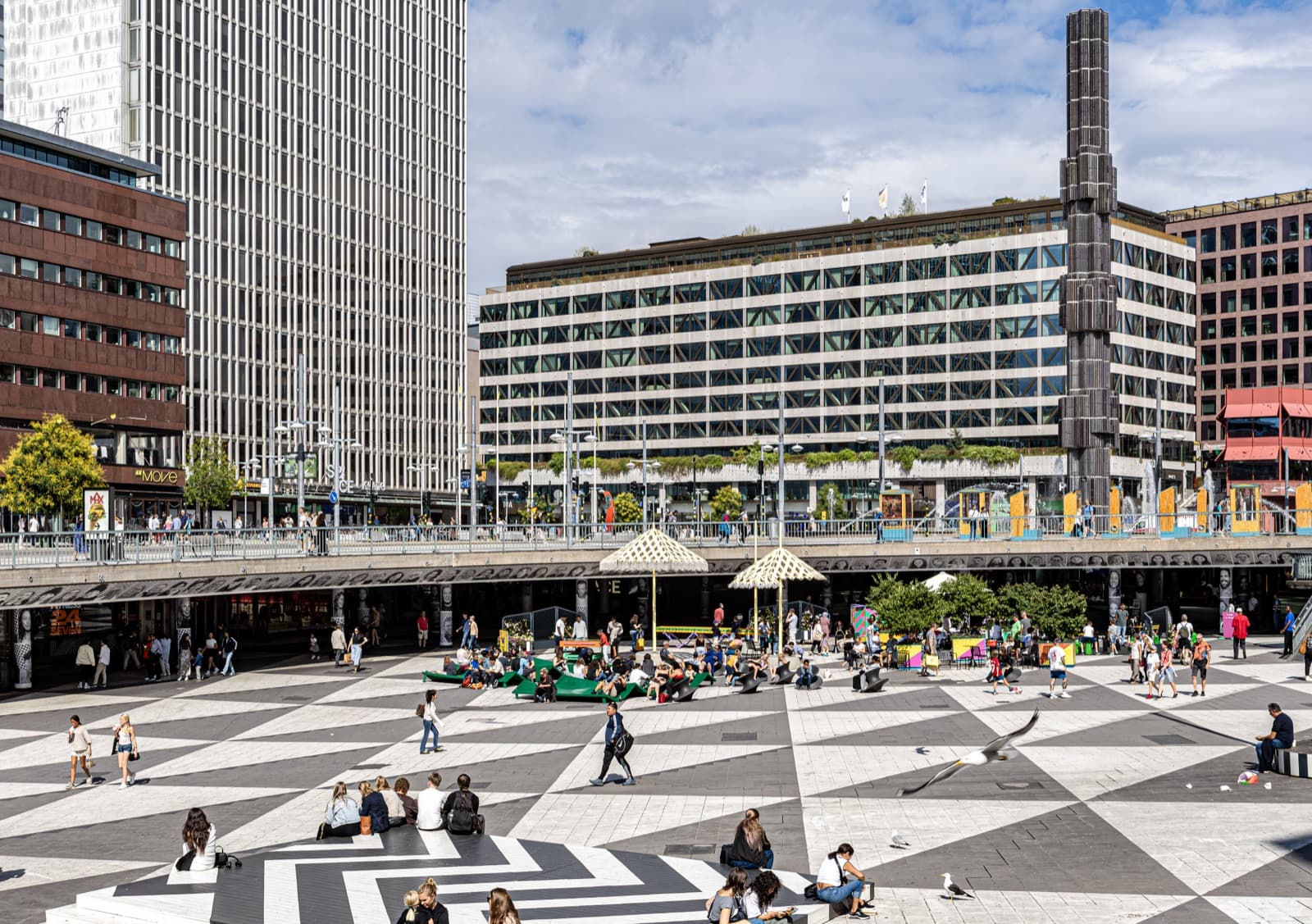
First impressions
Norrmalm is the part of Stockholm most visitors see first and most residents pass through every day. Step out of Central Station and you are in it: wide streets, department stores, office towers, and a tide of people moving between trains, trams and the metro. This is the city's engine room, not its quietest corner, and it wears that openly.
Norrmalm is Stockholm's City proper, built around Sergels torg, Hötorget and the long shopping street of Drottninggatan. Much of it was created in one dramatic sweep: through the 1950s and 60s the old Klara district was demolished and rebuilt in the Norrmalmsreglering, one of Europe's most drastic city-centre clearances, which gave Stockholm its five Hötorget high-rises and its modern downtown. Just to the north lies Vasastan, the handsome residential neighborhood that grew up alongside it and kept its early-1900s character; we cover Vasastan on its own page, so this one stays with the City.
Who lives here, and what the streets look like
Fewer people live in Norrmalm proper than you might expect: the Klara core is mostly offices, shops and cinemas, with relatively little housing. Those who do live in and around the centre skew older and affluent, among the highest-earning parts of the city, alongside younger professionals and students in newer housing. For a properly residential feel, with streets full of prams, dog-walkers and bakery queues, most people look just north to neighbouring Vasastan, which we cover as its own neighborhood.
By day the population multiplies. Sweden's two biggest commuter nodes, T-Centralen and Odenplan, are both here, and the Central Station area alone sees an estimated 200,000 people pass through daily. The streets are well kept and busy; the flip side is that the core can feel more like a place people visit than one they live in, and it is noticeably quieter and emptier late at night.
Getting around
This is the best-connected place in the country, full stop. Norrmalm holds T-Centralen, the only station where all three metro lines meet, right next to Stockholm Central for mainline and commuter trains, the Cityterminalen coach terminal, and the Arlanda Express to the airport. Odenplan, at the northern edge, is Sweden's second-largest commuter point and a stop on the Citybanan commuter rail. Trams and dense bus routes fill in the rest.
In practice, living here means you rarely plan a journey; you just leave. A car is close to pointless: parking is scarce and expensive, and the congestion charge applies to driving in and out of the centre at busy times. Cycling is easy on the flat central grid, and walking covers most of daily life, at least in Vasastan.
Typical weekday minutes from T-Centralen, with the icon showing how. Times via Google Routes API for a typical weekday ~08:00, measured from the neighborhood centre; the icon shows the fastest sensible way (walk, bike, transit or car), 2026-07.
Daily life
For shopping, this is the top of the city. Drottninggatan is the roughly one-kilometre pedestrian street running north from Sergels torg; Åhléns City is the flagship department store, with NK, the Gallerian mall, and the Hötorget market and its covered food halls all within a few blocks. Everyday retail, groceries, pharmacies and restaurants are exceptionally dense in the core and in Vasastan alike, so you can do a whole week on foot.
The trade-off is that Norrmalm proper is built for commerce more than for settling in. Vasastan is where the neighborhood delis, bakeries and independent shops sit, and where daily life feels most like a home rather than a high street.
Delivery apps that serve the area: Foodora, Wolt, Uber Eats. Coverage checked July 2026.
Local Places Worth Knowing
Independent or classic, close by, and chosen on merit. Nobody pays to appear here.
A beloved 1928 konditori on the corner of Kungsgatan, a warren of small rooms and one of the city's classic spots for a proper fika and Swedish pastries.
View on Google MapsA long-running French-style café on the Östermalm and Vasastan border, famous city-wide for its enormous cinnamon buns. The queue-out-the-door kind of local institution.
View on Google MapsA classic Swedish bistro by Odenplan, serving since 1929, with white tablecloths upstairs and a lively bar in the cellar.
View on Google MapsThe covered food hall under Hötorget, with a daily open-air produce and flower market on the square above. A good, unfussy spot for lunch and groceries.
Checked July 2026. Places close and change, so tell us if something here is out of date.
Schools and families
Norrmalm proper has few resident families; most of the neighborhood schooling sits just north in Vasastan. The central municipal year-9 schools post an average meritvärde of about 270 out of 340 (Utbildningsförvaltningen, 2024), above the city's municipal average, and the best-known school near the centre is Adolf Fredriks musikklasser, the city-wide music-profile school on Tegnérgatan. As always in Stockholm, you can apply outside your local area, but places at the popular schools fill early, so check before you sign a lease or purchase. The panel beside this article lists each school level.
Kids Restricted. Flat and pram-friendly, and being downtown the department stores, malls and food halls close by have changing tables and family toilets, with cafés welcoming children.
Pet Restricted. A busy commercial core with little green space nearby; dogs ride transit but the nearest parks are a walk away.
Green space, leisure and eating out
For a downtown, there is real green and real culture. Kungsträdgården, at Norrmalm's southern edge, is the city's most-used event park, with open-air concerts, a winter ice rink and cherry blossoms in spring. Observatorielunden and Vasaparken give Vasastan its everyday green, and Humlegården and Berzelii Park sit just over the edges. Culture is on the doorstep: Kulturhuset at Sergels torg, the Royal Opera, and a cluster of cinemas and theatres.
Eating and drinking is a strength across the district, from the food halls at Hötorget to the bistros and bars of Vasastan. Start with a fika at Vete-Katten, a wander down Drottninggatan, or dinner in the streets around Odenplan.
What it costs
Norrmalm is expensive, in the way central Stockholm is expensive. There is no published Norrmalm-only sale price, because the core holds so few owner-occupied flats, so the honest reference is the surrounding inner city: neighbouring Vasastan, the priciest district in the country, trades around 121 377 SEK / m² (about €11,000 / m²) (Svensk Mäklarstatistik, March 2026), and Norrmalm's residential stock sits in the same band. Groceries and everyday costs are city-standard; they do not care which side of Sergels torg you are on.
Renting cannot be reduced to a single number, because a rent-controlled first-hand contract and an open-market second-hand let differ by thousands of kronor for the same flat. A first-hand two-room in the inner city averages about 9,564 SEK a month; the Stockholm-wide second-hand average for the same flat is about 14,500 SEK. Set against a central mean income of roughly 54,200 SEK a month before tax, among the highest in the city, that gives a rough sense of the second-hand burden, though incomes here run well above the city as a whole. The chart below shows what the second-hand rent takes from a typical local income.
Monthly rent as a share of a typical local income (mean per earner, before tax). The same flat costs far more second-hand than on a first-hand contract. Prices and rents in figures are in the panel beside this article. Income: Stockholm stad, Områdesfakta Norra innerstaden stadsdelsområde (contains Norrmalm), 2024.
Weather and climate
Seasonal averages for Stockholm, one representative month per season. SMHI 1991-2020 normals (Stockholm) via Wikipedia climate box.
The honest downsides
The core is a workplace, not a home. Norrmalm proper is offices, shops and transit; it is busy and bright by day and can feel empty and hard-edged at night. If you want neighborhood life, look to Vasastan.
Sergels torg has an open drug scene. The Klara area is officially classed as an open drug scene, with dealing and use in public space. It is a persistent, if slowly improving, problem, and the single most-flagged issue in the district's own reporting.
It is loud and crowded. Constant footfall, traffic on the big streets, and night-time noise around the entertainment core. Ask which way a flat's windows face.
Pickpocketing spikes in summer. The crowds and transport nodes that make the area convenient also make it a target; petty theft rises with the tourist season.
You pay central-Stockholm prices. The same money buys considerably more space, and more quiet, a few stops out.
Crime and safety
Norrmalm is a safe district where the raw crime numbers look high, and both halves of that sentence are true. Because so many people pass through, the absolute counts of pickpocketing, fraud and drug offences are large, and the Klara and Sergels torg core is the single highest-crime spot in the district. Yet the official assessment is that central Stockholm here is overall a safe place with low actual victimisation, and that most offenders and victims are visitors rather than residents (Stockholms stad and Polisen, Lägesbild 2025). The clearest trend is a good one: reported robberies across the central district fell from 198 in 2020 to 74 in 2024. The everyday risk for a resident is petty theft in the crowds, not violence. As the city's main transport and shopping hub, Norrmalm also shows the most visible street life of these central districts, with panhandling around Sergels torg and the Central Station entrances, some street drinking and rough sleepers around the transport hubs, most of it concentrated in the Klara core rather than spread across the district. Once clean per-area reported-crime rates are settled, they will sit in the panel beside this article compared with the city average, with the fuller picture on the Stockholm safety page.
Is this you?
If you want to live on top of the city, step onto any train in minutes, and have Stockholm's best shopping and culture at the door, Norrmalm and Vasastan are hard to beat, and you will pay for the privilege. If you want quiet, space and a settled residential feel, Vasastan delivers more of it than the City core, and areas a few stops out deliver more still.
Want to know what homes here are actually worth?
Join the waitlistHow we source this
How we put this together. Gathered on the ground by our local field team and written up by the Apraiz research team. Every figure above carries its own source and date. The scores are not computed by the build; walking and transport will use open map and transit data first, then Apraiz's own model. We update prices quarterly, transport and amenities twice a year, and school data when the source publishes.
Sources: Svensk Mäklarstatistik, via Boio, Stockholm stad, Hyror i Stockholm 2025 / SCB, Qasa, Stockholm stad, Områdesfakta Norra innerstaden, Stockholms stad and Polisen, Lägesbild 2025.
Safety and crime in Stockholm →