
Long Story ShortReadHide
- What it is: a modern waterfront district on the north-west corner of Kungsholmen, built on an old industrial harbour and wrapped around a lakeside park.
- Who it suits: buyers who want new, bright and near the water, with a park promenade instead of a busy high street.
- What it costs: an inner-city waterfront premium, around 104,000 kr per m² to buy at the Kungsholmen level.
- What people complain about: it is new and a little uniform, and everyday life leans on one metro station.
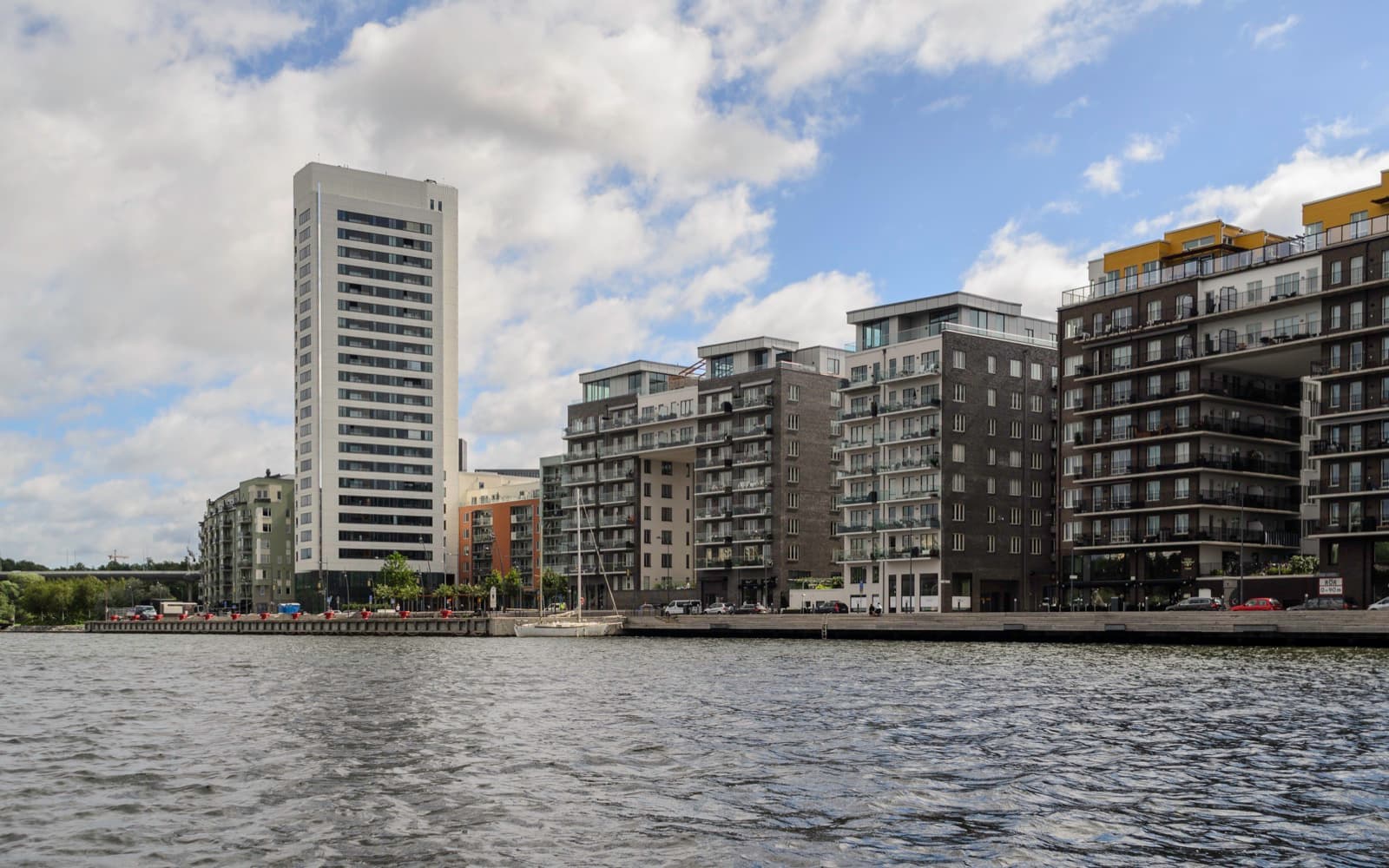
First impressions
Kristineberg is what Stockholm builds when it turns an old harbour into homes. It sits at the north-west end of Kungsholmen, a run of contemporary apartment blocks laid out along the lake Ulvsundasjou, with a wide boardwalk and a stepped waterfront park in front of them. The first thing you notice is the water and the light: long views west, open sky, and a promenade that carries on for the best part of a kilometre.
Behind the waterfront the streets are calm and recent, mostly 2000s and 2010s buildings with generous glass and clean lines rather than old-town character. At the heart of it, oddly, sits an 18th-century manor house, Kristinebergs slott, now a school, a reminder that this was a country estate long before it was a harbour or a district.
This is a prosperous, grown-up, water-facing part of the city, more residential than lively, and it is comfortable with that.
Who lives here, and what the streets look like
Kristineberg skews toward younger owner-occupiers and families who wanted something new and near the water rather than an old flat in the centre. Much of the stock is recent apartments, so the crowd is a little younger and more settled-professional than the older parts of Kungsholmen. It is a comfortable district: mean income among earners runs about 46,900 kr a month (Stockholm stad, Områdesfakta, 2024), above the city average, across a resident population of roughly 9,300.
The streetscape is orderly and modern. Ground floors are quieter than central Kungsholmen, with a scattering of cafes, a grocer and services rather than a dense high street, and the blocks open onto the promenade and the park. It is well kept, which is part of the appeal and part of the price.
Getting around
Kristineberg has its own metro station on the green line, an above-ground stop by Drottningholmsvägen a short ride from the centre, plus city buses along the main streets. It is genuinely walkable and cyclable, flat and green, with a continuous waterfront path, though it leans on that single green-line station and the nearest tram interchange is one stop west at Alvik.se.
Typical weekday minutes from Kristineberg, with the icon showing how. Times via Google Routes API for a typical weekday ~08:00, measured from the neighborhood centre; the icon shows the fastest sensible way (walk, bike, transit or car), 2026-08.
Daily life
Day to day, Kristineberg is calm. A handful of grocers and cafes cover the essentials, and for a fuller high street the shops of central Kungsholmen are a short ride or a long walk east. The real draw is the outdoors: the promenade, the swimming spots off the boardwalk and the run of parks are all part of ordinary life here.
For food delivery, Foodora, Wolt and Uber Eats all cover Kristineberg and the Hornsberg waterfront.
Local Places Worth Knowing
Independent and close by, chosen on merit. Nobody pays to appear here.
A waterfront park finished in 2010, with a stepped lawn, wooden lake stairs, playground and a long boardwalk along Ulvsundasjön that links on toward Rålambshovsparken.
A neighborhood café on the Hornsberg waterfront edge, run by the family behind Café Crema in Bromma, good for coffee and something baked by the lake.
A glass-walled restaurant on its own pier, with west-facing decks over the water and Swedish home cooking with a seafood lean; many pair a table with a swim.
A Lebanese kitchen on the Hornsbergs Strand waterfront strip next to Kristineberg, mezze and grills a short walk from the park.
Places close and change, so tell us if something here is out of date.
Schools and families
Kristineberg is a family neighborhood in the making, with new blocks and a primary school, Kristinebergsskolan, in the old manor at its centre. That school runs to grade 6, so for the year-9 years the area feeds into Kungsholmens grundskola, whose leaving grades average a meritvärde of 284.8 out of 340 (Skolverket via Skolkoll, 2024/25), comfortably above the city norm. Sweden lets you apply outside your local area, but places at popular schools fill early, so it is worth checking before you sign a lease or purchase. That year-9 result is the one cleanly sourced level; the others have no area-specific figure and are left open in the panel beside this article rather than guessed.
Kids Friendly. Flat and pram-friendly along the waterfront, most cafés welcome children, and the bigger cafés and stores nearby have changing tables and family toilets.
Pet Friendly. The lakeside promenade and connected parks make for easy waterfront walking, and there is a fenced dog run at Kristinebergs slottsväg.
Green space, leisure and eating out
This is Kristineberg's strong suit. Kristinebergs strandpark and the neighbouring Hornsberg waterfront give a long lakeside boardwalk with piers, swimming ladders, lawns and playgrounds, and the park chain links on toward Fredhall and Ralambshovsparken. Eating and drinking lean toward the water and the daytime, pier restaurants and neighborhood cafes rather than late nights, with the livelier tables a short trip into central Kungsholmen.
What it costs
Kristineberg is an expensive place to buy, a premium for new, bright and on the water. It is not broken out separately in the price statistics, so the sourced figure is the Kungsholmen level: around 103,900 kr per m² (Svensk Mäklarstatistik via Boio, March 2026), the lowest inner-city average but rising, with the very best waterfront addresses carrying a further premium. A first-hand rented two-room in the inner city runs about 9,564 kr a month (Hyror i Stockholm 2025). As across the inner city, most flats are cooperative (bostadsratt), so a monthly association fee (avgift) sits on top of the price and is easy to overlook when comparing listings, and in a district this new the fees are worth reading closely.
Monthly rent as a share of a typical local income (mean per earner, before tax). The same flat costs far more second-hand than on a first-hand contract. Prices and rents in figures are in the panel beside this article. Income: Stockholm stad, Områdesfakta (Kristineberg stadsdel), 2024.
Weather and climate
Seasonal averages for Stockholm, one representative month per season. SMHI 1991-2020 normals (Stockholm) via Wikipedia climate box.
The honest downsides
It is new, and it feels it. Much of Kristineberg is 2000s and 2010s blocks, so if you want old-town character and a dense, layered street life you will feel the newness.
Life leans on one station. The waterfront is lovely, but everyday transit rests on a single green-line stop, with the nearest tram and richer interchange one stop west at Alvik.
Crime and safety
Kristineberg feels like a calm, safe corner of a safe city, and as across central Stockholm the everyday risk is theft rather than violence, the opportunistic kind that follows people and crowds. Kungsholmen consistently rates as Stockholm's safest district: in the police 2024 safety survey only about 11 percent of residents felt unsafe out after dark, the lowest of any district in the city (Polismyndigheten, 2024). In a quiet waterfront residential area like this, visible rough sleeping and people begging are rare, seen more around the busier stations and shopping streets of central Kungsholmen than along the promenade. A standalone per-area crime rate for Kristineberg is not published, with the fuller picture on the Stockholm safety page.
Is this you?
If you want new, bright and near the water, with a park promenade at your door and a short ride to the centre, Kristineberg is worth the premium. If you want an old flat, a dense high street and late nights on your doorstep, central Kungsholmen or the islands across the water will suit you better.
Want to know what homes here are actually worth?
Join the waitlistHow we source this
How we put this together. Gathered on the ground by our local field team and written up by the Apraiz research team. Every figure above carries its own source and date. The scores are not computed by the build; walking and transport will use open map and transit data first, then Apraiz's own model. We update prices quarterly, transport and amenities twice a year, and school data when the source publishes.
Sources: Svensk Mäklarstatistik (via Boio), Stockholm stad, Hyror i Stockholm 2025 / SCB, Stockholm stad, Områdesfakta, Skolverket, via Skolkoll, Mitt i, Brå (National Council for Crime Prevention).
Safety and crime in Stockholm →