
Long Story ShortReadHide
- What it is: the medieval island where Stockholm began, ochre-and-rust merchant houses, cobbled lanes and water at the end of every street. It is a postcard, and about 3,000 people actually live inside it.
- Who it suits: heritage and character lovers who want the best transit in the city at the bottom of the alley, and who will trade the weekly-shop convenience of an ordinary neighborhood to get it. It is not a families-and-schools district.
- What it costs: central-Stockholm prices, but the per-area sale data is genuinely thin. Central Stockholm runs about 119 380 SEK / m² (about €11,000 / m²) (Svensk Mäklarstatistik, March 2026), and Gamla Stan trades around or above that on very few sales, so we do not print a firm Gamla Stan figure.
- What people complain about: no proper supermarket on the island, cobbles and stairs with few lifts, and tourist crowds year-round.
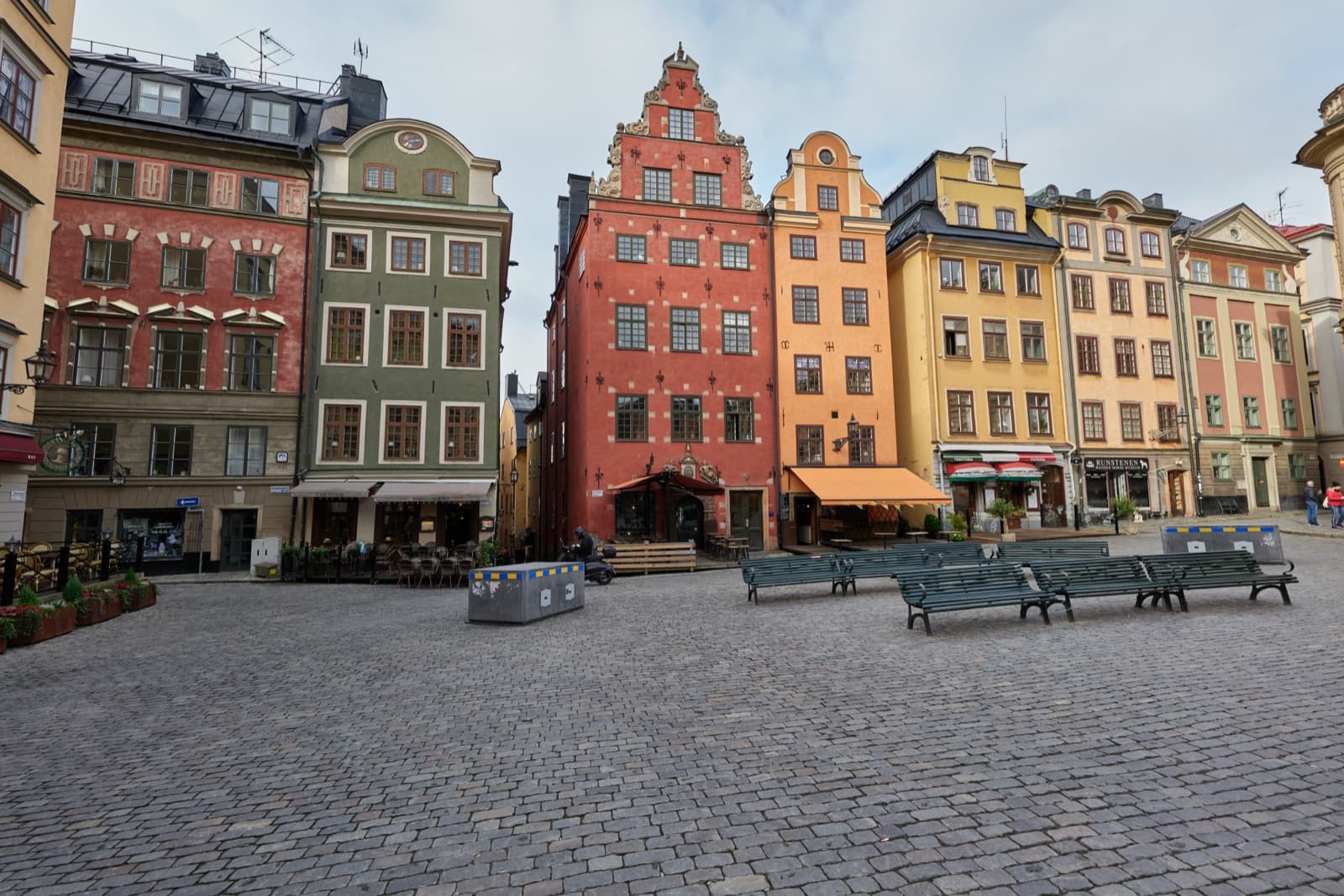
First impressions
Gamla Stan is the image on the postcard: ochre-and-rust merchant houses ringing Stortorget, cobbled lanes that bend out of sight, church spires overhead, and water at the end of nearly every street. It is where Stockholm began in the 13th century, and the medieval street plan is still intact. You do not so much move here as move inside a 700-year-old monument.
The first thing you feel underfoot is the surface. These are cobbles (kullersten), uneven and worn, and several of the lanes step up in stairs rather than ramps. The buildings are largely 17th and 18th century and listed, which is exactly why they are beautiful and exactly why lifts are rare. It is stunning, and it asks something of your legs and your patience every single day.
The second thing you notice is the crowds. The main lanes, Västerlånggatan and Österlånggatan, are the busiest tourist arteries in the city, and the footfall is heavy year-round, not just in summer. That is the trade at the heart of living here: you get the most photographed streets in Stockholm, and you share them.
Who lives here, and what the streets look like
Very few people, by city standards. Roughly 3,000 residents share the island (Wikipedia), which makes this one of the smallest resident communities in central Stockholm. It is self-selecting. People move here for the history and the water and accept the constraints that come with a medieval island, so the neighbours tend to be a settled mix rather than a churn of newcomers.
It is not a family-and-schools neighborhood, and the streets show it. Ground-floor life is built for visitors, not neighbours: souvenir shops, Dala-horse outlets, cafés and restaurants line the main lanes, and genuinely useful resident shops are thin on the ground. Step off the busy streets, onto the quieter eastern side around Prästgatan, and the crowds fall away and you get a sense of what the island is like when the day-trippers have gone home.
Getting around
This is the one unambiguous win, and it is a big one. Gamla Stan station sits on the shared central trunk of both the red and green metro lines, so departures are constant. It is one stop north to T-Centralen and one stop south to Slussen, the gateway to Södermalm, which means the whole city is minutes from your door. Above ground you walk everywhere, because the core lanes are largely car-free.
For the airport, ride one stop to T-Centralen and change to the Arlanda Express; door to door is roughly three quarters of an hour. You do not need a car here, and frankly a car is a liability: the pedestrian zones and narrow lanes make driving and parking awkward at best.
Typical weekday minutes from Gamla Stan, with the icon showing how. Times via Google Routes API for a typical weekday ~08:00, measured from the neighborhood centre; the icon shows the fastest sensible way (walk, bike, transit or car), 2026-07.
Daily life
Here is the honest catch. "You can walk everywhere" is true, but almost everywhere you can walk is tourist retail, not the shops that run a household. There is effectively no full supermarket on the island. Residents make do with a couple of small shops near the western edge, around Munkbron and Järntorget, and for a proper weekly shop they cross the water north to the Coop on the lower level of Stockholm Central Station or the Hemköp under Åhléns City, both about ten to fifteen minutes on foot. (Exact store names and hours are worth checking on the chains' own locators before you rely on them.)
Add the terrain to that. The buildings are listed 17th-century stock with few lifts, and the streets are cobbles and stairs, Mårten Trotzigs gränd being the extreme case at 90 cm wide with 36 steps. Prams, heavy bags and anyone with reduced mobility feel all of it. A quick errand is genuinely a small expedition, and that is the part of Gamla Stan that a weekend visit never shows you.
Delivery apps that serve the area: Foodora, Wolt. Deliveries into the island tend to run slower than the city average, roughly 35 to 50 minutes, because the pedestrian zones limit vehicle access. Coverage checked July 2026.
Local Places Worth Knowing
Independent, close by, and chosen on merit. Nobody pays to appear here.
A long-running independent café right on Stortorget, among the coloured merchant houses. A local living room, and historically one of the city's first openly LGBT-friendly cafés.
View on Google MapsSweden's most storied restaurant, on Österlånggatan since 1722 and owned by the Swedish Academy, serving classic husmanskost in vaulted 18th-century rooms.
The old town's long main street, a medieval lane of shopfronts and cafés running the length of the island, busy but unmistakably Gamla Stan.
On Järntorget, said to be Stockholm's oldest café, open since 1785, an old-world room of samovars and chandeliers.
View on Google MapsChecked July 2026. Places close and change, so tell us if something here is out of date.
Schools and families
Be clear-eyed about this one: Gamla Stan is not a neighborhood you move to for schools. There is one grundskola on the island, Storkyrkoskolan on Svartmangatan, and it stops at grade 6, with around 130 pupils (Skolkoll, 2024/25). That means there is no year-9 school on the island at all, so we do not publish a schools score here. The metric would be invented, and inventing it is exactly what this section refuses to do.
Older children commute out. Gamla Stan is administratively part of the wider Södermalm district, so the nearest same-district year-9 reference is Södermalmsskolan (meritvärde 265.6, läsår 2024/25, Skolverket via Skolkoll), but that school is off the island, so it is a pointer, not a local score. Sweden lets you apply outside your catchment, and popular places fill early, so confirm the exact route before you sign a lease or purchase.
Kids Restricted. The cobbles, stairs and few lifts make a pram hard work, though cafés welcome children and the bigger venues nearby have changing tables and family toilets.
Pet Restricted. Charming but dense and cobbled with little green space, so it suits a short-walk pet more than a big dog.
Green space, leisure and eating out
For a place with almost no parks of its own, Gamla Stan is saved by water. It is an island, framed by Lake Mälaren and the Saltsjön, with quays and bridges on every side, so an evening walk along the water is always at hand, and the neighbouring islets of Riddarholmen and Helgeandsholmen add quiet corners. Stortorget, the oldest square in the city, is ringed by the famous coloured houses and anchored by the Nobel Prize Museum, with Storkyrkan cathedral and the Royal Palace a few steps away.
Eating and drinking out is a real strength, if a touristy one. The main lanes are wall-to-wall cafés and restaurants, the cellar bars are atmospheric, and the fika institutions on Stortorget, Chokladkoppen and Grillska Huset, are as good a reason as any to live above the crowds. The flip side is noise: evening bar and restaurant footfall on the busy lanes is part of the deal.
What it costs
Gamla Stan is expensive, but the honest answer is that the per-area sale data is too thin to pin down. Svensk Mäklarstatistik has no standalone Gamla Stan page because the island simply does not sell enough apartments, and property portals showed only a handful of final sale prices in the trailing months. Central Stockholm as a whole runs about 119 380 SEK / m² (about €11,000 / m²) (Svensk Mäklarstatistik, March 2026), and the little Gamla Stan data there is sits around or above that, on too few sales to quote a firm figure. So we do not.
Renting cannot be reduced to a single figure either, and for Gamla Stan the clean per-area numbers are not published. A rent-controlled first-hand contract and an open-market second-hand let differ by thousands of kronor for the same flat, and only a Stockholm-wide second-hand average is available (around 15,000 SEK a month for a two-room). The gap between the two, not any headline, is the number worth working out for your own situation once a person has pulled the local figures.
One local detail worth knowing: most apartments here are cooperative (bostadsrätt) rather than directly owned, so on top of the price you pay a monthly fee to the housing association (the avgift). In old, listed buildings the upkeep behind that fee can be significant, and it is easy to forget when comparing listings.
Monthly rent as a share of a typical local income (mean per earner, before tax). The same flat costs far more second-hand than on a first-hand contract. Prices and rents in figures are in the panel beside this article. Income: Stockholm stad, Områdesfakta Storkyrkan (the delområde covering Gamla Stan); mean income among earners 16+, 526,600 kr/yr ÷ 12, 2024.
Weather and climate
Seasonal averages for Stockholm, one representative month per season. SMHI 1991-2020 normals (Stockholm) via Wikipedia climate box.
The honest downsides
No weekly shop. There is no full supermarket on the island. Every proper grocery run means crossing the water to Central Station or Åhléns, ten to fifteen minutes each way. This is the single biggest daily-life cost of living here.
Cobbles, stairs and few lifts. The streets are medieval and the buildings are listed, so ramps and lifts are the exception. Charming on a spring evening, punishing with shopping bags, a pram or a bad knee.
Tourists, year-round. Ground-floor life is built for visitors, footfall on the main lanes is heavy in every season, and evening noise on the busy streets comes with it.
Thin local life. Compared with Södermalm or Vasastan, the everyday texture of a lived-in neighborhood, the useful shops, the ordinary services, is genuinely sparse.
It is not for families chasing schools. No year-9 school on the island means older children commute out from the start.
Crime and safety
The reassuring part first: by perception this is a safe place. Gamla Stan sits inside the Södermalm district, where the city's own Medborgarundersökning 2026 found 75% of residents feel safe walking alone at night and 89% think the district is a safe place to live, against 69% and 83% for Stockholm as a whole. Both rose over the year before, from 69% and 88%.
The real local risk is not violence, it is your pockets. Pickpocketing is the everyday problem in Gamla Stan, concentrated exactly where the crowds are: Stortorget, the packed main lanes, and the metro at Gamla Stan and adjacent T-Centralen. Police specifically flag the narrow, busy lanes here. It is the classic tourist-district pattern, and the one practical habit is to keep bags closed and zipped in the crush. Being a tourist-heavy island, you will also see some visible street life around Stortorget and the main lanes, a few people asking for money outside the cafés and the occasional rough sleeper near the metro entrances, mostly low-level and part of any busy tourist quarter. Per-area reported-crime counts for Gamla Stan are still to be pulled from Brå; once they are, they will sit in the panel beside this article compared with the city average, with the fuller picture on the Stockholm safety page.
Is this you?
If you want to wake up inside the most beautiful few streets in Stockholm, with the best transit in the city at the bottom of your alley, and you will happily trade a supermarket and a quiet stairwell to get it, Gamla Stan is unlike anywhere else you can live. If you want a weekly shop on foot, a lift, and an ordinary neighborhood that is not also a tourist attraction, you will be happier one stop away in Södermalm, and you can still be standing on Stortorget in five minutes.
Want to know what homes here are actually worth?
Join the waitlistHow we source this
How we put this together. Gathered on the ground by our local field team and written up by the Apraiz research team. Every figure above carries its own source and date. The scores are not computed by the build; walking and transport will use open map and transit data first, then Apraiz's own model. We update prices quarterly, transport and amenities twice a year, and school data when the source publishes.
Sources: Svensk Mäklarstatistik, Stockholm stad, Hyror i Stockholm 2025 / SCB, Qasa, Stockholm stad, Områdesfakta Storkyrkan, Skolverket, via Skolkoll, Stockholm stad, Medborgarundersökning 2026, Wikipedia (Gamla stan), Stockholm City Museum, Stockholm stad, Områdesfakta, Brå (National Council for Crime Prevention).
Safety and crime in Stockholm →