
Long Story ShortReadHide
- What it is: a royal park island of museums, gardens and water just east of the centre, part of the world's first National City Park, with almost no one living on it.
- Who it suits: the rare buyer who lands one of its scarce, historic homes and wants to live inside a park rather than a neighborhood.
- What it costs: a rarefied, tightly limited market, sitting at the top of the inner-city range alongside the Östermalm streets across the bridge.
- What people complain about: summer crowds, next to no shops or services, and a housing stock that barely exists.
First impressions
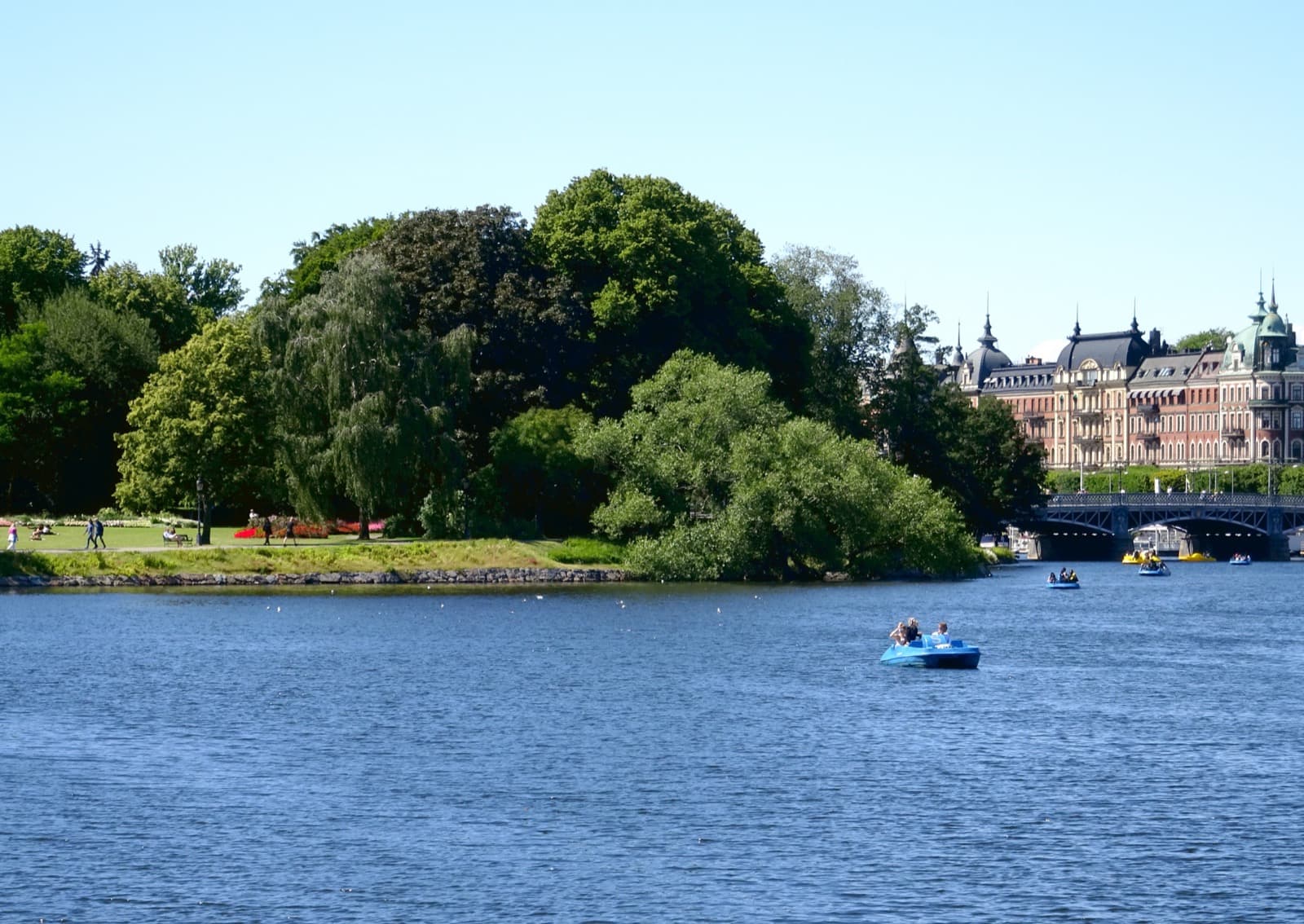
Djurgården is less a neighborhood than a park you can, just about, live in. The island sits a short ferry or tram ride east of the centre, and it is given over almost entirely to greenery, water and museums: Skansen, the Vasa Museum, Nordiska museet and the Gröna Lund funfair among them, with oak woods, canals and shorelines in between. It is Crown land, protected as part of the National City Park, and it has the calm, curated feel of somewhere that is looked after rather than lived in.
Homes are the exception here, not the rule. They cluster in a few pockets, most of all the old shipyard quarter of Djurgårdsstaden with its 17th-century seafarers' cottages, plus a scattering of villas. Everything is historic, scarce and tightly regulated.
This is one of the most beautiful addresses in Stockholm and one of the least ordinary, and it knows it.
Who lives here, and what the streets look like
Djurgården has one of the smallest resident communities of anywhere in central Stockholm: a few hundred people on an island that millions visit. Those who do live here occupy historic, protected homes on Crown-administered land, so the community is small, settled and exclusive. With so few residents, and with the island folded into the wider Norra innerstaden district for statistics since 2023, no Djurgården-specific income figure is published, so we leave one out here rather than borrow a wider number.
The streetscape is parkland and heritage: cobbled lanes in Djurgårdsstaden, museum buildings and palaces along the water, and paths rather than high streets. Day-to-day retail is built for visitors, not residents, so the everyday texture is greenery and grand institutions rather than corner shops.
Getting around
Djurgården is reached by the Djurgårdsfärjan ferry (line 82) from Slussen, docking at Allmänna gränd, and by the Spårväg City tram (line 7) that runs from Norrmalmstorg over Djurgårdsbron, with bus line 67 alongside. On the island itself, private cars are restricted, especially in summer, which is part of why it stays so quiet and walkable; getting around here means the ferry, the tram, your feet or a bike.se.
Typical weekday minutes from Allmänna gränd, with the icon showing how. Times via Google Routes API for a typical weekday ~08:00, measured from the neighborhood centre; the icon shows the fastest sensible way (walk, bike, transit or car), 2026-08.
Daily life
Day to day, Djurgården asks you to look outward. There are next to no everyday shops on the island, so a normal grocery run means the ferry or tram across to Östermalm and the centre. What the island gives back is the setting: a walk to work or to the shop can run through oak woods, past a palace or along the canal, and the cafes and restaurants, where they exist, are destinations in their own right.
For food delivery, Foodora, which advertises the widest Stockholm coverage, is the most likely to reach a Djurgården address, but with few restaurants on the island most orders come from the mainland, so coverage is thinner and slower here than in the central districts; check your address in the app.
Local Places Worth Knowing
Independent and close by, chosen on merit. Nobody pays to appear here.
A Karl Johan era summer palace built in the 1820s for King Karl XIV Johan, preserved largely intact and open for guided tours in summer.
A classic Swedish inn serving husmanskost in a building from the 1897 World's Fair, named for Bellman's muse, known for herring, roe and a garden veranda.
A classic restaurant in an 1874 villa that has been an inn since 1897, set in leafy grounds and known for husmanskost and its plank steak.
A large waterfront cafe by Djurgårdsbron with one of the city's biggest summer terraces, doubling as the visitor centre and a kayak and boat rental, open year round.
Places close and change, so tell us if something here is out of date.
Schools and families
Djurgården is not a schools district in any normal sense: the resident population is tiny and there is no local school on the island, so families here plan around the schools of Östermalm and the centre across the water. Sweden lets you apply outside your local area, but places at popular schools fill early, so it is worth checking before you sign a lease or purchase. There is no Djurgården-specific school metric to publish.
Kids Restricted. Flat, pram-friendly parkland paths, but everyday facilities are thin, so cafés welcome children while changing tables and family toilets mostly mean the larger museum cafés.
Pet Restricted. A wonderful place to walk a dog on a lead, but not off it: leashing is required across the National City Park, with a strict rule from 1 March to 20 August because wildlife covers the island, and dogs are barred inside Skansen.
Green space, leisure and eating out
Here the green space is not nearby, it is the whole neighborhood. As part of the Royal National City Park, Djurgården is oak woodland, meadows, canals and waterfront paths from end to end, with Rosendal's gardens, the museum grounds and the shoreline all part of ordinary life. Leisure is world-class and on your doorstep, from Skansen and the Vasa Museum to the Gröna Lund funfair, and eating out means a handful of historic inns and garden cafes rather than a restaurant strip.
What it costs
Djurgården is a rarefied market. Homes are few, historic and tightly regulated, and most of the island is Crown land, so what little comes up trades on scarcity as much as on square metres. It belongs to the Östermalm side of the city, where the March 2026 average was 125,362 kr per square metre, the highest price district in Sweden. Rents follow the inner-city scale rather than an island one, because first-hand rent in Sweden is negotiated at that grain. If you are looking seriously, expect a small pool of listings, heritage constraints on what you can change, and the running costs that old, protected buildings carry.
Weather and climate
Seasonal averages for Stockholm, one representative month per season. SMHI 1991-2020 normals (Stockholm) via Wikipedia climate box.
The honest downsides
Summer belongs to the visitors. Millions come each year, and in the warm months the island is busy and the paths are full, which is the price of living somewhere this famous.
It is built for visitors, not errands. With almost no shops or services, normal daily life means leaving the island, and the housing stock is so small and so regulated that simply finding a home here is the hardest part.
Crime and safety
Djurgården is, for residents, one of the calmer corners of the city, and Stockholm stad names it among the areas that add to the wider district's sense of safety. As a major visitor destination, though, the everyday risk is theft, pickpocketing in the summer crowds around the museums and the funfair, rather than violence. Those same visitor crowds draw the occasional person asking for money around the museums and the ferry and tram stops, while on the quiet residential lanes of the island visible rough sleeping is rare. No per-area crime rate is published for the island, with the fuller picture on the Stockholm safety page.
Is this you?
If one of Djurgården's scarce homes ever comes your way and you want to live inside a park, among museums and oak woods and water, with the city a ferry ride away, there is nowhere else like it. If you want shops on the corner, a lively high street and an ordinary week that does not start with a boat, almost anywhere else in these guides will suit you better.
Want to know what homes here are actually worth?
Join the waitlistHow we source this
How we put this together. Gathered on the ground by our local field team and written up by the Apraiz research team. Every figure above carries its own source and date. The scores are not computed by the build; walking and transport will use open map and transit data first, then Apraiz's own model. We update prices quarterly, transport and amenities twice a year, and school data when the source publishes.
Sources: Stockholm stad, Kungliga Djurgårdens Förvaltning, Boio / Svensk Mäklarstatistik, Stockholm stad, Hyror i Stockholm 2025 / SCB, Brå (National Council for Crime Prevention).
Safety and crime in Stockholm →