
Long Story ShortReadHide
- What it is: a leafy, affluent garden-city villa district in Bromma, one of Stockholm's early-1900s planned suburbs, on a bay of Lake Mälaren.
- Who it suits: families and settled buyers who want a house, a garden and quiet, and do not need a high street or nightlife on the doorstep.
- What it costs: large detached villas at a premium, typically 11 to 18 million kr, and among the highest incomes in the city.
- What people complain about: it is quiet and car-oriented, with few shops nearby, and the houses are expensive.
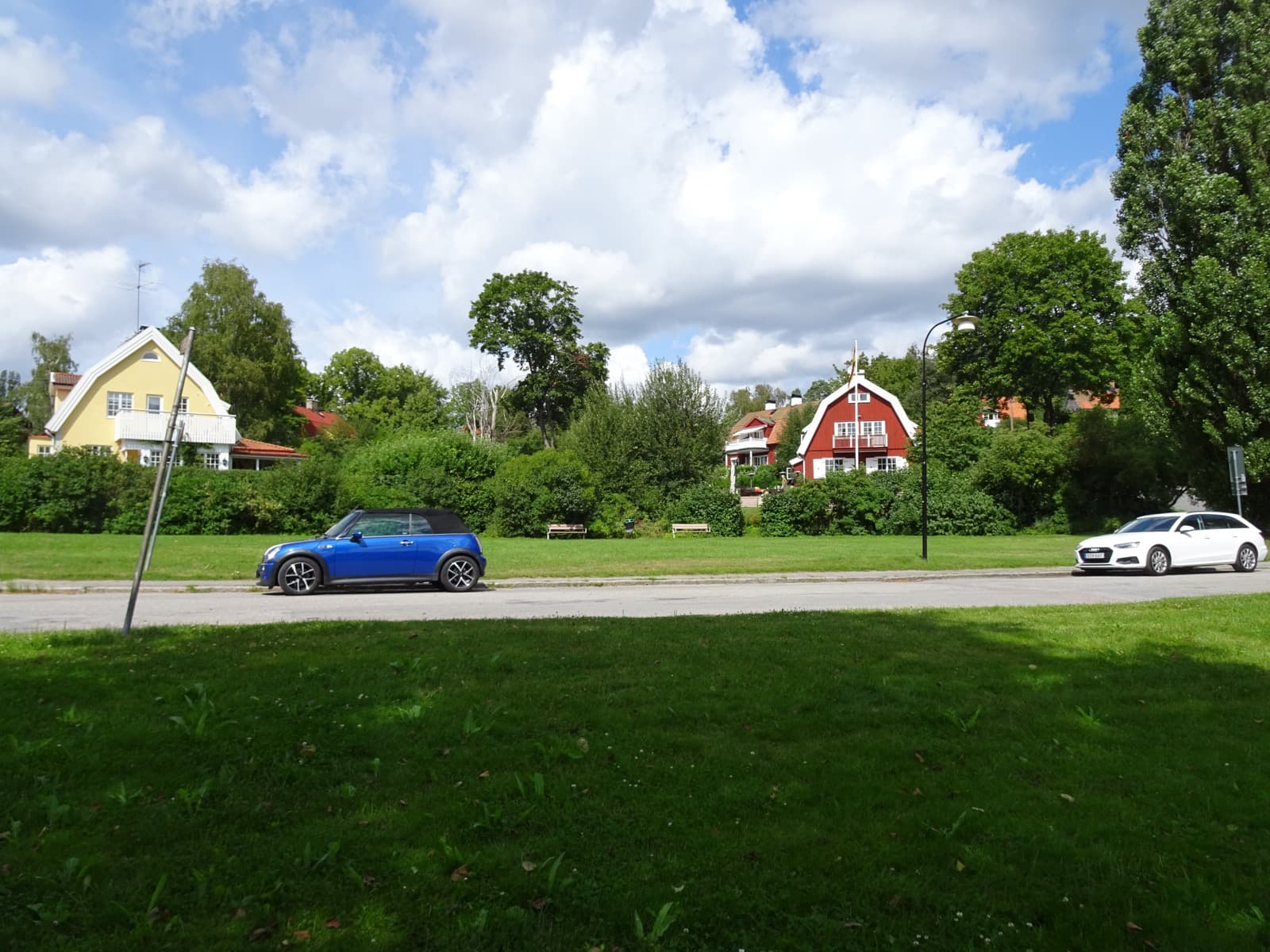
First impressions
Äppelviken is what Stockholm looks like when it stops being a city and becomes a garden. It sits in eastern Bromma, west of the centre, a district of detached villas in mature gardens laid out along tree-lined streets that run gently down toward a bay of Lake Mälaren. It was one of the city's first planned garden suburbs, built out mostly in the 1910s and early 1920s, and it still reads that way: consistent, well-preserved, and green.
The houses are the point. Painted timber and render in the old vernacular styles, Falun red, pale yellow panels and tarred brown, set behind hedges and fruit trees, with the old Nockebybanan tram, one of the oldest still running in the region, threading quietly through on its way to Nockeby.
This is a prosperous, grown-up, distinctly residential corner of the city, and it has been for a hundred years.
Who lives here, and what the streets look like
Äppelviken skews toward established families and long-settled residents, the kind of household that buys a villa and stays for decades. It is one of Stockholm's sought-after villa areas, and among its wealthiest: mean income among earners runs about 70,200 kr a month (Stockholm stad, Områdesfakta, 2024), well above the city average. The crowd is comfortable and rooted rather than young or transient.
The streetscape is leafy and calm: low-traffic streets, planted gardens, and a small cluster of shops and cafes around the tram stops and along Ålstensgatan rather than a proper high street. It is quiet, green and well kept, which is exactly the appeal and much of the price.
Getting around
The Nockebybanan tram (line 12) is the spine of the district, with its own Äppelviken stop, running east to Alvik where it meets the metro's green line and the Tvärbanan. Buses fill in around it, and the villa streets are pleasant to walk and cycle, though for a bigger shop or the city centre you are on the tram or, for many households here, in the car.se.
Typical weekday minutes from Äppelviken, with the icon showing how. Times via Google Routes API for a typical weekday ~08:00, measured from the neighborhood centre; the icon shows the fastest sensible way (walk, bike, transit or car), 2026-08.
Daily life
Day to day, Äppelviken is quiet and residential. A handful of bakeries, cafes and small shops around Ålstensgatan and Västerled cover the essentials, and for anything larger you head to Alvik or into town. The real texture of life here is the outdoors: private gardens, the Mälaren shoreline and its bathing spots, and the woods of the Judarskogen reserve a short way west.
For food delivery, Foodora and Uber Eats reach Äppelviken; Wolt's coverage this far out into Bromma is patchier, so check your address in the app.
Local Places Worth Knowing
Independent and close by, chosen on merit. Nobody pays to appear here.
A traditional bakery and konditori by the first Nockebybanan stop, baking bread, kanelbullar and semlor for the neighborhood for close to a century.
A branch of the well-known craft bakery on Ålstensgatan's small high street, for sourdough and fika pastries a short ride down the tram line.
The main sit-down and takeaway table on Ålstensgatan, a well-reviewed local pizzeria that also delivers.
A protected woodland and Natura 2000 site around Lake Judarn just west of the district, with a couple of kilometres of lakeside trails and Ängbybadet beach beyond.
Places close and change, so tell us if something here is out of date.
Schools and families
Äppelviken is a family district through and through, the kind of place people move to for the space and the schools and then stay. Its year-9 school, Äppelviksskolan, is one of the strongest in the city, with leaving grades averaging a meritvärde of 289.2 out of 340 (Skolverket via Skolkoll, 2024/25), well above the municipal and national norms. Sweden lets you apply outside your local area, but places at popular schools fill early, so it is worth checking before you sign a lease or purchase. That year-9 result is the one cleanly sourced level; the others have no separate published figure for the area, so the panel beside this article leaves them open rather than borrowing a wider one.
Kids Friendly. Flat, quiet villa streets are easy with a pram, most cafés welcome children, and the bigger cafés and stores nearby have changing tables and family toilets.
Pet Friendly. Private gardens, quiet low-traffic villa streets, the Mälaren shoreline and the Judarskogen nature reserve nearby make daily dog-walking easy; check seasonal leash and swimming rules at the reserve and beaches.
Green space, leisure and eating out
Green space is everywhere here, starting with the gardens themselves. The district runs down to the Mälaren shore, with bathing at Solviksbadet and Ängbybadet, and the Judarskogen nature reserve, a protected woodland around Lake Judarn with lakeside trails, sits just to the west. Eating and drinking are low-key and daytime, neighborhood bakeries and cafes around the tram stops rather than restaurants and late nights, which are a tram ride away in town.
What it costs
Äppelviken is an expensive place to buy, and what you are buying is mostly a detached villa with a garden, a different market from the inner-city flats elsewhere in these guides. In the Bromma-Västerled villa market, prices run about 85,000 to 110,000 kr per m², with Äppelviken among the areas at the top, over 100,000, and a typical villa changing hands somewhere between 11 and 18 million kr (Svensk Mäklarstatistik via Boio, March 2026). Budget for the running costs of a house, not just the purchase, and for a car if you want one, since much of daily life here assumes one.
Monthly rent as a share of a typical local income (mean per earner, before tax). The same flat costs far more second-hand than on a first-hand contract. Prices and rents in figures are in the panel beside this article. Income: Stockholm stad, Områdesfakta (Äppelviken stadsdel), 2024.
Weather and climate
Seasonal averages for Stockholm, one representative month per season. SMHI 1991-2020 normals (Stockholm) via Wikipedia climate box.
The honest downsides
It is quiet, and a little remote. The calm is the draw, but Äppelviken is residential to its core, so nightlife, big shops and buzz are all somewhere else.
It leans on the car. The tram is charming and useful, but for larger errands and many trips, households here tend to drive, and the area is planned around that.
Crime and safety
Äppelviken is a calm, safe villa district in a safe city, and the everyday risk here is property crime, break-ins and bike or car theft, rather than violence, the kind that follows quiet, well-off suburbs anywhere. In the city's safety survey, Bromma residents report higher perceived safety and lower victimisation than the Stockholm average (Stockholm stad, Trygghetsmätningen). In a calm, green villa area like this, visible rough sleeping and people asking for money are rare, seen mainly around the busier shopping and transport hubs of Alvik and the city rather than on these quiet streets. A standalone per-area crime rate for Äppelviken is not published, with the fuller picture on the Stockholm safety page.
Is this you?
If you want a house and a garden, quiet leafy streets and a shoreline and woods on your doorstep, and you do not mind a tram or a car for the rest, Äppelviken is one of the loveliest places in Stockholm to settle. If you want a flat in the thick of things, a high street and late nights nearby, the inner-city districts will suit you far better.
Want to know what homes here are actually worth?
Join the waitlistHow we source this
How we put this together. Gathered on the ground by our local field team and written up by the Apraiz research team. Every figure above carries its own source and date. The scores are not computed by the build; walking and transport will use open map and transit data first, then Apraiz's own model. We update prices quarterly, transport and amenities twice a year, and school data when the source publishes.
Sources: Svensk Mäklarstatistik (via Boio), Stockholm stad, Hyror i Stockholm 2025 / SCB, Stockholm stad, Områdesfakta, Skolverket, via Skolkoll, Stockholm stad, Trygghetsmätningen, Brå (National Council for Crime Prevention).
Safety and crime in Stockholm →