
Long Story ShortReadHide
- What it is: an old harbour-and-shipyard district turned bohemian, with the city's largest run of wooden landshövdingehus and a strong café and second-hand scene.
- Who it suits: people who want character, independents and Slottsskogen on the doorstep, and do not need a central address.
- What it costs: a little above the city average, around 55,000 to 68,000 kr per m² and rising.
- What people complain about: it is inner-west rather than central, and gentrification is pushing prices up.
First impressions
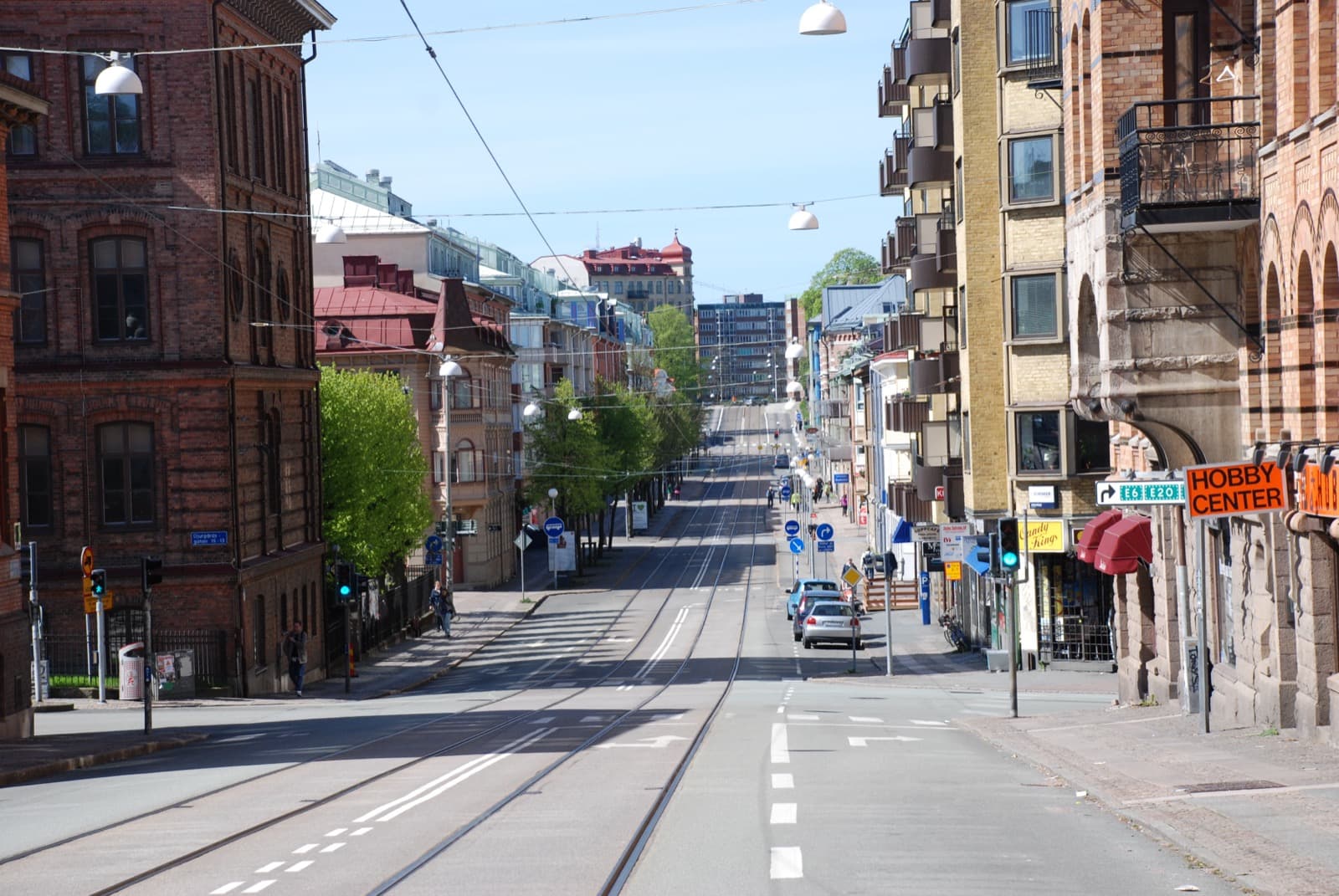
Majorna is Göteborg with its sleeves rolled up. Once a district of dockers and shipyard workers on the western approach to the harbour, it kept its streets of wooden landshövdingehus and turned, over a generation, into one of the city's most characterful neighborhoods: bohemian, independent, and proudly left of centre. Mariaplan, a round tram square, and Karl Johansgatan, the main street, set the tone with cafés, second-hand shops, pubs and small food places rather than chains.
The scale is human and the streetscape is distinctive, three-storey houses with a brick base and two timber floors, block after block, the largest surviving collection of the form in the city. Slottsskogen, Göteborg's big central park, runs along the eastern edge, and the river and the Röda Sten art hall sit to the north-west.
This is a rooted, creative, village-in-the-city part of Göteborg, and it wears its history openly.
Who lives here, and what the streets look like
Majorna's crowd is mixed and famously left-leaning: families, students and a creative set drawn by the second-hand-and-café culture, layered over the old working-class roots. Mean income among residents aged twenty and over runs about 31,400 kr a month (Göteborgs Stad, 2023), lower than the grander central districts, in keeping with its character.
The streetscape is low, wooden and independent, with daily life clustered around Mariaplan and Karl Johansgatan. It is walkable and well used, and gentrification is visible in the newer cafés and rising prices.
Getting around
Majorna is well served by trams, with lines 3, 9 and 11 running along the Mariaplan and Karl Johansgatan corridor toward the centre one way and Kungssten and Saltholmen the other. It is dense and flat, so daily needs are an easy walk, and the river ferry stops at Klippan on the district's northern edge.se.
Typical weekday minutes from Mariaplan, with the icon showing how. Times via Google Routes API for a typical weekday ~08:00, measured from the neighborhood centre; the icon shows the fastest sensible way (walk, bike, transit or car), 2026-08.
Daily life
Day to day, Majorna is largely self-contained: a saluhall and bakeries at Mariaplan, independents and second-hand shops along Karl Johansgatan, and cafés everywhere. For anything larger the centre is a short tram ride, but much of ordinary life happens within a few blocks. For food delivery, Foodora runs a dedicated Majorna and Linné area, and Wolt and Uber Eats cover it too.
Local Places Worth Knowing
Independent and close by, chosen on merit. Nobody pays to appear here. Links are being confirmed.
A KRAV-certified organic sourdough bakery-café in the heart of Majorna; the name is roughly Latin for a friend you share bread with.
A hugely popular fish-and-seafood street-food spot by Sannaplan, fish and chips and moules frites with sunny outdoor seating and lunch queues.
A contemporary-art hall in a former boiler house on the river edge under the Älvsborg bridge, with exhibitions, music and food.
A vintage and second-hand and interiors shop combined with a café on Karl Johansgatan, Majorna's main street.
Checked August 2026. Places close and change, so tell us if something here is out of date.
Schools and families
Majorna is a normal choice for families, with the space and the parks to match. Its Karl Johansskolan runs to grade 6; for the year-9 years the nearest school is Sannaskolan on the Kungsladugård edge, whose leaving grades average a meritvärde of 240.1 out of 340 (Skolverket, 2024/25), a little above the national mean. Göteborg has free school choice, so it is worth checking admission before you sign a lease or purchase.
Kids Friendly. Flat and pram-friendly, most cafés welcome children, and the bigger cafés and food halls nearby have changing tables and family toilets.
Pet Friendly. A low-rise district right on the edge of Slottsskogen park, with the river and the Klippan waterfront close by, so there is easy green space for a dog.
Green space, leisure and eating out
Green space is a real strength here. Slottsskogen, the city's big central park with its animals, ponds and open lawns, sits right on Majorna's eastern edge, and the river and the Klippan and Röda Sten area give waterfront and culture to the north-west. Leisure leans independent and creative: art at Röda Sten, second-hand and vinyl along Karl Johansgatan, and a dense, informal run of cafés and neighborhood restaurants rather than a nightlife strip.
What it costs
Majorna sits a little above the Göteborg average to buy: flats change hands at roughly 55,000 to 68,000 kr per m² (Boio, Svensk Mäklarstatistik, April 2026), against a city average of about 51,400, and prices have been rising as the district gentrifies. The stock is mostly older, characterful landshövdingehus apartments. First-hand rents are set city-wide rather than per neighborhood, so no Majorna-specific figure is published.
Weather and climate
Seasonal averages for Göteborg, one representative month per season. SMHI 1991-2020 normals (Goteborg) via Wikipedia climate box.
The honest downsides
It is inner-west, not central. The trade for the character and the calm is that you ride a tram into the centre rather than walking there.
Gentrification has a price. The second-hand-and-café charm has made Majorna popular, and prices have followed, so the district that made its name as working-class is no longer cheap.
Crime and safety
Majorna is a calm, residential district in a safe city, and the everyday risk here is property crime, bike theft and the like, rather than violence. In a residential inner-west district like this you might occasionally see someone asking for money outside the Mariaplan shops, but visible rough sleeping is rare and mostly a central-city sight. No standalone per-area crime rate is published for Majorna, with the fuller picture on the Göteborg safety page.
Is this you?
If you want character, independents and Slottsskogen on the doorstep, and you would rather ride a tram into town than pay for a central address, Majorna is one of the most likeable neighborhoods in Göteborg. If you want to be in the thick of the centre or want a big-box weekly shop nearby, the central districts or the outer areas will suit you better.
Want to know what homes here are actually worth?
Join the waitlistHow we source this
How we put this together. Gathered on the ground by our local field team and written up by the Apraiz research team. Every figure above carries its own source and date. The scores are not computed by the build; walking and transport will use open map and transit data first, then Apraiz's own model. We update prices quarterly, transport and amenities twice a year, and school data when the source publishes.
Sources: Boio / Svensk Mäklarstatistik, Göteborgs Stad, Göteborgsbladet, Skolverket, Utbildningsguiden, Göteborg & Co, Brå (National Council for Crime Prevention).
Safety and crime in Göteborg →Nearby: Haga · Masthugget · Vasastaden