
Long Story ShortReadHide
- What it is: Göteborg's oldest suburb, a small, central quarter of cobbled streets and wooden landshövdingehus, famous for its cafés.
- Who it suits: people who want to live in the middle of the postcard, in a small flat, and do not mind sharing the street with visitors.
- What it costs: above the city average, folded into the Linnéstaden market at roughly 60,000 to 75,000 kr per m².
- What people complain about: tourists, small apartments, and not much of a proper high street.
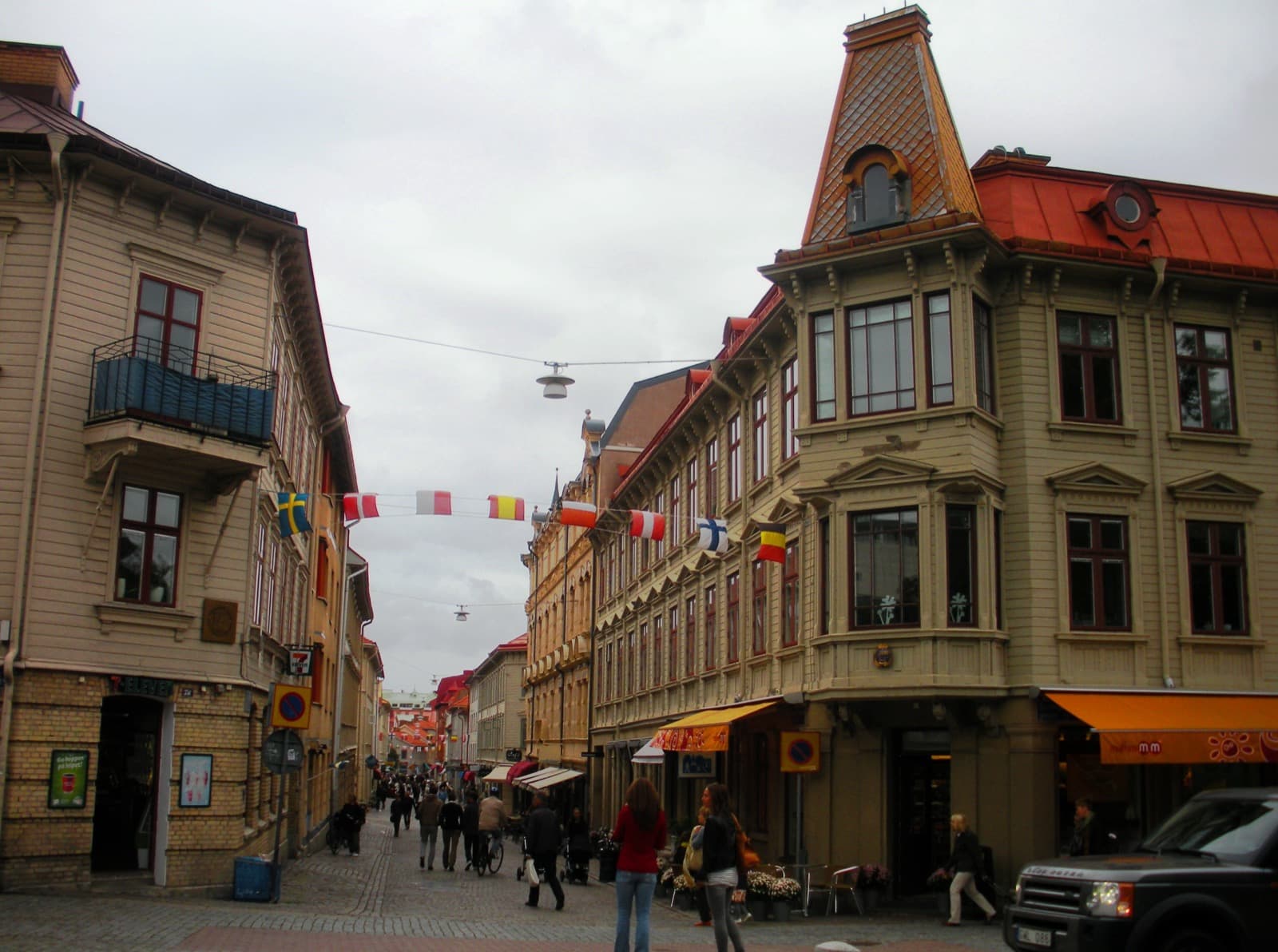
First impressions
Haga is the picture Göteborg puts on its postcards. Laid out in the 1640s as the city's first suburb, it is a compact grid of low wooden and landshövdingehus streets, cobbled and largely pedestrian, with Haga Nygata running through the middle lined with cafés, antiques shops and boutiques. You can walk the whole district in about fifteen minutes, and on a sunny weekend half the city seems to be doing exactly that.
It is pretty, historic and unmistakably central, wrapped just south-west of the moat with Järntorget at one end and the university and Linné a short step away. The 17th-century hilltop fort of Skansen Kronan sits on its grassy knoll immediately above, giving a green lookout over the rooftops.
This is a small, charming, much-loved and much-visited neighborhood, and it knows exactly what it is.
Who lives here, and what the streets look like
Far fewer people live in Haga than a century ago: the old houses that once held some fifteen thousand residents now hold a few thousand, in mostly small, sought-after flats. The crowd is mixed, with students drawn by the nearby university and Linné, and a heavily gentrified feel.
The streetscape is the draw and the constraint: low, wooden, cobbled and cared-for, with ground floors given over to cafés and independent shops. It is lovely to walk and to look at, and it is busy with visitors, especially along Haga Nygata.
Getting around
Haga sits on the edge of the tram network, with the Hagakyrkan stop on its northern edge and the major Järntorget hub just to the west, so the whole inner city is a short ride or walk away. The coming Västlänken commuter-rail tunnel will add an underground Haga station, boosting connections further. Above all it is walkable: flat, central and small.se.
Typical weekday minutes from Hagakyrkan, with the icon showing how. Times via Google Routes API for a typical weekday ~08:00, measured from the neighborhood centre; the icon shows the fastest sensible way (walk, bike, transit or car), 2026-08.
Daily life
Day to day, Haga is cafés, bakeries and small shops, with a grocer within easy reach and the fuller high streets of Linné and the centre a short walk away. The rhythm is café culture, a plate-sized cinnamon bun on Haga Nygata, and the hill up to Skansen Kronan for air and a view. For food delivery, Foodora, Wolt and Uber Eats all cover the central city.
Local Places Worth Knowing
Independent and close by, chosen on merit. Nobody pays to appear here. Links are being confirmed.
The classic Haga café on Haga Nygata, in a listed building, home of the plate-sized 'Hagabulle' cinnamon bun.
A long-running café at the Järntorget end of Haga Nygata, baking its own sourdough and pastries, with pavement seating on the cobbles.
A cosy fish-and-seafood restaurant on Haga Nygata, known for fish soup and seafood platters, with a summer courtyard.
The cobbled, pedestrianised main street lined with landshövdingehus, antiques, boutiques and cafés, the district's centrepiece.
Checked August 2026. Places close and change, so tell us if something here is out of date.
Schools and families
Haga is a small, central district rather than a family suburb, and it has no year-9 school of its own; its Hagaskolan runs to grade 6. The nearest year-9 school is Nordhemsskolan in adjacent Linné, whose leaving grades average a meritvärde of 260 out of 340 (Skolverket, 2024/25). Göteborg has free school choice, so this is the nearest school rather than a fixed catchment, and it is worth checking admission before you sign a lease or purchase.
Kids Restricted. The cobbles make a pram hard work, though cafés welcome children and the bigger venues nearby have changing tables and family toilets.
Pet Restricted. The cobbled streets and the Skansen Kronan hill are pleasant for a walk, but flats are small and the nearest big park, Slottsskogen, is a walk away rather than on the doorstep.
Green space, leisure and eating out
Haga's green is the hill: Skansen Kronan on its grassy rise gives the best short walk and view, and the larger Slottsskogen park and the Linné green corridor are a walk to the south-west. Leisure here means the cafés and the street itself, with the restaurants, bars and culture of Järntorget and Linné a few minutes away. Eating out leans toward the daytime and the classic, garden cafés and old-Göteborg tables rather than a late-night strip.
What it costs
Haga is not priced on its own; the statistics fold it into the surrounding Linnéstaden market, where flats change hands at roughly 60,000 to 75,000 kr per m² (Boio, Svensk Mäklarstatistik, April 2026), above the Göteborg city average of about 51,400. The housing is old, characterful and small, so you pay a premium per square metre for the address and the atmosphere. First-hand rents are set city-wide rather than per neighborhood, so no Haga-specific figure is published.
Weather and climate
Seasonal averages for Göteborg, one representative month per season. SMHI 1991-2020 normals (Goteborg) via Wikipedia climate box.
The honest downsides
It belongs to the visitors too. Haga Nygata is one of the city's most-walked streets, so the charm comes with crowds, especially on warm weekends.
The flats are small and old. The wooden houses are the whole point, but they mean compact apartments and a limited, pricey housing stock.
Crime and safety
Haga is a calm, central quarter in a safe city, and the everyday risk here is theft, the opportunistic pickpocketing that follows tourists and crowds, rather than violence. As in most of central Göteborg, you will also see some people asking for money around Järntorget and the tram stops, mostly low-level, while visible rough sleeping is uncommon. No standalone per-area crime rate is published for Haga, with the fuller picture on the Göteborg safety page.
Is this you?
If you want to live inside the postcard, in a small flat on a cobbled street with a café downstairs, and you do not mind visitors sharing your streets, Haga is one of the loveliest addresses in Göteborg. If you want space, a big weekly shop on the doorstep and quiet evenings, the residential districts up the hill will suit you better.
Want to know what homes here are actually worth?
Join the waitlistHow we source this
How we put this together. Gathered on the ground by our local field team and written up by the Apraiz research team. Every figure above carries its own source and date. The scores are not computed by the build; walking and transport will use open map and transit data first, then Apraiz's own model. We update prices quarterly, transport and amenities twice a year, and school data when the source publishes.
Sources: Boio / Svensk Mäklarstatistik, Skolverket, Utbildningsguiden, Göteborg & Co, Brå (National Council for Crime Prevention).
Safety and crime in Göteborg →Nearby: Majorna · Masthugget · Vasastaden