
Long Story ShortReadHide
- What it is: a large, leafy, hilly residential district on the east bank of the Neris, historically the city's most prestigious quarter, with embassies, campuses and the national Antakalnis Cemetery.
- Who it suits: diplomats, professionals and families who want green, riverside calm and space, and do not mind a ride to the centre.
- What it costs: about 3 711 EUR / m² ≈ $400 / sq ft to buy at the district average, below the city centre.
- What people complain about: the spread-out, steep layout that makes the outer parts car-dependent, and dated Soviet-era stock near Saulėtekis.
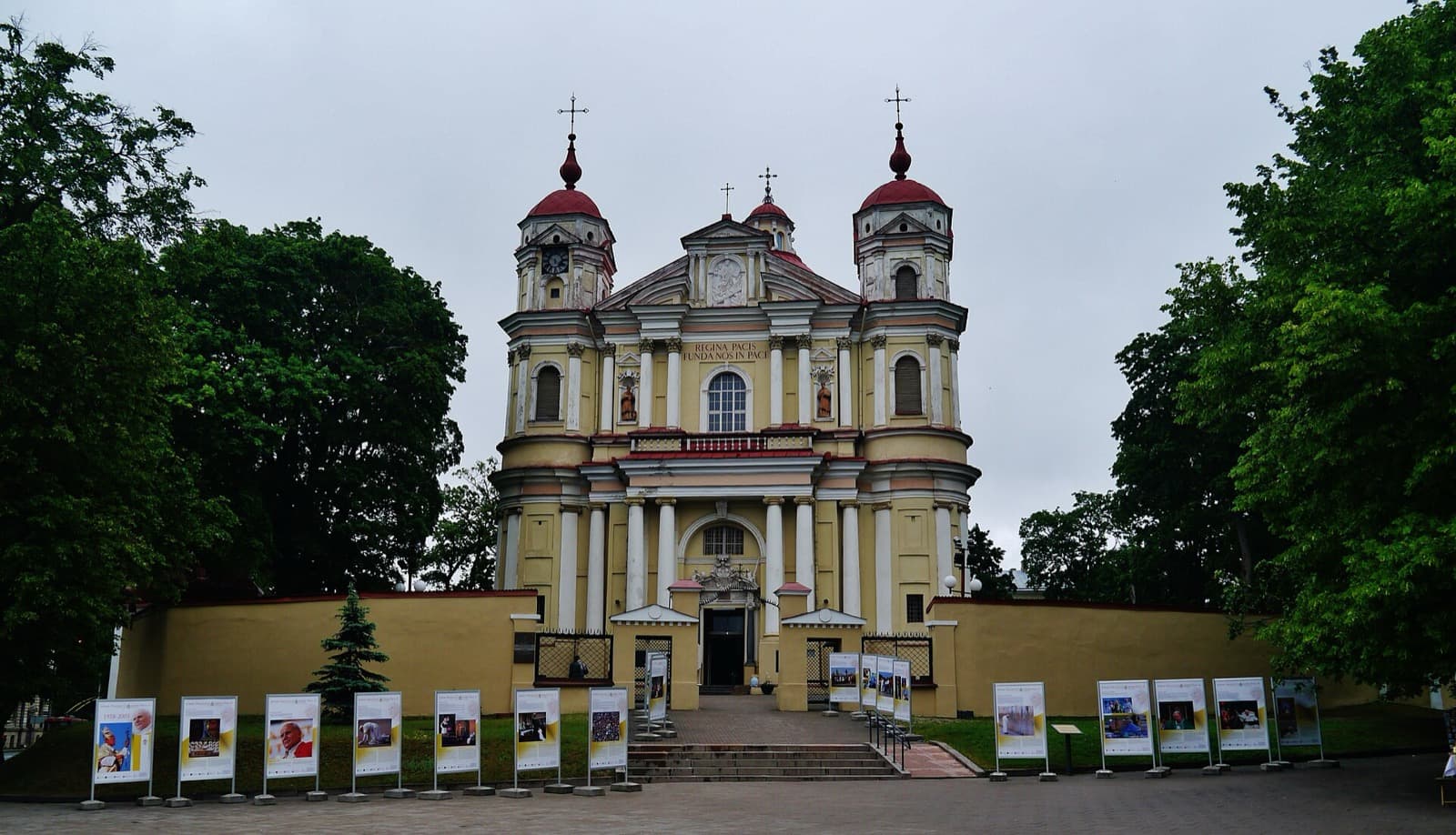
First impressions
Antakalnis is green and low-key rather than urban: wooded slopes, Baroque landmarks like the Church of St Peter and St Paul and the restored Sapieha Palace with Lithuania's only surviving Baroque park, then long ribbons of 1960s to 1980s apartment blocks and pockets of detached villas climbing toward Saulėtekis. It is genuinely hilly, with valleys, forest and river beaches at Valakampiai between the housing.
At its core it sits about two to three kilometres from Cathedral Square, a short ride away, but the district sprawls far northeast toward Kairėnai and Turniškės, where it turns car-dependent.
The honest caveat is that it is closer to a garden suburb than a downtown, and its size means the far edges are a world away from the walkable centre.
Who lives here, and what the streets look like
The population mixes established, well-off households, diplomats (the embassies of the UK, Denmark, Poland and the Vatican), professionals and families, plus a large student population around the Saulėtekis campuses of Vilnius Tech. The 2021 census recorded 39,257 residents; the December 2023 figure was 43,540.
The streetscape is wooded and stepped. The dense, walkable spine runs along Antakalnio gatvė with groceries and the local market close, and from there the housing climbs into forested slopes and thins into villas and student campuses toward the northeast.
Getting around
Antakalnis is well served by trolleybuses: route 2 (Stotis to Saulėtekis), route 4 (Antakalnis to Centras to Žemieji Paneriai) and route 19 (Pašilaičiai to Konstitucijos pr. to Antakalnis to Saulėtekis), plus city buses 15, 17, 38, 39, 114, 115 and 119, with an Antakalnis trolleybus loop as the local terminus. Vilnius has no tram or metro. The core is a quick hop to the centre, but the far northeast leans on longer headways or a car.
Typical weekday minutes from Antakalnis, with the icon showing how. Times are indicative for a typical weekday morning, measured from the neighborhood centre; the icon shows the fastest sensible way. Minutes were measured with the Google Routes API for a typical weekday around 08:00., 2026-08.
Daily life
Everyday shopping runs on neighborhood supermarkets, Maxima, Rimi and IKI along Antakalnio gatvė, and the local Antakalnio turgus for fresh produce; the Ozas mall and big-box retail sit a short ride north. It covers daily needs on the spine, with the bigger shop a drive away. For food delivery, Wolt and Bolt Food both cover the district.
Local Places Worth Knowing
Independent and close by, chosen on merit. Nobody pays to appear here.
An independent neighborhood cafe on M. K. Paco gatvė, a relaxed local fixture off the main spine.
A family cafe set inside Sapiega park, pairing coffee and cake with a Baroque-park setting.
The local produce market on the Antakalnio gatvė spine, the district's everyday fresh-food stop.
A restored 17th-century palace ringed by Lithuania's only surviving Baroque park, home to the city's oldest linden.
Checked August 2026. Places close and change, so tell us if something here is out of date.
Schools and families
Antakalnis is a strong family and student district, with the Saulėtekis campuses and several schools along the spine. Lithuania does publish a per-school ranking from centralised state-exam results (the Reitingai magazine tables built on National Examination Centre brandos egzaminai data), but we would rather flag that gap than guess a number. It is the sort of thing we would rather be honest about, which is part of why we build these Vilnius guides the way we do. Check the specific schools and their admission before you sign a lease or purchase.
Kids Friendly. Green, riverside and low-density, with forest, river beaches at Valakampiai and university campuses close, a long-established family and diplomat district.
Pet Friendly. Extensive forest, hills, riverside paths and parks (Kalnų, Sapiega, Sapieginė) plus low density make it one of the best dog-walking districts in the city.
Green space, leisure and eating out
Antakalnis is among the greenest districts in Vilnius: Kalnų Park, the Sapieginė hills and forest, the Sapieha Baroque park with the city's oldest linden, the Vilnius University Botanical Garden at Kairėnai, the Pavilniai Regional Park on the fringe, the Park of Benches, and river beaches at Valakampiai. Eating out is neighborhood-scaled, with independents like Sakwa and the park-set Taste Map rather than a dense downtown scene.
What it costs
Antakalnis buys below the city centre. The district average is about 3 711 EUR / m² ≈ $400 / sq ft to buy (BustoRadar, 2026), against roughly €2,967 per square metre outside the centre and €5,318 in the centre city-wide. No official Antakalnis rent is published, so we show the Vilnius outside-centre one-bed average of roughly 554 EUR / mo as a benchmark; live listings suggest about €8 to €15 per square metre a month.
Weather and climate
Seasonal averages for Vilnius, one representative month per season. LHMT (Lithuanian Hydrometeorological Service) 1991-2020 normals (Vilnius station) via Wikipedia climate box.
The honest downsides
Spread out and steep. The outer parts around Kairėnai and Turniškės are effectively car-dependent, and walking distances across the district are long.
Prestige, dated stock and quiet nights. Prices are high, much of the mid-district housing is dated Soviet-era blocks near Saulėtekis, and nightlife and dining density are thin compared with the Old Town.
Crime and safety
Antakalnis is a green, low-density, prestige district that reads as one of the safest-feeling parts of Vilnius. Lithuania records crime nationally and by county, with no per-district rate published. The one clean national figure is an intentional homicide rate of about 2.7 per 100,000 (UNODC, 2024), a low rate for Europe. Low traffic and a settled residential character make it feel calm day and night.
Is this you?
If you want green, riverside space, Baroque heritage and a prestige address, and can accept a ride to the centre, Antakalnis is Vilnius at its most spacious. If you want the same greenery in a smaller, more central package, neighbouring Žvėrynas trades the size for a tighter riverside villa quarter closer in.
Want to know what homes here are actually worth?
Join the waitlistHow we source this
How we put this together. Gathered on the ground by our local field team and written up by the Apraiz research team. Every figure above carries its own source and date. The scores are not computed by the build; walking and transport will use open map and transit data first, then Apraiz's own model. We update prices quarterly, transport and amenities twice a year, and school data when the source publishes.
Sources: Wikipedia, BustoRadar, Numbeo, UNODC via Wikipedia.
Safety and crime in Vilnius →Nearby: Senamiestis · Užupis · Naujamiestis