
Long Story ShortReadHide
- What it is: Vilnius's UNESCO-listed medieval core, a dense grid of about seventy cobbled streets packed with Gothic, Renaissance and Baroque facades and more than twenty churches.
- Who it suits: well-off professionals, students and expats who want a prestige address inside a living old town and can accept crowds and heritage-flat quirks.
- What it costs: the top band in the city, about 5 318 EUR / m² ≈ $570 / sq ft to buy at the city-centre premium.
- What people complain about: tourist footfall and short-let saturation on the main streets, and the cost and permission burden of protected heritage buildings.
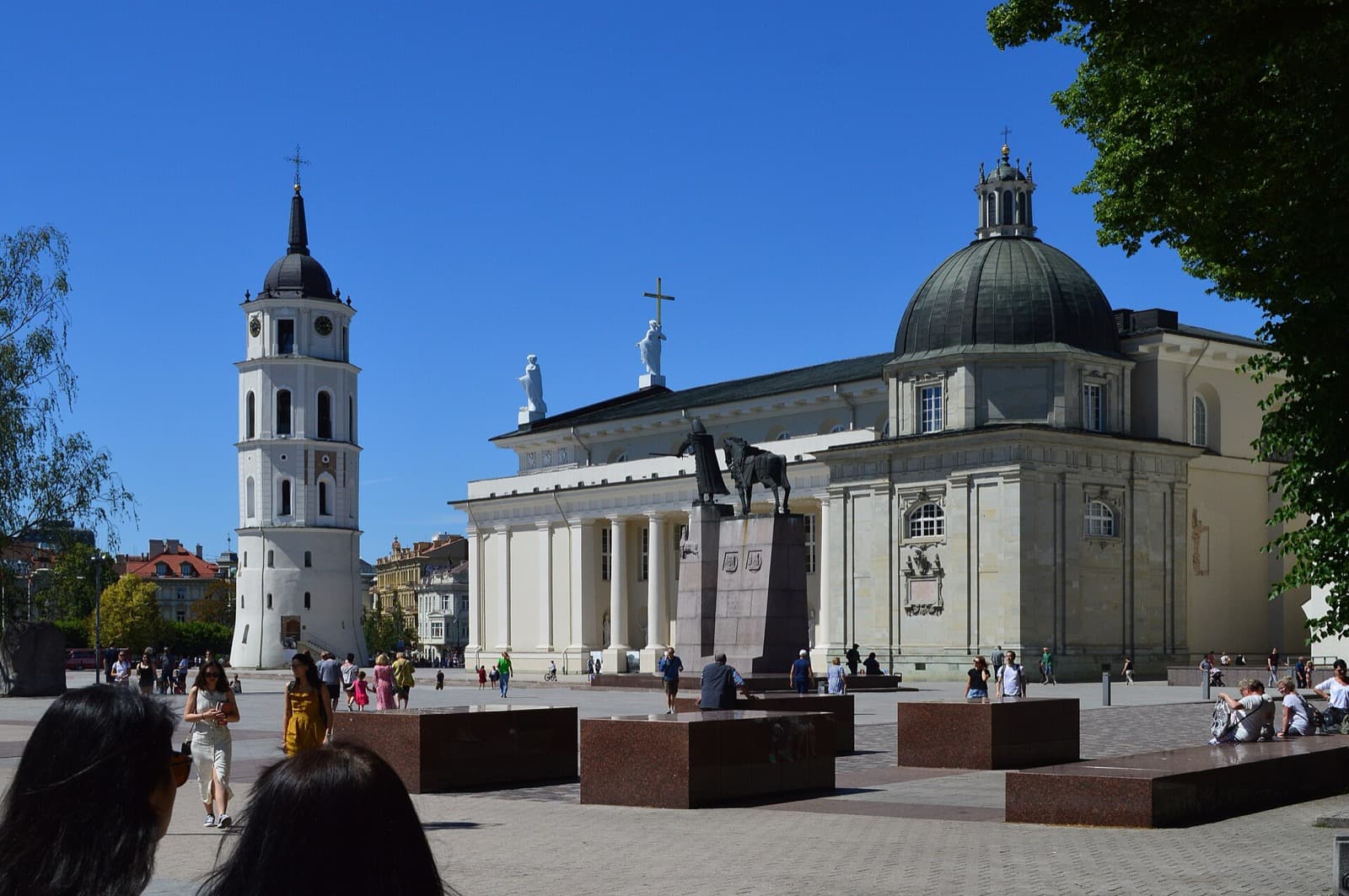
First impressions
Senamiestis is the historic, ceremonial and tourist heart of the capital, where the Vilnia meets the Neris. A dense grid of roughly seventy cobbled streets is threaded by the pedestrian-friendly Pilies gatvė, with Cathedral Square opening at the north end below Gediminas Tower and the Gate of Dawn closing the south. Over twenty churches dominate the sightlines, and the thirteen-courtyard Vilnius University ensemble sits mid-quarter.
It is a genuine working district, not a museum, but the tourist footfall on Pilies and Didžioji is heavy, and a rising share of flats run as short-lets.
The honest caveat is that living inside a UNESCO old town means living with its crowds, its prices and the practical limits of protected historic buildings.
Who lives here, and what the streets look like
The residents are a mix of long-standing owners in restored period flats, well-off professionals and expats drawn to the prestige addresses, and Vilnius University students. Households skew smaller and wealthier than the city average.
The streetscape is the point. Cobbled lanes open onto squares, Baroque churches lean over the pavements, and Sereikiškės Park and the Bernardine Garden green the eastern edge along the Vilnia. It is beautiful, atmospheric and busy in a way the quieter districts never are.
Getting around
Senamiestis is the most walkable district in Lithuania: everything central is a ten to fifteen minute walk, and Pilies and Didžioji are effectively pedestrian. Heavy vehicles are kept off the core, so bus and trolleybus routes run the periphery along Gedimino prospektas, Vokiečių, Žygimantų and Maironio. The Vilnius rail and coach stations are a short walk south of the Gate of Dawn. The city trolleybus network runs sixteen routes carrying about 200,000 riders a day.
Typical weekday minutes from Senamiestis, with the icon showing how. Times are indicative for a typical weekday morning, measured from the neighborhood centre; the icon shows the fastest sensible way. Minutes were measured with the Google Routes API for a typical weekday around 08:00., 2026-08.
Daily life
Everyday shopping is on foot: small-format Maxima, IKI, Rimi and Lidl stores in and around the Old Town, plus Halės turgus, the historic covered fresh-produce market on Pylimo gatvė on the southwest edge. That covers the weekly shop, though the retail on the main lanes skews toward visitors. For food delivery, Wolt and Bolt Food both cover the district densely, so a night in is easy.
Local Places Worth Knowing
Independent and close by, chosen on merit. Nobody pays to appear here.
A long-running independent restaurant in a medieval cellar on Stiklių gatvė, known for game dishes and old-Vilnius atmosphere.
An independent specialty coffee bar near Aušros Vartai, a calm spot a few steps off the tourist run.
The historic covered fresh-produce market on Pylimo gatvė 58, on the southwest edge of the Old Town.
The 16th-century city gate with its revered chapel, closing the south end of the Old Town.
Checked August 2026. Places close and change, so tell us if something here is out of date.
Schools and families
Vilnius University and several schools sit in and around the Old Town, so families have options close by. Lithuania does publish a per-school ranking from centralised state-exam results (the Reitingai magazine tables built on National Examination Centre brandos egzaminai data), but we would rather flag that gap than guess a number. It is the sort of thing we would rather be honest about, which is part of why we build these Vilnius guides the way we do. Check the specific schools and their admission before you sign a lease or purchase.
Kids Restricted. Atmospheric to grow up in, with parks and the university close, but the resident community skews small and wealthy and the main streets carry heavy tourist footfall.
Pet Friendly. Sereikiškės Park, the Bernardine Garden and the riverside give central dog-walking; the caveat is small heritage flats and busy tourist streets, not any restriction.
Green space, leisure and eating out
Green space fringes the core rather than filling it: Sereikiškės Park and the Bernardine Garden run along the Vilnia, the Hill of Three Crosses and Kalnai Park rise to the east, and Gediminas Hill sits in the centre. Culture is dense, with the Cathedral, the university courtyards and a saturated cafe, bar and restaurant scene. Eating out is broad, with genuine independents like Lokys holding their own among the tourist-facing spots.
What it costs
Senamiestis sits at the top of the Vilnius market. No clean Old Town figure is published, so we show the city-centre average of about 5 318 EUR / m² ≈ $570 / sq ft to buy (Numbeo, 2026); the Old Town trades at a premium above both this and the Vilnius-wide Ober-Haus index of around €3,019 per square metre. Vilnius publishes no per-district rent, so we show the city-centre one-bed average of roughly 766 EUR / mo as a guide, with Old Town flats at or above it.
Weather and climate
Seasonal averages for Vilnius, one representative month per season. LHMT (Lithuanian Hydrometeorological Service) 1991-2020 normals (Vilnius station) via Wikipedia climate box.
The honest downsides
It is a tourist stage set as much as a home. Heavy footfall and short-let saturation on Pilies and Didžioji erode day-to-day residential calm and push prices up, and the resident community is thinner than the crowds suggest.
Protected heritage buildings are hard work. Old plumbing and insulation, parking limits and costly, permission-bound renovations come with the territory inside a listed core.
Crime and safety
Senamiestis is central and busy rather than dangerous. Lithuania records crime nationally and by county, with no per-district rate published. The one clean national figure is an intentional homicide rate of about 2.7 per 100,000 (UNODC, 2024), a low rate for Europe. For a resident or visitor the everyday risk here is pickpocketing in the tourist crush, and treated sensibly the Old Town reads as a normal, walkable European core.
Is this you?
If you want to live inside a Baroque old town, walk to everything and do not mind crowds or a thin resident scene, Senamiestis is unmatched in the Baltics. If you want the same central access with more everyday calm and greenery, neighbouring Užupis gives you the atmosphere without the full tourist crush.
Want to know what homes here are actually worth?
Join the waitlistHow we source this
How we put this together. Gathered on the ground by our local field team and written up by the Apraiz research team. Every figure above carries its own source and date. The scores are not computed by the build; walking and transport will use open map and transit data first, then Apraiz's own model. We update prices quarterly, transport and amenities twice a year, and school data when the source publishes.
Sources: Wikipedia, Numbeo, Ober-Haus, UNODC via Wikipedia.
Safety and crime in Vilnius →Nearby: Užupis · Naujamiestis · Žvėrynas