
Long Story ShortReadHide
- What it is: the left bank of Toulouse, 0.44 km² of low brick streets, gardens and river frontage facing the old city across the Garonne.
- Who it suits: people who want a central address with grass, a playground and a bridge between them and the noise.
- What it costs: 4 643 EUR / m² ≈ $500 / sq ft to buy on the price actually paid, the middle of the three Toulouse districts here; tenants in this rent zone pay 14.1 EUR/m² a month excluding charges, and listings across the city ask 14.0 with charges included.
- The catch: incomes here are the lowest of the three districts covered, the shopping is thinner than in the centre, and the quarter's covered market sits just outside this boundary.
First impressions
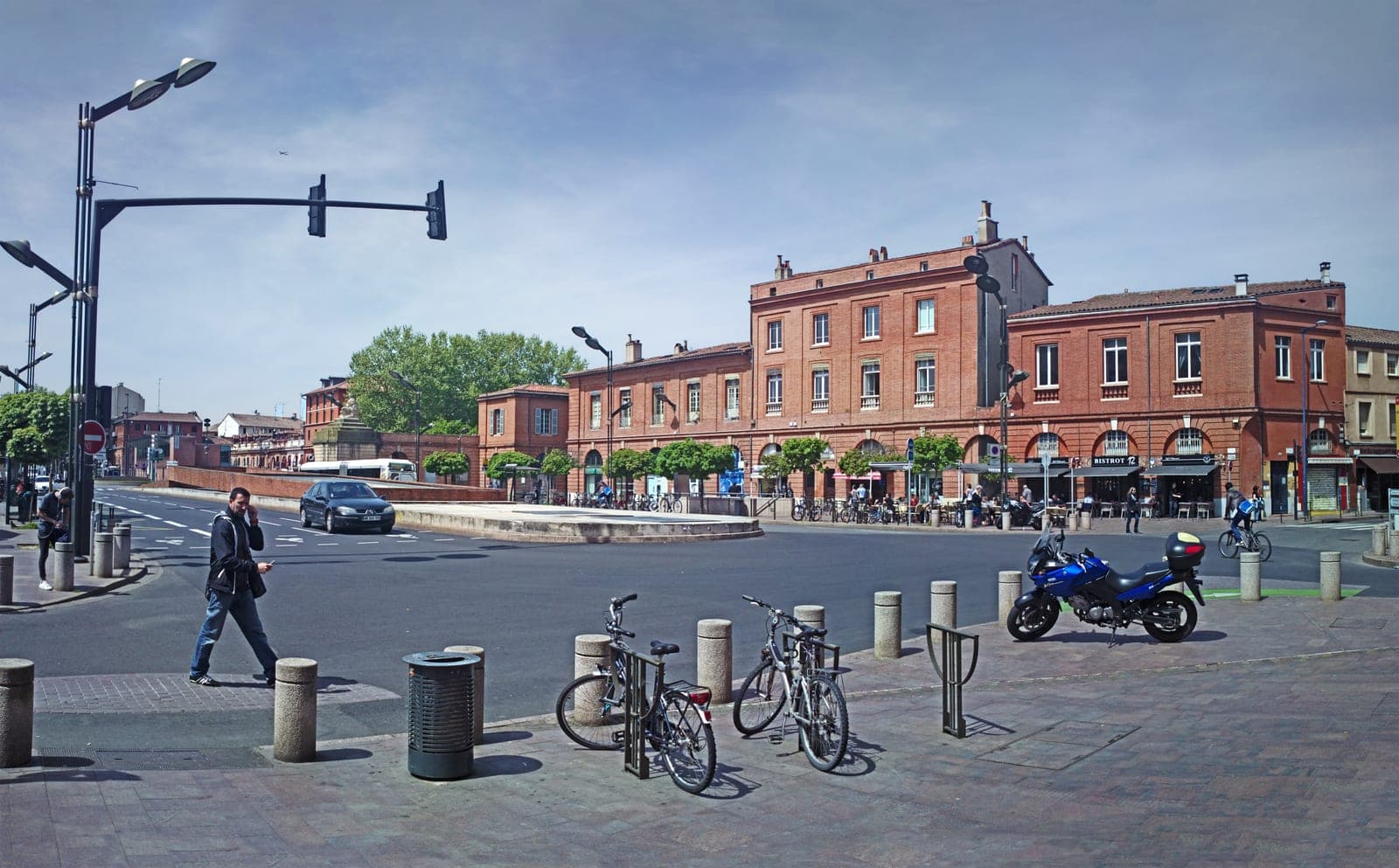
Saint-Cyprien is the other Toulouse, and the river is the whole explanation. For centuries this was the faubourg on the wrong bank: the ground everybody else's floods ran into, so it took the hospitals, the tanneries and the poor. Two of those hospitals are still the skyline. The dome of La Grave stands over the water like a cathedral that lost its city, and beside it the long river front of the Hôtel-Dieu Saint-Jacques, which took in pilgrims walking to Compostela and has been on the UNESCO World Heritage list since 1998 for exactly that reason.
The turning point was a catastrophe. In June 1875 the Garonne rose more than three metres above these streets and brought down about a thousand houses. What went up afterwards had to be solid and had to sit above the 1875 water line, which is why the quarter reads as it does today: sober brick, three or four storeys, doorways up a step or two, and a street grid laid out in one go rather than grown over centuries. Place Saint-Cyprien itself dates from the city's expansion in the 1840s and is still the middle of everything.
Walk it now and the character is domestic. Buggies, dogs, greengrocers, a lot of low buildings and a great deal of sky, because nothing here is tall enough to take it away. The Garonne bank on this side is a public park rather than a road, so the quarter's front garden is the Prairie des Filtres, where the city sits out in the evening. And where the abattoir used to be there is now a modern art museum, which is the single clearest sign of what this quarter has been doing for thirty years.
Cross the Pont Neuf and you are in the hypercentre in five minutes. That is the deal here: the address is central, the atmosphere is not.
Who lives here, and what the streets look like
A typical figure across this district's two small statistical areas is 24,370 EUR a year of disposable income per consumption unit, the lowest of the three Toulouse districts covered here, against 29,070 in Les Chalets and 29,645 in Capitole-Carmes. The figure is a median of the two area medians rather than a weighted statistic, so read the gap rather than the decimal: this is a mixed quarter where a hospital porter, a doctoral student and an architect live in the same street.
The stock is mostly nineteenth century, brick, three to four storeys, with the occasional low toulousaine, the single-storey terraced house with a yard behind it, in the quieter lanes. Flats are bigger on average than in the hypercentre and family-sized ones actually exist. Lifts are the exception. Ground floors are shops rather than restaurants, which is why the streets feel busy in the daytime and calm at eleven at night.
One thing to know before you renovate: the protected heritage perimeter that covers the old city also covers the Saint-Cyprien faubourg, 230 hectares in total, and its management plan was approved in February 2025. Anything that changes the outside of a building needs permission first.
Getting around
One metro station sits inside the boundary, Saint-Cyprien-République on line A, which puts the centre two stops away and the main railway station a straight ride with no change. Fourteen bus stops fill in the local network. There is no tram inside the district, though the tram lines are a short ride west from Arènes, and that is the route to the airport if you would rather not pay for the shuttle.
The other route is the bridge. Walking to the Capitole over the Pont Neuf takes about a quarter of an hour and is the nicest commute in Toulouse, and the river bank makes cycling genuinely quick in both directions because the city is flat and the path is continuous. The airport shuttle does not stop here: it runs from Jeanne d'Arc and Matabiau every 15 minutes at 9 EUR a single, taking 25 to 45 minutes, so from this side of the water you take the metro to it or the tram from Arènes.
Typical weekday minutes from Place Saint-Cyprien, with the icon showing how. Measured door to door for a typical weekday morning from place Saint-Cyprien, in the middle of the district; the icon shows the fastest sensible way., 2026-08.
Daily life
Sixteen food shops and two pharmacies inside 0.44 km², which works out at about 36 shops per square kilometre. That is a normal European density rather than an exceptional one, and in practice the quarter feeds itself: a couple of small supermarkets, bakeries, a butcher, greengrocers on the main streets and an evening shop for the things you forgot.
The thing to understand is the market. The covered market that everyone means when they say Saint-Cyprien stands just outside this district's western boundary, a few minutes' walk from place Saint-Cyprien, so it is part of daily life here without being part of the area these figures describe. Inside the boundary itself there is no market of its own, which is the single biggest difference between this quarter and the hypercentre across the river. Sundays are quiet, as they are everywhere in France, and the market morning is the exception.
Local Places Worth Knowing
Four places that tell you what the district is actually like, chosen because a resident would use them rather than because a visitor would photograph them.
A nineteenth-century brick water tower at the bridge head, a photography gallery since 1974 and still the best small exhibition room in the city. Half an hour, and cheap.
A modern bistro on rue Reclusane with a Bib Gourmand, a short market-led menu and a few tables on the square. The one to book when you want the neighbourhood to look good.
A small room on rue Charles Viguerie under the hospital walls, doing a short changing card at a level the street outside does not advertise. The obvious tables face the river.
A roaster's cafe by the dome of La Grave, small, plain and serious about the coffee, with pastries that go before lunch. Most ground floors here are aimed at dinner.
Checked August 2026. Places close and change, so tell us if something here is out of date.
Schools and families
The one lycée inside the boundary is a small private vocational school for hairdressing, which took 13 pupils in 2025. In practice that means a teenager living here travels: the general lycées are outside this boundary, and a family should count that journey rather than assume it, though the metro makes it a short one.
For everything below that age this is the strongest of the three Toulouse districts on these pages, and it is not close. Seven playgrounds and seventeen garden spaces inside a quarter of 0.44 km², a library, a flat street grid, and the Prairie des Filtres as a back garden that runs for the length of the district. Add two museums a pram-push away and a metro station that removes the need for a car, and you get the reason so many Toulouse families who want to stay central end up on this side of the water.
Kids Friendly. This is where families who want to stay central in Toulouse actually live. Seven playgrounds and seventeen garden spaces inside a small quarter, a library, the river bank as a back garden, two museums within walking distance, and a metro stop that puts the centre two stops away. Against it: no general lycée inside the boundary, so a teenager commutes, and the flats are old, which usually means stairs.
Pet Friendly. The best of the three Toulouse districts here for a dog, and by a distance. Seventeen garden spaces inside 0.44 km², the Prairie des Filtres running along the river with room to throw a ball, flat ground everywhere, and a bank path you can walk for kilometres without meeting a car. The caveats are ordinary: the riverside fills up on a warm evening, the allées on the western side carry real traffic, and shade is scarce on the open grass in July.
Green space, leisure and eating out
This is the district's real asset. Seventeen garden spaces inside the boundary, the Garonne bank as a continuous public park, and the Prairie des Filtres, the open riverside lawn that grew out of the old waterworks on this bank and still carries their name. It is where Toulouse sits out on a summer evening, and living beside it is the closest thing central Toulouse offers to having a garden.
Culture punches far above the quarter's size. Les Abattoirs, the modern and contemporary art museum in the nineteenth-century slaughterhouse, holds the enormous stage curtain Picasso painted in 1936, and the Château d'Eau at the bridge head has been showing photography since 1974, when it became the first public gallery in France devoted to it.
Eating out is a different proposition from the centre. 34 restaurants, 14 cafés and only 4 bars across the district, so the evening here is dinner and a walk home rather than a night out, and the good addresses are spread through the streets instead of packed into two squares. It is also where a lot of the city's better young kitchens have opened in the last few years, which is a change residents noticed before the guidebooks did.
What it costs
The number to start from is what people actually paid: 4 643 EUR / m² ≈ $500 / sq ft, the median across 87 recorded apartment sales inside these two statistical areas in 2025, from the state's register of transfers rather than from asking prices. Where a cellar or a parking space came with the flat the price includes it, and the same median over flats sold with nothing attached is 4,733, so that choice moves the figure by 1.9% and can be ignored.
Against the three Toulouse districts covered here this is the middle one: 4,528 in Les Chalets, 4,643 here, 4,919 in Capitole-Carmes. The spread across the three is about 9%, which is narrow, and what you are buying at this point on the scale is space and green rather than a shorter walk to a metro.
On renting there are two figures and they measure different things. What sitting tenants actually pay is 14.1 EUR/m² a month excluding charges, from the Toulouse rent observatory's 2024 survey of the occupied private stock, with quartiles of 12.0 to 17.1 behind it and 3,927 observations in the sample. The observatory works at the scale of its own price zones rather than districts, and both of this district's statistical areas sit in the same one, Toulouse Secteur 1, so that number describes the zone and is served to every area inside it, the two other districts on these pages included. The asking rent is 14.0, charges included and not separable, modelled from listings and published per commune, so it covers the whole city.
Put the two side by side and Toulouse looks unusual. The advertised figure, with charges inside it, is a shade below what sitting tenants pay before charges. In Bordeaux the advertised figure, 16.0, sits well above the 14.8 paid. The two are built in different ways, one modelled from listings and one surveyed from occupied tenancies, so we will not tell you what closes the gap here. What it means in practice is that a Toulouse listing price is close to the whole market, and a tenant moving in should not expect to be paying a large premium over the neighbours.
The local detail people miss is the ground itself. This quarter exists in the shape it does because of the 1875 flood, and the river has not gone anywhere: the low ground along the bank is a flood plain by design, which is why it is a park rather than housing. Ask which floor a flat is on, ask what the insurance history of the building is, and read the risk information the seller has to give you rather than skipping it.
Set the price against the income and a 45 m² one-bedroom at 4,643 EUR/m² is roughly 209,000 EUR, about eight and a half times the 24,370 EUR a year a typical one of this district's areas records. That is the weakest ratio of the three districts here, and it is a straightforward consequence of the incomes rather than of the prices. Renting the same flat at the paid rate of 14.1 EUR/m² costs about 634 EUR a month before charges, roughly 31% of that income over a year, and the same rent lands lighter in the two other districts on these pages simply because they earn more.
Weather and climate
Seasonal averages for Toulouse, one representative month per season. Météo-France 1991-2020 normals for station Toulouse-Blagnac, read 12 August 2026 via Infoclimat. Seasons are the representative months: January, April, July and October. Sunshine hours a day are the monthly totals divided by the days in the month (January 89.1 h, April 188.5 h, July 258.6 h, October 155.2 h). Annual figures: mean daily maximum 18.8 °C, mean daily minimum 9.6 °C, 627.0 mm of rain and 2,075.1 hours of sunshine. Rain days are left null because the count of days at or above 1 mm is not filled in on the published normals table. What the numbers say about living here: Toulouse is drier than its reputation, 627 mm a year against 925 mm in Bordeaux three hours west, and sunnier at 2,075 hours. It is also more continental than Atlantic: a 2.9 °C mean minimum in January means frost is routine, and July days average 28.2 °C with the brick of the old city holding the heat into the evening. The wind matters more than any of these figures, the autan blowing warm from the south-east for days at a time.
The honest downsides
The shopping is thinner than it looks. Sixteen food shops is enough to live on and it is less than a third of what the hypercentre carries, and the market everyone talks about is over the boundary to the west.
The through-traffic is real. The allées on the western side of the quarter carry a lot of cars, and a flat facing them is a different place to live from one in the lanes behind.
The flats are old. Brick, stairs, small windows on the older stock, and a heritage regime that puts an architect between you and a new shutter.
The riverside is a shared living room. Wonderful in May, crowded on a hot evening, and the noise on the bank travels further than you would expect.
Crime and safety
France publishes recorded crime per commune, and Toulouse is a single commune, so there is no Saint-Cyprien figure and nobody, including us, can honestly give you one. The numbers beside this section are for the whole city.
Toulouse's theft from the person rate, 205.0 per 10,000 residents against 91.0 for France, is more than twice the national rate, and robbery, 20.5 against 7.2, runs the same way. Home burglary, at 6.4 per 1,000 dwellings against 5.6, is close to normal, and domestic violence, at 37.2 against 37.6, is marginally below it. Recorded crime depends partly on how much gets reported, so read these as reported rates rather than as a full count.
Street theft is a crowd phenomenon, and the crowds in Toulouse are over the water: this district holds 34 restaurants and only 4 bars, its evening rhythm ends early, and its one metro station is a neighborhood stop rather than an interchange. The sensible reading is that the city's theft figure describes the shopping streets and the metro at the centre more than it describes these lanes, and that the burglary rate, close to the national average, is the one that applies to a flat here. The one place to pay attention is the riverside path after dark, which is long, open and lightly used once the evening crowd has gone home.
Is this you?
Saint-Cyprien suits someone who wants to be central in Toulouse without living inside it, and who will actually use the river. It is the obvious choice for a family that is not ready to move to the suburbs, for anyone with a dog, and for people who would rather walk over a bridge to the noise than live above it.
It is the wrong place if you want the densest shopping in the city, if you need a general lycée within walking distance, or if you want a quiet flat on a main road, which does not exist here any more than anywhere else. Whether you lease or purchase, walk the block once at nine in the morning and once at ten at night, and stand on the bank to see how close the water really is.
Want to know what homes here are actually worth?
Join the waitlistHow we source this
How we put this together. Gathered on the ground by our local field team and written up by the Apraiz research team. Every figure above carries its own source and date. The scores are not computed by the build; walking and transport will use open map and transit data first, then Apraiz's own model. We update prices quarterly, transport and amenities twice a year, and school data when the source publishes.
Sources: DVF (Demandes de valeurs foncières), data.gouv.fr, Carte des loyers 2025, DHUP and ANIL with leboncoin and Groupe SeLoger, Observatoire des loyers de l'agglomeration toulousaine, via the Observatoires des loyers network, INSEE, Ministère de l'Éducation nationale (IVAL 2025), SSMSI, via data.gouv.fr, Wikipedia (fr), with the PSMV regulation via the Géoportail de l'urbanisme, Tisséo Voyageurs, Wikipedia (fr), Chemins de Saint-Jacques-de-Compostelle en France, patrimoine mondial, Les Abattoirs, musée-Frac Occitanie Toulouse, Le Château d'Eau, Toulouse Métropole, Guide MICHELIN, OpenStreetMap contributors, via the Overpass API.
Safety and crime in Toulouse →Nearby: Capitole-Carmes · Les Chalets