
Long Story ShortReadHide
- What it is: the pink brick hypercentre of Toulouse, 0.97 km² of shops, squares and restaurants running from place du Capitole down to place des Carmes.
- Who it suits: people who want to live in the middle of a city, walk to everything, and never own a car.
- What it costs: 4 919 EUR / m² ≈ $530 / sq ft to buy on the price actually paid, the dearest of the three Toulouse districts here; tenants in this rent zone pay 14.1 EUR/m² a month excluding charges, and listings across the city ask 14.0 with charges included.
- The catch: 168 restaurants, 65 cafés and 55 bars inside a quarter you can cross in fifteen minutes, and the noise and footfall that go with them.
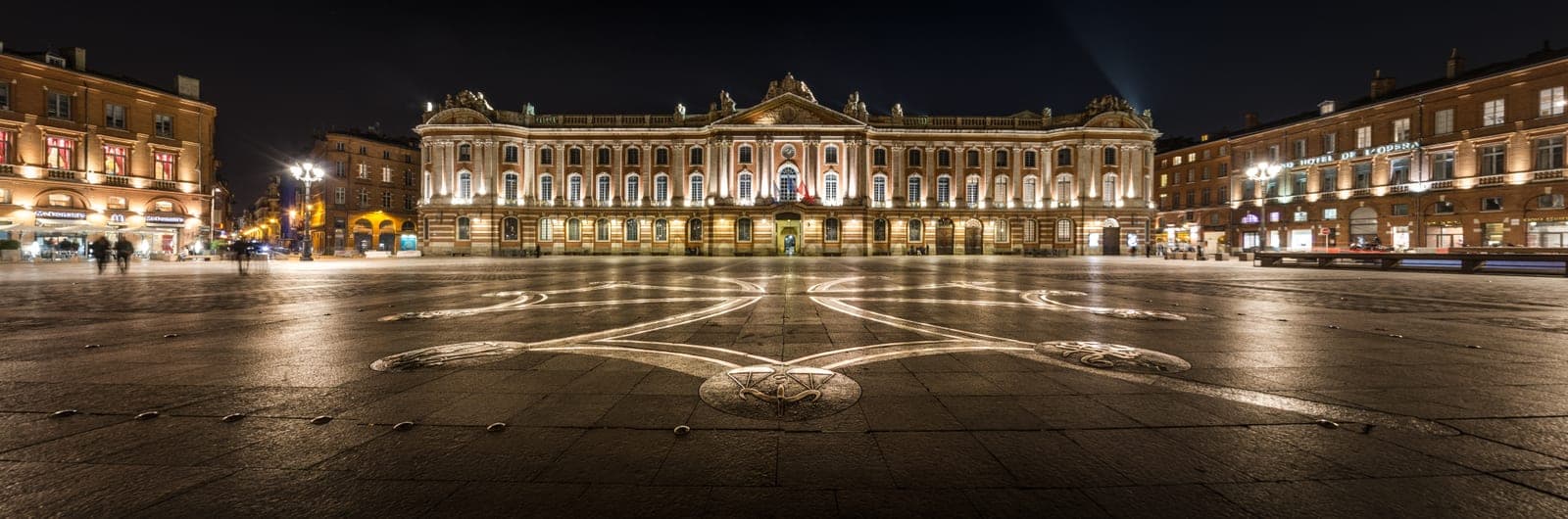
First impressions
The first thing you notice is the colour. Toulouse is built of fired clay brick rather than stone, and in this district almost nothing interrupts it: the same warm pink runs from the Capitole down every lane to the Carmes, and it changes shade twice a day as the light moves. The second thing you notice is that the cars have mostly gone. The old north to south spine, rue Saint-Rome and rue des Filatiers, is a narrow pedestrian run, and the lanes either side of it are too tight to be anything else.
The shape of the place is medieval and the money that paid for it was blue. Pastel, the dye pressed from woad leaves, made a handful of Toulouse merchants extremely rich in the sixteenth century, and they spent it on town houses with courtyards and staircase towers. The Hôtel d'Assézat, built between 1555 and 1562 for Pierre d'Assézat, is the one everybody points at, and you can still walk into its courtyard for nothing.
Two buildings anchor the ends. At the north, the Capitole, whose long front was finished in 1760 to Guillaume Cammas's design, with eight columns standing for the eight capitouls who ran the city, and the Donjon behind it, completed in 1530 and rebuilt in 1873 to Viollet-le-Duc's drawings. At the south, place des Carmes and its covered market. In between sits the church of the Jacobins, begun in 1230, whose vaults fan out from a single column that everyone in Toulouse calls the palm tree. The Dominicans built it in brick because that is what the ground gives here, and the effect at four in the afternoon is the reason it stays in your head.
What the district does not have is any pretence of being residential. Ground floors are shops and restaurants almost without exception, so you live above the noise rather than beside it, and the quiet comes only in the streets that lead nowhere.
Who lives here, and what the streets look like
A typical figure across this district's four small statistical areas is 29,645 EUR a year of disposable income per consumption unit, the highest of the three Toulouse districts covered here, against 29,070 in Les Chalets and 24,370 in Saint-Cyprien. That figure is a median of the four area medians rather than a weighted city statistic, so treat it as a level rather than a precise value, and read the gap between the three districts rather than the number itself.
The population is young and it turns over. Flats are small, often carved out of larger ones, and a 40 m² one-bedroom with a beam and a brick wall is the standard product. The universities are minutes away on foot, which puts students in the cheaper upper floors, and the professional couples who can afford it take the renovated ones. Families are rare, and the building stock explains why: three to five storeys, a courtyard, a staircase, and a lift only where somebody paid to put one in.
The streetscape is in good condition and consistently so, which is not an accident. The whole centre sits inside a protected heritage perimeter created in 1986, and since February 2025 it has had an approved management plan, so shopfronts, windows and paint colours are controlled. It is why the quarter looks coherent and why owners complain about the paperwork.
Getting around
This is the centre, so the honest answer is that you mostly do not use transport at all. Three metro stations sit inside the boundary, on both of the city's lines: Capitole and Esquirol on line A, Carmes on line B, with the two lines crossing at Jean-Jaurès a few minutes north. The tram terminus is on the southern edge at Palais de Justice, and 19 bus stops fill in the rest.
Two things are worth planning for. The airport is a shuttle ride, not a metro ride. Tisséo's airport shuttle runs every 15 minutes and takes 25 to 45 minutes depending on traffic, at 9 EUR a single, picking up at Jeanne d'Arc and at Matabiau rather than inside this district, so you walk or take one metro stop first. And a third metro line is coming: line C, 27 km and 21 stations, is due to carry its first passengers at the end of 2028, and it will serve Matabiau station rather than these streets, which is good for onward journeys and irrelevant to your daily walk.
Cycling is the underrated option. Toulouse is flat, the distances inside the ring of boulevards are tiny, and the pedestrian streets make a bicycle faster than anything with an engine between eleven and seven.
Typical weekday minutes from Place des Carmes, with the icon showing how. Measured door to door for a typical weekday morning from place des Carmes, at the southern end of the district; the icon shows the fastest sensible way., 2026-08.
Daily life
This is the district's strongest suit and it is not close. 63 food shops inside 0.97 km², about 65 per square kilometre, with 8 pharmacies and four market sites recorded inside the boundary. The one to know is the covered market on place des Carmes, which is a working food market rather than a visitor attraction, busiest on Saturday morning and closed by early afternoon.
Above that sits a real high street. Rue d'Alsace-Lorraine carries the chains and the department stores, rue Saint-Rome and rue des Filatiers carry the smaller shops, and the lanes between them carry everything else, from a cheesemonger to a violet-flavoured sweet shop. The gap in the week is Sunday, when most of it closes and you are down to the bakeries and the morning markets, which is normal for France and still surprises people who move from a big northern European city.
Local Places Worth Knowing
Four places that tell you what the district is actually like, chosen because a resident would use them rather than because a visitor would photograph them.
The covered market on place des Carmes, and why the southern end of the district shops the way its grandparents did: fish, cheese, meat and vegetables from named stalls.
The brick Dominican church begun in 1230, with the palm-tree column fanning over the choir and a quiet cloister beside it. The one building here that explains the whole city.
A tea room and patisserie on rue de la Bourse, off the main pedestrian run, with cakes made on the premises and a room quiet enough to read in. Most ground floors here are not.
Pierre Lambinon's two-Michelin-star restaurant by the river at the district's western edge. The local address for a night that is meant to be remembered.
Checked August 2026. Places close and change, so tell us if something here is out of date.
Schools and families
Lycée Pierre de Fermat stands inside the boundary, beside the Jacobins, and 321 pupils entered its seconde year in 2025. That is unusual for a district this small and it means a teenager here can walk to school, which almost nowhere else in central Toulouse offers.
Below that age the picture is mixed, and it is the flats rather than the services that decide it. There are three playgrounds and a library inside the quarter, the car-free lanes mean a small child can walk to the bakery without crossing a road, and the market makes a Saturday morning easy. What is against you is space: small rooms, stairs, and a heritage regime that makes enlarging anything slow. Families who stay tend to be in the calmer streets around the Dalbade rather than off the main pedestrian run.
Kids Restricted. Small children do better here than teenagers. Much of the street grid takes no cars, so a four-year-old can walk to the bakery without a road crossing, there are three playgrounds and a library inside the boundary, and the covered market makes a Saturday easy. Against that: flats are small, old and often without a lift, the ten garden spaces are squares rather than parks, and 55 bars and 168 restaurants make for evening noise a family bedroom cannot ignore.
Pet Restricted. Flat, short streets and a lot of car-free ground, which is easy on an old dog and easy on a lead. Against that, the ten garden spaces inside the boundary are squares and cloisters rather than places to let a dog run, the nearest open grass is the Prairie des Filtres across the Garonne or the Grand Rond to the east, the brick and stone hold heat in a Toulouse July, and café tables leave little room to pass on a summer evening. Fine for a small dog whose exercise happens elsewhere, hard work for a large one.
Green space, leisure and eating out
Green space is the weak point. Ten garden spaces are recorded inside the boundary and none of them is a park: they are squares, courtyards and the cloister of the Jacobins, pleasant to sit in and useless for a run. The real outdoor ground is over the water, on the Prairie des Filtres on the left bank, or east at the Grand Rond and the Jardin des Plantes, and both are ten to fifteen minutes on foot.
Eating out is the opposite problem, which is to say an excess of it. 168 restaurants, 65 cafés and 55 bars inside a district you can cross in fifteen minutes. The range runs from a two-star kitchen by the river to the cassoulet houses on the tourist runs, and the rule residents use is simple: one street back from the big squares, the cooking gets better and the bill gets smaller. The evening rhythm is late, loud on the lanes between the Capitole and the Carmes, and genuinely quiet in the streets nearer the Garonne.
What it costs
The number to start from is what people actually paid: 4 919 EUR / m² ≈ $530 / sq ft, the median across 199 recorded apartment sales inside these four statistical areas in 2025, taken from the state's register of transfers rather than from asking prices. That makes this the dearest of the three Toulouse districts on these pages, which run 4,528 in Les Chalets, 4,643 in Saint-Cyprien and 4,919 here, a spread of about 9%. It is a narrow range, and what the extra buys is the address and the walk, not a better building.
One detail here runs against the usual pattern. The same median over flats sold with nothing attached, no cellar and no parking space, is 5,239 EUR/m², 6.5% higher than the all-in figure. In most places an attached cellar or parking space pushes a price up. Here it does not, and the register does not say why, so when a listing makes much of a cave, price the flat rather than the cave.
On renting there are two figures and they measure different things. What sitting tenants actually pay is 14.1 EUR/m² a month excluding charges, from the Toulouse rent observatory's 2024 survey of the occupied private stock, with quartiles of 12.0 to 17.1 behind it and 3,927 observations in the sample. The observatory works at the scale of its own price zones rather than districts, and all four of this district's statistical areas sit in the same one, Toulouse Secteur 1, so that number describes the zone and is served to every area inside it, Saint-Cyprien and Les Chalets included. The asking rent is 14.0, charges included and not separable, modelled from listings and published per commune, so it covers the whole city.
Put the two side by side and Toulouse looks unusual. The advertised figure, with charges inside it, is a shade below what sitting tenants pay before charges. In Bordeaux the advertised figure, 16.0, sits well above the 14.8 paid. The two are built in different ways, one modelled from listings and one surveyed from occupied tenancies, so we will not tell you what closes the gap here. What it means in practice is that a Toulouse listing price is close to the whole market, and a tenant moving in should not expect to be paying a large premium over the neighbours.
The local cost detail people miss is the heritage regime. The centre has sat inside a protected perimeter since 21 August 1986, and the management plan for it was approved by the prefect on 17 February 2025, covering 230 hectares of the old city. Anything that changes the outside of a building, down to a window frame or a shutter, needs permission first. Budget time and an architect for it, and read the co-ownership minutes before you buy into a façade job.
Set the price against the income and a 45 m² one-bedroom at 4,919 EUR/m² is roughly 221,000 EUR, about seven and a half times the 29,645 EUR a year a typical one of this district's areas records. That is a better ratio than it looks for a hypercentre, and it is the reason the quarter still has owner-occupiers in it rather than only investors. Renting the same flat at the paid rate of 14.1 EUR/m² costs about 634 EUR a month before charges, roughly 26% of that income over a year, which is the figure to test a budget against rather than the advertised one.
Weather and climate
Seasonal averages for Toulouse, one representative month per season. Météo-France 1991-2020 normals for station Toulouse-Blagnac, read 12 August 2026 via Infoclimat. Seasons are the representative months: January, April, July and October. Sunshine hours a day are the monthly totals divided by the days in the month (January 89.1 h, April 188.5 h, July 258.6 h, October 155.2 h). Annual figures: mean daily maximum 18.8 °C, mean daily minimum 9.6 °C, 627.0 mm of rain and 2,075.1 hours of sunshine. Rain days are left null because the count of days at or above 1 mm is not filled in on the published normals table. What the numbers say about living here: Toulouse is drier than its reputation, 627 mm a year against 925 mm in Bordeaux three hours west, and sunnier at 2,075 hours. It is also more continental than Atlantic: a 2.9 °C mean minimum in January means frost is routine, and July days average 28.2 °C with the brick of the old city holding the heat into the evening. The wind matters more than any of these figures, the autan blowing warm from the south-east for days at a time.
The honest downsides
The noise is structural. A district with 55 bars and 168 restaurants in it is loud from Thursday to Saturday, late, and brick reflects sound as happily as stone. A flat on a pedestrian lane with tables under the windows is a different proposition from one three streets away, and the price does not always show the difference.
The crowds are constant. The shopping streets carry the whole region on a Saturday. That is what makes the district convenient and it is also what makes it tiring, and residents plan their errands around it.
The flats are old and the works are slow. Brick, stairs, small rooms, heat held into the evening in July, and a protected perimeter that puts a heritage architect between you and a new window.
There is no park. Ten garden spaces sound like a lot until you count them: they are squares and cloisters. Anything that needs grass is a walk over the river or out to the east.
Crime and safety
France publishes recorded crime per commune, and Toulouse is a single commune, so there is no Capitole-Carmes figure and nobody, including us, can honestly give you one. The numbers beside this section are for the whole city.
Read together they point somewhere specific. Toulouse's theft from the person rate, 205.0 per 10,000 residents against 91.0 for France, is more than twice the national rate, and robbery, 20.5 against 7.2, runs the same way. But home burglary, at 6.4 per 1,000 dwellings against 5.6, is close to normal, and domestic violence, at 37.2 against 37.6, is marginally below the national rate. Recorded crime also depends on how much gets reported, so figures move with reporting habits as well as with events.
That pattern describes a city where the everyday risk is to your pockets in a crowd rather than to your flat while you are out. This district is where the crowd is: the busiest shopping streets in the region, the squares the city drinks in, and two metro lines feeding both. Apply the city figure here with that in mind, keep a phone out of a back pocket on the pedestrian runs and on a Saturday metro, and treat the rest as ordinary city life.
Is this you?
Capitole-Carmes suits someone who wants the middle of a city without a car and is honest about the trade. If your evening starts by walking three minutes to a table, if you would use a covered market weekly, and if you can sleep through noise or afford a flat on a quiet lane, this is one of the more affordable historic centres in France at 4,919 EUR/m².
It is the wrong place if you need grass under a dog every morning, if you want a big family flat with a lift, or if you are buying for silence. Whether you lease or purchase, stand in the exact street at eleven on a Friday night and again at eleven on a Saturday morning, because those two visits tell you more than any figure on this page.
Want to know what homes here are actually worth?
Join the waitlistHow we source this
How we put this together. Gathered on the ground by our local field team and written up by the Apraiz research team. Every figure above carries its own source and date. The scores are not computed by the build; walking and transport will use open map and transit data first, then Apraiz's own model. We update prices quarterly, transport and amenities twice a year, and school data when the source publishes.
Sources: DVF (Demandes de valeurs foncières), data.gouv.fr, Carte des loyers 2025, DHUP and ANIL with leboncoin and Groupe SeLoger, Observatoire des loyers de l'agglomeration toulousaine, via the Observatoires des loyers network, INSEE, Ministère de l'Éducation nationale (IVAL 2025), SSMSI, via data.gouv.fr, Wikipedia (fr), with the PSMV regulation via the Géoportail de l'urbanisme, Tisséo Voyageurs, Tisséo Collectivités, Wikipedia (en), Guide MICHELIN, OpenStreetMap contributors, via the Overpass API.
Safety and crime in Toulouse →Nearby: Saint-Cyprien · Les Chalets