
Long Story ShortReadHide
- What it is: the whole of old Montpellier, 0.55 km² of medieval lanes inside a ring of boulevards, with the market hall, the museum and most of the city's restaurants in it.
- Who it suits: people who want to live in the middle of a city, walk everywhere and eat out constantly, and who do not need grass or silence.
- What it costs: 3 790 EUR / m² ≈ $410 / sq ft to buy on the price actually paid, the cheapest of the three Montpellier districts here; sitting tenants pay 14.7 EUR/m² a month excluding charges.
- The catch: 193 restaurants and 64 bars inside a quarter you can cross on foot, and the noise that implies.
First impressions
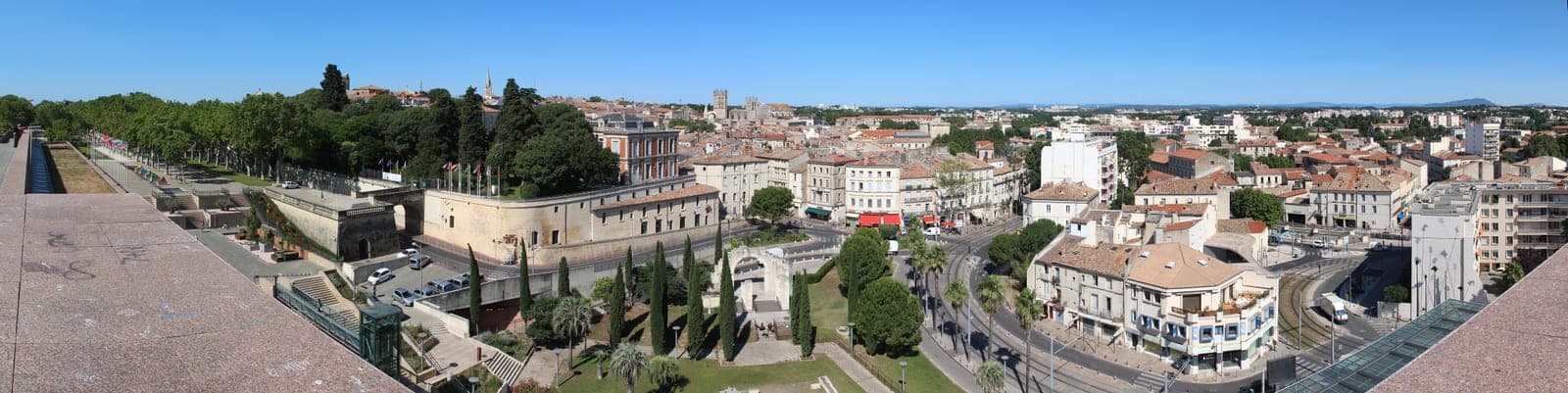
The Écusson is not a quarter of Montpellier so much as the original town, and it is small. Half a square kilometre, three small statistical areas, and a ring of boulevards around the outside that you can walk in half an hour. Inside it the streets are medieval: narrow, bent, paved in pale stone, and almost none of them take cars.
The shape is the story. The first walls went up in the middle of the twelfth century and the main medieval enclosure followed at the end of the thirteenth. From the seventeenth century the walls came down, the moats were filled and boulevards were laid along the line of them, which is why the old town today is ringed by wide roads and threaded with lanes that go nowhere in particular. The outline those boulevards left behind looks like an old French shield, and that is where the name comes from.
What the nineteenth century added is still doing the work. The Halles Castellane, iron and cast iron under a zinc roof, had its first stone laid in April 1858 and opened in February 1859, built by the municipal architect Jean Cassan on the model of Baltard's halles in Paris, and listed as a monument historique in 1999. The Musée Fabre had opened thirty years earlier, on 3 December 1828, in a mansion the city bought for the purpose. Then in July 2000 the first tram line arrived and the centre was handed back to people on foot, which is the single change most residents would name if you asked what made the Écusson what it is now.
Arrive at place de la Comédie and you get the scale wrong, because the square is enormous and the lanes behind it are not. Walk two minutes in and the city closes around you: three-metre-wide streets, shutters, a courtyard door left open, and a café table wherever the geometry allows one.
Who lives here, and what the streets look like
A typical figure across this district's three small statistical areas is 23,460 EUR a year of disposable income per consumption unit, which sits between Port Marianne at 21,985 and Antigone at 24,130. None of the three is a rich quarter by French big-city standards, and the Écusson's number describes a young population rather than a poor one.
The physical evidence is easy to read. Ground floors are almost entirely commercial, there are 193 restaurants, 72 cafés and 64 bars inside 0.55 km², and the flats above them are old, cut small, and reached by stairs. Lifts are the exception. A 40 m² one-bedroom with a stone wall and a beam is the standard product here, and a large family flat is genuinely hard to find. Turnover is high, which you notice in the number of letting boards rather than in any statistic.
The upkeep is uneven in the way medieval centres usually are. The streets around the Comédie and the rue de la Loge are swept and lit and busy; the lanes in the Préfecture quarter are quieter, darker and full of very good doorways. Renovation is slow because the buildings are protected and the streets are too narrow for a lorry.
Getting around
The honest answer is that you mostly do not use transport at all. Everything in this quarter is within a fifteen-minute walk of everything else, and that is the whole point of living here.
When you do need it, six tram stops sit inside the boundary and the network converges on the ring, with Gare de Montpellier Saint-Roch just off the southern edge for trains to Nîmes, Sète and Paris. There is no metro in Montpellier and there is no plan for one, so the tram is the network. Buses run the boulevards rather than the lanes, which is why none of their stops fall inside the boundary.
Here is the local detail that changes the sums. Trams and buses are free for residents of the Métropole, and have been since December 2023. It is not free at the point of boarding for everyone: you register for a pass, it lives on your phone, and you validate it every time you get on. For a household inside the Écusson, where a car is a liability anyway, that turns public transport into a fixed zero rather than a monthly line item.
The weak point is the airport. Montpellier Méditerranée is south-east of the city and the trip involves a tram and then a shuttle bus, which is why the figure below is measured door to door rather than taken off a timetable.
Typical weekday minutes from Place de la Comédie, with the icon showing how. Measured door to door for a typical weekday morning from the place de la Comédie, at the eastern corner of the quarter; the icon shows the fastest sensible way., 2026-08.
Daily life
This is the quarter's strongest suit and it is not close. 45 food shops inside 0.55 km², which is 82 per square kilometre, plus three markets and six pharmacies. The Halles Castellane is the one that matters: a real covered market, open in the morning, where a weekly shop is a fifteen-minute walk and a conversation rather than a car journey.
The high street is really two streets. Rue de la Loge runs from the Comédie into the middle of the quarter and is the busy commercial spine, and rue Saint-Guilhem carries the walking traffic west. Between them are the small independent shops that make the difference on an ordinary Tuesday: bakers, a cheesemonger, wine, hardware, and enough of them that you can genuinely live here without a supermarket run.
Two gaps are worth naming. There is no public library inside the ring, the city's main médiathèque being out along the axis at Antigone, and there is no proper park, which is dealt with below. Everything else you need is in the lanes.
Local Places Worth Knowing
Four places that tell you what the district is actually like, chosen because a resident would use them rather than because a visitor would photograph them.
The cast iron and glass covered market on place Castellane, and why a lot of people in the Ecusson never need a supermarket. Fish, cheese, vegetables and counters to eat at.
One of the strongest painting collections in France outside Paris, five minutes from anywhere in the quarter. Worth an annual pass rather than a single visit.
A garden in the middle of the Ecusson with a bistro on one side and a more serious dining room on the other. The answer to the one thing this quarter lacks, which is space.
A small coffee bar on rue Saint-Guilhem, on the busiest walking route in the old town, doing filter and espresso properly. One of few rooms here not aimed at the evening.
Checked August 2026. Places close and change, so tell us if something here is out of date.
Schools and families
Families are the exception in the Écusson, and the reasons are physical rather than institutional. The flats are small and old, most of them are up two or three flights of stairs, and there are three playgrounds for the whole quarter.
What works in the other direction is the traffic, or rather the absence of it. Much of the old town takes no cars at all, so a small child can walk to the bakery without a road crossing, and the school run happens on foot. The Halles Castellane make the daily logistics easier than they would be in a car-dependent suburb, and there is a real advantage in being able to leave the house without a pushchair fight down a lift shaft that does not exist.
The families who do stay tend to be on the quieter western and southern lanes rather than around the Comédie, and they tend to have made their peace with noise. That is the trade-off in one sentence: this is an easy quarter for a four-year-old's legs and a hard one for their bedtime.
Kids Restricted. Small children do better here than teenagers. The lanes take almost no traffic, so a four-year-old can walk to the bakery without a road crossing, and the Halles Castellane make a weekly shop easy. Against that: three playgrounds for the whole quarter, no real park inside the ring, flats that are old, small and usually without a lift, and a noise level on the restaurant streets that a family bedroom cannot ignore.
Pet Restricted. The lanes are flat, short and mostly car-free, which suits an old or a small dog. Everything else is against it: the garden spaces inside the ring are squares and courtyards rather than anywhere to run, the nearest proper grass is the Peyrou and the Jardin des plantes just outside the boundary, the stone holds heat through a Languedoc summer, and café tables fill the streets from six in the evening. Fine for a dog whose running happens elsewhere, hard work for a large one.
Green space, leisure and eating out
Green space is the weakest thing about the Écusson. Open maps record 33 garden and park spaces inside the boundary, which sounds generous until you do the arithmetic: 55 hectares of quarter, most of it buildings, so what those 33 entries describe are squares, courtyards and pocket gardens rather than anywhere to spend an afternoon. The green residents actually name sits just outside the ring, at the Peyrou on the western edge of the old town and the Jardin des plantes beyond it.
Eating out is the opposite problem, an embarrassment of it. 193 restaurants, 72 cafés and 64 bars inside a quarter you can cross in fifteen minutes, plus two cinemas. The range runs from the terraces on place Jean Jaurès, which are aimed squarely at whoever is passing, to small rooms on the lanes that hold twenty people and take bookings a week out. The rule here is the same as in every historic centre: the good ones are one street back from the square.
What it costs
The number to start from is what people actually paid: 3 790 EUR / m² ≈ $410 / sq ft, the median across 251 recorded apartment sales inside these three statistical areas in 2025, from the state's register of transfers rather than from asking prices. That is a lot of sales for half a square kilometre, so the figure is well supported.
One oddity is worth flagging because it runs against the usual pattern. Where a cellar or a parking space came with the flat, the recorded price includes it, and the median over flats sold with nothing attached is 3,940 EUR/m², about 4% higher. In most districts that comparison goes the other way. Do not build a theory on it, just do not treat either number as the single truth.
Against the three Montpellier districts covered here, this is the cheapest: 3,790 in the Écusson, 3,902 in Antigone, 4,452 in Port Marianne, a spread of about 17%. The old town being the cheapest of the three surprises people, and the explanation is in the stock rather than the address: small flats, no lifts, no parking, and works that are slow and constrained.
On renting there are two kinds of figure and they measure different things. What sitting tenants actually pay is 14.7 EUR/m² a month excluding charges, from the Montpellier rent observatory's 2024 survey of the occupied private stock, with quartiles of 12.6 to 17.5 behind it and 4,031 observations. All three of this district's statistical areas sit in the observatory's zone 1, so unusually one number covers the whole quarter. The asking rent is 15.5, charges included and not separable, published per commune, so it describes the whole city rather than these lanes.
Montpellier caps rents. A préfectoral arrêté sets reference rents per square metre for five zones inside the city, by room count, building era, and whether the flat is let furnished, and the legal ceiling is the reference rent plus 20%. It has applied since 1 July 2022. This page carries no ceiling figure, because the table is reissued and a stale cap is worse than none: check the arrêté in force for the flat's own zone and category before signing.
Set the price against the income and a 45 m² one-bedroom at 3,790 EUR/m² is roughly 171,000 EUR, about seven times the 23,460 EUR a year a typical one of this district's areas records. For a historic centre in a city this size, that is a genuinely reasonable ratio.
Weather and climate
Seasonal averages for Montpellier, one representative month per season. Météo-France 1991-2020 normals for station Montpellier-Fréjorgues, read 12 August 2026 via Infoclimat. Seasons are the representative months: January, April, July and October. Sunshine hours a day are the monthly totals divided by the days in the month (January 145.6 h, April 228.6 h, July 344.8 h, October 175.5 h). Annual figures: mean daily maximum 20.2 °C, mean daily minimum 10.8 °C, 639.2 mm of rain and 2,705.3 hours of sunshine. Rain days are left null because the count of days at or above 1 mm is not filled in on the published normals table. What the numbers say about living here: hot, dry summers and a genuinely mild winter, 2,705 hours of sun a year and July averaging 29.5 °C by day with 17.1 mm of rain across the whole month. Two things shape the year more than the averages do. October is the wet month at 94.7 mm, and on this coast that arrives as the épisode cévenol, a very large amount of rain in a few hours rather than steady drizzle. And winter nights are cool rather than warm, a 3.3 °C mean minimum, so the Mediterranean label misleads people who arrive in January.
The honest downsides
The noise is not a rumour. A quarter with 64 bars and 193 restaurants in it is loud from Thursday to Saturday, late, and the stone throws the sound back at you. A flat on place Jean Jaurès is a completely different proposition from one three streets west, and the price does not always show it.
There is no park. Small squares and courtyards, and that is all. If a daily walk on grass matters to you, the Écusson will wear you down, and the Peyrou is a walk rather than a doorstep.
The flats are old. Small rooms, stairs instead of lifts, stone that stores a Languedoc summer and gives it back at midnight, and renovation constrained by protection rules. Charges on an old building can be heavy and they sit inside the advertised rent where you cannot see them.
Deliveries and moving in are a project. Streets three metres wide with bollards at the ends mean no van at the door, and a sofa arrives the hard way.
Crime and safety
France publishes recorded crime per commune, and Montpellier is a single commune, so there is no Écusson figure and nobody, including us, can honestly give you one. The numbers beside this section are for the whole city.
Read together they say something specific. Montpellier's theft from the person rate, 231.1 per 10,000 residents against 91.0 for France, is two and a half times the national rate, and robbery, 26.8 against 7.2, runs the same way. Home burglary, at 7.7 per 1,000 dwellings against 5.6, is above the national rate but nothing like as far above. Domestic violence, at 29.8 against 37.6, is below it.
That pattern describes a city where the risk is to your pockets in a crowd rather than to your flat while you are out, and this district is where the crowd is. The busiest evening ground in Montpellier is inside these 0.55 km², and the trams that carry everyone home run along its edge. Apply the city figure here with that in mind: keep a phone out of a back pocket on the Comédie and around place Jean Jaurès late, and treat the rest as ordinary city life.
Is this you?
The Écusson suits someone who wants the middle of a city with no compromise and is honest about what that costs. If your ideal evening starts by walking three minutes to a table, if you would rather have a market than a car park, and if you can sleep through noise or afford a flat on a quiet lane, this is one of the better-value historic centres in France at 3,790 EUR/m².
It is the wrong place if you want a garden, a lift, a parking space or a quiet Saturday morning. Whether you lease or purchase, stand on the actual street at eleven on a Friday night before you decide, and then again at eight on a Sunday, because the same address is two different places.
Want to know what homes here are actually worth?
Join the waitlistHow we source this
How we put this together. Gathered on the ground by our local field team and written up by the Apraiz research team. Every figure above carries its own source and date. The scores are not computed by the build; walking and transport will use open map and transit data first, then Apraiz's own model. We update prices quarterly, transport and amenities twice a year, and school data when the source publishes.
Sources: DVF (Demandes de valeurs foncières), data.gouv.fr, Observatoire local des loyers de Montpellier, via the Observatoires des loyers network, Carte des loyers 2025, DHUP and ANIL with leboncoin and Groupe SeLoger, INSEE, SSMSI, via data.gouv.fr, Préfecture de l'Hérault, Ville de Montpellier, Euronews, Wikipedia (fr), Écusson (Montpellier), Wikipedia (fr), Musée Fabre, Wikipedia (fr), Halle Castellane, OpenStreetMap contributors, via the Overpass API.
Safety and crime in Montpellier →Nearby: Antigone