
Long Story ShortReadHide
- What it is: a whole quarter designed by one architect, half a square kilometre of giant classical shapes cast in concrete, laid out on a straight line from the old town towards the river Lez.
- Who it suits: people who want to walk into the historic centre in ten minutes but sleep in a flat with a lift, a balcony and no bar underneath it.
- What it costs: 3 902 EUR / m² ≈ $420 / sq ft to buy on the price actually paid, from a thin year of 40 sales; sitting tenants pay 14.6 EUR/m² a month excluding charges.
- The catch: it is stone, concrete and open space, hot in July, windy in January, and the architecture divides people on sight.
First impressions
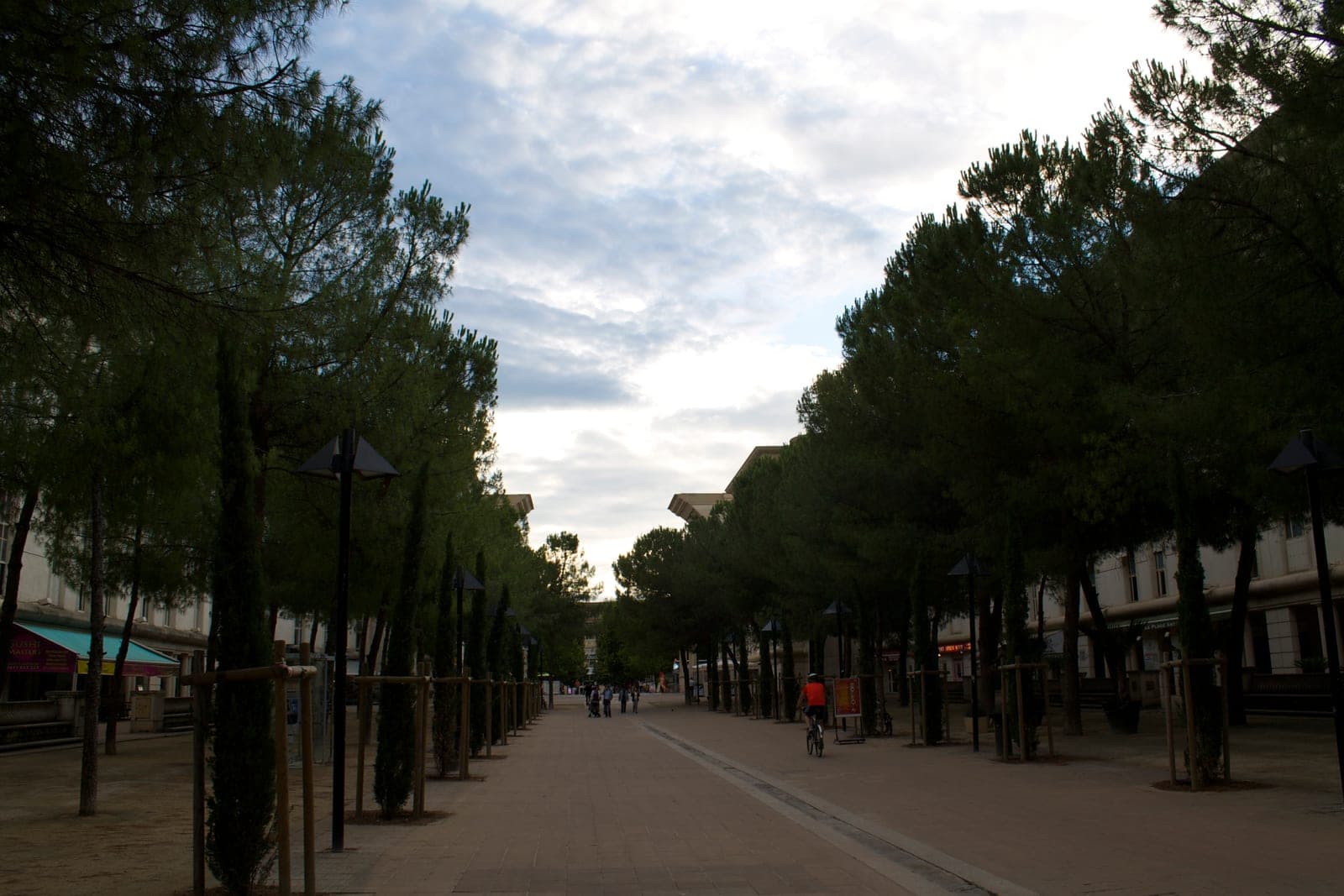
Antigone is the least French-looking quarter in a very French city, and it was built on purpose, all of it, from one plan. You walk out of the old town through a shopping centre, and the city suddenly becomes enormous: colonnades four storeys high, pediments the size of a house, a square laid out like a Roman forum, and a straight axis running away from you towards the river.
The ground under it was the army's. The Joffre barracks stood here, and when the city took the land the mayor Georges Frêche set out to build a new centre rather than a housing estate. He brought in the Catalan architect Ricardo Bofill, whose Taller de Arquitectura drew the master plan; the council committed to the project in 1979 and building started in 1983. The result covers 36 hectares and is one of the largest single developments ever completed in France, an axis of about a kilometre from the edge of the old town to the Lez, which locals long ago nicknamed the Champs-Élysées of Montpellier.
The one thing the army left behind is the best story on the site. The citadel, built between 1624 and 1627 on the orders of Louis XIII to hold a rebellious city under his eye, survived the clearance. Since 1947 it has been a school, the Lycée Joffre, so a seventeenth-century fortress at the western edge of the quarter now fills and empties twice a day with teenagers.
One honest note about the boundary. The figures on this page are computed inside a single statistical area, the Nombre d'Or, which covers the western and central part of Bofill's quarter. The far end at the Esplanade de l'Europe, along with the city's main library and the Olympic pool, sits in the neighbouring area and is not counted here, although it is a few minutes' walk along the axis.
Who lives here, and what the streets look like
A typical figure across this district's statistical area is 24,130 EUR a year of disposable income per consumption unit, the highest of the three Montpellier districts covered here, above the Écusson at 23,460 and Port Marianne at 21,985. The gap between the three is small, which is itself the point: Montpellier does not have the income spread that its architecture might suggest.
The stock explains most of daily life here. These are 1980s and 1990s apartment buildings behind classical façades, which means lifts, underground parking, double glazing, balconies and rooms of a normal size. A good deal of Antigone was built as social housing, alongside public buildings and shops, and it still holds a mix of that and private flats on the same axis and often in the same block. Compared with the old town, a family-sized flat here is easy to find and easy to live in.
The streetscape is unusually consistent because one office drew it. Everything is symmetrical, the shopfronts sit in the arcades, and the surfaces are hard: stone, concrete, gravel, and repeated columns. Upkeep is decent and the ground floors are active around the squares, thinner in the middle stretches where whole façades are flats.
Getting around
This is one of the easiest addresses in Montpellier to move around from, mostly because of where it sits. Place de la Comédie and the whole historic centre are about ten minutes away on foot, and the walk is flat and covered for part of the way.
Four tram stops sit inside the boundary and the network runs the length of the quarter, with two bus stops as well. There is no metro in Montpellier and no plan for one, so the tram is the network. Trams and buses are free for residents of the Métropole, and have been since December 2023: you register for a pass, keep it on your phone and validate at every boarding. In a household that already walks to the centre, that removes the last argument for a second car.
Two practical points. The main station, Saint-Roch, is one short tram ride or a fifteen-minute walk away, and the airport is the weak link as it is everywhere in this city, needing a tram and then a shuttle bus. And unlike the old town, this quarter was built for cars underneath rather than beside it, so a parking space is a normal thing to own here rather than a lottery.
Typical weekday minutes from Place du Nombre d'Or, with the icon showing how. Measured door to door for a typical weekday morning from the place du Nombre d'Or, at the western end of the axis; the icon shows the fastest sensible way., 2026-08.
Daily life
Antigone runs on two anchors and not much in between. At the western end, where the quarter meets the old town, there is a large indoor shopping centre with a supermarket in it, which is where most households do the bulk of a weekly shop. In the middle, on the boulevard, the Halles Jacques Cœur is the covered market: small, producer-led, and the thing that makes it possible to live here without driving anywhere.
Beyond those two, the numbers are modest. 19 food shops across 0.47 km², which works out at 41 per square kilometre, half the density of the Écusson, plus two pharmacies. What that means in practice is that you are rarely more than five minutes from something, but the something is often the same something, and Sunday is thin.
The compensation is that daily life here is calm. 33 restaurants, five cafés and a single bar in the whole quarter, so the squares belong to residents in the evening rather than to a night out, and the shopping centre absorbs the crowds that would otherwise be on your street.
Local Places Worth Knowing
Four places that tell you what the district is actually like, chosen because a resident would use them rather than because a visitor would photograph them.
The farmers' market on the Place du Nombre d'Or. 4.2 on Google across 561 reviews.
The square that sets the rules for everything else, laid out on the golden ratio with 288 flats and shops built into its walls. Stand in the middle and the quarter explains itself.
A Greek grill on place du Millenaire with a lunch queue and thousands of reviews, unusual for a quarter this quiet. Antigone's restaurants are mostly terraces on the walk.
The bakery on rue Leon Blum, in the residential half of the district. With shopping split between a market hall and a mall, a good baker on foot matters more than usual.
Checked August 2026. Places close and change, so tell us if something here is out of date.
Schools and families
Antigone is a straightforwardly practical quarter for a family, and the reasons are physical. There are four playgrounds inside 0.47 km² and five garden spaces, the axis takes no through traffic so a child can cross most of the district without meeting a car, and the flats have lifts, which sounds trivial until you have carried a pushchair up three flights in the old town for a year.
The Lycée Joffre stands at the western edge of the quarter, in the citadel, which is a strange and rather good thing to have at the end of your street. Primary and lower-secondary provision is in and around the quarter in the ordinary French way, with the map redrawn by the city from time to time, so check the current sector for the exact address rather than the district.
The honest limits are about surface and shade. This is a quarter of stone squares. A four-year-old on a scooter is in heaven; the same square at three in the afternoon in July has nowhere to stand out of the sun, and families here plan around that rather than pretend it away.
Kids Friendly. Better for children than it looks from the architecture. Four playgrounds inside 0.47 km², five garden spaces, a covered market for the daily shop, a large shopping centre under cover for a rainy Saturday, and almost no nightlife, with one bar recorded in the whole quarter. The flats are post-1980 with lifts, which matters with a pushchair. Against it: hard surfaces everywhere, and the open squares are hot in summer and windy in winter.
Pet Friendly. An easy quarter for a dog. It is dead flat, there is no through traffic on the axis, the squares and colonnades are wide enough that nobody has to squeeze past, and the banks of the Lez are a few minutes east for a proper run. Two caveats: most of the ground is stone rather than grass, and there is very little shade on the axis in July, so the walk moves to early morning and late evening in summer.
Green space, leisure and eating out
There are five garden spaces inside the boundary, which is more than the old town manages and still not a park. The real outdoor asset is the shape of the place: a kilometre of flat, car-free axis, wide enough to run on, cycle on and let a dog off the lead, with the banks of the Lez a few minutes east at the end of it. For anyone who exercises by leaving the front door and going straight, this is one of the best addresses in Montpellier.
Eating out is quiet and local. Thirty-three restaurants, mostly terraces on place du Nombre d'Or and place du Millénaire, with a Greek grill that pulls people from across the city and a scattering of small rooms in the arcades. There is no cinema inside the boundary and there is one bar, which is either the point of the quarter or the problem with it, depending on your age. For a night out you walk ten minutes west, and, crucially, you walk ten minutes back afterwards to somewhere silent.
What it costs
The number to start from is what people actually paid: 3 902 EUR / m² ≈ $420 / sq ft, the median across 40 recorded apartment sales inside this statistical area in 2025, from the state's register of transfers rather than from asking prices.
Forty sales is the local detail worth knowing here, and it cuts both ways. Antigone has a lot of housing and very little of it changes hands in a given year, partly because a good share of the quarter is social housing that never reaches the open market. So the price signal is thin, the median moves around more than it would in a bigger sample, and a buyer should read it as an indication rather than a valuation. The Écusson figure on these pages rests on 251 sales for comparison. Where a cellar or a parking space came with the flat the price includes it, and the median over flats sold with nothing attached is 4,272 EUR/m², 9% higher.
On renting there are two kinds of figure and they measure different things. What sitting tenants actually pay is 14.6 EUR/m² a month excluding charges, from the Montpellier rent observatory's 2024 survey of the occupied private stock, with quartiles of 12.3 to 17.7 behind it and 2,552 observations. This district's single statistical area sits in the observatory's zone 2, so one number covers the whole quarter. The asking rent is 15.5, charges included and not separable, published per commune, so it describes the whole city rather than this axis.
Montpellier caps rents. A préfectoral arrêté sets reference rents per square metre for five zones inside the city, by room count, building era, and whether the flat is let furnished, and the legal ceiling is the reference rent plus 20%. It has applied since 1 July 2022. This page carries no ceiling figure, because the table is reissued and a stale cap is worse than none: check the arrêté in force for the flat's own zone and category before signing.
Set the price against the income and a 45 m² one-bedroom at 3,902 EUR/m² is roughly 176,000 EUR, about seven times the 24,130 EUR a year a typical household here records. What that buys, compared with the same money in the old town, is a lift, a balcony, a parking space and a quiet night, in exchange for the address.
Weather and climate
Seasonal averages for Montpellier, one representative month per season. Météo-France 1991-2020 normals for station Montpellier-Fréjorgues, read 12 August 2026 via Infoclimat. Seasons are the representative months: January, April, July and October. Sunshine hours a day are the monthly totals divided by the days in the month (January 145.6 h, April 228.6 h, July 344.8 h, October 175.5 h). Annual figures: mean daily maximum 20.2 °C, mean daily minimum 10.8 °C, 639.2 mm of rain and 2,705.3 hours of sunshine. Rain days are left null because the count of days at or above 1 mm is not filled in on the published normals table. What the numbers say about living here: hot, dry summers and a genuinely mild winter, 2,705 hours of sun a year and July averaging 29.5 °C by day with 17.1 mm of rain across the whole month. Two things shape the year more than the averages do. October is the wet month at 94.7 mm, and on this coast that arrives as the épisode cévenol, a very large amount of rain in a few hours rather than steady drizzle. And winter nights are cool rather than warm, a 3.3 °C mean minimum, so the Mediterranean label misleads people who arrive in January.
The honest downsides
The architecture is not neutral. Some people find Antigone magnificent and some find it cold and theatrical, and almost nobody is indifferent. The façades are concrete cast to look like stone, and up close that is obvious. Walk it twice, in different weather, before you decide which camp you are in.
It is hard ground. Stone and concrete everywhere, very little shade, and open squares that hold heat in summer and channel wind in winter. The five garden spaces are small.
The shopping is barbelled. A market hall and a shopping centre, with a thin independent food trade between them, and Sunday is quiet. If you like a street of small shops, the old town is ten minutes away and that is where you will end up going.
The market is thin. Forty flats sold in a whole year means less choice, slower sales and a price that is harder to pin down than in the centre.
Crime and safety
France publishes recorded crime per commune, and Montpellier is a single commune, so there is no Antigone figure and nobody, including us, can honestly give you one. The numbers beside this section are for the whole city.
Read together they say something specific. Montpellier's theft from the person rate, 231.1 per 10,000 residents against 91.0 for France, is two and a half times the national rate, and robbery, 26.8 against 7.2, runs the same way. Home burglary, at 7.7 per 1,000 dwellings against 5.6, is above the national rate but far less dramatically so, and domestic violence, at 29.8 against 37.6, is below it.
That pattern describes a city where the risk is to your pockets in a crowd. This quarter has two kinds of ground and they behave differently. The shopping centre end is busy, commercial and full of people who do not live here, and it is the part of Antigone the city figure most obviously describes. The residential axis east of it has one bar, few reasons to pass through and long sightlines, which is a quiet combination after dark, though the same open squares can feel empty rather than calm on a February evening. The burglary figure is the one that applies to a flat here as much as anywhere in the city.
Is this you?
Antigone suits someone who wants the middle of Montpellier without living inside its noise, and who is not sentimental about old buildings. If you want a lift, a balcony, a parking space and a ten-minute walk to the Comédie, it is the most straightforward answer in the city, and the space to walk and run on your doorstep is genuinely rare.
It is the wrong place if you want small streets, a lot of small shops and a bar you can fall out of at midnight, or if the architecture makes your heart sink, because you will see it every single day. Whether you lease or purchase, walk the axis end to end at three in the afternoon in high summer, and then again after dark, before you commit.
Want to know what homes here are actually worth?
Join the waitlistHow we source this
How we put this together. Gathered on the ground by our local field team and written up by the Apraiz research team. Every figure above carries its own source and date. The scores are not computed by the build; walking and transport will use open map and transit data first, then Apraiz's own model. We update prices quarterly, transport and amenities twice a year, and school data when the source publishes.
Sources: DVF (Demandes de valeurs foncières), data.gouv.fr, Observatoire local des loyers de Montpellier, via the Observatoires des loyers network, Carte des loyers 2025, DHUP and ANIL with leboncoin and Groupe SeLoger, INSEE, SSMSI, via data.gouv.fr, Préfecture de l'Hérault, Ville de Montpellier, Euronews, Wikipedia (en), Antigone, Montpellier, Wikipedia (fr), Citadelle de Montpellier, OpenStreetMap contributors, via the Overpass API.
Safety and crime in Montpellier →Nearby: Écusson