
Long Story ShortReadHide
- What it is: Copenhagen's densest and most multicultural district, north-west of the Lakes, a lively grid of cafés, cheap grocers and Denmark's most cycled streets.
- Who it suits: young professionals, students and anyone who wants an affordable, social, walkable inner-city life and does not need a garden.
- What it costs: around to a little below the city average; no separate figure is published, so we show the Copenhagen owner-flat average of about 55,000 kr per m².
- What people complain about: the density and the grit, and a safety and social feel that changes block to block.
First impressions
Nørrebro is Copenhagen's densest district, packed onto about four square kilometres north-west of the Lakes. It splits into the gentrified Indre Nørrebro, around Sankt Hans Torv, Elmegade and Blagards Plads, and the more mixed and working Ydre Nørrebro out toward Mimersgade and Stefansgade. Running through it are cheap grocers, café streets and the constant river of bikes on Norrebrogade.
It is lively, social and multicultural, the city's most diverse quarter, with a café-and-music scene and an honest streak of grit.
This is inner-city Copenhagen at its most crowded and most alive, and it is frank about the trade-offs.
Who lives here, and what the streets look like
Nørrebro is young, mixed and international, students, young professionals, and immigrants and their descendants from more than fifty countries, alongside a broad age range in the tenement flats. Indre Nørrebro is gentrifying fast; Ydre Nørrebro stays more working and mixed.
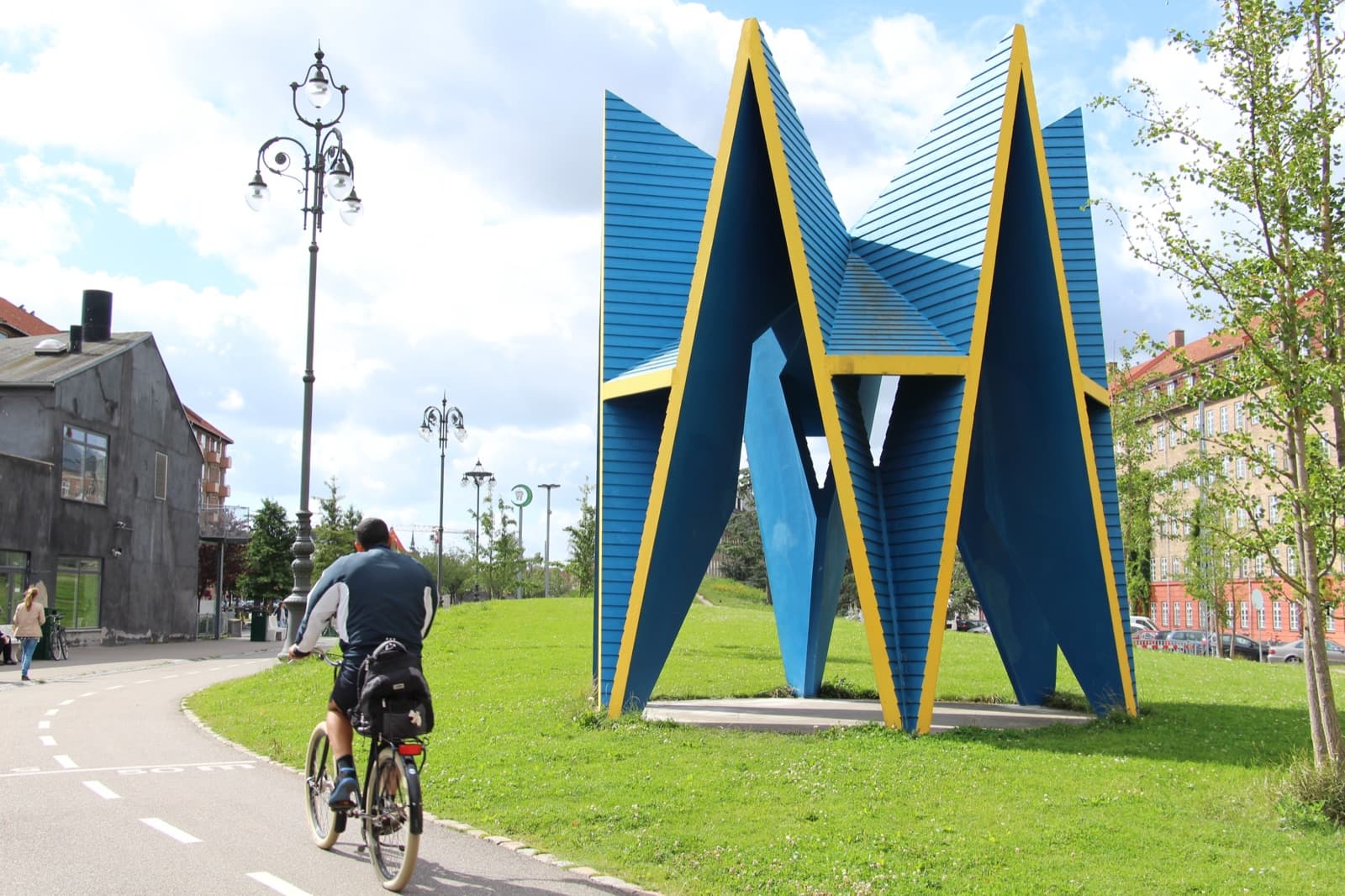
The streetscape is dense and flat: tall tenement blocks, the cycle superhighway of Norrebrogade, the character runs of Jaegersborggade, Elmegade and Stefansgade, and the green relief of Assistens and Superkilen. It is busy, social and tightly built.
Getting around
Nørrebro runs on the bike, the train and now the Metro. Nørrebro station sits on the S-tog Ringbane, three Cityring Metro stops (Nørrebro, Norrebros Runddel and Skjolds Plads) opened across the district in 2019, and the streets carry some of the most cycled traffic in Europe. Central Copenhagen is a short Metro or bus ride, and the airport is reachable by Metro with one change.
Typical weekday minutes from Nørrebro St, with the icon showing how. Times via Google Routes API for a typical weekday around 08:00, measured from the neighborhood centre; the icon shows the fastest sensible way (walk, bike, transit or car)., 2026-08.
Daily life
Day to day, Nørrebro is cheap grocers and character streets. The everyday shopping is plentiful and inexpensive, Netto, Lidl and Rema 1000 plus the Middle Eastern greengrocers along Norrebrogade, and the character retail is on Jaegersborggade, Elmegade and Stefansgade. For food delivery, Wolt and Just Eat both cover Copenhagen.
Local Places Worth Knowing
Independent and close by, chosen on merit. Nobody pays to appear here. Links are being confirmed.
The pioneering Copenhagen roaster's original bar on Jaegersborggade, a corner of the city's specialty-coffee movement.
View on Google MapsA vegetable-forward natural-wine bistro on Jaegersborggade, small, seasonal and much-loved.
View on Google MapsThe 1760 park-cemetery where Andersen, Kierkegaard and Bohr are buried, used as an everyday green by the whole district.
View on Google MapsAn independent Nordic design and homeware shop on Jaegersborggade, part of the street's run of makers and boutiques.
View on Google MapsChecked August 2026. Places close and change, so tell us if something here is out of date.
Schools and families
Nørrebro has numerous folkeskoler, among them Blagard, Guldberg, Nørrebro Park Skole and Radmandsgades Skole, and gentrifying family pockets around Sankt Hans Torv. Denmark publishes leaving results, the afgangskarakterer, through the Borne- og Undervisningsministeriet, but not at a per-district grain, so we do not rate schools here. Copenhagen has broadly free school choice, so it is worth checking admission before you sign a lease or purchase.
Kids Restricted. Young, lively and walkable with playgrounds and Superkilen, and gentrifying family pockets around Sankt Hans Torv, but the densest district in the city with little private outdoor space and a few blocks still on the disadvantaged-area list; families weigh it block by block.
Pet Friendly. Dense but green-served, Assistens Kirkegard and Norrebroparken are the everyday dog walks and Fælledparken is a short hop east; leash rules apply in the cemetery-park.
Green space, leisure and eating out
Nørrebro's outdoors is its parks and cemeteries. Assistens Kirkegard doubles as the district's everyday green, Norrebroparken and Superkilen's red square give play and gathering space, and the Lakes are the running loop on the southern edge, with Fælledparken a short hop east. Eating out is one of the city's strengths here, a dense scene of cheap and global kitchens, natural-wine bistros and late-night bars.
What it costs
Nørrebro prices around, to a little below, the city average, cheaper out in Ydre Nørrebro and dearer in gentrified Indre Nørrebro near the Lakes. No Nørrebro-specific sale price is published, so we show the Copenhagen owner-flat average of about 55 000 DKK / m² (about €7,400 / m²) ≈ $790 / sq ft (Boligsiden and Finans Danmark, second quarter of 2026), and this district sits around it. Rent is largely set by the market, and Denmark does not publish a per-city 2-room figure, so we show a market asking level of around 12 000 DKK / mo (about €1,600 / mo) (BoligPortal, 2026) as a guide; much older stock is rent-regulated and cheaper.
Weather and climate
Seasonal averages for Copenhagen, one representative month per season. DMI normals (Copenhagen) via Wikipedia climate box.
The honest downsides
Density and grit. Nørrebro is the most crowded district in the city, thin on private green, with tired tenement stock in places, so it can feel loud and hard-edged compared with the calmer bridges.
Uneven safety and social contrast. Gentrified café blocks sit near the still-listed Mjolnerparken estate, the district saw gang-related violence between 2008 and 2012, and the feel genuinely varies block to block, so it pays to know the exact street.
Crime and safety
Nørrebro is broadly safe and hugely popular, but it carries more of the city's reported incidents than the quiet bridges, concentrated in specific outer blocks rather than spread across the district, and Denmark does not publish neighborhood-level crime figures, so there is no local number. Denmark has high police-reporting trust, so the city-wide figures track real incidence closely. The fuller Copenhagen picture is on the city safety page.
Is this you?
If you want an affordable, social, walkable inner-city life with the best cheap eating in Copenhagen and a bike as your main transport, and you take the density and the grit as part of the deal, Nørrebro is hard to beat. If you want quiet, a garden or a settled block-by-block calm, Østerbro or the outer districts will suit you better.
Want to know what homes here are actually worth?
Join the waitlistHow we source this
How we put this together. Gathered on the ground by our local field team and written up by the Apraiz research team. Every figure above carries its own source and date. The scores are not computed by the build; walking and transport will use open map and transit data first, then Apraiz's own model. We update prices quarterly, transport and amenities twice a year, and school data when the source publishes.
Sources: Boligsiden / Finans Danmark Boligmarkedsstatistik, BoligPortal market listings, Wikipedia, Danmarks Statistik, table STRAF11.
Safety and crime in Copenhagen →