Where in Europe can you actually live without a car?
We scored 581 neighbourhoods in 122 European cities on walking, getting around and everyday shopping, using one rubric everywhere. Here is where car-free living genuinely works, where it does not, and what it costs you.
On this page7
A car is usually the second biggest thing a household pays for after the home itself, and it is the one expense a move can genuinely delete. That is why the question comes up on almost every European house hunt: could we live here without one?
The answer almost never depends on the country, and it depends less on the city than people expect. It depends on the street. So we measured it street by street.
What we measured, and how
Apraiz Neighborhood Insights scores every district we profile on the same six measures, applied the same way in every market. Three of them decide the car question:
- Walking score. Whether the things you need are within a walk, counted from the district's own centre, with terrain folded in. A flat kilometre and a kilometre up a granite ridge are not the same kilometre, and the score treats them differently.
- Getting around. How far the rest of the city is once you leave the district, by whatever the local network actually is: metro, tram, bus, ferry, or a train that runs twice an hour.
- Everyday shopping. Whether a normal week of food, chemist and post can be done on foot, which is the measure that quietly decides whether people keep a car anyway.
All three run 0 to 100, higher is better, and they are calibrated to Europe rather than to North America. That matters: a rubric built on American suburbs marks almost every European district as excellent and tells you nothing. The figures below are our own scores from that model, computed in 2026 across 581 districts in 122 cities, and each district's page carries its own working.
These are Apraiz scores, not a national statistic. They are one rubric applied identically everywhere, which is what makes them comparable across borders, and they are dated on every page so you can see how current they are.
The cities where it works best
Ranking cities means taking the median of their districts, which is a fairer test than picking the best one: it asks what a typical neighbourhood in that city is like, not what its showpiece is like.
| City | Country | Walking | Getting around | Shopping |
|---|---|---|---|---|
| Bilbao | Spain | 92 | 90 | 88 |
| Geneva | Switzerland | 90 | 88 | 89 |
| Turin | Italy | 90 | 88 | 89 |
| Basel | Switzerland | 90 | 92 | 88 |
| Lausanne | Switzerland | 86 | 93 | 90 |
| Milan | Italy | 90 | 90 | 85 |
| Munich | Germany | 89 | 88 | 87 |
| Zurich | Switzerland | 86 | 92 | 88 |
| Paris | France | 90 | 88 | 86 |
| Madrid | Spain | 90 | 92 | 84 |
| Cologne | Germany | 87 | 84 | 88 |
| Barcelona | Spain | 92 | 85 | 84 |
Four Swiss cities in the top eight is not what most people would guess, and it is worth understanding why, because the reason generalises. Swiss cities are small, dense and built around a rail station that everything else timetables itself against. You are rarely more than a short walk from a stop, and the stop is worth walking to because the service is frequent enough that you do not check a timetable. Frequency, not coverage, is what makes people give up a car.
The southern European entries work differently. Bilbao, Turin, Milan and Barcelona score on density and on the ground floor: apartment blocks with shops underneath them, so the walking score and the shopping score rise together. Madrid is the clearest example of a metro doing the heavy lifting, with the highest getting-around score on this list and a shopping score notably lower.
The district decides it, not the city
This is the finding that should change how you search. Take Turku, a mid-sized Finnish city that most rankings would treat as a single dot on a map. Its central district scores 91 on our combined measure. Hirvensalo, an island suburb inside the same city boundary, scores 42. That 49-point gap is wider than the gap between the best and worst cities on the list above.
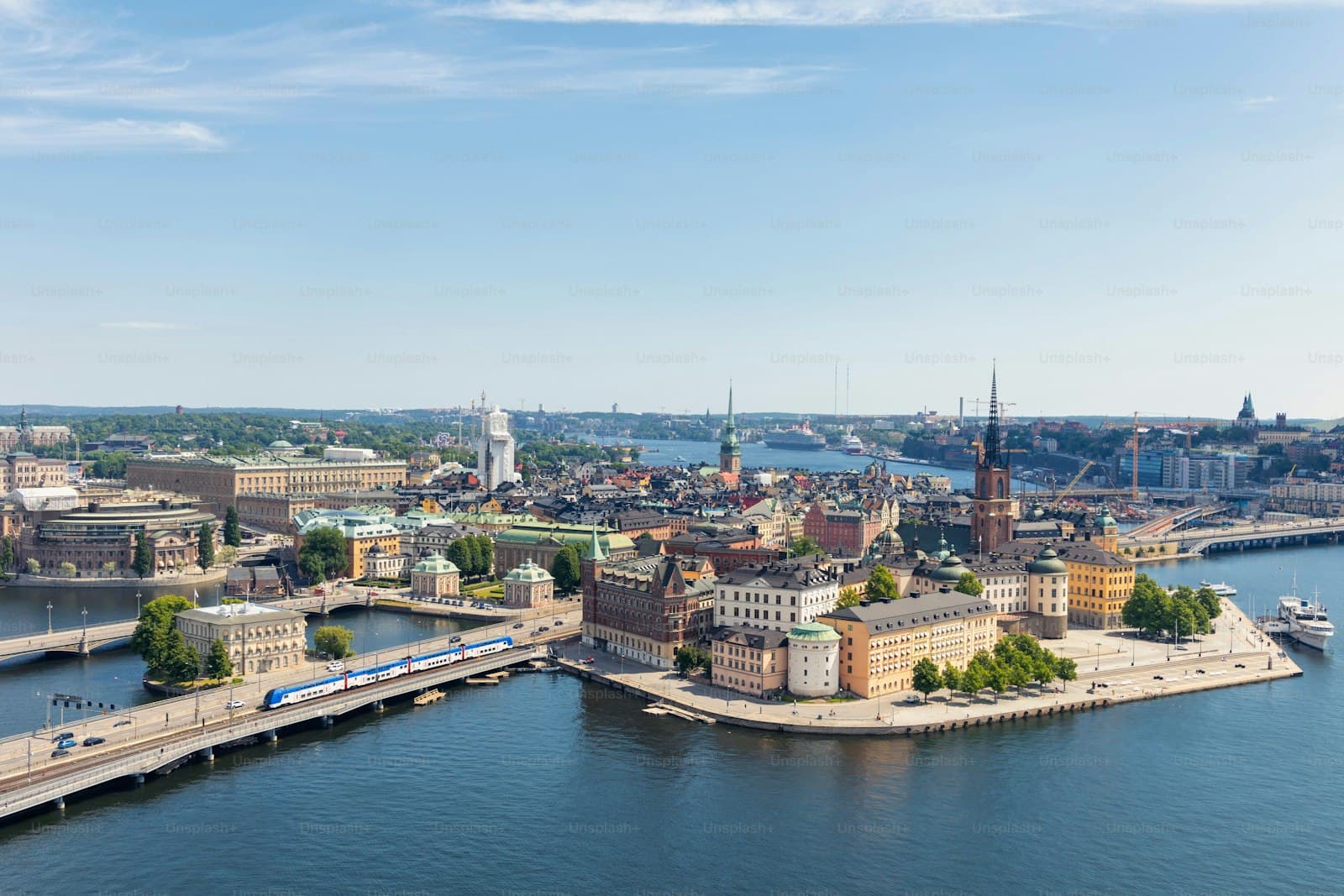
It is not unusual. Stockholm runs from 89 in Norrmalm to 52 on Djurgården. Uppsala goes from 91 in Centrum to 57 in Gamla Uppsala. Tampere, Esbjerg and Kristiansand all show gaps above 30 points between their best and worst districts.
So a headline like "the most walkable cities in Europe" is close to useless for an actual decision. You are not buying a city. You are buying a walk to a specific tram stop and a specific supermarket, and two addresses four kilometres apart in the same city can give completely different answers.
Where a car is not optional
Of the 581 districts we have scored, 248 come in at 80 or above, and 79 fall below 60. Below 60, in practice, means a household without a car is organising its week around the gaps.
The places at the bottom are not random. They fall into three types:
- Islands and resort towns. Zakynthos, Kefalonia, Paros, Lake Como and Lagos all score in the forties. Distances are short but nothing connects, buses run to a summer timetable, and the shops that stay open all year are in one place.
- Low-density suburbs of otherwise walkable cities. Viimsi outside Tallinn, Hirvensalo in Turku, Flekkerøy in Kristiansand. Detached houses, one road in, and a bus that is fine at 08:00 and useless at 22:00.
- Places where the walk is technically short but genuinely unpleasant. A dual carriageway between you and the supermarket counts against a district in our model, because it counts against it in real life.
The trade-off nobody prices in
Car-free districts are not a bargain hiding in plain sight. Across all 581 districts, our combined car-free measure and our cost-of-living measure move together, with a correlation of 0.39. Put concretely: the fifty most walkable districts we have scored average a cost level of 78 out of 100, and the fifty least walkable average 53.
That is the real arithmetic of selling the car. You are not saving the running costs for nothing, you are usually paying part of them back in rent or in price per square metre. Whether it nets out depends on your city and on how much you actually drive, and it is worth doing that sum with real numbers rather than assuming either way. Our guide to how much you need to earn to buy a home in Europe has the income side of it.
Two things soften the trade-off. A district one stop out from the walkable core often keeps most of the getting-around score at a visibly lower cost level. And a second car is far easier to drop than a first, which is why car-sharing memberships and, in Switzerland especially, station-based schemes show up in exactly these neighbourhoods.
How to check it for the address you are actually looking at
Scores narrow a search. They do not settle it. Before you commit to living without a car at a specific address:
- Walk from the front door to the nearest full-sized supermarket, at the time of day you would actually do it, carrying something.
- Check the last departure home on a Sunday night, not the weekday frequency. The weekday number is what sells the flat; the Sunday number is what you live with.
- Find out what happens in February. Coastal and island timetables and half the shops on a seasonal street can be a different service entirely out of season.
- Count what you would still need a car for in a year: the tip, the flat-pack, the visit to family, the ski or beach weekend. Then price those as hires rather than as ownership.
- Look at what is already parked on the street. A neighbourhood where nobody has given up their car usually has a reason, and it is worth asking a resident what it is.
Look it up rather than guess
Every district we profile carries these three scores with the working behind them, alongside cost, schools and the honest downsides, written the same way in every country so the answer in Munich and the answer in Málaga are the same question answered twice. You can browse them by country and city in Neighborhood Insights.
Common questions
Which European city is the easiest to live in without a car?
On our scores the Swiss cities are the strongest as a group, with Basel, Zurich, Geneva and Lausanne all in the top eight, joined by Bilbao, Turin, Milan and Munich. But the city ranking matters less than the district: the gap between the best and worst neighbourhood inside one city reaches 49 points, which is wider than the gap between most cities.
Is living without a car cheaper?
Not automatically. Walkable districts cost measurably more: the fifty most walkable districts we have scored average a cost level of 78 out of 100 against 53 for the fifty least. You save the running costs of a car and usually pay some of that back in rent or purchase price, so the honest answer depends on your city and how much you currently drive.
How are these walking and transport scores calculated?
They come from the Apraiz scoring model, applied identically in every market so the numbers compare across borders. Walking is measured from the district's own centre with terrain folded in, getting around reflects the local network as it actually runs, and everyday shopping asks whether a normal week can be done on foot. Each district page shows the score with its date and its working.
Do I need a car in a small European town?
Usually yes, and more often than the size alone suggests. Small dense towns with a station can score very well, while island towns, resort towns and post-war suburbs score in the forties even when distances look short, because the shops cluster in one place and services thin out badly in the evening and out of season.