
Long Story ShortReadHide
- What it is: a leafy, settled residential district northwest of central Västerås, built mostly in the 1940s and 1950s as blocks, terraces and villas on green, flower-named streets.
- Who it suits: families and older residents who want quiet, greenery and an easy flat walk, and do not need a lively high street at the door.
- What it costs: around the Västerås average, roughly 22,000 to 28,000 kr per m², folded into the wider city and Skallberget market.
- What people complain about: the everyday shops are modest, some of the 1950s stock is tired, and it is buses only into town.
First impressions
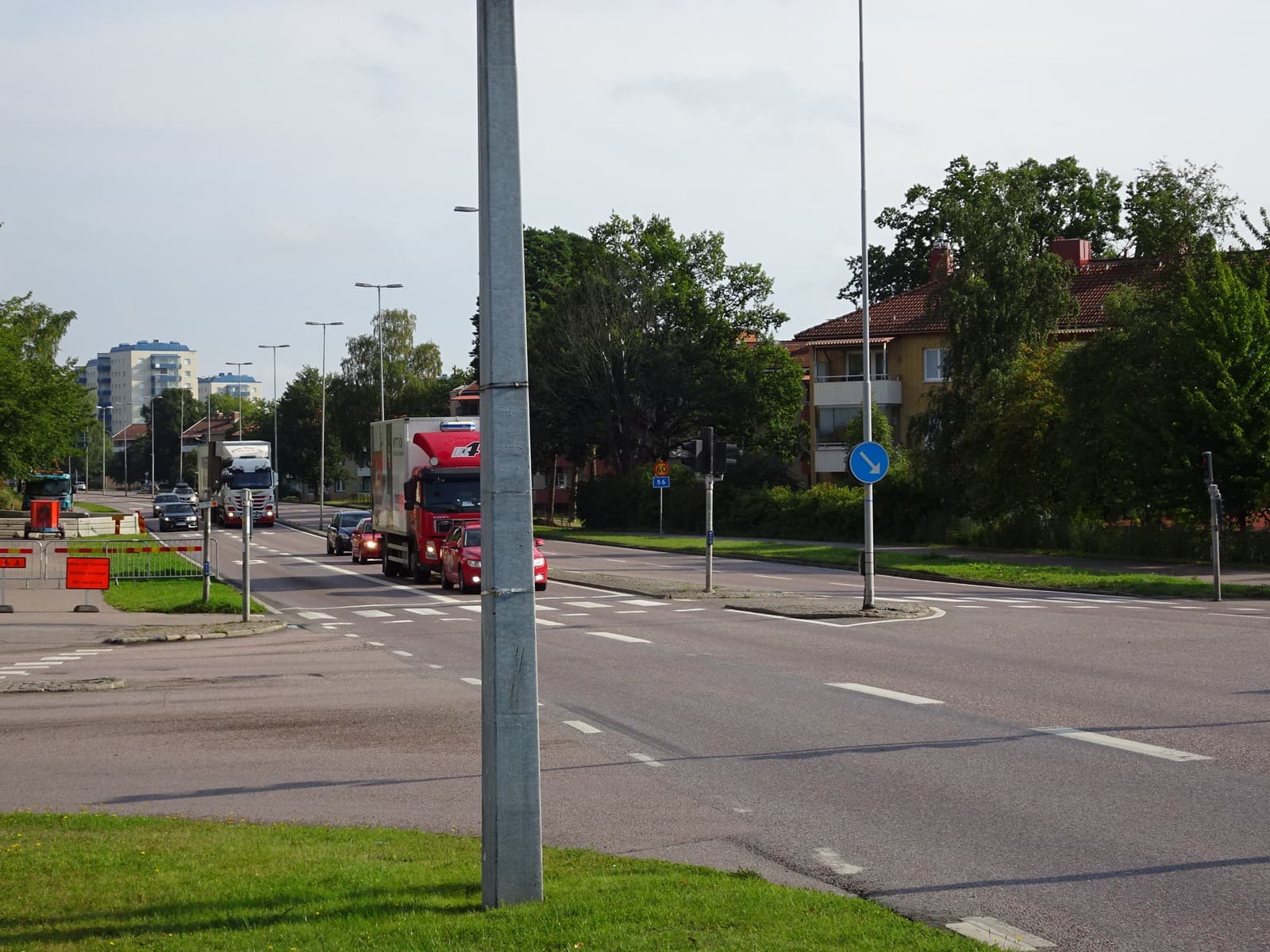
Gideonsberg is the calm, green Västerås that does not make the postcards. Set on rising ground a short way northwest of the centre, it was built out mainly through the 1940s and 1950s, a mix of pale point blocks and slab blocks, terraces and older villas, dropped along streets named after wildflowers. Locals shorten it to "Gidde". The single strongest impression is how leafy and quiet it is: gardens between the buildings, the Emaus stream and its park strip running through, and allotment greens toward the Svartån.
Its one flourish is architectural. On Vitmåragatan stand five eight-storey star-shaped houses from 1954, grouped around a shared garden, the only stjärnhus in the city and the thing residents point out first. Beyond that, this is an unshowy, well-settled district that gets on with everyday life.
This is a green, low-key, family-and-elders corner of Västerås, close to town but a world away from it in pace.
Who lives here, and what the streets look like
Gideonsberg is a settled district of a few thousand people, weighted toward families and long-resident older households, in a mix of owned flats, rentals, terraces and villas. Together with Emaus and Nordanby gärde it makes up the administrative area, and the feel across it is quiet and rooted rather than transient.
The streetscape is mid-century and green: render-fronted blocks with lawns and playgrounds between them, older villas on the fringes, and trees along most streets. Some of the 1950s stock is showing its age and being renovated in turn, and the southern edge keeps a light industrial character where old works once stood, but the everyday texture is calm, planted and residential.
Getting around
Gideonsberg leans on the bus and the bike. VL city buses run into the centre in roughly a quarter of an hour, on a flat and easy route, and because Västerås has no tram or metro the bus is the public option. The flat ground is the plus here: cycling in and out is genuinely easy, unlike the hillier suburbs, so the bike is a real everyday choice. For longer trips, Västerås Centralstation puts you on fast trains to Stockholm and toward Arlanda.
Typical weekday minutes from Gideonsberg, with the icon showing how. Times via Google Routes API for a typical weekday ~08:00, measured from the neighborhood centre; the icon shows the fastest sensible way (walk, bike, transit or car), 2026-08.
Daily life
Day to day, Gideonsberg is quiet and self-contained for the basics. A neighborhood grocer and a pharmacy sit on Emausgatan, enough for the weekly shop on foot, with the fuller shops at nearby Skallberget centrum or in the centre a short ride away. The rhythm here is local: a burger at the old Giddegrillen kiosk, a pizza at the neighborhood pub, a walk along the stream or up to the star houses. It is a plain, modest local offer rather than a high street, which is what holds the shopping score down. For food delivery, Foodora and Wolt reach the area and Uber Eats covers much of the city, so check your address in the app.
Local Places Worth Knowing
Independent and close by, chosen on merit. Nobody pays to appear here. Links are being confirmed.
The neighborhood pizzeria and pub, a straightforward local for pizza and everyday fare, and reachable by food delivery.
The 'Giddegrillen' at Gideonsbergsgatan 3, reputedly the city's oldest sausage kiosk and now a beloved burger stop, a proper local institution.
The everyday grocer at Emausgatan 35, with a pharmacy close by; the place you do the weekly shop on foot without heading into town.
Five eight-storey star-shaped houses from 1954, the only stjärnhus in Västerås, set around a shared garden and a green rise, the district's architectural signature.
Checked August 2026. Places close and change, so tell us if something here is out of date.
Schools and families
Gideonsberg is a family district, and it once had its own year 7-9 school, Gideonsbergsskolan, but that 1950s building is being wound down for a housing conversion, so the nearest operating municipal year-9 school is Rönnbyskolan, an F-9 school in Rönnby to the northwest, whose leaving grades average a meritvärde of about 221.9 out of 340 (Skolverket, 2024/25). Västerås has free school choice, so this is the nearest school rather than a fixed catchment, and it is worth checking admission before you sign a lease or purchase.
Kids Friendly. It is a settled family and older-resident district with playgrounds, schools and green space at hand, and the flat ground makes it kinder on a pram than the hillier suburbs; a grocer and pharmacy on Emausgatan cover day-to-day needs, and larger venues in town have changing tables.
Pet Friendly. Flat, leafy streets, the Emaus stream and its park strip, and the allotment greens toward the Svartån make this an easy district for a dog, with the walking kind on the paws; the usual on-lead rules apply in the parks.
Green space, leisure and eating out
Green space is the quiet strength here. The Emaus stream threads a park strip through the district, the allotment gardens run toward the Svartån, and there are lawns, playgrounds and mature trees between the blocks, so a walk or a run starts at the door. Leisure means the outdoors and the local rather than nightlife: the family stroll, the allotments, the star-house rise for a bit of air. Eating out locally is the pizzeria pub and the burger kiosk, with the restaurants, bars and culture of central Västerås a short bus ride away.
What it costs
Gideonsberg is a moderately priced part of Västerås, sitting around the city average rather than in the dearest bracket. It is not priced on its own; the statistics fold it into the wider city and the neighbouring Skallberget market, where flats change hands at roughly 22,000 to 28,000 kr per m², against a Västerås city average of about 24,015 kr per m² (Svensk Mäklarstatistik, February 2026). The stock is mostly 1940s and 1950s and some of it is mid-renovation, so condition varies block to block and is worth checking. First-hand rents are set city-wide rather than per neighborhood, so no Gideonsberg-specific figure is published.
Weather and climate
Seasonal averages for Västerås, one representative month per season. Temps SMHI (Vasteras); sunshine from Stockholm (nearest station) via Wikipedia climate box.
The honest downsides
The local offer is modest. A grocer and a pharmacy cover the basics, but this is not a high street, and the fuller shops and cafés are at Skallberget or in the centre.
Older stock, and buses only. Some of the 1950s buildings are tired and mid-renovation, the southern edge keeps a light industrial feel, and with no tram you rely on the bus or the bike into town.
Crime and safety
Gideonsberg is a calm, green residential district in a safe city, and the everyday risk here is low-level property crime such as break-ins and bike theft rather than violence. In a quiet area like this, street begging and visible rough sleeping are uncommon, seen mainly around the central squares and the station rather than on these planted streets. No standalone per-area crime rate is published for Gideonsberg, with the fuller picture on the Västerås safety page.
Is this you?
If you want quiet, greenery and a flat, easy walk, a settled family district a short ride from the centre, and you do not mind a modest local offer and buses into town, Gideonsberg is one of the calmer places to settle in Västerås. If you want a lively high street, café culture and late nights nearby, the central districts will suit you better.
Want to know what homes here are actually worth?
Join the waitlistHow we source this
How we put this together. Gathered on the ground by our local field team and written up by the Apraiz research team. Every figure above carries its own source and date. The scores are not computed by the build; walking and transport will use open map and transit data first, then Apraiz's own model. We update prices quarterly, transport and amenities twice a year, and school data when the source publishes.
Sources: Boio / Svensk Mäklarstatistik, Skolverket, via Skolkoll, Västerås stad / Wikipedia, Brå (National Council for Crime Prevention).
Safety and crime in Västerås →Nearby: Centrum · Öster Mälarstrand · Viksäng